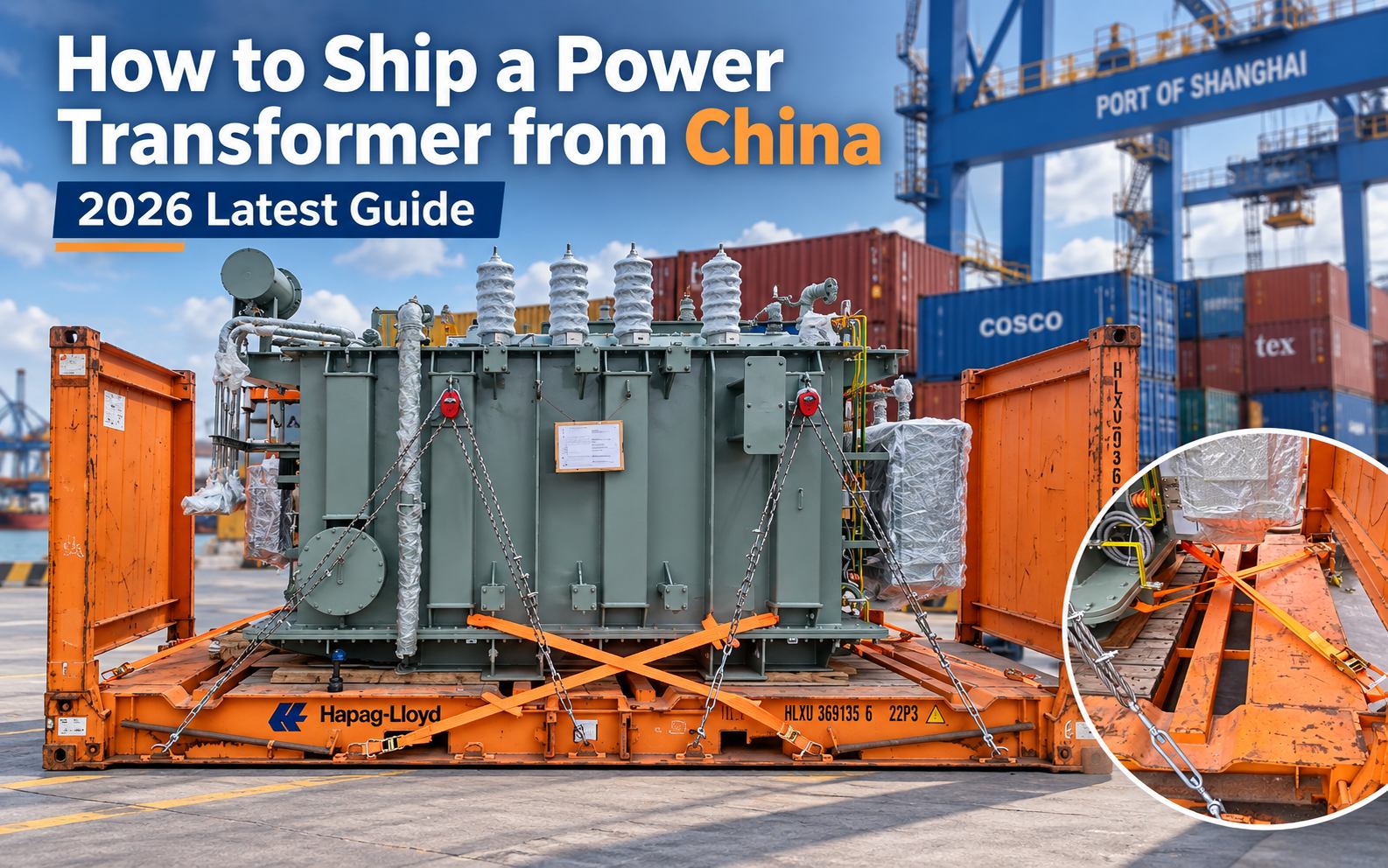
Shipping a power transformer from China requires early planning because the cargo may be heavy, oversized, high-value, oil-filled, and sensitive to shock or tilt. Smaller units can move in standard containers, while larger transformers may require Open Top, Flat Rack, RoRo, Breakbulk, or heavy-lift vessels.
For custom units, logistics planning should begin before production is finished. Final dimensions, shipping weight, center of gravity, oil status, lifting points, and the full factory-to-site route all affect the transport plan.
What Information Do You Need Before Shipping a Power Transformer from China?
A reliable power transformer shipping quote starts with technical cargo data. Model name and rated capacity are useful, but they are not enough to determine how the transformer can actually move.
The freight forwarder needs the final transport condition of the unit, including any accessories removed for shipment.
|
Information |
Why It Matters |
|
Transformer type and quantity |
Basic transport and equipment planning |
|
Final packed L × W × H |
Determines container, OOG, or Breakbulk feasibility |
|
Final shipping weight |
Determines trailer, lifting, container, and vessel requirements |
|
Base / footprint dimensions |
Used to assess floor and point loading |
|
Center of gravity |
Important for lifting, trailer stability, and securing |
|
Lifting drawing / lifting points |
Required to design the lifting arrangement |
|
Packing drawing |
Helps assess dimensions, protection, and load distribution |
|
Oil status and quantity |
Affects weight and dangerous goods review |
|
SDS for insulating liquid |
Used for transport classification where applicable |
|
Factory pickup address |
Required for inland route planning |
|
Destination port and project site |
Required for port and final-mile feasibility |
|
Incoterm |
Defines transport responsibility |
|
Cargo-ready and required delivery dates |
Used for booking and project scheduling |
For heavy equipment, where the weight sits can be as important as how much the equipment weighs. A transformer may be within a container's nominal payload but still be unsuitable because the load is concentrated over a small base area.
The same applies to production planning. Custom transformers commonly require around 8 to 20 weeks to manufacture. Transport planning should therefore run alongside production, FAT, packing preparation, and final dimension confirmation.
For other types of heavy industrial cargo, many of the same principles apply. Our guide to shipping oversized construction machinery from China explains similar issues around dimensions, heavy haulage, loading, and equipment selection.
Which Shipping Method Is Best for a Power Transformer?
The correct power transformer sea freight method depends on packed dimensions, shipping weight, center of gravity, point load, lifting arrangement, route restrictions, and port capabilities.
There is no single weight threshold that automatically determines whether a transformer should move by container, Flat Rack, or Breakbulk.
|
Cargo Condition |
Typical Shipping Solution |
|
Within container limits |
20GP / 40GP / 40HQ |
|
Mainly over-height |
Open Top |
|
Over-width or over-height |
Flat Rack / OOG |
|
Suitable for rolling operation |
RoRo |
|
Too large or heavy for practical containerization |
Breakbulk |
|
Extreme heavy-lift project cargo |
Heavy-lift vessel |
For most transformer projects, ocean transport will fall under one of several forms of sea freight from China, with the equipment and booking method selected according to the cargo profile.
Standard Containers
Smaller distribution transformers can often move by FCL ocean freight from China. Depending on the container and route, a 40HQ may provide roughly 25–26 tonnes of practical payload, but this should never be treated as a universal transformer limit.
Internal dimensions, container payload, floor loading, concentrated load, road axle restrictions, and carrier acceptance still need to be checked.
If you need to compare the physical differences between standard equipment and special containers, see our guide to 20GP, 40GP, 40HQ, Flat Rack, Open Top, and other shipping container types.
Open Top and Flat Rack Shipping
An Open Top container is useful when height is the main issue. A Flat Rack has no conventional side walls and is commonly used for transformers that exceed standard container width or height.
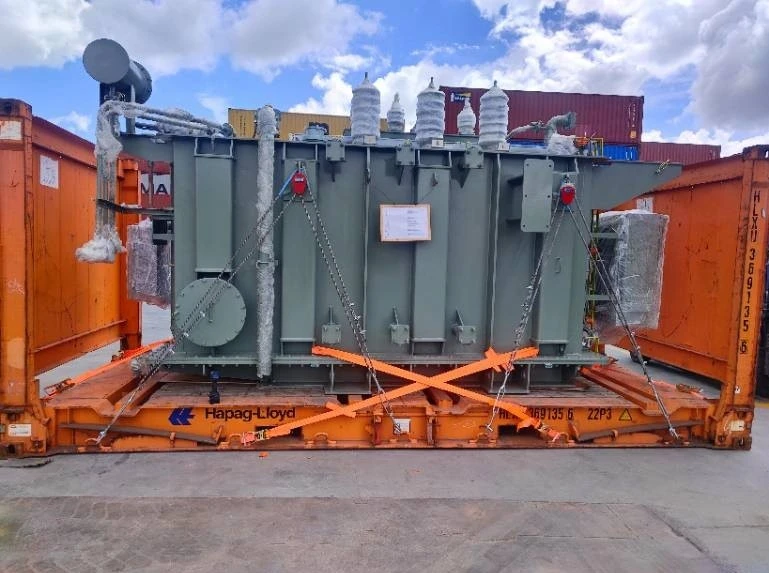
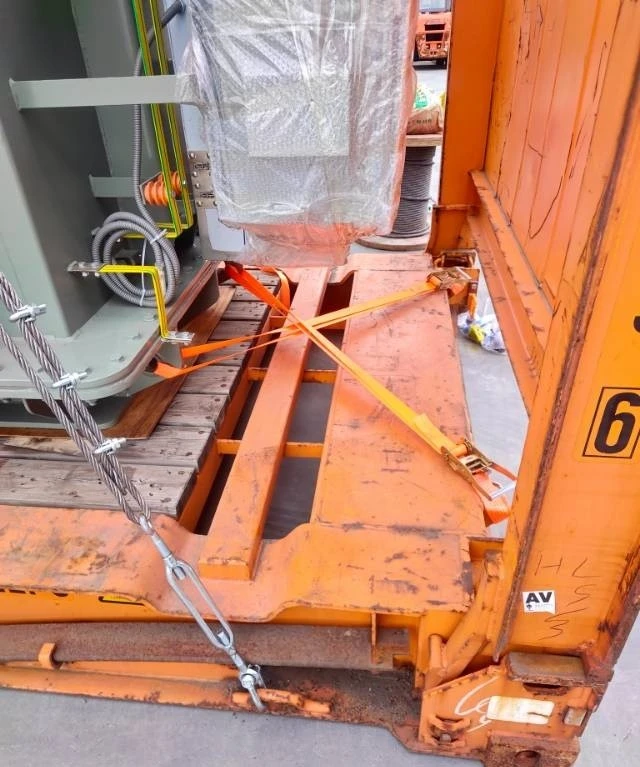
Flat Rack transformer shipping normally requires more engineering than standard FCL. The forwarder needs to consider dunnage, load spreading, blocking, bracing, lashing points, weather protection, and the amount of cargo extending beyond the equipment profile.
For early budgeting, Flat Rack or Open Top ocean freight can sometimes cost around 1.5 to 2.5 times standard FCL on the same trade lane. Actual pricing varies considerably with OOG dimensions, equipment supply, slot loss, and carrier policy.
RoRo, Breakbulk, and Heavy-Lift Shipping
Large substation transformers may be better suited to RoRo, Breakbulk, or heavy-lift vessels.
Breakbulk cargo is loaded as an individual unit rather than inside a container. If this method is unfamiliar, our guide to Breakbulk shipping explains how non-containerized heavy and oversized cargo is handled.
RoRo can be practical when the transformer can be moved on a suitable roll trailer, hydraulic modular trailer, or SPMT system. Wilson also provides RoRo sea freight from China for cargo suited to roll-on/roll-off handling.
Extremely heavy units may require vessel cranes, shore cranes, or a dedicated lifting plan.
At this scale, the ocean vessel is only one part of the engineering problem. The Chinese inland route and destination delivery route may determine the entire solution.
Plan the Entire Factory-to-Project-Site Route
For oversized transformer shipping, route feasibility should be checked before final transport equipment is booked.
A route survey is an engineering review of the roads, structures, clearances, turns, access points, and restrictions along the planned heavy-haul route.
Factory to Chinese Port
The origin survey may need to check the factory gate, internal roads, overhead structures, turning radius, bridge capacity, tunnels, toll gates, road width, axle-load restrictions, and overhead utility lines.
It should also confirm how the transformer will leave the production area. A transformer may require an overhead crane, jacking system, skidding arrangement, hydraulic trailer, or another controlled transfer method before it even reaches the public road.
For this part of the movement, suitable trucking and inland road freight must be planned around the transformer's actual weight, dimensions, route restrictions, and loading method.
Choosing the Chinese Port
The nearest port is not always the right port.
For heavy project cargo from China, port selection should consider terminal handling capability, lifting arrangements, OOG acceptance, laydown space, berth access, suitable vessel schedules, and the cost of moving the unit from the factory.
The same check applies at destination. Confirm whether discharge will use terminal cranes, mobile harbor cranes, vessel gear, or a RoRo solution before the cargo sails.
Destination Port to Project Site
The final inland leg can be the most difficult part of the shipment.
Bridge restrictions, urban roads, overhead cables, local permits, escort requirements, site entrance dimensions, unloading space, and crane availability should be checked in advance. A successful ocean voyage does not solve a transformer that cannot pass the last bridge before the substation.
How Should a Power Transformer Be Packed, Lifted, and Secured?
Transformers are sensitive to shock, vibration, excessive tilt, moisture, corrosion, and uncontrolled cargo movement. Packing and securing therefore need to match both the equipment design and the transport mode.
Lifting and Lashing
The lifting plan should follow manufacturer-approved lifting points and center-of-gravity information. Depending on the design, the operation may require spreader beams, engineered sling angles, specific lifting lugs, or temporary transport frames.
For container, Flat Rack, and Breakbulk transport, securing may include steel or timber dunnage, anti-slip materials, blocking, bracing, chains, wire rope, or other engineered lashing systems.
Load spreading is especially important when a heavy transformer sits on a relatively small footprint.
Oil-Filled, Oil-Drained, and Nitrogen-Blanketed Transport
Large oil-immersed transformers may travel oil-filled, partially drained, or drained and protected with a dry nitrogen blanket. The manufacturer should determine the acceptable transport condition for the specific design.
Draining oil can reduce shipping weight. Nitrogen blanketing may help prevent moisture from entering the transformer during transit. Where this method is used, pressure and seal condition should be monitored during the journey and checked again on arrival.
Shock, Tilt, and Weather Protection
For high-value units, I recommend using shock or impact recorders and, where appropriate, tilt indicators. These devices create a record of abnormal handling forces during loading, inland haulage, sea transport, and discharge.
That data can be valuable during arrival inspection and insurance claims.
Open or partially exposed cargo also needs suitable protection from rain, sea spray, dust, and corrosion. The solution may involve shrink wrapping, tarpaulins, wooden enclosures, desiccants, vapor barriers, or other protection specified for the equipment.
Is an Oil-Filled Transformer Dangerous Goods?
An oil-filled transformer is not automatically classified as dangerous goods. It should also not be assumed to be non-DG without reviewing the actual insulating liquid.
For ocean freight, classification should be checked against the applicable IMDG requirements using the product SDS and technical data. Important factors can include the type of insulating liquid, flash point, quantity, and environmental classification.
If the shipment is classified as dangerous goods, the booking may require carrier approval, additional declarations, specific handling procedures, and extra charges. Vessel and routing options may also become more limited.
For a broader explanation of classification, documentation, and carrier requirements, see our guide to dangerous goods shipping from China.
The right time to resolve this is before booking.
HS Code and Shipping Documents
Power transformers fall under HS heading 8504, although the exact subheading depends on technical characteristics such as transformer type and rated capacity.
If you are unfamiliar with tariff classification, our guide explains how to find the correct HS code and why the full code must match the actual product specifications.
A typical transformer shipment may involve a Commercial Invoice, Packing List, Bill of Lading, Certificate of Origin where applicable, transformer specification, test reports where required, lifting and packing drawings, SDS for relevant liquids, dangerous goods documents when applicable, and insurance documentation.
Product conformity documents should be reviewed separately from shipping documents. IEC, IEEE, ANSI, efficiency, local grid-code, and certification requirements depend on the actual equipment and destination market.
If solid wood crates, skids, or dunnage are used, confirm the applicable ISPM 15 treatment and marking requirements before shipment.
How Much Does It Cost to Ship a Power Transformer from China?
There is no useful universal rate for power transformer shipping from China because two transformers with the same value can require completely different logistics solutions.
A realistic total logistics cost may include:
China inland heavy haul + route survey and permits + lifting + packing and lashing + origin terminal handling + ocean freight + OOG or DG surcharges + marine insurance + destination handling + customs + destination heavy haul + site unloading.
Standard FCL is usually the easiest mode to budget. Flat Rack and Open Top cargo carry higher equipment and space costs. Breakbulk and heavy-lift shipments are normally quoted project by project.
As a budgeting example, Flat Rack freight to the US West Coast may reach around USD 5,000–9,000 or more for the ocean leg, depending on market conditions and cargo dimensions. Origin THC may be around USD 80–300, while destination THC can run around USD 150–500 in standard situations.
Those figures should be treated as planning references, not live freight rates.
For high-value transformer projects, ocean freight may account for only around 15%–25% of total landed cost. Inland heavy haul, terminal operations, duties, taxes, cranes, permits, insurance, and site delivery can materially change the total.
If you want to understand the freight component in more detail, our guide to how sea freight costs are calculated explains the main rate components and surcharges.
How Long Does Transformer Shipping from China Take?
Sea transit is only one part of the project schedule.
Typical port-to-port planning ranges include:
|
Route |
Indicative Sea Transit |
|
Southeast Asia / India |
10–20 days |
|
Middle East |
18–28 days |
|
Northern Europe |
28–35 days |
|
US West Coast |
15–20 days |
|
US East Coast |
28–35 days |
|
East Africa |
20–30 days |
Destination customs clearance may add roughly 3–7 days in routine cases. Heavy-lift discharge, road permits, special equipment mobilization, and Breakbulk vessel scheduling can add considerably more.
For a custom transformer, around 5–7 months from purchase order to project-site delivery is a practical planning assumption for many projects. Very large power transformers may require a longer schedule.
Insurance, Arrival Inspection, and Damage Control
Standard carrier liability is rarely enough for a high-value transformer.
All-Risk Marine Cargo Insurance is commonly used to protect against physical damage during loading, ocean transit, discharge, and inland delivery. Typical premium references for transformer cargo may fall around 0.3%–0.6% of CIF value, depending on cargo value, route, packing, deductible, and underwriting conditions.
For example, insurance for a USD 200,000 transformer may cost roughly USD 600–1,200.
Critical infrastructure projects can also consider specialist delay-related coverage, including Delay in Start-Up (DSU) exposure where an insured cargo loss could delay commissioning. This is separate from ordinary cargo insurance and normally requires project-specific underwriting.
At destination, inspect the transformer before final handover. Check the external condition, packing, seals, oil leakage, nitrogen pressure where applicable, impact and tilt recorder data, accessories, serial numbers, and any visible deformation.
If damage is found, photograph it immediately, preserve recorder data and packing evidence, notify the insurer and logistics parties, and arrange an independent survey when necessary.
FAQs
Can a Power Transformer Be Shipped in a Standard Container?
Yes. Smaller transformers can move in 20GP, 40GP, or 40HQ containers when packed dimensions, total weight, point load, and carrier limits allow it.
Large power and substation transformers are more likely to require Open Top, Flat Rack, RoRo, Breakbulk, or heavy-lift transport.
When Should I Use Flat Rack Instead of Breakbulk?
Flat Rack is generally appropriate when the transformer exceeds normal container dimensions but can still be handled safely within the containerized transport system.
Breakbulk becomes more practical when the unit is too large, too heavy, or otherwise unsuitable for containerization.
The decision should include port capability and inland transport, not just the ocean rate.
Are Oil-Filled Transformers Dangerous Goods?
Not automatically.
Provide the freight forwarder with the insulating liquid SDS, oil quantity, and relevant technical information before booking. The actual classification should be confirmed under the applicable transport rules.
What Information Does a Freight Forwarder Need for a Transformer Quote?
At minimum, provide the final packed dimensions, shipping weight, base dimensions, center of gravity, lifting drawing, oil status and SDS where relevant, factory address, destination port or project site, cargo-ready date, and required delivery date.
For OOG and project cargo, photographs and technical drawings can significantly improve the accuracy of the first transport assessment.
How Far in Advance Should I Arrange the Shipment?
Standard container shipments can usually be planned closer to the cargo-ready date. Large Flat Rack, Breakbulk, RoRo, and heavy-lift shipments should be discussed much earlier.
For a custom power transformer, I recommend involving the logistics team while the unit is still in production. That gives enough time to review dimensions, shipping condition, route restrictions, port capabilities, lifting requirements, and vessel availability before the transformer is released.
Conclusion
The safest way to ship a power transformer from China is to plan from the final project site backward. Confirm the packed dimensions, shipping weight, center of gravity, lifting points, oil status, and road restrictions first. Then select the container, OOG, RoRo, Breakbulk, or heavy-lift solution that works across the entire factory-to-site route.
Zhejiang Wilson Supply Chain Management Co., Ltd. provides international freight forwarding, OOG and heavy-equipment logistics, customs support, cargo securing, and end-to-end supply chain coordination from China. If you are preparing a transformer shipment, send us the cargo dimensions, shipping weight, lifting drawing, pickup location, and destination. We can review the transport feasibility and discuss a practical shipping plan for your project.