A Practical Guide for B2B Importers & Traders
Whether you are importing machinery from China, consolidating consumer goods for an LCL shipment, or planning a full container load, knowing how to calculate CBM for shipping is essential. CBM, or cubic meter, is one of the key measurements used to determine cargo volume, select suitable shipping equipment, and prepare an accurate freight quote. Get it wrong and you may overestimate the space you need or underestimate your overall shipping costs.
This guide explains the CBM formula, unit conversions, container capacity benchmarks, volumetric and chargeable weight, and common mistakes in CBM calculation for shipping. It also reflects practical considerations our team encounters when supporting overseas importers and B2B buyers with shipping from China.
What Is CBM and Why It Matters
CBM stands for Cubic Meter, a standard unit of volume used in international freight. A cubic metre is part of the International System of Units (SI), and in shipping it tells carriers, freight forwarders, and other logistics providers how much three-dimensional space your cargo occupies in a container, on a vessel, in an aircraft hold, or in a warehouse.
In practice, CBM matters because shipping resources are finite. A ship's hold, a container's interior, and an aircraft's cargo space all have limits on both weight and volume. Depending on the transport mode and applicable tariff, carriers may consider cargo volume, weight, or both when calculating freight charges. This makes CBM particularly important for LCL Ocean Freight, where cargo is consolidated with shipments from other customers.
CBM is not just a number on a freight quote - it is an important factor in freight pricing, container selection, warehouse space allocation, and overall shipping planning.
The CBM Formula
The basic cubic meter calculation is straightforward. For a single carton, crate, pallet, or rectangular package, multiply its three dimensions:
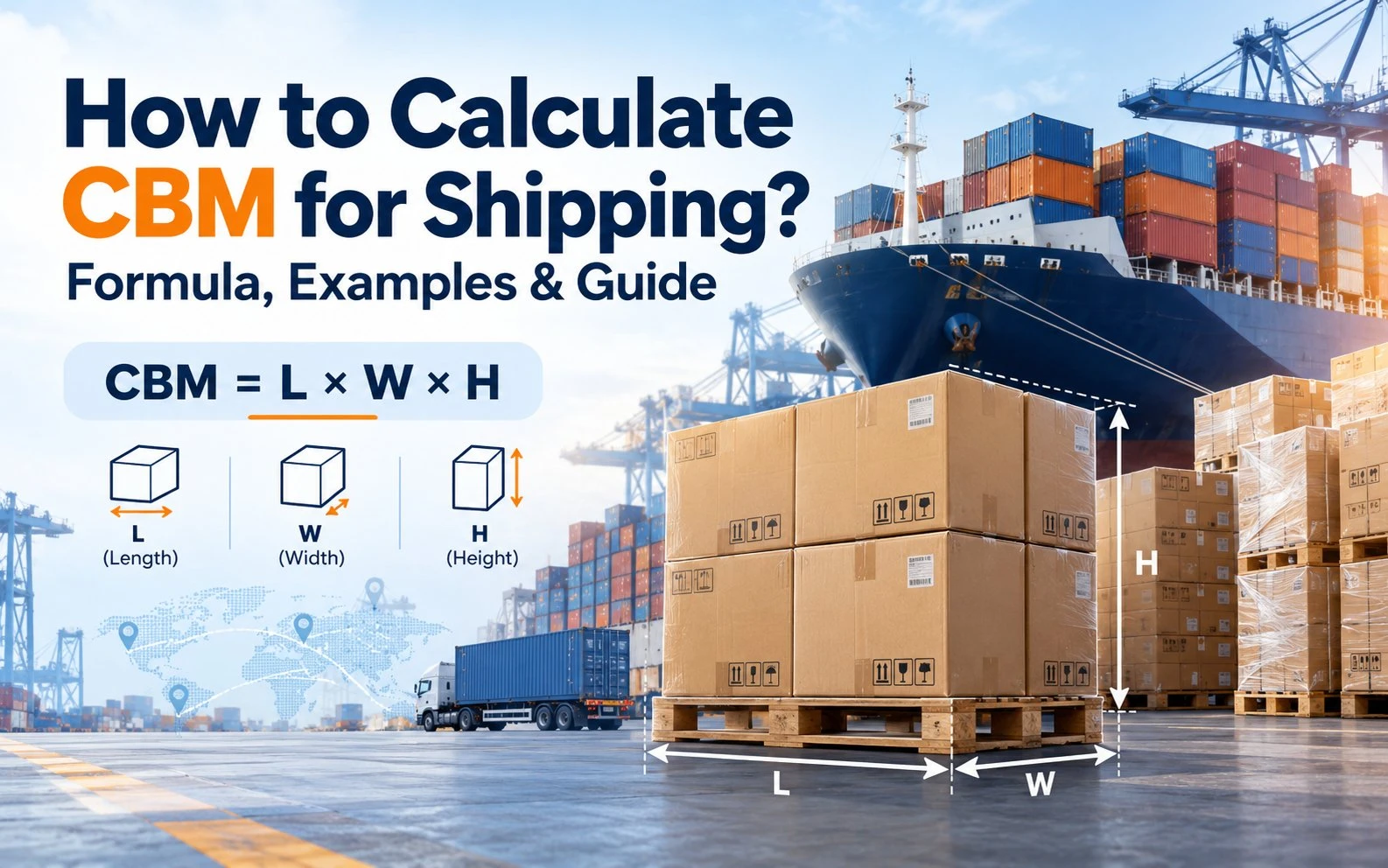
CBM = Length × Width × Height
All dimensions should be expressed in meters (m).
The critical rule is that all three measurements must use the same unit. If your factory or supplier provides dimensions in centimeters, which is common for cargo shipped from China, you can use either of the following methods.
Convert to meters first
Divide each centimeter measurement by 100 and then multiply the three values. For example, a carton measuring 50 cm × 40 cm × 30 cm becomes:
0.5 × 0.4 × 0.3 = 0.06 CBM
Multiply in centimeters, then divide
Multiply length × width × height in centimeters and divide the result by 1,000,000, because 1 m³ equals 1,000,000 cm³.
(50 × 40 × 30) ÷ 1,000,000 = 0.06 CBM
Both methods produce the same result. The second method is often convenient when calculating cargo volume directly from carton specifications on a supplier's packing list.
Calculating CBM for Multiple Cartons
Most commercial shipments contain multiple cartons. If all cartons have the same dimensions, calculate the CBM of one carton and multiply it by the total quantity. If your shipment contains cartons of different sizes, calculate each size group separately and then add the subtotals together.
Calculate the CBM for each carton or size group
For identical cartons, use:
CBM per carton × Number of cartons = Total CBM
For cartons of different dimensions, calculate the volume of each size group independently.
Sum all CBM values
Add the calculated volumes together to determine the shipment's total CBM. This is one of the main figures your freight forwarder will use when evaluating shipping options and preparing a quotation.
Worked example: A shipment contains 100 cartons, each measuring 60 cm × 40 cm × 30 cm.
Single carton CBM = 0.6 × 0.4 × 0.3 = 0.072 CBM
Total CBM = 0.072 × 100 = 7.2 CBM
For mixed shipments with different carton sizes, calculate each size group separately and add the subtotals to obtain the total cargo volume.
CBM for Irregularly Shaped Cargo
Not everything ships in neat rectangular cartons. For irregularly shaped cargo such as machinery with protruding parts, cylindrical items, industrial equipment, or furniture with curved edges, use the minimum bounding box principle: measure the longest, widest, and tallest points of the packaged item and then apply the standard CBM formula.
This means measuring to the outermost point in each dimension, including protruding components, protective padding, frames, supports, or other packaging extensions. For shipping purposes, the space occupied by the cargo's outer dimensions is generally more relevant than the physical volume of the product itself.
Container Capacity: How Much CBM Fits?
For FCL (Full Container Load) shipments, understanding container capacity helps you select a suitable container and estimate how many cartons or pallets may fit. Standard freight-container dimensions and ratings are covered by ISO 668, while actual equipment specifications can vary slightly by container manufacturer and operator.
If you want a broader comparison of standard equipment, see our guide to 20ft vs 40ft shipping container sizes and capacity. You can also review the main types and specifications of shipping containers used for different cargo requirements.
|
Container Type |
Internal Dimensions (L×W×H, m) |
Theoretical CBM |
Practical CBM |
Max Payload |
|
20' GP (Standard) |
5.90 × 2.35 × 2.39 |
~33 CBM |
~26–28 CBM |
~28 tons |
|
40' GP (Standard) |
12.03 × 2.35 × 2.39 |
~67 CBM |
~54–58 CBM |
~26–28 tons |
|
40' HC (High Cube) |
12.03 × 2.35 × 2.70 |
~76 CBM |
~68 CBM |
~26–28 tons |
Table: Standard dry-container capacity benchmarks. Practical CBM reflects typical real-world packing efficiency, with space potentially lost to gaps, door clearance, bracing materials, pallets, and stacking limitations.
Why is there a gap between theoretical and practical CBM? Cargo rarely fills every cubic meter of a container perfectly. Carton dimensions may not divide evenly into the container's internal dimensions, while pallets, bracing materials, door clearance, and loading patterns also consume space. As a general rule of thumb, the original estimate of approximately 80–90% space utilization can be useful when planning cartonized cargo.
For businesses regularly using dedicated containers, FCL Ocean Freight may be suitable once cargo volume and overall shipment requirements justify a full container.

From CBM to Chargeable Weight
CBM alone does not always determine shipping cost. Depending on the transport mode, carriers may compare your cargo's actual weight with its volumetric weight or apply a weight-or-measurement rule. The resulting billing basis is often referred to as chargeable weight.
The commonly used conversion ratios in the original calculation are:
|
Transport Mode |
Conversion Ratio |
Meaning |
|
Sea Freight (LCL) |
1 CBM ≈ 1,000 kg (1 ton) |
Charges may be based on weight or measurement |
|
Air Freight |
1 CBM ≈ 167 kg |
Volumetric weight = L×W×H (cm) ÷ 6,000 |
|
International Express |
1 CBM ≈ 200 kg |
Volumetric weight = L×W×H (cm) ÷ 5,000 |
Table: Common volumetric-weight conversion ratios by transport mode. Actual chargeable-weight rules, minimum charges, and conversion factors may vary by carrier, route, consolidator, and service.
Example: A shipment measures 2 CBM and weighs 1,200 kg. Using the sea freight LCL comparison of 1 CBM to 1,000 kg, the measurement equivalent is 2,000 kg. Since 2,000 kg is higher than the actual weight of 1,200 kg, the shipment would be considered relatively light for the space it occupies. This type of cargo is often referred to as light goods or measurement cargo.
Conversely, if the same 2 CBM shipment weighed 3,000 kg, its actual weight would exceed the measurement equivalent. It would therefore be considered heavy goods or relatively dense cargo.
CBM is only one part of freight pricing. If you want to understand the broader cost structure, including ocean freight and related charges, see our guide on how to calculate sea freight costs.
Common CBM Calculation Mistakes
1. Measuring the product, not the carton
Always calculate shipping volume using the final outer packaging dimensions, including padding, protective materials, and protruding corners. The shipping space required is based on the packed cargo rather than only the dimensions of the product inside.
2. Mixing measurement units
This is one of the most common CBM calculation errors. If one dimension is in centimeters and another is in millimeters, the result can be incorrect by a large margin. Convert all dimensions into the same unit before multiplying.
3. Ignoring pallet dimensions
If the cargo is palletized, the pallet adds height and may extend beyond the edges of the cartons. Calculate the CBM based on the complete palletized unit rather than the cartons alone. For container-planning purposes, our guide on how many pallets fit in a 20ft and 40ft container provides additional practical context.
4. Forgetting stacking gaps
When estimating container loading capacity, simply dividing theoretical container CBM by carton CBM can overstate how much cargo will actually fit. Gaps between cartons, along container walls, near the doors, and around bracing materials can reduce usable loading space.
CBM in Practice: Choosing the Right Shipping Method
Once you know your total cargo CBM, it becomes easier to compare LCL and FCL shipping options. As a general guideline:
|
Total CBM |
Recommended Option |
Why |
|
Below ~15 CBM |
LCL (Less than Container Load) |
You share container space with other shipments. Charges are commonly based on the applicable weight-or-measurement rule, making LCL practical for smaller shipments. |
|
15–25 CBM |
Compare LCL vs. 20' FCL |
This is often a break-even range where a dedicated 20' container may become competitive with LCL pricing. |
|
Above ~25 CBM |
FCL (Full Container Load) |
A dedicated container may be more economical and can avoid consolidation and deconsolidation procedures. |
Table: General guidance for LCL vs. FCL based on shipment volume. Actual break-even points vary by route, season, cargo type, local charges, and carrier.
Because the break-even point is not determined by CBM alone, it is worth comparing the complete advantages, limitations, and cost structure of FCL vs LCL shipping before booking.
For businesses using sea freight from China, accurate cargo dimensions and gross weight help freight forwarders compare equipment, routing, and consolidation options more effectively.
For DDP (Delivered Duty Paid) shipments, accurate CBM is also important from the beginning because cargo volume can affect ocean freight, destination warehousing, inland trucking, and other logistics costs. DDP is one of the delivery terms defined under the Incoterms® rules published by the International Chamber of Commerce. Wilson Supply Chain can coordinate DDP and door-to-door shipping as part of a broader international freight and supply chain solution.

Quick Reference: CBM Conversion Cheat Sheet
|
From |
To |
Divide By |
|
Cubic centimeters (cm³) |
CBM (m³) |
1,000,000 |
|
Cubic feet (ft³ / CFT) |
CBM (m³) |
35.315 |
|
Cubic inches (in³) |
CBM (m³) |
61,024 |
Table: Common volume conversions used in international shipping.
For example, 10 cubic feet (CFT) ÷ 35.315 ≈ 0.283 CBM. This conversion is useful when packing information is provided in imperial rather than metric units.
How Wilson Supply Chain Helps
Zhejiang Wilson Supply Chain Management Co., Ltd. is a China-based international freight forwarder and supply chain company supporting global transportation from China. Our services include sea freight, air freight from China, multimodal transportation, customs clearance, warehousing, DDP services, and related supply chain support.
For more complex cargo, Wilson also has practical logistics experience with vehicles, heavy equipment, chemical and dangerous goods, oversized and project cargo, special containers, reefer cargo, and high-value yacht and boat transportation. For a specific shipment, our team can review cargo dimensions, weight, packing details, and shipping requirements to help calculate the total CBM, evaluate container utilization, and compare suitable freight options.
FAQ
What does CBM mean in shipping?
CBM means cubic meter. It measures the volume of cargo and is widely used in sea freight, air freight, warehousing, container planning, and international shipping quotations.
How do you calculate CBM from centimeters?
Multiply the length, width, and height in centimeters and divide the result by 1,000,000:
CBM = Length (cm) × Width (cm) × Height (cm) ÷ 1,000,000
For example, a carton measuring 60 × 40 × 30 cm equals 0.072 CBM.
How do you calculate CBM for multiple cartons?
If all cartons are the same size, calculate the CBM of one carton and multiply it by the number of cartons. If the carton sizes differ, calculate the CBM of each size group separately and add all subtotals together.
Is CBM the same as volumetric weight?
No. CBM measures cargo volume, while volumetric weight converts the cargo's dimensions into an equivalent weight for freight-rating purposes. The applicable conversion factor depends on the shipping mode and service provider.
Does CBM determine shipping cost?
CBM is an important factor, especially for LCL sea freight and other volume-sensitive services, but it is not the only factor. Freight cost can also depend on gross weight, route, origin and destination charges, cargo type, container or equipment requirements, season, Incoterms, and special handling needs.
Final Thoughts
Learning how to calculate CBM for shipping is straightforward: measure the packed cargo's length, width, and height, convert the dimensions into meters, multiply them to obtain the volume in cubic meters, and then multiply by the quantity when necessary. An accurate CBM calculation helps you compare LCL and FCL shipping, estimate container utilization, understand volumetric or chargeable weight, and obtain more reliable freight quotations.
If you are shipping goods from China and need help checking cargo dimensions, calculating total CBM, selecting a container, or comparing sea freight, air freight, DDP, or multimodal options, Zhejiang Wilson Supply Chain Management Co., Ltd. can help you evaluate the shipment. Contact our team with your packing list, cargo details, origin, and destination to discuss a suitable logistics solution.