Shipping containers are standardized around a relatively small number of sizes, but their structures, capacities, and operating requirements vary considerably. A 20GP may suit dense cargo, while a 40HC is usually more efficient for lightweight, bulky goods. Temperature-sensitive products may require a reefer, and oversized machinery may need an Open Top or Flat Rack.
Understanding the main shipping container types, dimensions, payload limits, and loading restrictions makes it much easier to choose suitable equipment before booking FCL ocean freight.
Understanding Shipping Container Sizes, Types and TEUs
In container shipping, size and type describe different characteristics.
Container size mainly refers to the external dimensions of the equipment. The most common sizes in international ocean freight are 20-foot, 40-foot, and 40-foot High Cube containers.
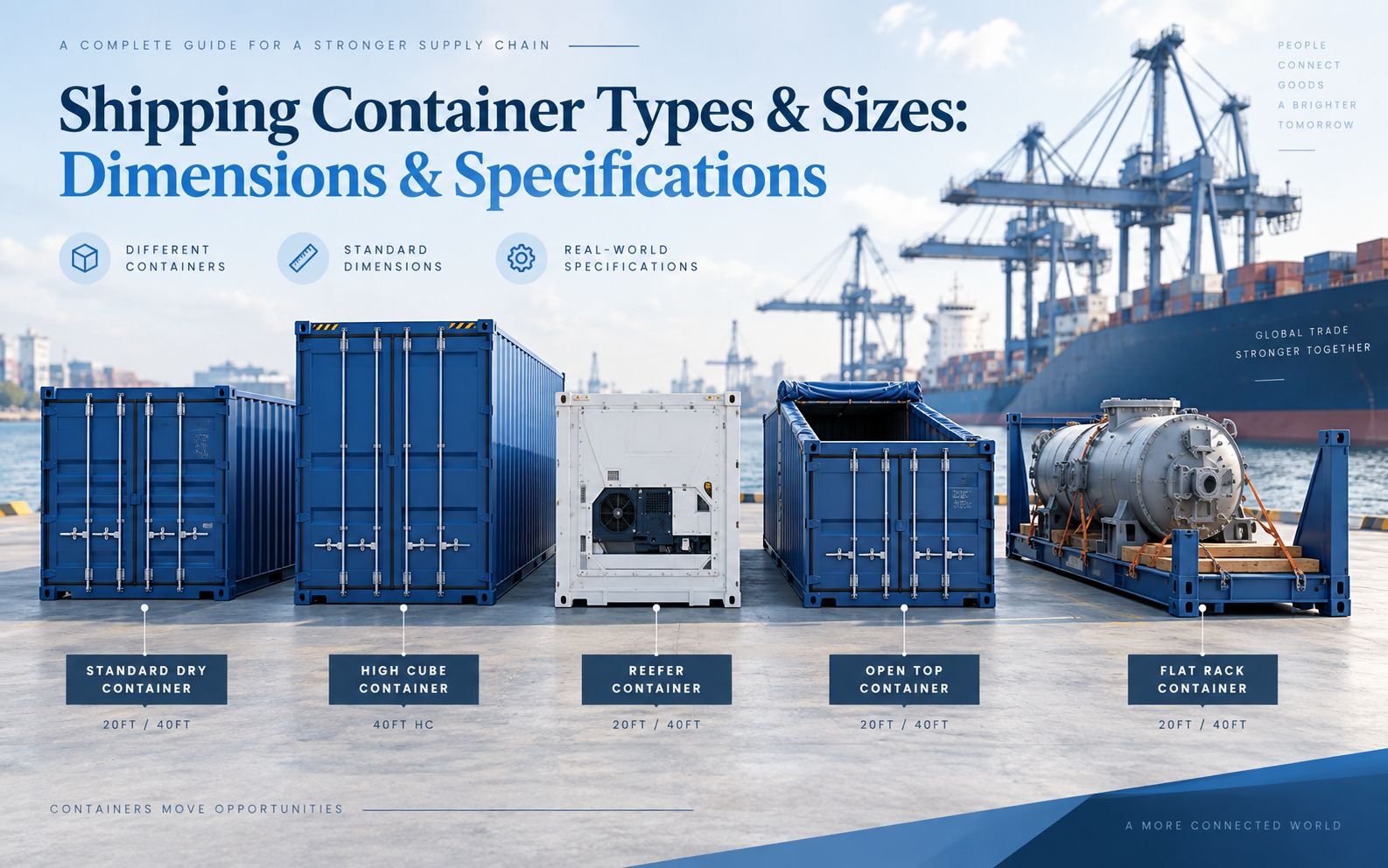
Container type describes how the equipment is constructed and what kind of cargo it is designed to handle. Dry containers, reefers, Open Tops, Flat Racks, and tank containers are different container types.
Another term you will see frequently is TEU, or Twenty-foot Equivalent Unit. It is the standard unit used to express container vessel capacity and port throughput.
- One 20-foot container equals 1 TEU.
- One 40-foot container equals 2 TEUs.
Standard dry containers are generally 8 ft 6 in, or about 2.59 m, high. A High Cube container is 9 ft 6 in, or about 2.89 m, high. That extra foot of vertical space is one reason High Cube equipment is widely used for cargo that occupies a large amount of volume.
For importers and exporters arranging container sea freight from China, understanding this distinction helps narrow down equipment options before requesting rates or booking space.
Standard Shipping Container Dimensions and Specifications
For most general cargo shipments, the first comparison is between 20GP, 40GP, and 40HC containers.
The figures below are typical industry specifications. Exact internal dimensions, tare weight, and payload can vary slightly according to the container manufacturer, equipment series, and shipping line.
20GP, 40GP and 40HC Container Size Chart
|
Specification |
20GP |
40GP |
40HC / 40HQ |
|
External Length |
6.06 m |
12.19 m |
12.19 m |
|
External Width |
approx. 2.44 m |
approx. 2.44 m |
approx. 2.44 m |
|
External Height |
2.59 m |
2.59 m |
2.89 m |
|
Internal Length |
approx. 5.90 m |
approx. 12.03 m |
approx. 12.03 m |
|
Internal Width |
approx. 2.35 m |
approx. 2.35 m |
approx. 2.35 m |
|
Internal Height |
approx. 2.39 m |
approx. 2.39 m |
approx. 2.69 m |
|
Cubic Capacity |
approx. 33.2 CBM |
approx. 67.7 CBM |
approx. 76.4 CBM |
|
Typical Max Payload |
approx. 28.2 t |
approx. 26.5 t |
approx. 26.4 t |
|
TEU |
1 |
2 |
2 |
CBM means cubic meter and describes the theoretical internal volume available inside the container.
Payload means the maximum weight of cargo that the container is rated to carry.
Payload, Tare Weight and Maximum Gross Weight
These three figures are closely related but should not be confused.
Tare weight is the weight of the empty container.
Payload is the permitted cargo weight.
Maximum gross weight is the combined maximum weight of the container and the cargo inside it.
In practical terms:
Gross weight = container tare weight + cargo weight
If cargo is weight-sensitive, it is worth understanding how much a shipping container weighs before finalizing the loading plan.
The container door opening also deserves attention. Internal dimensions tell you whether cargo can theoretically fit inside the box. The cargo still has to pass through the door during loading unless another loading method is available.
Large machinery is a common example: its final dimensions may fit within the internal space, while one section is too tall or too wide to enter through the standard end doors.
Common Types of Shipping Containers and Their Uses
Container design changes according to the cargo being transported. General cargo usually needs a closed, weather-resistant box. Perishable products need temperature control. Large industrial equipment may require equipment without a fixed roof or side walls.
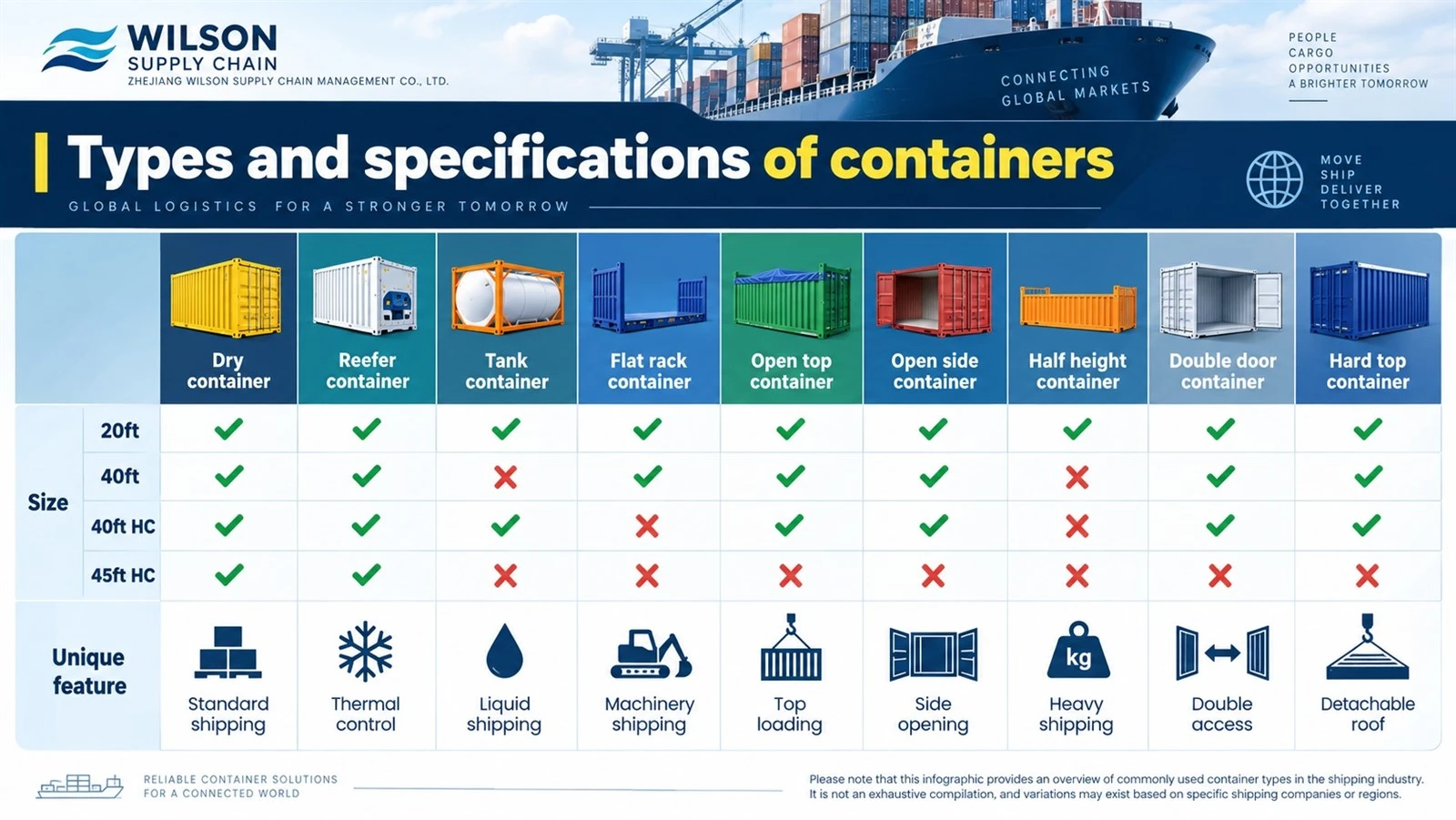
Dry / General Purpose Containers
The Dry Container, also called a General Purpose or GP container, is the most common shipping container used in ocean freight.
It is fully enclosed and weather-resistant and is suitable for cargo that does not need controlled temperature conditions. Typical shipments include cartons, pallets, textiles, consumer electronics, machinery parts, building materials, barrels, and other packaged goods.
Common versions include 20GP, 40GP, and 40HC.
Under ISO container type coding, general-purpose equipment is identified with the letter G in the type designation.
Refrigerated Containers
A Refrigerated Container, usually called a reefer, has an integrated refrigeration system for temperature-sensitive cargo.
Typical reefer cargo includes:
- Fresh fruit and vegetables
- Frozen meat and seafood
- Dairy products
- Flowers
- Pharmaceuticals
The exact operating range depends on the refrigeration unit and cargo requirements. Standard reefer equipment handles most chilled and frozen cargo, while specialized units can support substantially lower temperatures.
Reefer transportation also requires reliable power and correct air circulation. During sea and terminal operations, the refrigeration unit is normally connected to an external power supply. Generator sets may be used during inland transport where required.
Proper loading matters as well. Blocking the designed airflow can create uneven temperatures inside the container even when the temperature setting itself is correct.
For a deeper explanation of temperature-controlled equipment, see our guide to the reefer container.
Open Top and Flat Rack Containers
An Open Top container replaces a fixed steel roof with a removable tarpaulin arrangement. It allows cargo to be loaded vertically by crane and is commonly used for tall machinery, stone products, prefabricated structures, and other cargo that cannot conveniently enter through standard container doors.
A Flat Rack container has a heavy-duty floor and end walls, usually with no side walls or roof. This gives much greater freedom for top and side loading.
Flat Racks are widely used for construction machinery, vehicles, industrial equipment, pipes, steel products, yachts, boats, and other oversized or irregular cargo.
Tank and Other Specialized Containers
An ISO Tank container consists of a cylindrical tank secured inside an ISO-compatible frame. It is mainly used for bulk liquids, gases, and certain chemical or dangerous goods. The 20-foot frame is the most common configuration.
Other specialized container types include:
- Open Side containers, with doors along the long side for wider loading access.
- Double Door containers, with doors at both ends.
- Hard Top containers, with a removable steel roof for heavy or tall cargo.
- Half Height containers, commonly used for dense heavy cargo that does not require full standard height.
- Ventilated containers, designed to improve natural air circulation for products such as coffee or cocoa.
- Insulated containers, which reduce the effect of external temperature changes without using an active refrigeration system.
ISO size and type codes provide a standardized way to identify these equipment categories. For example, G represents general purpose, R reefer, T tank, and P platform-type equipment.
20GP vs 40GP vs 40HC: Which Container Should You Choose?
For ordinary dry cargo, this is usually the most useful comparison.
|
Cargo Situation |
Common Choice |
|
Dense, heavy cargo |
20GP |
|
Larger-volume general cargo |
40GP |
|
Lightweight, bulky cargo |
40HC |
|
Tall cartons or pallets |
40HC |
|
Cargo close to weight limits |
Check payload and road limits carefully |
A 20GP offers about 33.2 CBM of theoretical capacity. A 40GP provides around 67.7 CBM, while a 40HC increases this to roughly 76.4 CBM.
The weight figures are more revealing.
A 40-foot container provides roughly twice the internal volume of a 20-foot container, but its permitted cargo weight is not twice as high. That is why dense cargo such as heavy materials or machinery components is often well suited to 20-foot equipment.
High Cube containers solve a different problem. They provide additional vertical space without increasing the container footprint. A 40HC offers about 8.7 CBM more theoretical volume than a 40GP.
Lightweight cargo such as mattresses, empty bottles, some plastic products, and large packaged goods often cubes out before reaching the container's payload limit. For these shipments, the extra height of a 40HC can improve space utilization considerably.
Dense cargo tends to reach its weight limit much sooner. In that situation, extra cubic capacity may provide little practical benefit.
For a more detailed comparison of dimensions and use cases, see our guide to 20GP vs 40GP vs 40HQ.
Open Top vs Flat Rack: Choosing Containers for Oversized Cargo
Oversized cargo often falls outside the limits of GP containers. Open Top and Flat Rack equipment are two of the most common solutions, but they solve different dimensional problems.
|
Feature |
Open Top |
Flat Rack |
|
Fixed roof |
No |
No |
|
Side walls |
Yes |
No |
|
End walls |
Yes |
Usually yes, often collapsible |
|
Top loading |
Yes |
Yes |
|
Side loading |
Limited |
Yes |
|
Suitable for over-height cargo |
Yes |
Yes |
|
Suitable for over-width cargo |
Limited |
Yes |
|
Typical cargo |
Tall machinery, stone, equipment |
Excavators, vehicles, pipes, boats, wide machinery |
When to Use an Open Top Container
An Open Top is usually the stronger option when cargo height or the loading method is the main issue.
A machine may fit within the width of the container but be too tall to enter through the doors. Loading it from above with a crane can solve the problem.
Open Tops are therefore commonly used for tall machinery, heavy equipment, stone slabs, marble blocks, and similar cargo.
When to Use a Flat Rack Container
A Flat Rack becomes more suitable when the cargo is also too wide, unusually shaped, or requires unrestricted side access.
Excavators, tracked equipment, large industrial machines, pipes, vehicles, yachts, and boats are typical Flat Rack candidates.
For this type of cargo, the container is only one part of the decision. Exact dimensions, gross weight, center of gravity, lifting points, securing points, and handling method all affect the final transport plan.
Our pages on used excavator shipping from China and shipping construction machinery from China provide more context on equipment selection for heavy and oversized machinery.
Simply put, over-height cargo may suit an Open Top; over-height plus over-width or irregular cargo often points toward a Flat Rack or another OOG solution.
How to Choose the Right Shipping Container for Your Cargo
A reliable container selection starts with the actual cargo data.
First, confirm the dimensions. For machinery or industrial products, this should include the dimensions of each major piece, not only the total shipment volume.
Then check the weight and density. A shipment can have plenty of unused cubic space and still reach the container's permitted payload.
The physical form of the cargo also matters. Standard packaged solids usually fit GP containers. Bulk liquids or gases may require tank equipment. Temperature-sensitive products may require a reefer or another controlled-temperature solution.
Loading method is another practical consideration. Confirm whether the cargo can be loaded through the end doors or whether it needs:
- Top loading by crane
- Side loading
- Forklift access
- Special lifting equipment
For oversized cargo, record exactly how far the shipment exceeds standard dimensions. Over-height and over-width cargo can have very different equipment, handling, and freight requirements.
Heavy machinery and project cargo require a deeper review. Dimensions and weight should be considered together with center of gravity, lifting points, lashing positions, equipment availability, terminal handling, and route restrictions.
The right shipping container is determined by the combination of cargo dimensions, weight, density, loading method, temperature requirements, and any oversized characteristics.
Common Container Loading Mistakes and Practical Limitations
Container specification tables are excellent planning tools, but several practical limits only become obvious once the loading method and cargo dimensions are examined together.
Theoretical CBM vs Actual Loading Capacity
A 20GP may have approximately 33.2 CBM of internal volume, but that does not mean a shipment measured at exactly 33.2 CBM can be loaded successfully.
Real loading capacity depends on carton dimensions, pallets, stacking patterns, irregular shapes, required protection, and unused gaps between pieces.
Cargo does not arrange itself into a perfect rectangular block.
The same applies to 40GP and 40HC containers. The published CBM is a useful reference for comparison, not a guaranteed usable loading volume.
For palletized cargo, our guide to how many pallets fit in a 20ft or 40ft container gives a more practical view of container space utilization.
Internal Dimensions vs Door Opening
Internal height and width are only part of the fit calculation.
If a piece of equipment cannot pass through the door, additional space inside the container does not solve the loading problem. This is one reason Open Top and Flat Rack equipment is used even when the cargo's final position may appear compatible with some of the internal dimensions of a standard box.
Reefer Power and Airflow Requirements
Reefer cargo needs more than the correct temperature set point.
The refrigeration unit requires continuous power, and the designed airflow inside the container must remain open. Incorrect loading can interfere with air circulation and produce uneven temperature conditions.
Cargo type, packaging, ventilation requirements, and loading pattern should therefore be reviewed before stuffing a reefer.
Container Specifications Can Vary
ISO standards create a consistent framework for container equipment, but individual containers are not perfectly identical.
Tare weight, payload, and some internal dimensions can differ slightly by manufacturer and equipment model. For cargo close to dimensional or weight limits, the specification of the actual container should be confirmed before loading.
Choosing unsuitable equipment can lead to repacking, additional handling, terminal delays, extra charges, or cargo damage. These problems are much easier to prevent during the planning stage.
FAQs
What is the most common shipping container size?
20ft and 40ft dry containers are among the most widely used equipment in international shipping, together with 40ft High Cube containers. The best choice depends on the cargo's volume, weight, and dimensions.
What is the difference between a 40GP and a 40HC container?
Both are approximately 40 ft long and 8 ft wide externally. A 40HC is about one foot taller.
Typical internal capacity is about 67.7 CBM for a 40GP and 76.4 CBM for a 40HC, making the High Cube especially useful for bulky cargo.
How many CBM fit in a 20ft container?
A typical 20GP has a theoretical internal capacity of approximately 33.2 CBM.
Actual loading volume may be lower depending on carton dimensions, pallet use, cargo shape, stacking method, and required clearance.
How many CBM fit in a 40ft container?
A typical 40GP provides around 67.7 CBM, while a 40HC provides approximately 76.4 CBM.
These figures represent theoretical internal capacity rather than guaranteed usable cargo volume.
Which container is best for heavy machinery?
It depends on the machine's dimensions, weight, shape, and loading method.
Machinery that fits standard dimensions may still use a GP container. Tall equipment may require an Open Top, while wide or irregular machinery often requires a Flat Rack. Very large equipment may be better suited to another OOG, RoRo, or project cargo solution.
Can oversized cargo be shipped in a container?
Yes. Open Top and Flat Rack containers are widely used for OOG, or Out of Gauge, cargo.
The correct equipment depends on whether the cargo exceeds standard limits in height, width, length, or weight and on how it can be safely lifted and secured.
Are shipping container dimensions always exactly the same?
No. Standard container dimensions follow ISO-based specifications, but actual internal dimensions, tare weight, and payload may vary slightly between equipment manufacturers and individual container models.
For cargo close to a limit, check the actual equipment specification before loading.
Choosing a shipping container starts with the cargo itself. For standard shipments, 20GP, 40GP, and 40HC cover a large share of international freight. Reefer, Open Top, Flat Rack, Tank, and other specialized equipment handle cargo with temperature, dimensional, or loading requirements that standard dry containers cannot accommodate efficiently.
For shipments from China, Zhejiang Wilson Supply Chain Management Co., Ltd. can review your cargo dimensions, weight, quantity, loading requirements, origin, and destination and help determine a suitable container and transport solution. Contact our team before booking if you want to confirm the equipment choice and shipping plan for a specific shipment.