What Is Project Cargo?
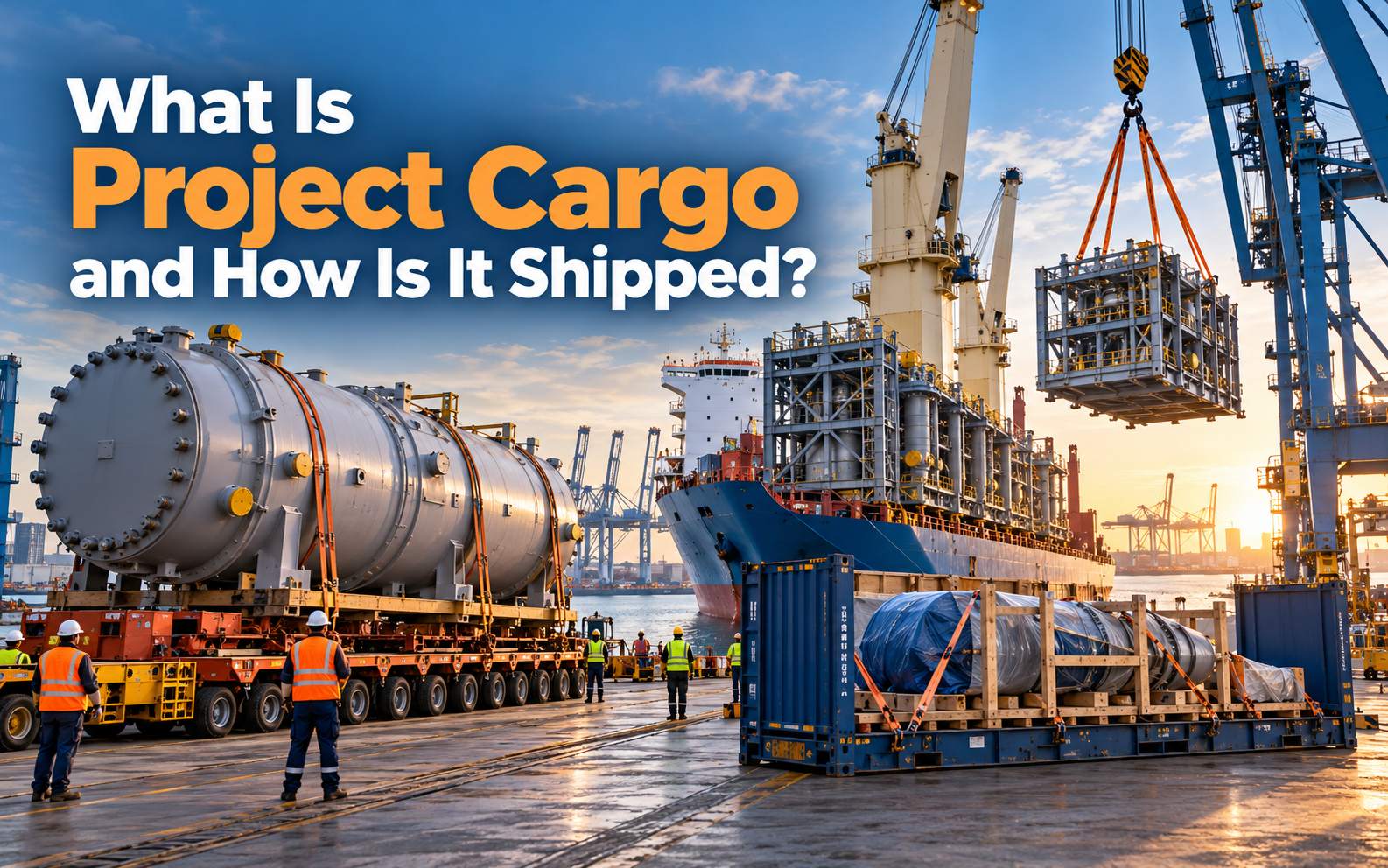
Project cargo refers to the transportation of large, heavy, high-value, oversized, or technically complex equipment that requires specialized handling, equipment, and logistics planning. In many cases, the cargo cannot fit into a standard shipping container or cannot be handled through conventional containerized freight procedures.
Typical examples of project cargo include wind turbine components, construction machinery, oil and gas equipment, power plant modules, industrial vessels, drilling rigs, large production equipment, and other heavy or oversized cargo.
Unlike routine container shipping, project cargo shipping often involves a customized transportation plan covering cargo measurements, route surveys, port selection, lifting arrangements, cargo securing, regulatory requirements, and final delivery.
Defining Characteristics
The defining characteristic of project cargo is that each shipment is unique.
Unlike containerized freight that follows fixed schedules and standardized processes, project cargo logistics usually require a tailored plan based on the cargo's dimensions, weight, center of gravity, lifting requirements, transport route, and destination conditions.
Typical planning activities may include:
- Route surveys
- Port and terminal selection
- Lifting engineering
- Loading planning
- Cargo lashing and securing
- Regulatory permits
- Specialized equipment selection
- Inland transportation planning
For heavy equipment shipping and oversized cargo transportation, even small differences in dimensions or weight distribution can significantly affect the shipping method, handling requirements, and total cost. Importers moving excavators and similar equipment can also refer to our used excavator shipping from China service for a more cargo-specific example.
Freight Classification
Project cargo overlaps with, but is broader than, breakbulk cargo and out-of-gauge cargo (OOG cargo).
Not all breakbulk cargo is project cargo, but many project cargo shipments involve breakbulk, OOG cargo, heavy lift cargo, or special equipment. For a deeper explanation of this transport category, see What Is Breakbulk Shipping?.
|
Comparison |
Standard Freight |
Project Cargo |
|
Cargo Nature |
Standardized, uniform goods |
Large, heavy, high-value, oversized, or complex equipment |
|
Logistics Plan |
Fixed schedules and standardized processes |
Tailored route surveys, lifting engineering, and permits |
|
Handling |
Standard container handling |
Specialized equipment and cargo handling |
Every project cargo shipment requires a bespoke approach because no two pieces of industrial equipment necessarily share the same dimensions, weight distribution, center of gravity, or handling constraints.
How Is Project Cargo Shipped?
Project cargo shipping relies on several main transportation methods. The most suitable method depends primarily on the cargo's dimensions, weight, shape, mobility, value, and destination.
Selecting the correct method has a direct impact on project cargo shipping cost, routing, transit time, equipment requirements, and transportation safety.
Container-Based Solutions
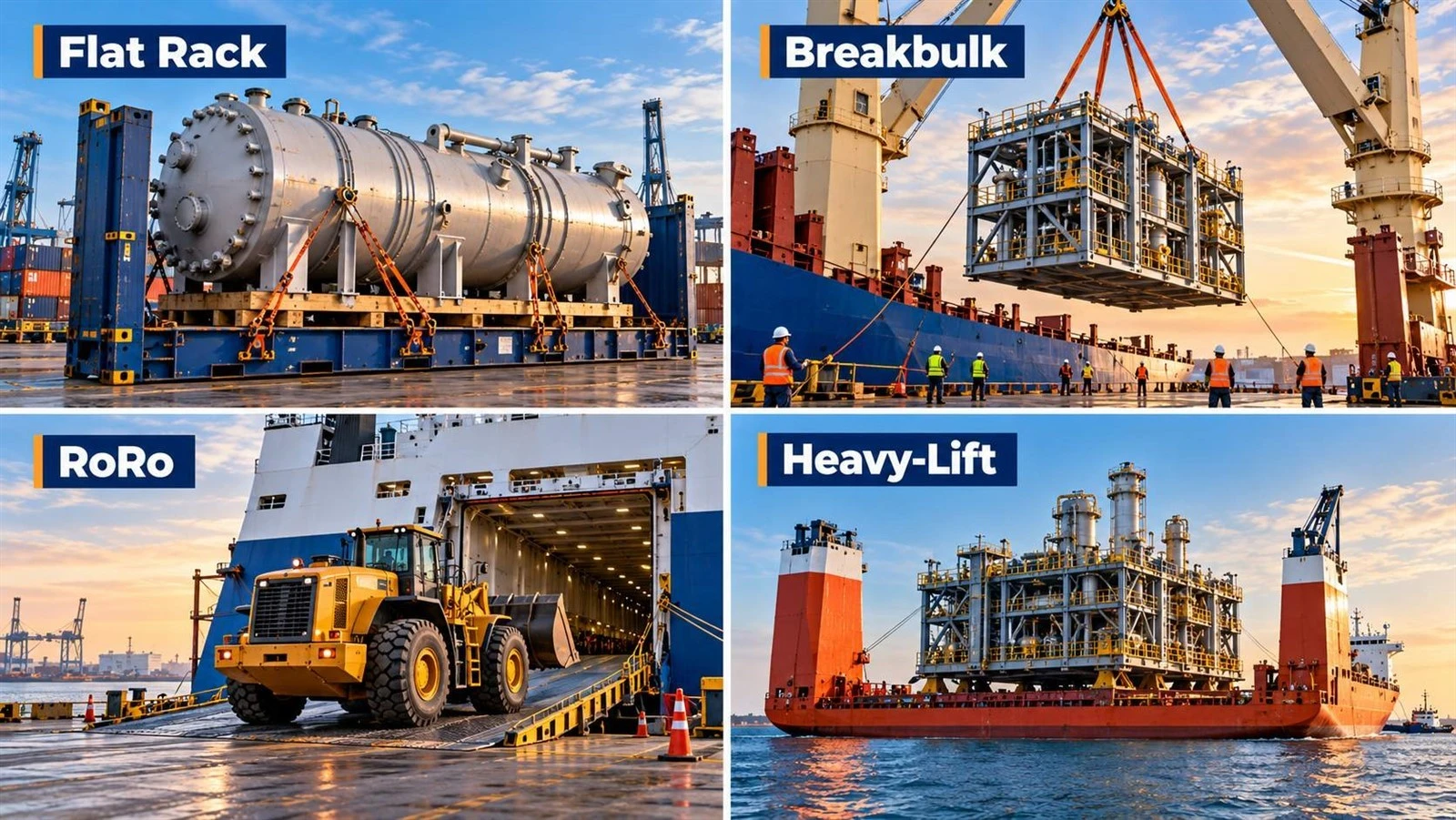
For moderately oversized cargo, container vessels can often transport the shipment using flat rack containers or open top containers.
A flat rack container is a platform-style unit without conventional side walls or a roof. It is designed for out-of-gauge cargo that exceeds standard container width or height.
Typical payloads can reach approximately:
- 22 tons for 20ft flat rack units
- 40 tons for 40ft flat rack units
Actual equipment limits should always be confirmed before booking.
Flat racks are commonly used for:
- Construction machinery
- Industrial equipment
- Pipes
- Vehicles
- Steel structures
- Oversized machinery
An open top container has a removable tarpaulin roof, allowing tall machinery, pipes, and similar cargo to be loaded from above by crane.
It can accommodate cargo exceeding the standard container height of roughly 2.59 meters.
For a broader comparison of special container equipment, including Flat Rack and Open Top units, see our guide to types of shipping containers.
For many moderately oversized shipments, Flat Rack and Open Top solutions provide a balance between cost, vessel frequency, and cargo protection. These shipments are typically arranged through specialized sea freight from China services.
International container equipment itself is also subject to safety requirements under the International Convention for Safe Containers (CSC), which establishes internationally recognized standards for container safety.
Breakbulk Shipping
Breakbulk shipping loads cargo individually onto the vessel deck or into the vessel hold instead of placing it inside a standard container.
This method is suitable for equipment that is too large, too heavy, or too irregularly shaped for container-based transport.
Breakbulk vessels may be equipped with heavy-lift cranes, typically ranging from approximately 40 tons to more than 1,000 tons of lifting capacity.
Common breakbulk cargo includes:
- Reactors
- Turbines
- Large industrial modules
- Heavy machinery
- Steel structures
- Oversized equipment
Because cargo is handled individually, breakbulk project cargo requires careful planning for lifting points, crane capacity, stowage, lashing, and sea fastening.
RoRo Shipping
RoRo shipping, or Roll-on/Roll-off shipping, is commonly used for wheeled and mobile cargo.
Vehicles, construction machinery, trucks, and other rolling equipment can be driven onto and off the vessel under their own power or transported using towing equipment and specialized trailers.
Typical RoRo cargo includes:
- Cars
- Trucks
- Buses
- Construction machinery
- Mobile cranes
- Wheeled industrial equipment
- Other self-propelled machinery
Because RoRo transportation can eliminate or reduce crane lifting, it may lower handling risks and improve loading efficiency for suitable cargo.
However, RoRo availability depends on the route, vessel schedule, cargo dimensions, operational condition, and destination port. If you want to understand the method in more detail, read What Is RoRo Shipping and How Does It Work?. For route and service options, you can also review our RoRo shipping from China service.
Heavy-Lift Vessel Chartering
For extremely heavy or oversized cargo that cannot be transported efficiently by container, RoRo, or conventional breakbulk services, a dedicated heavy-lift vessel or semi-submersible vessel may be required.
Semi-submersible vessels can lower their decks below the waterline, allowing floating cargo to be positioned above the deck before the vessel is raised again through de-ballasting.
This transportation method may be used for:
- Offshore platforms
- Large reactor vessels
- Complete industrial modules
- Large vessels
- Extremely heavy equipment
- Offshore and energy project cargo
Because of the high level of specialization involved, heavy-lift vessel chartering is generally one of the most expensive forms of project cargo transportation.
Project Cargo Shipping Methods at a Glance
|
Method |
Best For |
Typical Cargo |
Cost Level |
|
Flat Rack Container |
Moderately oversized cargo using regular container services |
Machinery, pipes, vehicles |
Low–Medium |
|
Open Top Container |
Tall but relatively narrow cargo loaded by crane |
Tall equipment, pipes, steel structures |
Low–Medium |
|
Breakbulk |
Large or irregular cargo requiring crane lifting |
Reactors, turbines, steel modules |
Medium–High |
|
RoRo |
Wheeled or self-propelled equipment |
Vehicles, construction machinery, trucks |
Medium |
|
Heavy-Lift / Semi-Submersible Charter |
Extreme weight, dimensions, or floating cargo |
Offshore platforms, large modules, vessels |
Very High |
Selecting the right shipping method requires matching the cargo's physical characteristics with the correct vessel and equipment type while balancing safety, schedule, and total logistics cost.
What Is the Project Cargo Shipping Process?
Moving project cargo from China requires close coordination between freight forwarders, carriers, terminals, truckers, customs teams, lifting contractors, and destination partners.
A typical project cargo transportation process involves six critical stages.
|
Step |
Key Activities |
Critical Output |
|
Feasibility & Engineering |
Cargo measurement, center of gravity calculation, lift planning, lashing design |
Transport engineering plan |
|
Route Survey |
Bridge load checks, tunnel clearance, road width, port facility assessment |
Approved transport route |
|
Packing & Securing |
Custom crating, steel wire lashing, chains, timber shoring |
Cargo securing arrangement |
|
Port Handling & Customs |
Berth planning, stevedore coordination, export documentation |
Cargo cleared and ready for loading |
|
Ocean Transport |
Vessel loading, stowage, sea fastening, voyage monitoring |
Cargo in transit |
|
Discharge & Final Delivery |
Port discharge, inland transport, positioning at site |
Cargo delivered to final destination |
Planning and Route Survey
Project cargo logistics begin with accurate cargo information.
The shipper or project cargo freight forwarder normally needs to confirm:
- Cargo name
- Length, width, and height
- Gross weight
- Number of pieces
- Center of gravity
- Lifting points
- Cargo value
- Whether the equipment can be dismantled
- Whether the equipment can move under its own power
- Origin and destination
- Required delivery schedule
Engineers or project teams may calculate the cargo center of gravity, lifting points, and deck load distribution before transportation.
For oversized road transport in China, permits are mandatory when cargo exceeds 4 meters in height, 2.55 meters in width, or 18.1 meters in length. Because oversized road transport is subject to regulatory requirements that may vary by route and shipment type, applicable rules should be checked with the Ministry of Transport of the People's Republic of China before movement.
A route survey may cover the complete inland journey from the factory to the port and, where required, onward from the destination port to the final project site.
Important factors include:
- Bridge load capacities
- Tunnel clearance
- Road width
- Turning radius
- Overhead power lines
- Port gate restrictions
- Terminal handling capabilities
- Crane capacity
- Destination discharge facilities
For international project cargo, these checks may also extend to transshipment ports and final delivery locations.
For practical examples involving loaders, excavators, cranes, and other large machinery, our guide on how to ship construction machinery from China explains how cargo dimensions and equipment type influence the shipping plan.
Packing, Port Handling, and Transport
Cargo securing may follow the requirements of the IMO Code of Safe Practice for Cargo Stowage and Securing (CSS Code) and other applicable transport standards.
Depending on the cargo, securing materials can include:
- Steel wire
- Chains
- Turnbuckles
- Timber shoring
- Blocking materials
- Anti-slip materials
- Protective coverings
The objective is to prevent cargo from shifting, overturning, vibrating excessively, or suffering damage as a result of vessel roll, pitch, and heave.
Port handling also requires coordination with terminal operators and stevedores.
Project cargo may require:
- Special berth arrangements
- Extended handling time
- Dedicated crane hire
- Special lifting equipment
- Customized loading sequences
- Additional terminal space
Customs documentation from China normally includes commercial invoices, packing lists, bills of lading, and certificates of origin where applicable.
During ocean transportation, cargo is stowed and sea-fastened according to the approved transport plan. The shipment may then be tracked through key voyage milestones until arrival.
The final stage includes vessel discharge, destination port handling, inland transportation, and final positioning at the project site.
How to Choose the Right Project Cargo Shipping Method
Selecting the right project cargo shipping method depends mainly on the cargo's:
- Dimensions
- Weight
- Shape
- Mobility
- Value
- Urgency
- Origin and destination
- Port capabilities
- Availability of specialized equipment
The greater the degree of specialization required, the higher the transportation cost will generally be.
|
Cargo Characteristic |
Recommended Method |
Why |
|
Fits container footprint but is slightly over-height or over-width |
Flat Rack / Open Top |
Uses scheduled container vessels and can reduce additional transport cost |
|
Wheeled, self-propelled, or towable |
RoRo |
No or limited crane lifting, efficient loading, lower handling exposure |
|
Large, irregular, and non-containerizable |
Breakbulk |
Can be crane-loaded directly onto the deck or into the hold |
|
Extremely heavy or oversized beyond conventional breakbulk |
Heavy-Lift Charter |
Dedicated vessel capacity and specialized lifting equipment |
|
High-value, time-critical, moderate-sized cargo |
Flat Rack on suitable scheduled service |
Balances cost, schedule, and security |
The lowest freight rate is not always the lowest total transportation cost.
A cheaper shipping method may create additional expenses if it requires extensive dismantling, specialized inland transportation, long port waiting times, additional crane operations, or complex destination handling.
For example, the transport plan for mobile cranes can differ significantly depending on axle configuration, dimensions, crane boom arrangement, and whether RoRo, Flat Rack, or Breakbulk is more suitable. Our guide on how to ship a crane from China discusses these choices in more detail.
A professional project cargo freight forwarder should therefore compare the total logistics cost, rather than ocean freight alone.
Cost and Risk Implications
Container-based solutions such as a flat rack container are generally among the most cost-effective options for moderately oversized cargo and may cost only slightly more than standard freight in suitable situations.
Breakbulk shipping rates are often quoted based on freight tons, calculated using the greater of cargo weight or volume according to the applicable quotation terms.
A full vessel charter can cost hundreds of thousands or even millions of US dollars per voyage.
Heavy-lift chartering is therefore usually reserved for cargo whose dimensions, weight, or operational requirements make other shipping methods impractical.
The final project cargo shipping cost can also be affected by:
- Inland trucking
- Special transport permits
- Crane hire
- Terminal handling
- Cargo packing
- Lashing and securing
- Flat rack or special-container equipment
- Port storage
- Customs clearance
- Transshipment
- Cargo insurance
- Final-mile delivery
Correctly matching the transportation method to the cargo's physical limits helps avoid unnecessary expenditure while reducing the risk of damage in transit.
For high-value or oversized equipment, proper loading and securing are especially important. Common risks include incorrect lifting points, cargo movement, insufficient support, collision, scratches, improper weight distribution, and weather exposure.
Pre-shipment inspection, loading supervision, photographic records, appropriate support, lashing, anti-slip protection, and final securing checks can all help reduce these risks.
FAQ
What is considered project cargo?
Project cargo generally includes heavy, oversized, high-value, or technically complex equipment that requires customized logistics planning and specialized handling. Examples include construction machinery, turbines, drilling rigs, industrial modules, large vessels, power equipment, and other OOG cargo.
What is the difference between project cargo and breakbulk cargo?
Breakbulk describes cargo transported as individual pieces rather than inside standard containers. Project cargo refers more broadly to complex shipments that require customized logistics planning. Breakbulk can be one transportation method used for project cargo, but not all breakbulk shipments are necessarily project cargo.
Can project cargo be shipped in containers?
Yes. Some project cargo can be transported using Flat Rack or Open Top containers. These solutions are commonly used when the cargo exceeds standard container dimensions but can still be safely transported on scheduled container vessels.
How much does project cargo shipping cost?
There is no standard project cargo shipping price because each shipment is different. Cost depends on cargo dimensions, weight, origin, destination, transport mode, lifting requirements, special equipment, port handling, inland transportation, customs requirements, and cargo securing.
For an accurate project cargo quote, the freight forwarder normally needs the cargo name, dimensions, weight, quantity, origin, destination, and preferred shipping schedule.
Do I need a specialized freight forwarder for project cargo?
For oversized, heavy, high-value, or technically complex cargo, working with an experienced project cargo freight forwarder can reduce operational risks. A capable forwarder should be able to evaluate suitable shipping methods, coordinate special equipment, plan loading and lashing, manage documentation, and connect the different inland, port, ocean, and destination stages of the shipment.
Conclusion
Project cargo is the specialized transportation of oversized, heavy, high-value, or technically complex equipment that requires more planning and coordination than standard freight. Depending on the cargo, it may be shipped using Flat Rack or Open Top containers, Breakbulk services, RoRo vessels, or dedicated heavy-lift solutions.
The most important part of project cargo shipping is not simply finding a vessel. Safe and cost-effective transportation depends on choosing the right transport mode, confirming cargo dimensions and weight, planning the route, coordinating lifting and loading, securing the cargo correctly, and managing each stage from origin to final delivery.
If you are sourcing machinery, heavy equipment, OOG cargo, or other project-critical goods from China, Zhejiang Wilson Supply Chain Management Co., Ltd. can help evaluate suitable Flat Rack, Open Top, RoRo, Breakbulk, and other project cargo logistics solutions. Our team supports customers with transportation planning, pickup, customs coordination, loading and securing, international freight, shipment tracking, and destination coordination-contact us to discuss your cargo details and develop a tailored shipping plan.