Shipping a mobile crane from China is not the same as shipping a truck, an excavator, or a standard containerized machine.
A mobile crane may have wheels and an engine, but that does not automatically make it suitable for RoRo shipping from China. It may also be too wide for standard container handling, too heavy for a flat rack, or too complex to lift without a proper plan.
For most mobile crane shipments, the real choice is between three methods: RoRo, flat rack, and breakbulk.
The right answer depends on the crane's running condition, actual dimensions, gross weight, boom and counterweight arrangement, loading method, port capability, route availability, and destination handling. Price matters, but it should not be the first question.
Shipping method comes before freight rate.
What Makes Mobile Crane Shipping Different from Standard Cargo?
A mobile crane sits between two cargo categories. It is partly a vehicle, partly oversized machinery.
That is why a freight forwarder cannot judge the shipment from the model name alone. A 25-ton truck crane, an 80-ton all-terrain crane, and a used crawler crane body may all be called "cranes," but their shipping plans can be completely different.
The first checks are practical:
- Can the crane start, steer, brake, and move at low speed?
- What are the actual length, width, height, and gross weight in shipping condition?
- Will the boom, counterweights, hook block, outrigger pads, or attachments be removed?
- Are the lifting points and lashing points clear?
- Can the origin port and destination port handle the crane safely?
- Is inland transport from the supplier's yard to the port possible without route problems?
OOG, or out of gauge cargo, means the cargo exceeds the normal usable limits of standard container equipment because of its width, height, length, weight, shape, or loading method. Many mobile cranes become OOG cargo once the boom, counterweight, base frame, tires, or working attachments are considered.
Do not measure only the bare machine.
For shipping, the usable dimensions are the dimensions of the crane as it will actually move: boom folded or removed, counterweights installed or removed, tires inflated, outriggers retracted, accessories packed, and enough space left for lifting and securing.
A wrong measurement can change the whole method. A crane that looked suitable for flat rack may suddenly require breakbulk. A machine planned for RoRo may be rejected if it cannot drive onto the vessel.
That is the main difference from standard cargo: with a mobile crane, the shipment is not just booked. It is engineered.
The Three Main Ways to Ship a Mobile Crane from China
The three main shipping methods for mobile cranes from China are RoRo shipping, flat rack shipping, and breakbulk shipping. Each method uses a different loading logic.
| Shipping Method | Best For | Setup Logic | Main Constraint |
|---|---|---|---|
| RoRo | Drivable or towable wheeled cranes | Crane rolls onto the vessel by ramp | Crane must move safely and fit vessel limits |
| Flat Rack | Dismantled cranes or OOG crane parts | Cargo is lifted onto a flat rack and secured | Width, height, weight, and lashing must be accepted |
| Breakbulk | Very large, heavy, or irregular cranes | Cargo is lifted directly onto vessel hold or deck | Needs port, vessel, lifting, and securing coordination |
RoRo Shipping for Mobile Cranes
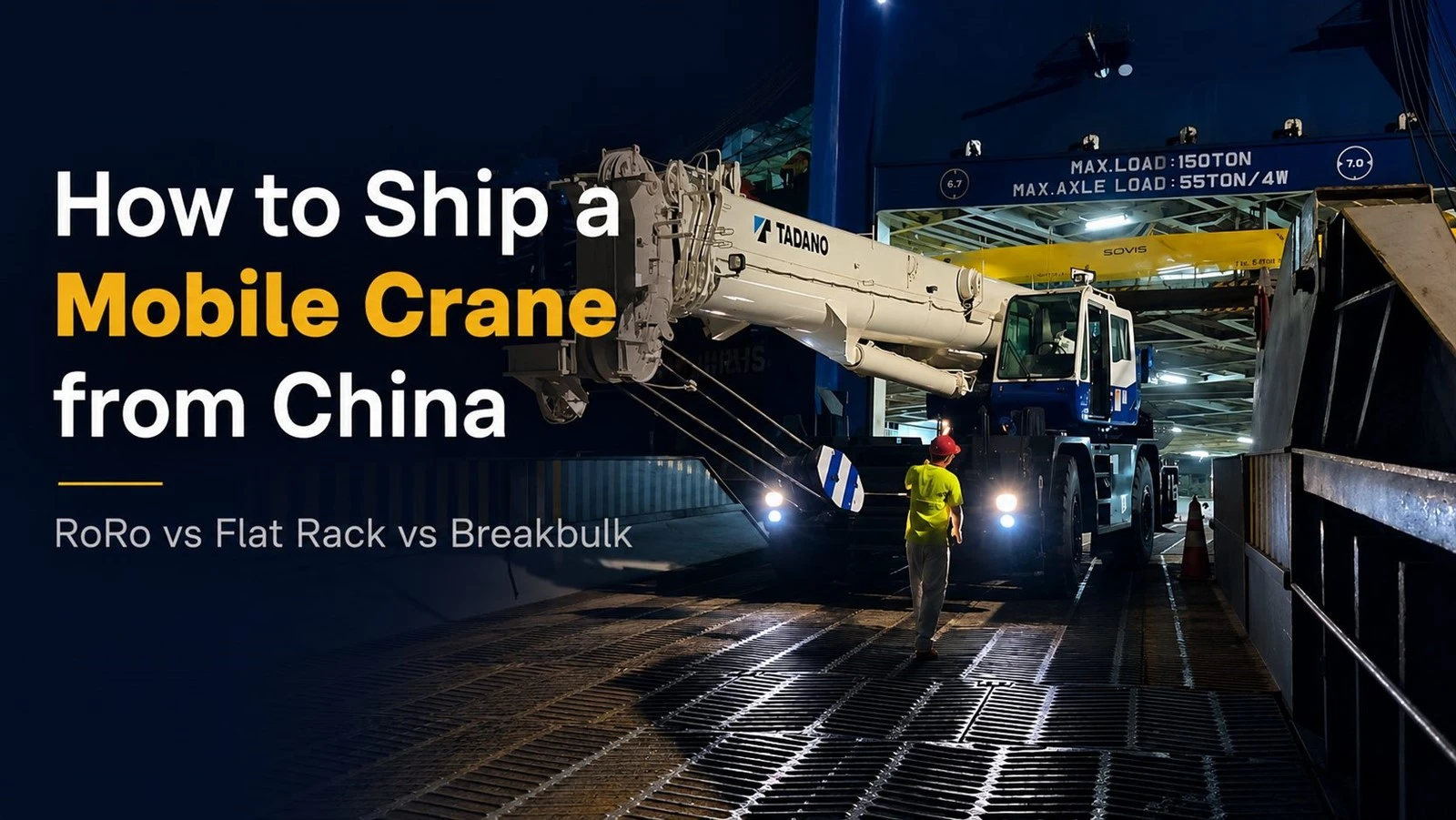
RoRo means Roll-on/Roll-off. The cargo is driven or towed onto a specialized vessel through a ramp, then secured on the vessel deck.
For mobile cranes, RoRo is usually suitable when the crane can operate like a vehicle. A truck crane or all-terrain crane that can start, steer, brake, and move safely is a good candidate.
The main advantage is reduced lifting exposure. Instead of lifting the whole crane body by crane, the machine moves onto the vessel under its own power or under controlled towing. This lowers the risk of damage to the frame, cab, hydraulic lines, tires, and external components.
But RoRo has strict limits.
The carrier will check the crane's length, width, height, gross weight, ground clearance, tire condition, ramp angle, deck strength, and whether the unit is safe to move. The origin and destination ports must also have RoRo facilities.
A crane with wheels is not automatically RoRo cargo. It must be able to roll safely.
Flat Rack Shipping for Mobile Cranes
A flat rack container is a special container platform with no side walls and no roof. It is used for cargo that is too wide, too high, too heavy, or too irregular for a standard dry container.
For mobile cranes, flat rack shipping often works when the machine can be partly dismantled. The main body may be loaded on one flat rack, while boom sections, counterweights, hook blocks, outrigger pads, and accessories may move on other flat racks or in standard containers.
This method is common for medium-size machines or crane components because container vessel networks are broad. In many routes, flat rack service is easier to arrange than breakbulk.
The limitation is that flat rack cargo must pass carrier and terminal review. A typical 40-foot flat rack may handle roughly 39–40 metric tons of payload in many cases, but this is only a planning reference. Actual acceptance depends on the equipment type, weight distribution, center of gravity, carrier rules, road limits, and port handling.
Flat rack is not just "put the crane on a platform."
It needs lifting, blocking, lashing, sometimes weather protection, and clear responsibility for loading and unloading.
Breakbulk Shipping for Mobile Cranes
Breakbulk shipping means the cargo is not shipped inside a container. The crane or its large components are lifted directly into the vessel hold or secured on deck.
Breakbulk is usually used when the mobile crane is too large, too heavy, or too irregular for RoRo or flat rack. Large crawler crane bodies, heavy crane bases, long boom systems, and oversized project cargo may fall into this category.
Breakbulk gives more flexibility, but it also requires more planning. The forwarder must coordinate vessel space, lifting method, port cranes, stowage plan, lashing materials, survey requirements, and destination discharge.
Breakbulk should not be the first answer just because the cargo is large. If the crane can be safely dismantled and secured on flat racks, containerized OOG shipping may be more practical. Breakbulk becomes the right option when RoRo and flat rack are no longer workable.
RoRo vs Flat Rack vs Breakbulk: Which Option Is Best?
There is no single best way to ship a mobile crane from China. The best method is the one that can be executed safely at origin, during ocean transport, and at destination.
When RoRo Is the Best Option
RoRo should be checked first when the crane can move safely.
For example, a used 50-ton truck crane in running condition, with tires in good shape and dimensions accepted by the carrier, may be a strong RoRo candidate. The machine can be driven to the RoRo terminal, loaded by ramp, secured on deck, and discharged the same way at destination.
RoRo is usually a good fit when:
- The crane can start, drive, steer, and brake.
- Tires, battery, engine, hydraulic system, and fuel condition are acceptable.
- The unit does not exceed vessel ramp or deck limits.
- The route has RoRo service from China to the destination region.
- The destination port can receive and move the crane after discharge.
The weak point is availability. RoRo routes do not cover every port, and carriers may reject units that are non-running, leaking oil, too high, too heavy, or unsafe to operate.
When Flat Rack Makes More Sense
Flat rack makes sense when dismantling can bring the crane into a workable OOG shipping profile.
For example, a compact mobile crane or crane body may be too wide for a standard container but still suitable for a 40-foot flat rack after removing the boom, counterweights, and attachments. The parts can be shipped separately, reducing overhang and making the shipment easier to approve.
Flat rack is often the better option when:
- The crane can be dismantled into manageable units.
- The gross weight and weight distribution are acceptable.
- Lifting points and lashing points are clear.
- The destination port has container OOG handling ability.
- RoRo service is not available or not suitable.
Flat rack can be cost-effective, but overhang changes the cost quickly. If the cargo blocks adjacent vessel slots, the carrier may apply lost slot charges. If the unit needs heavy lifting, special blocking, certified lashing, and weather protection, those costs must be included from the beginning.
When Breakbulk Is Necessary
Breakbulk is necessary when the crane cannot be safely handled as RoRo or flat rack cargo.
This may happen with a large crawler crane body, an oversized all-terrain crane that exceeds RoRo limits, or a heavy crane base that cannot be loaded onto a flat rack because of weight, center of gravity, or lifting restrictions.
Breakbulk is usually considered when:
- The crane is too heavy or too large for flat rack acceptance.
- The unit cannot be driven or towed onto a RoRo vessel.
- Dismantling is not practical or does not solve the transport problem.
- The cargo requires direct heavy-lift handling.
- The origin and destination ports can handle breakbulk cargo.
Breakbulk is closer to project logistics than normal sea freight. The booking is not just about space on a ship. It is about whether the cargo can be lifted, stowed, secured, discharged, and moved inland without creating a new problem at every handover point.
When a Combined Shipping Solution Works Better
Some mobile crane shipments should not be forced into one method.
A practical plan may look like this:
- Main crane body by RoRo.
- Boom sections and counterweights by flat rack.
- Small accessories, tools, and spare parts by standard container.
- Oversized components by breakbulk if flat rack cannot handle them.
This is common when the crane is technically drivable but some attachments make the full unit too high, too long, or too heavy for direct RoRo acceptance.
A combined solution can reduce cost and risk, but only when the parts are clearly listed, measured, marked, and shipped with a clean document flow.
Key Factors That Decide the Shipping Method
The shipping method is decided by the crane profile, not by preference.
Crane Dimensions and Gross Weight
Length, width, height, and gross weight are the first decision points.
Height affects RoRo deck clearance and flat rack over-height acceptance. Width affects overhang, lost slots, terminal handling, and inland road permits. Weight affects flat rack payload, lifting equipment, trailer type, and port acceptance.
A model brochure is not enough. A crane may have optional boom sections, counterweights, tire changes, or attachments that change the real shipping dimensions.
The dimensions must reflect the actual shipping condition.
Operating Condition and Mobility
For RoRo, running condition is the deciding factor.
A crane that cannot start, brake, steer, or move safely may not be accepted. If the unit is only towable, the carrier and port must confirm whether towing is allowed and what equipment is needed.
For used cranes, check:
- Battery condition
- Tire condition
- Brake system
- Steering
- Oil leakage
- Hydraulic system
- Fuel level
- Whether the operator can move the crane safely at port
A non-running mobile crane may still be shipped, but the method changes. It may require flat rack, breakbulk, towing equipment, or special port handling.
Boom, Counterweight and Attachments
Booms and counterweights often decide whether flat rack is possible.
A crane body may fit after removing the boom. Counterweights may need to move as separate cargo because they change weight distribution. Hook blocks, outrigger pads, toolboxes, spare tires, and accessories should be listed separately.
Dismantling can reduce freight cost, but it can also create new risks: missing parts, unclear packing, reassembly difficulty, and extra handling at destination.
For every removed part, record the size, weight, photos, markings, and packing method.
Center of Gravity, Lifting Points and Lashing Points
Mobile cranes are not evenly balanced. The upper structure, boom base, counterweight position, and chassis design can create uneven weight distribution.
For flat rack and breakbulk, the carrier or terminal may ask for lifting points, center of gravity, and securing method before acceptance.
Poor lashing can damage the crane. Chains fixed to the wrong point may bend structural parts, crush hydraulic lines, or damage outrigger housings. Blocking and timber supports should match the machine's load points, not just the easiest place to attach a chain.
This is where many cheap quotations become expensive later.
Port, Route and Vessel Availability
A shipping plan can fail even when the cargo technically fits the vessel.
RoRo needs a RoRo route and RoRo terminal. Flat rack needs special container equipment, OOG approval, and terminal handling. Breakbulk needs suitable berth, lifting capacity, vessel gear or shore crane, and a destination port that can discharge the cargo.
The best port is not always the nearest port.
For a crane located in inland China, the closest seaport may not have the right vessel service or OOG handling setup. A longer inland move to a stronger port may be safer and cheaper in total.
Inland Transport and Destination Handling
The ocean leg is only one part of the move.
In China, a mobile crane may require low-bed trailer transport, temporary permits, route checks, or special loading at the supplier's yard. At destination, the receiver must have enough space, unloading equipment, customs documents, and inland transport capacity.
Many shipment problems appear after arrival because nobody checked the final delivery site early enough.
A crane that can be shipped to port is not necessarily a crane that can be delivered to the jobsite.
Cost Comparison: RoRo, Flat Rack and Breakbulk
A useful cost comparison must include the full movement, not only the ocean freight.
RoRo Cost Structure
RoRo costs may include:
- Ocean freight
- Origin and destination port charges
- Inland movement to RoRo terminal
- Export customs declaration
- Cleaning or inspection if required
- Towing or special operation if the crane is not fully drivable
RoRo can reduce lifting and handling cost when the crane is accepted and can move safely. But it is not always the cheapest. Limited routes, tight space, large dimensions, and non-running status can change the price or make RoRo unavailable.
Flat Rack Cost Structure
Flat rack costs may include:
- Flat rack ocean freight
- OOG surcharge
- Lost slot charges
- Crane lifting
- Blocking, lashing, and securing
- Port handling
- Inland transport
- Dismantling and packing
- Weather protection
- Destination unloading
Flat rack can be a strong option when dismantling reduces width, height, and overhang. But if the cargo is wide enough to block nearby vessel slots or heavy enough to require special lifting, the final cost can rise quickly.
Breakbulk Cost Structure
Breakbulk costs may include:
- Breakbulk ocean freight
- Heavy-lift handling
- Port storage and terminal charges
- Lashing, welding, blocking, or support materials
- Survey or supervision
- Special inland transport
- Insurance
- Destination discharge coordination
Breakbulk pricing is usually case-by-case. Vessel availability, port windows, lifting capacity, cargo size, and route demand all affect the rate.
Breakbulk is not the first method to assume. It is the method to use when the crane cannot be handled safely by RoRo or flat rack.
Cost Factors That Often Change the Final Quote
| Cost Factor | Why It Changes the Quote |
|---|---|
| Final shipping dimensions | Over-width or over-height cargo may create OOG or lost slot charges |
| Gross weight and weight distribution | Affects flat rack acceptance, lifting gear, trailer type, and port handling |
| Running condition | Non-running cranes may need towing, lifting, or method change |
| Dismantling scope | May reduce freight but adds labor, packing, and reassembly risk |
| Lashing and securing | Heavy cargo needs chains, timber, blocking, and sometimes survey approval |
| Inland transport | Low-bed trailers, permits, route checks, and escort may be needed |
| Port capability | Not every port can handle RoRo, OOG flat rack, or breakbulk cargo |
| Destination unloading | Lack of equipment at destination can cause delays and extra fees |
| Weather protection | Exposed cargo may need wrapping, tarpaulin, VCI materials, or anti-rust protection |
The lowest ocean freight is not always the lowest landed cost.
Documents and Information Needed Before Getting a Quote
A mobile crane shipping quote is only as accurate as the information provided.
Basic Crane Information
Send the basic identity of the crane first:
- Brand and model
- Year of manufacture
- New or used condition
- Manufacturer specification sheet
- Nameplate photos
- Front, side, rear, and top photos
- Engine or machinery details if required
Photos matter. They show tire condition, boom position, counterweights, attachments, leaks, cab condition, and lifting access.
Dimensions, Weight and Handling Details
For method selection, provide:
- Actual length, width, and height in shipping condition
- Gross weight
- Axle load, if available
- Boom length
- Counterweight details
- Center of gravity, if available
- Lifting points
- Lashing points
- Whether the crane can start, drive, steer, and brake
- Whether there is oil leakage, tire damage, or battery issue
- Whether dismantling is allowed or required
A short video showing the crane starting and moving can help when checking RoRo feasibility.
Route and Delivery Information
The route also affects the method:
- Supplier city or pickup location in China
- Preferred loading port, if any
- Destination port
- Final delivery address, if door delivery is needed
- Site type: port, yard, warehouse, factory, or jobsite
- Ready date
- Required delivery deadline
- Whether unloading support is needed at destination
Do not choose the route only by map distance. Choose it by what can actually be executed.
Export and Customs Documents
Common export documents include:
- Commercial invoice
- Packing list
- Sales contract
- Bill of lading
- Export declaration documents
- HS code confirmation
- Used equipment condition documents, if required
- Destination country import documents, if applicable
For used mobile cranes, destination rules may be stricter. Some markets may require cleaning, inspection, emission documents, compliance plates, or specific import approvals. These should be checked before booking, not after arrival.
Common Risks When Shipping a Mobile Crane from China
Most problems happen at handover points: supplier yard, inland transport, terminal entry, loading, securing, customs, discharge, and final delivery.
Running Condition and RoRo Rejection Risk
The most common RoRo misunderstanding is simple: the buyer sees wheels and assumes the crane can roll onto the ship.
The carrier sees something else. They check whether it can move safely.
If the crane cannot start at the terminal, leaks oil, has weak brakes, or cannot steer reliably, the RoRo plan may collapse. The result can be extra handling fees, missed vessel, storage charges, or a forced switch to another shipping method.
Loading and Discharging Risk
Flat rack and breakbulk require lifting. Lifting a mobile crane without clear lifting points or weight distribution can cause tilting, collision, structural stress, or damage to hydraulic parts.
Discharge is just as important. A destination port may accept the cargo on paper but lack the right crane, trailer, or operating window when the vessel arrives.
The unloading plan should be checked before the cargo leaves China.
Lashing, Securing and Center of Gravity Risk
A crane is not secured like a steel box.
The lashing plan must consider the frame, axles, tires, boom base, counterweight, center of gravity, and sensitive parts. Chains should not crush hydraulic lines or pull against weak structures. Timber supports should prevent movement without creating pressure damage.
For high-value or complex shipments, loading photos, lashing records, and third-party supervision can reduce disputes later.
Insurance is not a loading plan. It is the last layer of protection after the work has already been done correctly.
Weather Exposure and Corrosion Risk
Flat rack and some breakbulk shipments are exposed to sea air, rain, spray, and terminal dwell time.
Mobile cranes may tolerate outdoor conditions, but hydraulic cylinders, electrical boxes, cab interiors, exposed connectors, bare metal parts, and control panels still need protection. Depending on the route and cargo value, protection may include tarpaulin, shrink wrap, anti-rust oil, VCI material, desiccants, or sealed covers for sensitive parts.
Documentation and Compliance Risk
Wrong documents can stop a shipment as quickly as wrong dimensions.
The model, serial number, HS code, value, condition, weight, and cargo description should match across the invoice, packing list, export declaration, bill of lading, and destination clearance documents.
For used machinery, mismatched information can trigger inspection, delay, cleaning order, extra storage, or customs questions.
Clean documents reduce friction. Vague documents create problems.
Step-by-Step Process to Ship a Mobile Crane from China
A workable mobile crane shipment usually follows this sequence:
- Collect crane specifications, photos, and nameplate information. Start with the brand, model, year, condition, photos, and technical sheet.
- Confirm actual shipping dimensions and weight. Measure the crane in the condition it will ship, not only from the catalogue.
- Check running condition and dismantling feasibility. Confirm whether the crane can drive, whether RoRo is realistic, and whether boom or counterweights should be removed.
- Compare RoRo, flat rack, and breakbulk options. Do not force one method. Compare feasibility first, then compare cost.
- Confirm carrier, port, and route acceptance. Check vessel limits, port handling, OOG approval, and destination capability.
- Plan inland transport from supplier or yard to port. Arrange the right trailer, permits, loading equipment, and delivery timing to match vessel cutoff.
- Arrange dismantling, lifting, packing, and lashing if needed. Prepare the crane body and parts according to the chosen shipping method.
- Handle export customs declaration in China. Prepare invoice, packing list, contract, HS code, and export declaration data.
- Load and secure the crane. Follow the RoRo, flat rack, or breakbulk loading plan. Record photos where needed.
- Track shipment and prepare destination clearance. Send documents early, coordinate discharge, and prepare final delivery if required.
For complex cranes, the main unit and attachments may move under different shipping methods. That is normal when it reduces risk or keeps the shipment executable.
Conclusion
Shipping a mobile crane from China is a method-selection problem before it is a price problem.
RoRo is usually the first option to check when the crane can drive safely and the route is available. Flat rack works when the crane can be dismantled, lifted, and secured as OOG cargo. Breakbulk is used when the crane is too large, too heavy, or too complex for RoRo or flat rack.
The right choice depends on actual dimensions, gross weight, running condition, dismantling plan, lifting points, port capability, route availability, lashing requirements, customs documents, and destination handling.
Send the crane model, photos, nameplate, actual dimensions, gross weight, running condition, pickup location in China, and destination port. Wilson can review the shipment and help decide whether RoRo, flat rack, or breakbulk is the safest and most workable option. You can contact us to discuss your mobile crane shipping plan.
Why Work with Wilson for Mobile Crane Shipping from China?
Zhejiang Wilson Supply Chain Management Co., Ltd. supports mobile crane and heavy equipment shipping from China with a focus on execution control, not only freight quotation.
For this type of shipment, the key work is at the handover points: supplier pickup, terminal entry, loading, securing, customs documents, vessel booking, destination discharge, and final delivery planning.
We can help with:
- RoRo, flat rack, and breakbulk feasibility review
- China-side pickup and inland transport coordination
- Dismantling and packing advice for boom, counterweights, and accessories
- OOG and project cargo booking coordination
- Lifting, lashing, securing, and port operation arrangements
- Export customs documentation in China
- Destination port and delivery planning support where required
A mobile crane shipment should not depend on guesswork. With the right details, the route and method can be checked before the machine reaches the port.
FAQ
Can a mobile crane be shipped by RoRo from China?
Yes, if the crane can start, drive, steer, and brake safely, and if the RoRo carrier accepts its size, weight, ramp requirements, and port conditions. A wheeled crane is not automatically RoRo cargo.
Is flat rack cheaper than RoRo for mobile crane shipping?
Not always. Flat rack may offer more route flexibility, but OOG surcharge, lost slot charges, lifting, lashing, dismantling, port handling, and destination unloading can increase the total cost.
When should I use breakbulk for a mobile crane?
Use breakbulk when the crane is too large, too heavy, too irregular, non-running, or unsuitable for RoRo or flat rack. It is often the right choice for large crane bodies, heavy-lift components, or cargo that cannot be safely containerized.
Do I need to dismantle the crane before shipping?
It depends on the shipping method and crane structure. Flat rack often requires partial dismantling. RoRo usually works better when the crane can move as one unit. Breakbulk may allow larger units, but some parts may still need removal for safety or cost control.
Can the crane body and attachments use different shipping methods?
Yes. The main crane body may move by RoRo, while boom sections, counterweights, hook blocks, and spare parts move by flat rack or standard container. Some large projects may combine breakbulk and flat rack.
What information is needed for a mobile crane shipping quote?
You should provide the brand, model, year, actual length, width, height, gross weight, photos, nameplate, running condition, boom and counterweight details, dismantling requirements, pickup location in China, and destination port.
Can Wilson arrange inland transport in China before export?
Yes. Depending on the crane size and location, Wilson can coordinate suitable China-side transport, including supplier pickup, low-bed trailer arrangements, port delivery, and connection with export customs and vessel booking.
What is the safest way to ship a mobile crane from China?
There is no fixed safest method. The safest method is the one that matches the crane's actual condition, loading requirements, securing plan, port capability, and destination handling. A proper feasibility check should come before booking.