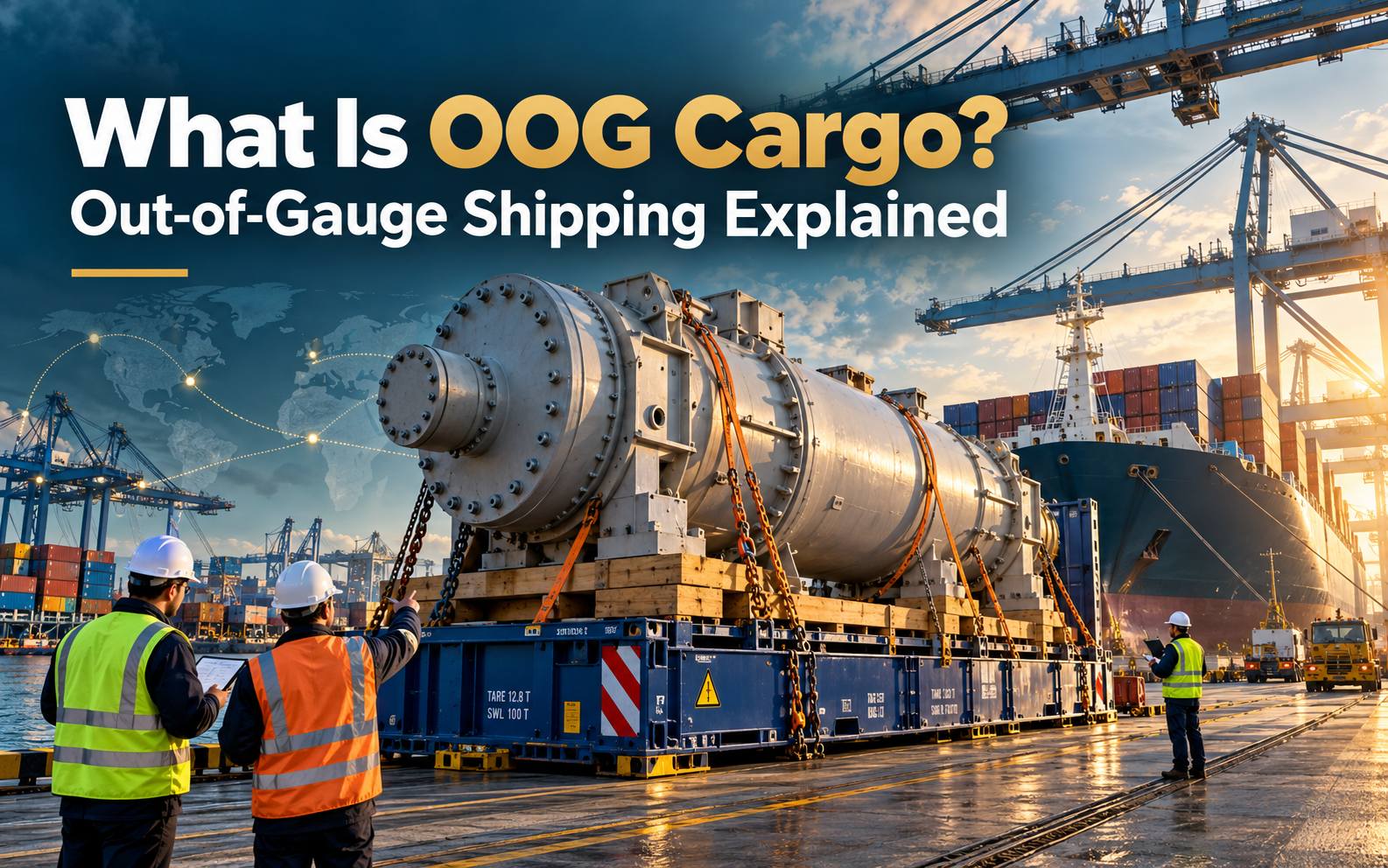
Out-of-gauge (OOG) cargo is any shipment whose dimensions exceed the internal measurements of a standard ISO container-meaning it extends beyond standard container limits in length, width, or height and cannot be fully enclosed inside a regular 20-foot or 40-foot dry container. If your goods do not fit within those limits, they may require specialized equipment, special pricing, and a different shipping process from standard container freight.
For importers moving machinery, vehicles, industrial equipment, or other oversized cargo, understanding OOG shipping is essential before arranging sea freight from China.
What Qualifies as OOG Cargo?
OOG cargo is generally identified by a simple question: does the freight fit within the usable dimensions of a standard six-sided shipping container? If any part of the cargo protrudes beyond those limits, the shipment may be classified as out-of-gauge cargo and require specialized equipment rather than a standard dry container.
The threshold is tied to standard container dimensions. The ISO 668 standard for Series 1 freight containers defines the principal dimensions and related specifications used for standard freight containers in international transport.
A standard 40-foot dry container offers roughly 12.05 meters of internal length, 2.35 meters of width, and 2.39 meters of height. A 40-foot high-cube container adds about 30 centimeters of vertical clearance. Cargo exceeding those internal dimensions in one or more directions may require an OOG shipping solution.
Common OOG cargo types include:
|
Cargo Category |
Typical Examples |
Why It's OOG |
|
Over-length |
Steel pipes, timber, wind turbine blades |
Exceeds 12.05 m internal length |
|
Over-width |
Excavators, bulldozers, large molds |
Exceeds 2.35 m internal width |
|
Over-height |
Tall machinery, transformers, tanks |
Exceeds 2.39 m, or 2.69 m for a high-cube |
|
Over-weight |
Heavy industrial equipment, pressure vessels |
Exceeds container payload capacity |
|
Irregular shape |
Yachts, project modules, bridge sections |
Cannot be conventionally containerized |
Many shipments are over-dimensional in more than one direction simultaneously. An excavator, for example, may be both over-width and over-height, which increases the complexity of equipment selection, handling, lashing, and vessel stowage.
Importers handling large industrial machinery may also find it useful to review practical guidance on how to ship construction machinery from China.
It is also important to distinguish OOG cargo from heavy cargo. A shipment may be very heavy while still fitting inside a standard container, while another shipment may be relatively light but classified as OOG because its width, height, or length exceeds standard limits.
Standard Container Dimensions Used to Identify OOG Cargo
To determine whether freight is out of gauge, you first need to understand the container dimensions against which the cargo is being measured.
|
Container Type |
External (L × W × H) |
Internal (L × W × H) |
Max Payload |
|
20-foot Dry (20GP) |
6.06 × 2.44 × 2.59 m |
5.90 × 2.35 × 2.39 m |
~21–24 tons |
|
40-foot Dry (40GP) |
12.19 × 2.44 × 2.59 m |
12.05 × 2.35 × 2.39 m |
~26–28 tons |
|
40-foot High Cube (40HC) |
12.19 × 2.44 × 2.90 m |
12.05 × 2.35 × 2.69 m |
~26 tons |
These figures provide a useful reference point for evaluating OOG cargo dimensions. If your cargo's length, width, or height exceeds the usable dimensions of a standard container, a conventional dry container may not be suitable.
For a broader comparison of standard and special equipment, see this guide to types of shipping containers, including 20GP, 40GP, 40HQ, flat rack, open-top, and reefer containers.
Actual payload limits, equipment specifications, and acceptance criteria can vary by container, carrier, route, terminal, and local regulations, so the cargo dimensions and weight should always be confirmed before booking.
Specialized Equipment for OOG Shipping
OOG cargo usually cannot move in a standard dry container. Instead, freight forwarders and carriers use specialized equipment designed for oversized cargo shipping, including flat racks, open-top containers, platforms, and, for larger cargo, breakbulk vessels.
Flat Rack Containers
Flat rack containers have a floor base and two end walls but no side walls or fixed roof. Cargo can be loaded from the top or side using cranes or other lifting equipment and then secured with appropriate lashing and bracing.
Flat rack shipping is widely used for over-width and over-height cargo such as construction machinery, industrial equipment, vehicles, steel structures, and other oversized freight. Excavators are a typical example, and importers handling this type of machinery can also review Wilson's used excavator shipping from China service.
Because the cargo remains partially exposed, correct weight distribution, support, weather protection, and cargo securing are especially important.
Open-Top Containers
Open-top containers share a similar basic structure with standard containers but use a removable tarpaulin roof instead of a permanent steel roof.
They are commonly used for over-height cargo that remains within the container's width and length limits, as well as cargo that needs to be loaded vertically by crane rather than through the container doors.
Typical applications include tall machinery, industrial equipment, pipes, and other cargo requiring top loading.
Platform Containers
Platform containers consist primarily of a reinforced deck without side walls or end walls. They can accommodate certain loads that exceed the practical dimensions of a conventional flat rack, particularly very heavy, long, or wide cargo.
However, because the cargo has little structural protection from the container itself, lifting plans, support points, weight distribution, lashing, and cargo protection require careful planning.
|
Equipment |
Best For |
Key Limitation |
|
Flat Rack (FR) |
Over-width and over-height machinery or vehicles |
End structures may limit certain cargo configurations |
|
Open-Top (OT) |
Over-height cargo within suitable length and width |
Width and length remain restricted |
|
Platform |
Extremely heavy, long, or wide loads |
Minimal cargo protection |
|
Breakbulk Vessel |
Cargo unsuitable for container-frame solutions |
More complex handling and project coordination |
For cargo that cannot reasonably be transported using flat rack, open-top, or platform equipment-such as exceptionally large pressure vessels, industrial modules, large marine equipment, or other indivisible loads-breakbulk shipping may be a more suitable solution. For a deeper explanation of this transport method, see what is breakbulk shipping.
Why OOG Shipping Costs More
OOG shipping costs are generally higher than standard container freight because oversized cargo consumes more equipment, vessel space, handling resources, and operational planning.
First, specialized equipment such as flat racks and open-top containers is less widely available than standard dry containers. Equipment availability therefore becomes an important factor in both price and sailing schedule.
Second, OOG cargo may consume more vessel space than a normal container. Over-width or over-height freight can prevent adjacent container positions from being used, meaning carriers may price the lost capacity into the freight rate.
Third, oversized cargo often requires special handling at both the origin and destination. Depending on the shipment, this may involve cranes, lifting supervision, additional lashing, special terminal handling, weather protection, or specific vessel stowage arrangements.
The cost drivers that often affect an OOG freight rate include:
- OOG surcharge - additional carrier charges related to the cargo's over-width, over-height, or over-length dimensions.
- Lost slot compensation - charges associated with container positions that cannot be used because of cargo overhang.
- Special handling fees - crane operations, terminal handling, lifting, securing, and other non-standard operations.
- Inland transport surcharges - low-bed trailers, oversized trucking permits, route surveys, or escort vehicles where required.
- Cargo securing and lashing - materials and labor required to prevent movement during transportation.
- Insurance costs - oversized, exposed, high-value, or difficult-to-handle cargo may require additional risk assessment.
The total cost of an OOG shipment can run approximately two to four times that of a comparable standard container move, although actual costs vary considerably by cargo dimensions, weight, route, equipment, carrier, and handling requirements.
Planning early and selecting the correct shipping method from the beginning are among the most effective ways to control total OOG shipping costs.
How the OOG Shipping Process Works
Shipping OOG cargo involves more planning than booking a standard container. The process generally includes the following steps.
Precise Measurement
Measure the cargo's exact length, width, height, and gross weight, including packaging, crating, attachments, and protruding components.
For complex equipment, it may also be necessary to provide the center of gravity, lifting points, technical drawings, photographs, and loading diagrams.
Incorrect dimensions are one of the most common causes of unsuitable equipment selection, booking delays, and unexpected additional charges.
Equipment Selection
Based on the cargo dimensions, weight, shape, lifting requirements, and route, determine whether a flat rack, open-top container, platform, breakbulk vessel, or another project cargo solution is appropriate.
The correct choice depends not only on whether the cargo is oversized, but also on which dimensions exceed standard limits and how the cargo can safely be lifted, supported, secured, and delivered.
For large excavators, cranes, loaders, and similar equipment, professional construction machinery shipping from China may involve a combination of flat rack, open-top, RoRo, or breakbulk transport depending on the cargo profile.
Carrier Booking
The cargo profile is submitted to the carrier or freight forwarder for review.
OOG bookings normally require more technical information than standard container bookings. Dimensions, gross weight, photographs, equipment requirements, and overhang details may need to be reviewed before the carrier confirms acceptance and stowage.
For this reason, OOG cargo should generally be planned earlier than standard container freight.
Lashing and Securing
Cargo must be properly secured to prevent sliding, tipping, vibration damage, or movement during inland and ocean transportation.
Depending on the shipment, securing methods may include chains, wire ropes, webbing, timber blocking, steel supports, wheel chocks, anti-slip materials, or customized support structures.
The IMO/ILO/UNECE Code of Practice for Packing of Cargo Transport Units (CTU Code) provides internationally recognized guidance for packing and securing cargo transport units and is a useful reference for loading, blocking, bracing, and securing practices.
The securing plan should consider the cargo's weight, center of gravity, support points, and exposure to forces during transportation.
Port Handling and Vessel Stowage
At the terminal, OOG cargo may require special lifting, handling, and stowage arrangements.
Depending on its dimensions, overhang, and equipment type, the shipment may need specific positioning aboard the vessel and additional operational coordination between the terminal, carrier, shipper, and freight forwarder.
Large mobile cranes are a useful example of cargo requiring careful mode selection, loading analysis, and securing. This guide on how to ship a crane from China discusses some of the practical options for this type of oversized equipment.
Destination Clearance and Delivery
At the destination, the cargo may require specialized unloading equipment, oversized trucks, permits, escorts, or route planning for inland delivery.
For door-to-door OOG shipping, destination handling should therefore be assessed before the cargo departs from origin rather than after it reaches the discharge port.
As a practical planning guideline, OOG shipments are often arranged approximately four to six weeks before the intended sailing date, particularly where specialized equipment, carrier approval, or complicated stowage arrangements are involved.

OOG Cargo vs. Breakbulk vs. Project Cargo
OOG cargo, breakbulk cargo, and project cargo are closely related terms, but they do not mean exactly the same thing.
OOG cargo primarily describes freight that exceeds the dimensional limits of standard containerized shipping and therefore needs special equipment or handling.
Breakbulk cargo is loaded individually rather than being fully enclosed in a standard shipping container. Breakbulk can be useful for cargo that is too large, heavy, or irregular for practical container-based transportation.
For example, some oversized buses, machinery, or other large units may require breakbulk shipping for oversized cargo when container-based options are impractical.
Project cargo is a broader logistics concept. It usually involves the coordinated transportation of heavy, oversized, high-value, or technically complex cargo for industrial, infrastructure, energy, construction, manufacturing, or similar projects. A project may include standard containers, OOG cargo, breakbulk shipments, heavy lift operations, and inland transport under one coordinated logistics plan.
|
Category |
Container Frame? |
Typical Cargo |
Cost Level |
|
OOG |
Often flat rack / open-top / platform |
Machinery, vehicles, steel structures |
Medium-High |
|
Breakbulk |
Generally loaded as individual cargo |
Large equipment, modules, vessels |
High |
|
Project Cargo |
May use multiple transport methods |
Industrial plants, infrastructure equipment |
Variable |
For many oversized shipments from China, a flat rack or open-top container can provide a practical balance between containerized shipping efficiency and the flexibility required for over-dimensional cargo. Larger or more complex loads may require breakbulk or customized project cargo solutions.
When OOG Cargo Is Also Dangerous Goods
Some OOG shipments may also be classified as dangerous goods-for example, certain industrial tanks, battery energy storage systems, chemical equipment containing regulated substances, or large gas cylinders.
When cargo is both out of gauge and dangerous goods, dimensional planning and dangerous goods compliance need to be managed together.
Dangerous goods transported by sea are governed by the International Maritime Dangerous Goods (IMDG) Code, which establishes requirements for the classification, packaging, marking, documentation, stowage, and segregation of hazardous materials carried by sea.
Depending on the commodity, documentation and operational requirements may include:
- A current SDS and the appropriate UN number or dangerous goods classification where applicable.
- Packaging, marking, and labeling that meet applicable dangerous goods requirements.
- Dangerous goods declarations and carrier documentation.
- Stowage and segregation requirements.
- Confirmation that the carrier, terminal, and route can accept the specific commodity.
- Suitable OOG equipment, loading, lashing, and cargo protection.
Because acceptance requirements can differ significantly by cargo, port, route, and carrier, OOG + DG cargo should be reviewed before booking.
Common Mistakes in OOG Shipping
The most expensive OOG shipping mistakes often happen before the cargo reaches the port.
- Inaccurate measurements. Measuring the equipment without including packaging, attachments, protrusions, or crating can lead to incorrect equipment selection and booking problems. Confirm final transport dimensions rather than relying only on manufacturer's nominal dimensions.
- Booking too late. Specialized equipment and OOG vessel space can be limited. Late booking may reduce carrier options, increase costs, or cause missed sailings.
- Choosing the wrong equipment. Flat rack, open-top, platform, RoRo, and breakbulk solutions serve different cargo profiles. Equipment should be selected according to dimensions, weight, lifting method, cargo structure, route, and delivery requirements.
- Ignoring inland transport limits. Cargo that can travel safely by sea may still exceed road width, height, axle-load, bridge, tunnel, or turning restrictions during inland transportation.
- Underestimating destination handling. The discharge port and final delivery location need suitable cranes, lifting equipment, trucking capacity, unloading space, and permits where applicable.
These mistakes have a common root: treating OOG cargo like ordinary container freight. Successful oversized cargo shipping depends on accurate information, suitable equipment, careful loading and lashing, and coordination across the entire transport chain.
FAQ
What does OOG mean in shipping?
OOG stands for Out of Gauge. It refers to cargo whose dimensions exceed the normal limits of standard containerized freight, typically because the shipment is too wide, too high, too long, or otherwise unsuitable for a conventional dry container.
What information is needed for an OOG shipping quote?
For an accurate OOG shipping quote, provide the cargo name, quantity, exact length × width × height, gross weight, pickup location, destination, and clear photographs. For complex equipment, drawings, lifting points, center of gravity, packaging information, and whether components can be removed are also useful.
Should I use a flat rack or an open-top container for OOG cargo?
A flat rack container is usually more suitable for cargo that exceeds standard width or height limits and needs side or top loading. An open-top container is often suitable for cargo that mainly exceeds height limits while remaining within the container's usable width and length. Final equipment selection should be based on exact cargo dimensions, weight, lifting method, and carrier requirements.
How is OOG shipping cost calculated?
OOG shipping costs depend on factors such as cargo dimensions, gross weight, origin and destination, equipment type, overhang, carrier acceptance, blocked vessel slots, terminal handling, lifting, lashing, inland trucking, permits, and equipment availability. For this reason, OOG freight normally requires a customized quotation rather than a standard FCL rate.
Can OOG cargo be shipped door to door?
Yes. A door-to-door OOG logistics solution can include factory pickup, specialized trucking, port handling, export customs clearance, ocean freight, destination clearance, oversized inland transport, and final delivery. The route should be checked in advance to ensure that trucks, roads, bridges, terminals, and unloading facilities can accommodate the cargo.
Final Thoughts
OOG cargo is freight that exceeds the practical dimensions or limits of standard container shipping and therefore requires specialized equipment, handling, or a customized transport plan. Depending on the cargo, the solution may involve flat rack shipping, open-top containers, platforms, breakbulk transportation, or a broader project cargo arrangement.
The key to successful out-of-gauge shipping is not simply finding a larger container. Accurate measurements, proper equipment selection, suitable lifting and lashing, early carrier approval, inland route planning, and destination handling all need to work together.
Zhejiang Wilson Supply Chain Management Co., Ltd. provides international freight forwarding and supply chain services for customers shipping cargo from China. If you are preparing to move oversized machinery, vehicles, industrial equipment, or other out-of-gauge cargo, contact our team with the cargo dimensions, weight, photos, origin, and destination so we can discuss a suitable shipping solution.