Oversized cargo - freight that exceeds the internal dimensions or payload capacity of a standard shipping container - moves differently from ordinary containerized goods. It cannot simply be stuffed into a 40-foot container and forgotten. Every shipment demands a tailored plan covering packaging, equipment selection, lifting, cargo securing, route clearance, and handling coordination.
When any link in that chain fails, the result can be damaged equipment, insurance disputes, additional handling costs, and weeks of delay. Effective oversized cargo damage prevention therefore starts long before the cargo reaches the port. This guide explains the operational decisions that help reduce damage risk at each stage of oversized cargo shipping, especially for industrial machinery, heavy equipment, and other project cargo moving through international supply chains.
Why Oversized Cargo Gets Damaged
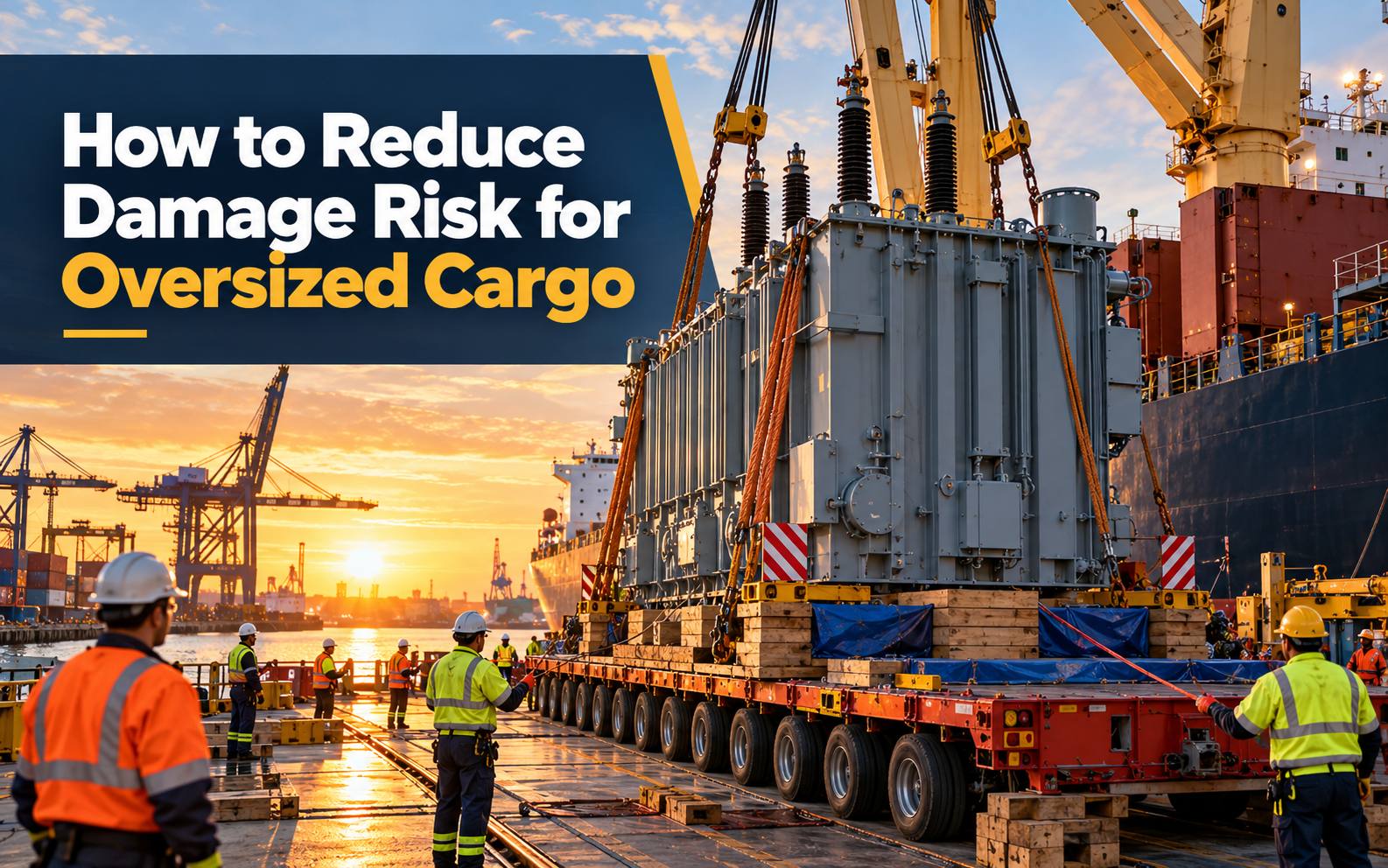
In international shipping, oversized cargo, also called out-of-gauge cargo or OOG cargo, refers to a unit whose length, width, height, or weight exceeds what a standard shipping container can legally and physically accommodate.
Typical examples include construction machinery, wind turbine blades, transformers, industrial boilers, heavy equipment, and large steel fabrications. Importers handling machinery projects may also find our guide on how to ship construction machinery from China useful when comparing equipment, loading, and transport options.
Because oversized items cannot always be fully enclosed, they may be exposed to risks that conventional boxed cargo avoids, including direct weather exposure, crane sling abrasion, shifting forces, and repeated handling during multimodal transportation.
Damage rarely comes from one catastrophic event. More often, it develops from several smaller failures: a lashing chain with insufficient capacity, timber dunnage that cannot withstand dynamic loading, inadequate edge protection, or weatherproof covering that fails during the voyage. The main causes generally fall into four areas.
Inadequate Securing
Lashing points may be selected without considering the cargo's center of gravity. Chains or straps may be underrated for the forces encountered during sea or road transport, or securing may rely too heavily on friction instead of positive restraint.
For heavy equipment and OOG cargo, proper cargo securing, blocking and bracing, and lashing are essential to prevent shifting during transit.
Wrong Transport Equipment
A flat rack may be selected where an open-top container would provide better structural support, or a platform may be used without sufficient provision for external securing.
Incorrect equipment selection can create stress concentrations, excessive overhang, unstable loading conditions, and additional handling requirements.
Poor Packaging
Damage can occur when contact points are not protected, corrosion prevention is insufficient, or wooden packaging is designed only for domestic transportation instead of repeated international handling.
For high-value machinery, oversized cargo packaging must address both physical impact and environmental exposure.
Route and Handling Gaps
Oversized cargo may encounter low bridges, weight restrictions, tight turns, unsuitable lifting equipment, or uncoordinated handoffs between factories, trucks, terminals, and vessels.
Without proper OOG cargo handling and route planning, even well-packed and well-secured cargo may still be damaged.
Most damage claims involving project cargo can ultimately be traced back to decisions made - or skipped - before the cargo ever leaves the factory floor.
How to Choose the Right Transport Equipment
Equipment selection is one of the most consequential decisions in oversized cargo transportation. The wrong platform forces compensatory measures at every downstream stage, including additional lashing, custom bracing, special lifting arrangements, and sometimes even shore-side modifications.
Selecting the right equipment at the beginning eliminates an entire category of avoidable risk.
For containerized OOG shipments, three equipment types dominate: flat racks, open-top containers, and platforms. If you need a broader comparison of container designs and applications, see our guide to flat rack and open top containers.
|
Equipment |
Best For |
Key Limitation |
Typical Payload |
|
20' Flat Rack (20FR) |
Heavy, compact machinery; transformers; generators |
End walls limit overhang; height fixed at ~2.6 m |
Approx. 22–26 tonnes |
|
40' Flat Rack (40FR) |
Long steel structures; pipes; vehicles |
Overhang beyond ends needs special approval |
Approx. 30–40 tonnes |
|
20'/40' Open Top |
Tall cargo loaded by crane from above |
Width and length constrained by box walls |
Approx. 26–28 tonnes |
|
40' Platform (Flatbed) |
Extremely wide or irregularly shaped cargo |
No containment; all securing is external |
Approx. 30–40 tonnes |
Payload figures are approximate because actual limits depend on the specific container's CSC plate, carrier policies, equipment condition, and route-specific restrictions. The International Convention for Safe Containers (CSC) provides the international safety framework behind approved freight container operation. Always verify capacity against the physical unit assigned to the shipment.
Flat rack container shipping is commonly used for machinery and other cargo that exceeds standard container dimensions in width or height, while open top container shipping is often suitable for cargo that requires crane loading from above but still fits within the side walls.
For cargo exceeding flat rack capacity - typically anything above 40 tonnes or longer than 12 metres - breakbulk shipping or heavy-lift vessel service may be the appropriate solution. Importers can review our explanation of breakbulk shipping for oversized cargo to understand when conventional containers are no longer practical.
Breakbulk and heavy-lift vessels use cranes and securing systems designed for individual heavy units, removing the conventional container interface entirely. For many China-origin projects, a specialist sea freight from China solution may combine flat rack, open top, breakbulk, or other transport modes according to the cargo dimensions and destination requirements.
How to Protect and Package Oversized Cargo
Oversized cargo packaging serves two functions that are often confused: protecting the cargo from transportation forces and creating a stable interface for lifting, handling, and lashing.
A crate or protective system that protects the equipment surface but provides no reliable access to lifting and securing points is only half a solution.
Export-Grade Crating
Wooden crates used for oversized export cargo should be designed to survive multimodal handling: truck, port crane, vessel, destination port handling, and final delivery.
That normally means heat-treated timber bearing the ISPM 15 mark, steel banding at structural joints, and skid bases designed for the intended handling method. The official ISPM 15 standard for wood packaging material in international trade explains the phytosanitary requirements that apply to regulated wood packaging used in international shipments.
Packaging that is sufficient for a short domestic truck movement may not be suitable for an international marine voyage.
Contact-Point Protection
Every point where a chain, wire rope, sling, or strap touches the cargo is a potential damage site.
Steel wire rope under tension can damage paint, plating, protective coatings, and thin structural components. The normal countermeasure is edge protection, using rubber pads, hardwood blocks, sleeves, or purpose-designed channels between the securing equipment and cargo surface.
For heavy equipment shipping, protecting vulnerable corners, hydraulic lines, control panels, glass, painted surfaces, and protruding parts should be included in the loading plan rather than treated as an afterthought. This is especially relevant for used construction machinery shipping from China, where pre-existing condition checks and careful surface protection are important before export loading begins.
Environmental Protection
On-deck or partially exposed cargo may face salt spray, UV radiation, rain, humidity, and temperature cycling.
Electrical and mechanical equipment may therefore require VCI protection, moisture barriers, desiccants, shrink wrapping, tarpaulins, and corrosion protection according to the sensitivity of the cargo and expected voyage conditions.
A common mistake is treating weather protection as ordinary covering. A material that works for short-distance road transport may not withstand extended marine exposure.
Packaging decisions made at the factory determine what will be possible during every later stage. Under-specification at this point cannot always be compensated for by additional lashing.

How to Lash and Secure Oversized Cargo
If there is one discipline central to oversized cargo damage prevention, it is proper lashing and securing.
The securing system must restrain cargo against the dynamic forces encountered during road transportation, terminal handling, and sea transit. Done correctly, the cargo remains where it was positioned. Done poorly, even a small amount of initial movement can increase forces and eventually damage the cargo, equipment, or transport unit.
The cargo that shifts in transit was never secured. It was only placed.
Use the CTU Code as a Baseline
The IMO/ILO/UNECE Code of Practice for Packing of Cargo Transport Units (CTU Code) is a widely recognized international reference for cargo packing and securing.
It provides principles covering cargo distribution, securing, transport-unit loading, and safe handling. A sound lashing plan for containerized or platform-based project cargo should be compatible with those principles.
Follow Key Cargo Securing Principles
- Calculate before securing. Lashing capacity should reflect cargo mass, expected transportation forces, the friction coefficient between the cargo and supporting surface, and the geometry of the securing arrangement.
- Use correctly rated hardware. Chains, wire ropes, shackles, turnbuckles, tensioners, and anchor points must all have adequate capacity. The overall securing system is only as strong as its weakest component.
- Secure to structural points. Manufacturer-designated lifting and securing points are designed to take load. Random attachment to body panels, housings, pipes, or other non-structural components can cause cargo damage.
- Apply proper pre-tension. Excessively loose securing allows cargo to gain momentum before the restraint system begins working. Securing arrangements should be checked after loading and, when practical, again after the initial transportation stage.
- Distribute the load. Multiple securing points should be arranged so forces are distributed across the cargo structure rather than concentrated at one or two locations.
Effective heavy cargo lashing often works together with blocking and bracing, anti-slip materials, structural supports, and purpose-built cradles.
A lashing plan should also be documented. Drawings, materials, securing locations, and inspection records help receiving teams verify the arrangement when the cargo changes hands at a port or transshipment location.
How to Plan Routes and Coordinate Cargo Handling
Even the best packaging and lashing cannot compensate for an unsuitable route or poorly coordinated crane operation.
Oversized cargo passes through a chain of physical interfaces - factory to truck, truck to port, port to vessel, vessel to destination port, and finally port to delivery site. Each interface introduces another opportunity for damage.
Conduct an Inland Route Survey
Before an oversized shipment moves, the inland route should be assessed for factors such as:
- Bridge height and width clearances
- Bridge or road weight restrictions
- Overhead power lines and utility structures
- Tight turning radii
- Road width and access restrictions
- Permits for over-dimensional transportation
- Suitable staging and parking areas
In China, cross-provincial oversized road transportation requires appropriate advance permitting. Other markets have their own local requirements.
A proper route survey for oversized cargo can prevent costly rerouting, waiting time, equipment changes, or situations where the cargo cannot physically continue along the planned route. For projects involving factory pickup, heavy-haul trucking, or port delivery, coordinated trucking and inland road freight planning is an important part of the overall risk-control process.
Coordinate Port and Vessel Handling
At the port, OOG cargo may require quay cranes, heavy-lift forklifts, special trailers, terminal platforms, or other dedicated equipment.
For vessel loading, securing and stowage must also take into account the vessel's Cargo Securing Manual (CSM) and the carrier's operational requirements.
Important coordination checkpoints include:
- Pre-stowage plan: Confirm the expected vessel position and cargo orientation before loading.
- Lifting plan: Confirm crane capacity, sling arrangement, lift points, spreader requirements, and cargo center of gravity.
- Transshipment plan: If the voyage involves an intermediate port, confirm who will handle the cargo and how securing will be inspected afterward.
- Discharge plan: Confirm crane availability, staging requirements, truck arrangements, and final-mile access at destination.
Lifting plans are especially important for cranes and other machinery with high or offset centers of gravity. For an example of how transport mode, dimensions, lifting, and equipment choice interact, see our guide on how to ship a crane from China.
Every major handling point should have a clearly responsible party.
Oversized cargo damage frequently occurs at handoff points where responsibilities are unclear rather than during the longest portion of the voyage itself.
How Insurance and Documentation Reduce Financial Loss
Even when appropriate precautions are taken, residual transportation risk remains.
For high-value oversized cargo, suitable marine cargo insurance should therefore be considered as part of the overall risk management strategy. Insurance does not prevent cargo damage; it helps reduce the financial exposure when an insured event occurs.
Good documentation supports both cargo damage prevention and any subsequent insurance claim.
Important records may include:
- Pre-shipment survey report: Photographs and condition notes before loading to establish the cargo's original condition.
- Lashing plan and securing records: Documentation showing materials, securing methods, and the completed arrangement.
- Stowage information: Records of the agreed vessel position and transportation arrangement where applicable.
- Post-discharge inspection: Photographs and condition records before the cargo leaves the destination terminal or designated delivery point.
The comparison between pre-shipment and post-discharge records helps establish when damage occurred.
Without accurate photographs, loading records, and inspection documentation, cargo claims can become disputes over responsibility and timing.
FAQ
What is the biggest cause of damage during oversized cargo shipping?
There is rarely one universal cause. Common problems include insufficient lashing, incorrect equipment selection, inadequate blocking and bracing, improper lifting, poor protection at contact points, and uncoordinated handling. Many of these risks can be reduced during the pre-shipment planning stage.
Is a flat rack always the best option for OOG cargo?
No. A flat rack is useful for many oversized machines and industrial cargoes, but it is not automatically the safest or most economical solution. Depending on the cargo's dimensions, weight, lifting requirements, and structure, an open-top container, platform, RoRo service, breakbulk vessel, or another project cargo solution may be more appropriate.
How do you prevent oversized cargo from shifting during transit?
Preventing cargo movement normally requires a combination of correctly designed lashing, structural blocking and bracing, anti-slip materials, suitable support points, and proper weight distribution. The securing arrangement should consider the cargo's weight, center of gravity, transport mode, and expected dynamic forces.
Does oversized cargo need marine cargo insurance?
Insurance is strongly worth considering for high-value, heavy, or difficult-to-replace cargo because careful planning cannot eliminate every transportation risk. Coverage should be reviewed according to the cargo value, route, transportation method, Incoterms, and specific policy exclusions.
What information should I provide before requesting an oversized cargo shipping quote?
Providing accurate information at the beginning helps a freight forwarder assess the appropriate equipment and transport method. Normally, you should provide the cargo description, quantity, exact dimensions, gross weight, center of gravity where relevant, lifting points, photographs or drawings, loading address, destination, cargo value, and any special handling requirements.
Conclusion
Reducing damage risk for oversized cargo is not one single action. It is a sequence of disciplined decisions covering transport equipment selection, oversized cargo packaging, lifting, cargo securing, blocking and bracing, route planning, handling supervision, documentation, and insurance.
The most effective way to prevent damage is to identify risks before loading begins and make sure every party involved understands how the cargo should be lifted, supported, secured, transported, and discharged.
Zhejiang Wilson Supply Chain Management Co., Ltd. provides international freight forwarding and specialized logistics services for oversized/OOG cargo, heavy equipment, engineering machinery, vehicles, and other complex shipments. Our project cargo capabilities include transport-solution planning, equipment selection, loading plans, onsite loading supervision, cargo protection, securing, documentation, transportation tracking, and destination coordination.
If you are planning an oversized or project cargo shipment from China, contact our team to discuss your cargo dimensions, weight, route, lifting requirements, and delivery conditions. As a freight forwarder in China, Wilson can help evaluate the available transport options and develop a safer, more practical shipping solution for your project.