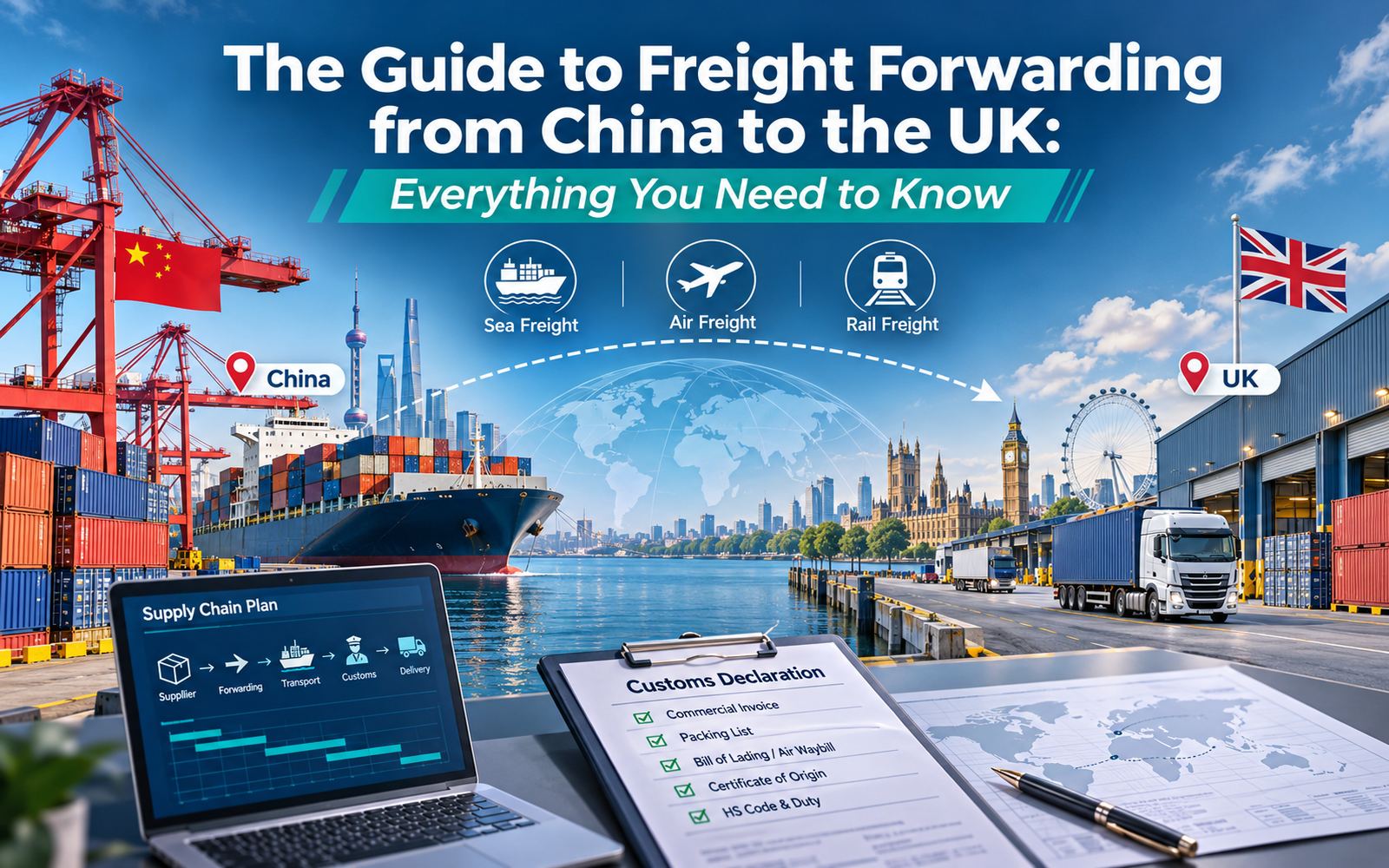
Freight forwarding from China to the UK involves choosing the right transport mode, navigating post-Brexit customs, and managing import duties correctly. Get any of these wrong and you face delays, fines, or returned cargo. This guide covers every major decision point - shipping methods, transit times, cost benchmarks, UK customs clearance procedures, and DDP shipping from China to the UK - so you can plan with confidence.
What Is Freight Forwarding from China to the UK?
Freight forwarding is the coordination of international cargo movement by a logistics specialist - the freight forwarder - who arranges origin pickup, export customs, international transport, destination customs clearance, and final delivery. When the route runs from a Chinese origin port or airport to a UK destination, the full chain is referred to as freight forwarding from China to the UK.
A capable forwarder consolidates shipments, negotiates carrier rates, prepares customs documentation, and handles duty payments on your behalf. For most importers, the forwarder is the single point of contact across the entire journey - from a factory in Shenzhen to a warehouse in Coventry.
Shipping Methods from China to the UK: Costs and Transit Times
Shipping from China to the UK is not a one-size-fits-all decision. The right mode depends on cargo weight, urgency, budget, and product type. A detailed sea freight vs air freight comparison can help clarify the trade-offs between cost and delivery speed. Below is a side-by-side comparison of all six mainstream methods, based on industry data from 2026 market levels.
Table 1 Shipping Methods from China to the UK - Transit, Cost, and Best Use
|
Method |
Transit Time |
Cost (DDP) |
Minimum |
Best For |
|
Express Courier |
3–7 days |
USD 8–12/kg |
0.5 kg |
Samples, parcels under 50 kg |
|
Air Freight |
5–10 days |
USD 5–9/kg |
45 kg |
45–500 kg, urgent e-commerce restocking |
|
LCL Sea Freight |
40–50 days |
USD 120–180/CBM |
1 CBM |
1–15 CBM, budget priority |
|
FCL 20GP Container |
35–45 days |
~USD 2,350 |
1 container (~25 CBM) |
Lower-volume full container |
|
FCL 40HQ Container |
35–45 days |
~USD 4,700 |
1 container (~68 CBM) |
15+ CBM, lowest per-unit cost |
|
Rail Freight (China–Europe Rail) |
18–22 days |
20GP USD 5,500–6,500; 40HQ USD 9,000–11,000 |
1 CBM (LCL available) |
Speed-cost balance, medium-value goods |
How to Choose the Right Mode
The decision framework is straightforward:
- Under 50 kg, urgent: Express courier. Door-to-door in under a week, but the most expensive per kilo.
- 45–500 kg, time-sensitive: Air freight. Typically 30–50% cheaper than express for this weight bracket.
- 1–15 CBM, budget priority: LCL sea freight. Cheapest per unit but slowest - plan for 40+ days door-to-door.
- 15+ CBM, non-urgent: FCL, preferably a 40HQ. The per-unit cost drops sharply once you fill a container.
- 3–4 week lead time, medium value: Rail freight. Twice as fast as sea, roughly a quarter of air freight cost.
One practical tip: the break-even point between LCL and FCL typically sits around 12–15 CBM. If your cargo exceeds that volume, booking a full container is almost always cheaper than paying LCL per-CBM rates plus destination handling charges. Understanding the differences between FCL and LCL shipping can help you select the most cost-effective option.
Sea Freight from China to the UK: The Main Shipping Route
Sea freight from China to the UK remains the dominant mode for bulk and heavy cargo. The traditional Suez Canal route - from Shanghai, Ningbo, or Shenzhen through the Indian Ocean and Mediterranean to the UK - handles the vast majority of container traffic.
Major UK ports:
- Felixstowe (Suffolk): The UK's largest container port, handling approximately 40% of the country's container trade.
- Southampton (Hampshire): Second-largest container terminal.
- London Gateway: Modern deep-water facility serving the Southeast.
Direct sailings from Shenzhen or Shanghai to Felixstowe typically take 28–35 days port-to-port. Transit or feeder services via Rotterdam or Antwerp add 5–15 days. Door-to-door, including customs clearance and inland delivery, expect 35–50 days total.
FCL pricing has fallen significantly from 2022 peaks. Based on 2026 market data, a 20GP runs roughly USD 1,300–3,800 port-to-port, while a 40HQ sits in the USD 2,200–6,000 range depending on carrier, origin, and seasonality. LCL rates typically fall between USD 55–200 per CBM. For a more detailed breakdown of freight charges, understanding how to calculate sea freight costs can help importers estimate their total shipping expenses.
Peak season - August through December, driven by Christmas and Black Friday inventory builds - can push rates up 30–50% and tighten vessel space. Booking 4–6 weeks ahead during this window is essential.
Air Freight from China to the UK: When Speed Matters
Air freight from China to the UK is the fastest mainstream option for cargo above 45 kg. Direct flights from Hong Kong, Shanghai Pudong, or Guangzhou to London Heathrow (LHR) take 11–13 hours flight time, with airport-to-airport transit of 3–5 days including handling and customs handoff.
Major UK airports for cargo:
- London Heathrow (LHR): Primary cargo hub, most direct flights from China.
- Manchester (MAN): Direct service options from Beijing and connecting flights.
- East Midlands (EMA): Central England location, 30 minutes from Leicester's distribution hubs.
A notable development: in June 2026, a full-cargo route from Urumqi Tian Shan International Airport to East Midlands Airport was launched, compressing transit from the previous 7–10 days (via London or Birmingham connections) to 3–4 days direct. This route particularly benefits shipments destined for the Midlands manufacturing and e-commerce belt.
Air freight pricing follows IATA chargeable weight rules - actual weight versus volumetric weight (length × width × height in cm ÷ 6000), whichever is greater. A compact 80 kg metal component ships at actual weight; a bulky 480 kg wooden-cased machine might bill at 800 kg volumetric. Always measure the outer packaging, not the equipment itself.
Rail Freight from China to the UK: Balancing Cost and Speed
Rail freight from China to the UK via China–Europe rail freight services has become a strategic option for importers who need faster delivery than sea but cannot justify air freight pricing.
How it works: Trains depart from Chinese inland hubs - Chongqing, Chengdu, Xi'an, Zhengzhou, Yiwu - and travel through Kazakhstan, Russia, Belarus, and Poland. Cargo then enters the UK via the Channel Tunnel, typically transshipped at Duisburg (Germany) onto road or short-sea connections to British ports.
Table 2 Rail Freight Routes from China to the UK
|
China Departure |
UK Arrival |
Transit Time |
Notes |
|
Chongqing / Chengdu |
London |
18–20 days |
Longest-established route; most frequent departures |
|
Yiwu |
London |
18–21 days |
Small-commodity hub; ideal for mixed-SKU shipments |
|
Zhengzhou |
Birmingham |
20–22 days |
Central China manufacturing belt; electronics and machinery |
Rail costs run roughly one-quarter of air freight and about double sea freight - but transit is twice as fast as ocean. For high-value goods like electronics, EVs, or machinery where capital is tied up in inventory, the faster turnaround often offsets the premium. A closer comparison of sea freight vs rail freight from China to Europe can help businesses evaluate these trade-offs.
The China–Europe rail network also supports electric vehicle (EV) exports with battery packs intact, a capability that air freight cannot match due to dangerous goods restrictions. As of 2026, the service operates from over 120 Chinese cities with 17 fixed-schedule "transit table" routes that achieve on-time rates above 98%.
Rail is not without risk. Geopolitical factors along the Russia-Belarus corridor can cause delays, so confirming current routing with your forwarder before booking is prudent.
UK Customs Clearance Requirements After Brexit
UK customs clearance has been a separate process from EU customs since Brexit took full effect. The UK now operates an independent tariff regime and its own declaration systems - understanding these is non-negotiable for any importer.
The UK Global Tariff (UKGT)
Post-Brexit, the UK replaced the EU's Common External Tariff with the UK Global Tariff (UKGT) - an independent duty schedule applied to goods imported from countries without a UK free trade agreement. Since China and the UK have no bilateral FTA, most Chinese-origin goods are subject to UKGT most-favoured-nation rates.
Duty rates vary by HS code (the international commodity classification system), typically ranging from 0% to 12% for common consumer goods. Protected sectors - agriculture, ceramics, automotive - can see higher rates.
Key Customs Requirements
Every commercial import into the UK requires the following:
- GB EORI number: An Economic Operators Registration and Identification number starting with "GB". An EU EORI is no longer valid. Without it, goods cannot clear customs. Registration is free via GOV.UK and typically takes 1–3 working days.
- CDS declaration: All import declarations must be filed through the Customs Declaration Service (CDS), which replaced the legacy CHIEF system. Declarations include commodity codes, customs value, and procedure codes.
- ENS (Entry Summary Declaration): A safety and security pre-arrival declaration, required for sea freight before the vessel reaches a UK port.
- Commercial invoice: In English, with buyer and seller details, accurate HS code, unit and total value, currency, Incoterms, and country of origin. Vague descriptions like "parts" invite scrutiny - specify product name and material.
- Packing list: Carton count, gross/net weight, dimensions per carton.
The £135 Threshold and Upcoming Policy Changes
The £135 consignment value threshold is the critical dividing line for how VAT is handled:
- At or below £135: VAT is collected at the point of sale by the seller or online marketplace, not at the border. Duty is typically waived.
- Above £135: VAT and any applicable duty are paid at import clearance.
The UK government confirmed in 2026 that the £135 low-value duty relief will be abolished, with implementation expected no later than October 2028. Once enacted, virtually all imports - regardless of value - will be subject to duty at typical rates of 5–12%. Importers currently relying on low-value consignment splitting should transition to compliant DDP models before this takes effect.
UK Import Duties and VAT: How They Are Calculated
UK import duties consist of two main charges: customs duty and import VAT. Understanding the calculation method is essential for accurate cost forecasting.
The Calculation Formula
For most commercial imports, the formulas are:
- Customs value (CIF) = goods value + international freight + insurance
- Import duty = customs value × UKGT duty rate (per HS code)
- Import VAT = (customs value + import duty) × 20%
The standard VAT rate is 20%. A reduced rate of 5% applies to certain categories like children's car seats and home energy materials. Most consumer goods imported from China - electronics, textiles, furniture, toys - fall under the 20% bracket.
Table 3 Typical UKGT Duty Rates for Common Chinese Imports
|
Product Category |
UKGT Duty Rate |
VAT |
|
Electronics |
0%–3.5% |
20% |
|
Clothing (textiles) |
8%–12% |
20% |
|
Footwear |
8%–17% |
20% |
|
Furniture |
0%–5.5% |
20% |
|
Home appliances |
0%–2.7% |
20% |
|
Plastics |
3%–6.5% |
20% |
|
Toys |
0%–4.7% |
20% |
Postponed VAT Accounting (PVA)
UK-registered VAT businesses can use Postponed VAT Accounting (PVA) to defer import VAT payment. Instead of paying VAT at the border and reclaiming it later, the importer accounts for it on their regular VAT return - both as output tax and input tax in the same period. This eliminates the cash flow gap that would otherwise tie up 20% of shipment value for weeks or months.
PVA is not a tax exemption. It is a timing mechanism. But for businesses moving regular volumes, the cash flow benefit is substantial.
A Worked Example
Consider a shipment with these parameters:
- Goods value: GBP 10,000
- International freight and insurance: GBP 1,000
- Product duty rate: 5%
Calculation:
- Customs value (CIF): GBP 11,000
- Import duty: GBP 11,000 × 5% = GBP 550
- Import VAT: (GBP 11,000 + GBP 550) × 20% = GBP 2,310
- Total duties and taxes: GBP 2,860
Without PVA, the importer pays GBP 2,310 upfront at clearance and reclaims it on the next VAT return. With PVA, that cash stays in the business until the return is filed.
DDP Shipping from China to the UK: What It Includes
DDP (Delivered Duty Paid) is an Incoterms term under which the seller, usually supported by a freight forwarder, assumes responsibility for the entire journey - origin pickup, export customs, international transport, UK import clearance, duty and VAT payment, and final delivery. The buyer receives goods at their door with no additional customs or tax obligations.
For most importers - especially first-time buyers, SMEs, and e-commerce sellers - DDP shipping from China to the UK is the recommended model. Here is why.
What DDP Includes
A properly structured DDP quote bundles:
- Origin pickup and domestic transport to the departure port/airport
- Export customs declaration in China
- International freight (sea, air, or rail)
- UK customs clearance via CDS
- Import duty and VAT (calculated on declared value)
- Destination handling and last-mile delivery (via UK parcel and courier networks)
For businesses seeking integrated transportation and delivery solutions, door-to-door shipping from China to Europe provides a broader overview of how origin handling, international freight, and destination delivery can be coordinated.
What DDP Typically Excludes
Even under DDP, certain costs are usually billed separately:
- Customs inspection fees: If HMRC selects a shipment for physical examination, handling charges of roughly GBP 100–300 may apply.
- Remote area delivery surcharges: Postcodes in the Scottish Highlands, Northern Ireland (BT), and offshore islands often carry additional fees.
- Storage and demurrage: If delivery is delayed by the buyer (e.g., a failed fulfilment-centre appointment), warehouse charges accrue.
Always ask your forwarder: "Beyond this quote, what charges could still arise?" A forwarder who says "everything is included, no surprises" is either absorbing risk into the unit price or planning to add charges later.
DDP vs DDU: The Key Difference
Under DDU (Delivered Duty Unpaid), the forwarder handles transport and customs filing, but the importer pays duty and VAT directly to HMRC. DDU is an older term; DAP (Delivered at Place) is the current Incoterms rule commonly used for duty-unpaid delivery arrangements. DDU freight rates are lower - typically 15–30% below DDP - but the importer must have a GB EORI and, where applicable, VAT registration, and be prepared to settle taxes at clearance.
DDU suits established businesses with VAT registration who want to use PVA and maintain direct tax control. DDP suits everyone else - particularly those without UK tax registration or who want predictable, all-in pricing.
Table 4 DDP vs DDU at a Glance
|
Dimension |
DDP |
DDU |
|
Freight rate |
Higher (includes tax estimate) |
Lower (15–30% below DDP) |
|
Duty/VAT responsibility |
Seller arranges payment at clearance |
Importer pays directly to HMRC |
|
GB EORI/VAT required? |
Depends on the importer-of-record arrangement |
GB EORI generally; VAT registration if applicable |
|
PVA eligibility |
N/A (forwarder handles) |
Yes, if VAT-registered |
|
Best for |
First-time importers, SMEs, e-commerce |
Established businesses with tax infrastructure |
|
Risk of delivery refusal |
Very low (no surprise charges) |
Moderate (recipient may reject unexpected tax bill) |
Shipping Dangerous Goods, Electronics, and Oversized Cargo to the UK
Not all cargo moves through standard channels. Certain product categories require specialised handling, documentation, and carrier approval.
Dangerous Goods
Lithium batteries, aerosols, flammable liquids, and chemical products fall under IATA Dangerous Goods Regulations for air freight and IMDG Code for sea freight. Required documentation includes:
- MSDS (Material Safety Data Sheet): Details composition, hazards, and handling protocols.
- UN38.3 test report: Mandatory for lithium battery shipments, certifying safety under transport conditions.
- Dangerous goods declaration and packaging certification: UN-spec packaging with correct hazard labels.
Dangerous goods freight typically costs 30–50% above standard rates, and not all forwarders accept them. Confirm capability before booking.
Electronics and UKCA Marking
Since Brexit, conformity marking requirements for goods placed on the Great Britain market have depended on the product category. CE marking remains accepted for many regulated products, while UKCA marking or other sector-specific requirements may apply. Products that do not meet the applicable rules may be refused entry or withdrawn from sale.
Importers should verify with their Chinese supplier which UKCA, CE, or sector-specific conformity rules apply before shipping. Retrofitting compliance after goods arrive in the UK is costly and often impractical.
Oversized and Heavy Equipment
Large machinery, vehicles, and industrial equipment require special planning:
- Volumetric weight: Air freight charges on the greater of actual or volumetric weight. A compact 80 kg machine in a 130×110×140 cm crate bills at approximately 334 kg - measure outer packaging, not the equipment.
- Container selection: Standard 40HQ containers accommodate most equipment. For vehicles, specialised 40-foot general-purpose car containers (with 23.4 cm additional internal height) can carry 4 sedans or 3 SUVs - a 25–33% efficiency gain over standard boxes.
- Route planning: Oversized cargo may not fit rail tunnel clearances or standard port handling equipment. Sea freight via Felixstowe or London Gateway, with their deep-water berths and heavy-lift capability, is typically the safest choice.
Wooden Packaging and ISPM 15
All wooden packing materials - pallets, crates, dunnage - must comply with ISPM 15, the international phytosanitary standard requiring heat treatment or fumigation and visible IPPC marking. Non-compliant packaging is refused entry and may trigger quarantine disposal at the importer's expense.
How to Choose a Freight Forwarder from China to the UK
The forwarder you choose determines whether your shipment arrives on time, clears customs without incident, and costs what you were quoted. Price alone is a poor selection criterion.
Look for these capabilities:
- UK customs clearance capability: A forwarder with an experienced UK customs team or dependable local clearance partners can help resolve issues quickly and coordinate CDS filing. Confirm who acts as the importer of record and how customs responsibilities are assigned.
- Carrier relationships: Forwarders with access to established container shipping lines and airlines can help maintain capacity during peak season when spot-market bookings fail.
- Transparent quoting: A reliable forwarder breaks down freight, origin charges, destination charges, duty, and VAT as separate line items. Quotes that bundle everything into one number hide where margins are taken.
- Cargo insurance: Typically 0.3–0.5% of declared goods value. DDP quotes do not automatically include insurance - confirm coverage for loss and damage.
- Tracking and communication: Real-time shipment tracking with milestone updates is the baseline, not a premium feature.
Red flags:
- Quotes dramatically below market rates - the gap is recovered through destination charges you only see when cargo arrives.
- Forwarders who cannot explain the importer-of-record arrangement and the GB EORI used for DDP clearance.
- Reluctance to itemise destination port fees, customs charges, and delivery costs separately.
How to Reduce Shipping Costs and Transit Times
A few operational habits consistently reduce both cost and transit time:
- Book FCL above 12–15 CBM: The per-unit savings over LCL are significant, and container handling is faster than consolidation/deconsolidation.
- Optimise packaging before quoting: Reducing carton height by even 5 cm can cut volumetric weight by 10–15% on air freight. Vacuum-seal bulky items like down jackets or foam products.
- Ship in shoulder season: January–April typically offers the lowest sea freight rates and best vessel availability. August–December is peak - rates rise 30–50% and space tightens.
- Pre-file customs documents: Submit commercial invoices, packing lists, and EORI details to your forwarder before cargo departs. Pre-arrival CDS filing enables clearance within hours of port arrival.
- Split large shipments: For high-value or sensitive cargo, dividing a single large consignment into 2–3 smaller ones reduces the impact of any single customs inspection and lowers per-shipment risk exposure.
- Use PVA if VAT-registered: The cash flow benefit compounds across regular shipments. A business importing GBP 50,000 monthly in goods value keeps roughly GBP 10,000 working capital free each cycle.
FAQ
What is the cheapest way to ship goods from China to the UK?
Sea freight is generally the most economical option for heavy or high-volume cargo. LCL suits smaller consignments, while FCL often becomes more cost-effective once shipment volume reaches approximately 12–15 CBM. Compare destination handling and delivery charges as well as the ocean freight rate.
How long does freight shipping from China to the UK take?
The estimates in this guide are 35–50 days door-to-door for sea freight, 5–10 days for air freight, 18–22 days for rail freight, and 3–7 days for express courier services. Actual delivery times depend on origin, routing, customs clearance, and final destination.
What documents are required for UK customs clearance?
Commercial import shipments generally need a commercial invoice, packing list, a valid GB EORI for the relevant importer, and a customs declaration through CDS. Safety and security declarations and product-specific certificates may also apply, depending on the cargo and mode of transport. Correctly classifying your goods is equally important, so importers should understand how to find the right HS code before submitting their customs documents.
Is DDP shipping from China to the UK suitable for every importer?
DDP is often convenient for businesses seeking a door-to-door price that includes agreed import duties and taxes. However, the seller must have a compliant arrangement for UK import clearance and payment of charges. VAT-registered importers may prefer greater control over import VAT and postponed VAT accounting, depending on their circumstances.
Conclusion
Freight forwarding from China to the UK comes down to three decisions: choose the right transport mode for your cargo weight and urgency, prepare accurate UK customs documentation before departure, and select trade terms that clearly assign responsibility for duty, VAT, and delivery. Sea freight generally offers the lowest cost for larger shipments; air freight wins on speed; rail can provide a middle ground. A properly arranged DDP service can simplify delivery, while established importers may prefer to manage customs and VAT directly.
Zhejiang Wilson Supply Chain Management Co., Ltd. is a China-based freight forwarding and supply chain company established in 2011, coordinating sea freight, air freight, rail transport, customs clearance support, warehousing, DDP solutions, and door-to-door logistics through its service network. Contact our team to discuss your shipment from China to the UK and request an itemised quote based on your cargo, destination, and delivery requirements.