Sea freight is usually the lower-cost choice for shipping from China to Europe, while rail freight is substantially faster. Sea works best for large volumes, heavy cargo, planned inventory, and shipments where cost per unit matters most. Rail is stronger when saving 10–25 days can protect sales, production, or inventory availability.
Sea freight moves cargo by ocean vessel, normally as FCL or LCL. China-Europe rail freight moves containerized cargo on scheduled Eurasian rail services to inland terminals. Choosing between them comes down to total cost, delivery time, cargo type, destination, and supply-chain risk.

Sea Freight vs Rail Freight from China to Europe: Quick Comparison
For most shipments, the practical difference is straightforward: sea freight offers greater capacity and lower transport cost; rail freight offers shorter lead times and better access to some inland European destinations.
|
Factor |
Sea Freight |
Rail Freight |
|
Main transit time |
About 25–45 days |
About 12–20 days |
|
Typical door-to-door time |
About 35–50 days |
About 20–35 days |
|
Freight cost |
Usually lower |
Usually higher |
|
Single-shipment capacity |
Very high |
Moderate |
|
Heavy cargo |
Strong advantage |
More restricted |
|
Oversized cargo |
More transport options |
Route and terminal limits apply |
|
Inland Europe access |
Requires onward transport from port |
Strong near major rail hubs |
|
Schedule variation |
Often wider |
Often narrower |
|
Best suited for |
Base inventory, large volumes, heavy cargo |
Urgent replenishment, higher-value cargo |
|
Position between sea and air |
Lowest-cost mainstream option |
Faster middle option |
These ranges are useful for planning, but they are not fixed schedules. Origin, destination, consolidation, border conditions, vessel routing, customs, and final delivery can all change the result.
For importers comparing Sea Freight from China to Europe with China to Europe Rail Freight, the right choice depends on what matters more for that shipment: cost, time, capacity, or inland access.
Rail also occupies a useful position between ocean and air freight. It is more expensive than sea, yet far more practical than air freight for many containerized shipments that need to arrive faster without paying premium airfreight rates. For a broader comparison of speed and transport cost, see our guide to sea freight vs air freight.
Transit Time: How Much Faster Is Rail Freight Than Sea Freight?
A fair transit-time comparison must use the same service scope.
A quoted 14-day rail service normally refers to terminal-to-terminal movement. A 40-day ocean shipment might include port waiting, vessel transit, and part of the destination handling. Comparing the two numbers directly would give the wrong impression.
For sea freight from major Chinese ports such as Shanghai, Ningbo, Shenzhen, Qingdao, and Xiamen, the main ocean transit commonly falls within roughly 25–45 days. Once factory pickup, export clearance, departure waiting time, port handling, import customs, and inland delivery are added, 35–50 days door to door is a more practical planning range. Disruptions around the Suez Canal, port congestion, strikes, or rerouting around the Cape of Good Hope can extend it further.
China-Europe rail freight commonly takes about 12–20 days terminal to terminal. Door-to-door delivery is more often 20–35 days, depending on consolidation, export procedures, border handling, gauge changes, import clearance, and last-mile trucking. In practice, rail often saves about 10–25 days compared with a comparable door-to-door sea shipment.
That is why Door-to-Door Shipping from China to Europe is the more useful basis for many commercial comparisons. Factory pickup, customs, terminal handling, main transport, and final European delivery all affect the actual lead time.
That time difference matters most when delay has a measurable cost. Automotive spare parts, production materials, electronics, seasonal products, and urgent warehouse replenishment are typical examples.
If another two or three weeks in transit does not affect production or sales, paying the rail premium usually makes less sense.

Cost Comparison: Sea Freight Rates vs Rail Freight Total Cost
Sea freight normally wins on the basic freight rate. Large container vessels create a scale advantage that rail cannot match, particularly for regular FCL shipments and high-volume procurement.
Rail freight pricing varies widely by origin terminal, European destination, container type, season, service level, and inland trucking. For planning purposes, rail line-haul can cost around 1.5 to 3 times a comparable ocean line-haul rate. On a like-for-like door-to-door basis, the rail premium is often closer to 30%–100%.
That is why a useful quotation comparison needs the same:
- Pickup location and final delivery address
- Container or shipment size
- Incoterm
- Customs scope
- Origin and destination charges
- Final inland transport
A port-to-port ocean rate and a door-to-door rail rate tell you very little when placed beside each other. If you need to understand the components behind an ocean quotation, our guide explains how sea freight costs are calculated.
Freight Rate Is Only Part of the Cost
For supply-chain planning, total logistics cost includes more than international freight. Inventory carrying cost, warehousing, financing, stockout risk, obsolescence, and lost sales can change the economics.
Consider a shipment worth USD 100,000 that arrives 20 days earlier by rail. At an annual financing cost of 8%, the reduction in capital tied up during transit is about USD 438. That saving by itself may not justify several thousand dollars of additional freight.
The calculation changes if those 20 days prevent a production shutdown, avoid emergency airfreight, keep a seasonal promotion on schedule, or prevent an important SKU from running out.
One reported furniture-import case found a 25–30% reduction in total logistics costs after shifting cargo from sea to rail once warehousing, financing, and opportunity costs were included, even though the rail freight charge itself was higher.
So the useful question is: what is each day saved worth to the business?
Which Cargo Is Better Suited to Sea Freight or Rail Freight?
Cargo characteristics can decide the transport mode before the freight rate is discussed.
Cargo Better Suited to Sea Freight
Sea freight is usually the stronger option for:
- Large-volume standard container cargo
- Dense or heavy products
- Low-value consumer goods
- Industrial machinery
- Project cargo
- Oversized or overweight equipment
- Long-term or predictable inventory
- Cargo requiring open-top, flat-rack, reefer, tank, RoRo, or breakbulk solutions
Modern Asia-Europe container vessels can carry around 20,000–24,000 TEU or more, giving ocean transport a scale advantage that is particularly important for repetitive high-volume shipments.
Extremely heavy or oversized machinery also has more options by sea. If a unit exceeds rail-gauge, wagon, or terminal limits, a flat rack, open top, RoRo, breakbulk vessel, or other project-cargo solution may be more realistic.
Cargo Better Suited to Rail Freight
Rail freight fits especially well with:
- Automotive parts
- Electronics and components
- Precision equipment
- Production materials
- Seasonal fashion and consumer goods
- E-commerce replenishment
- Medium- to high-value products
- Cargo too urgent for sea but too expensive to move by air
The value of rail rises as inventory becomes more time-sensitive. An expensive component required to keep a European production line running deserves a different transport decision from low-value stock that can be ordered three months in advance.
Special Cargo Requires Route-by-Route Checks
Lithium batteries, chemicals, dangerous goods, liquids, refrigerated cargo, and oversized units need an acceptance check before routing is confirmed. The operator may need to review the UN number, SDS/MSDS, packaging, dimensions, gross weight, terminal rules, and specific corridor restrictions.
For maritime dangerous goods, the IMO Dangerous Goods and IMDG Code provides the international framework for classification, packing, marking, documentation, and safe carriage.
Acceptance by an ocean carrier does not automatically mean the same cargo can move by rail. For special cargo, feasibility comes first.
Routes and Inland Delivery: Why Your European Destination Matters
Geography can materially change a sea freight vs rail freight comparison.
Main Sea Freight Routes to Europe
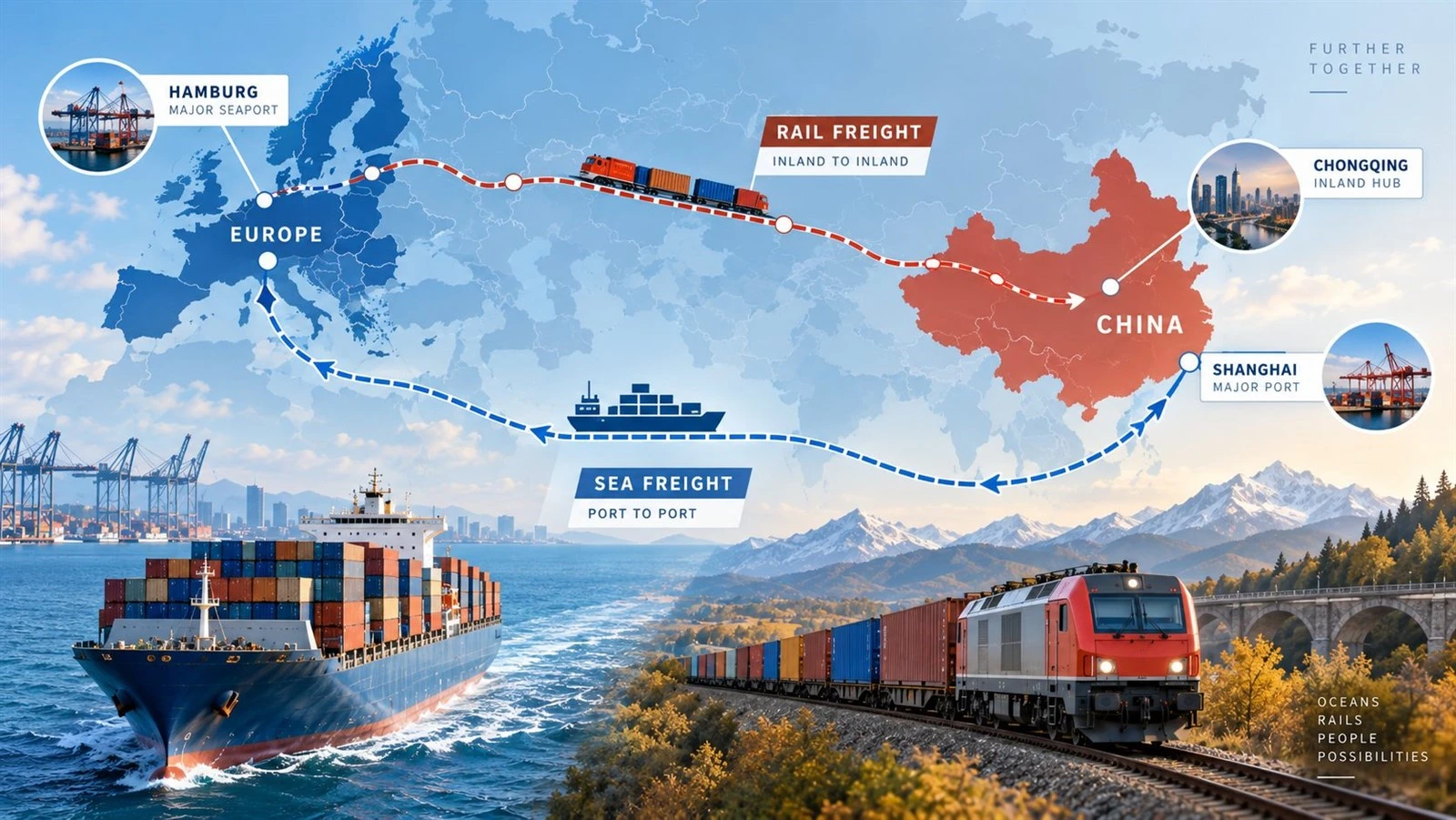
A typical China-Europe ocean route starts from ports such as Shanghai, Ningbo, Shenzhen, or Qingdao, passes through Asian waters and the Indian Ocean, and normally reaches Europe through the Suez route when operational conditions permit.
Major European gateways include Rotterdam, Hamburg, Antwerp-Bruges, Bremerhaven, and other North European or Mediterranean ports. If you are comparing European gateway options, our overview of major ports in Europe provides additional context.
Arrival at the port is only one stage. A container bound for Munich, Prague, Budapest, or another inland destination may still need a substantial truck, rail, or barge movement.
Main China-Europe Rail Corridors
China-Europe rail services commonly connect inland Chinese hubs such as Xi'an, Chongqing, Chengdu, Zhengzhou, and Wuhan with European terminals including Duisburg, Małaszewicze, Łódź, and Hamburg. Traditional Eurasian routes cross Kazakhstan and continue through eastern Europe, while alternative corridors can use combinations of rail, ports, and ferry links farther south.
This has an important commercial effect.
A shipment ending close to Rotterdam or Hamburg will usually strengthen the sea-freight case. A shipment bound for inland Germany, Poland, the Czech Republic, Slovakia, Hungary, or Austria deserves a serious rail comparison.
Always compare factory to final delivery address. A low ocean rate can lose part of its advantage once expensive European inland transport is added.
Reliability, Customs and Geopolitical Risks
Rail freight often has tighter schedule predictability on suitable routes, while ocean freight has more exposure to maritime chokepoints, port conditions, and long-route disruptions. Neither mode is immune to delays.
Sea Freight Risks
China-Europe ocean shipments can be affected by port congestion, vessel schedule changes, blank sailings, transshipment delays, storms, port strikes, and demurrage or detention. Red Sea and Suez Canal disruptions can also force carriers onto longer routings around the Cape of Good Hope.
These disruptions do not make sea freight unsuitable. They do increase the buffer stock and schedule tolerance needed for some supply chains.
Rail Freight Risks
Rail replaces some maritime risks with land-corridor risks. Border congestion, gauge changes, limited terminal capacity, transit-country policy, customs differences, and sanctions exposure involving Russia or Belarus can affect a shipment. Middle Corridor services may also involve additional port and ferry interfaces.
This is why rail can be more predictable on one route and less attractive on another.
Customs and Documentation
Both transport modes depend on accurate customs and product documentation. Typical documents can include the Commercial Invoice, Packing List, HS Code, export declaration, EORI and VAT information, certificates where required, plus SDS/MSDS and dangerous-goods documentation for regulated cargo.
Businesses carrying out customs activities in the EU generally need an EORI number, which is used by customs authorities to identify economic operators.
Sea freight normally uses a Bill of Lading, while international rail movements may use CIM/SMGS consignment documentation.
Rail's shorter line-haul does not guarantee faster customs clearance. Declaration quality, importer status, product compliance, and document accuracy still determine how smoothly the cargo clears.

Sea or Rail? A Practical Decision Framework
The most useful decision rule is to match the transport mode to the commercial consequence of delay.
Choose Sea Freight When
Sea freight should normally be the first option when transport cost has a high priority, volumes are large, cargo is heavy or oversized, delivery dates are flexible, and inventory demand can be forecast reasonably well.
It also makes sense when special equipment is required or the consignee is close to a major European seaport.
For regular procurement, sea freight is the natural base-inventory mode.
Choose Rail Freight When
Rail deserves priority when ocean transit is too slow but air freight is unnecessarily expensive.
It becomes especially attractive when the goods are higher value, a warehouse needs urgent replenishment, production depends on the shipment, or the consignee sits deep inside continental Europe.
Rail works best when the days saved have a financial value.
Use Sea and Rail Together When
Many established importers get better results by assigning different jobs to different modes.
|
Business Need |
Recommended Mode |
|
Lowest unit transport cost |
Sea freight |
|
Stable, high-volume inventory |
Sea freight |
|
Heavy or oversized machinery |
Usually sea freight |
|
Faster replenishment |
Rail freight |
|
Time-sensitive inland European cargo |
Compare rail first |
|
Very urgent, high-value shipment |
Consider air freight |
|
Route-risk diversification |
Sea + rail |
A practical inventory strategy is to move baseline demand by sea and use rail for top-ups, launch stock, seasonal orders, or unexpected demand. During maritime disruption, part of the volume can also shift temporarily to rail.
That approach builds resilience without paying rail rates for every container. It is consistent with the broader dual-mode strategy used for China-Europe supply chains.
Final Verdict: Sea Freight or Rail Freight from China to Europe?
For most China-Europe shipments, sea freight remains the best choice for cost efficiency, large volumes, heavy cargo, and flexible delivery schedules. Rail freight becomes more attractive when saving one to three weeks protects inventory availability, customer commitments, or production. For regular importers, using sea for base inventory and rail for urgent replenishment often gives the strongest balance of cost, speed, and supply-chain resilience.
Zhejiang Wilson Supply Chain Management Co., Ltd. provides sea, rail, road, air, multimodal, customs-clearance, warehousing, and door-to-door logistics services from China, including solutions for Europe. If you share your cargo details, origin, European delivery address, volume, and required arrival date, our team can compare sea, rail, or a combined transport plan for your shipment.
FAQ
Is rail freight cheaper than sea freight from China to Europe?
Usually no. Sea freight generally has the lower base transport cost, especially for full containers and larger volumes. The cost gap can narrow when the European delivery point is far inland, ocean rates rise, or faster delivery avoids an expensive stockout.
How much faster is rail freight than sea freight?
Rail commonly saves around 10–25 days on a comparable door-to-door shipment. Terminal-to-terminal rail is often around 12–20 days, while complete delivery usually takes around 20–35 days.
Is rail freight more reliable than sea freight?
Rail can have narrower schedule variation on suitable corridors and avoids port congestion and ocean weather. Border delays, gauge changes, terminal congestion, sanctions, and transit-country controls still need to be considered.
Is rail better for inland Europe?
It can be. A destination near Duisburg, Poland, or another major inland rail hub may reduce the amount of European first- or last-mile trucking required. The comparison should always include the final delivery postcode.
Can batteries or dangerous goods be shipped by rail?
Some can, but acceptance depends on the specific product and route. Provide the UN number, SDS/MSDS, packaging information, dimensions, weight, and battery or dangerous-goods status before booking.
What information is needed for an accurate sea vs rail quote?
For a useful door-to-door comparison, provide the pickup address, delivery postcode, cargo description, HS Code, package count, gross weight, CBM and package dimensions, Incoterm, DG or battery status, and required delivery date.