Choosing the right shipping method can make or break your import or export margins. Many businesses we work with initially focus only on the quoted ocean freight rate. Weeks later they discover that the total landed cost and delivery reliability tell a completely different story.
FCL (Full Container Load) and LCL (Less than Container Load) represent two fundamentally different approaches to container shipping. Understanding when each makes sense is one of the most practical skills an international buyer or seller can develop.

What is FCL and LCL Shipping?
FCL means you book exclusive use of an entire shipping container. The container is assigned to your shipment, even if your cargo does not fill it completely. Once loaded and sealed at origin, it typically stays sealed until it reaches your destination area.
LCL means your cargo shares space inside a container with shipments from other companies. A freight forwarder or consolidator combines multiple smaller shipments into one container at a CFS (Container Freight Station) warehouse.
These are not simply "big shipment" versus "small shipment" options. The choice affects how many times your goods are handled, who bears responsibility at each stage, and ultimately what you pay when all charges arrive.
FCL vs LCL Shipping Process: Step-by-Step Comparison
The operational differences become clear when you walk through the actual steps.
FCL Shipping Process
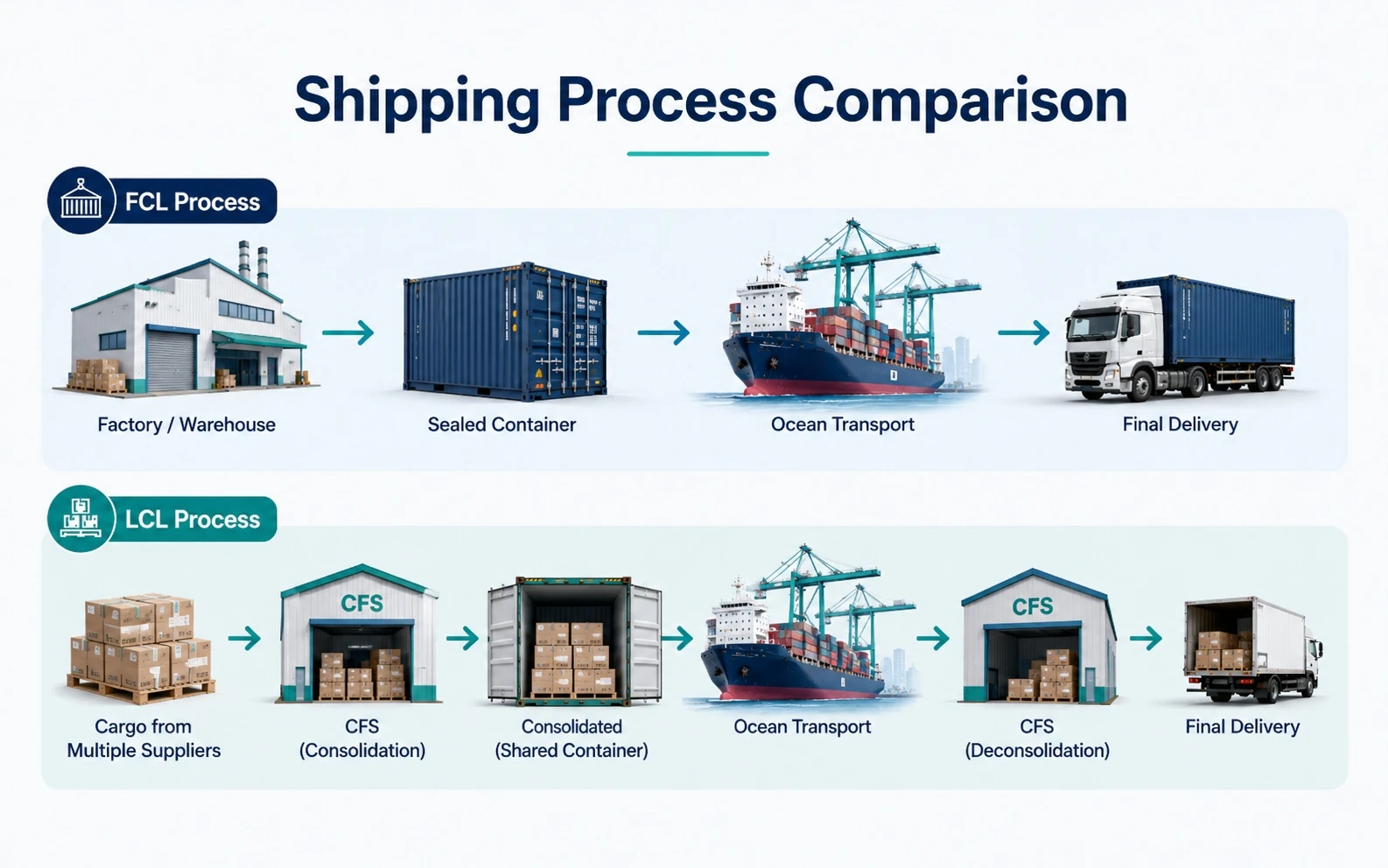
Your factory or warehouse loads the container. After loading, the container is sealed and the seal number recorded. It moves to the port, gets loaded onto the vessel, and travels as one unit. At the destination port, you (or your trucker) pick up the intact container and unload it yourself or at your facility. Fewer handoffs usually mean fewer opportunities for damage or delay.
LCL Shipping Process
You deliver your cargo to the forwarder's designated CFS warehouse at origin. The warehouse team measures, weighs, labels, and consolidates your goods with other shipments. Once the container is filled, it follows the ocean journey. At the destination port, the container goes to a CFS warehouse for deconsolidation. Your cargo is separated, cleared, and made available for final delivery. This extra handling at both ends adds steps most shippers underestimate.
The contrast matters most on busy routes or during peak seasons. A FCL shipment often moves more predictably because it avoids consolidation schedules and shared-container complications.
Pros and Cons of FCL vs LCL
FCL Advantages and Disadvantages
FCL shines when control and security matter. Goods experience fewer touchpoints, which reduces damage risk - especially important for electronics, glassware, furniture, or machinery. Transit time tends to be more stable, and you avoid destination CFS charges. For shipments approaching 20 CBM or more, the per-unit cost often becomes competitive or better.
On the downside, you pay for the entire container regardless of how full it is. This can feel expensive for smaller volumes, and you must manage empty container return and any demurrage carefully.
LCL Advantages and Disadvantages
LCL offers real flexibility for smaller orders. You pay only for the space you use, making it ideal for trial orders, samples, spare parts, or regular small replenishments. Many growing businesses start with LCL while testing new markets.
However, the additional handling increases damage potential and extends overall transit time - sometimes by several days depending on consolidation schedules and destination port efficiency. Destination deconsolidation charges and potential delays from other shipments in the same container are common pain points.
Here is a practical comparison:
| Factor | FCL | LCL |
|---|---|---|
| Best for | 15+ CBM, high-value, fragile, urgent | Under 15 CBM, trial orders, flexible needs |
| Cost structure | Fixed container rate | Per CBM or W/M (higher of weight/volume) |
| Handling points | Fewer | More (CFS at both ends) |
| Transit predictability | Higher | Lower, affected by consolidation |
| Cargo security | Better | Higher mixing and damage risk |
| Destination process | Direct pickup possible | Requires deconsolidation |
Cost Breakdown: Understanding Total Landed Cost
Never decide based on ocean freight alone.
FCL costs include ocean freight (per container), origin trucking, loading charges, port fees, documentation, destination port charges, customs clearance, and final delivery. If the container sits too long, demurrage and detention fees add up quickly.
LCL is charged by volume (CBM) or W/M - whichever is greater. Light bulky goods pay by measurement; heavy compact items like stone or metal hardware pay by weight. On top of ocean freight you face CFS receiving charges, consolidation fees, destination deconsolidation, warehouse storage if delayed, and delivery order fees.
Many clients discover that a 12–14 CBM LCL shipment ends up costing more than a 20GP FCL once all destination charges are added. This is especially true at congested ports or when your cargo requires special handling.
When to Choose FCL vs LCL: Practical Decision Framework
The 15 CBM mark serves as a useful reference point rather than a strict rule.

- Below 15 CBM: LCL is often the smarter starting point. It keeps upfront costs lower and gives flexibility for testing or frequent small orders.
- 15–25 CBM range: This is the critical evaluation zone. Always ask your forwarder to quote both options side by side.
- Above 25 CBM: FCL usually delivers better control and unit economics.
Volume is only one factor. Consider these real scenarios we see regularly:
A Shenzhen electronics manufacturer shipping 8 CBM of components for a new client in Europe chooses LCL to keep costs low during the trial phase. Six months later, with steady orders at 22 CBM, they switch to FCL and reduce per-unit shipping cost while improving delivery reliability.
A Ningbo furniture exporter with seasonal peaks finds that booking FCL earlier during peak season avoids LCL space shortages and gives them tighter control over arrival timing before major retail holidays.
Other key factors include cargo nature (fragile or high-value favors FCL), destination port complexity, inventory capacity, and whether you source from multiple Chinese suppliers. In multi-supplier cases, a good forwarder can consolidate at origin and then recommend the most efficient transport mode.
Risks and Mitigation Strategies
LCL carries higher handling risk. Your cargo shares space with unknown shipments, and issues with another party's documentation can delay the entire container. Extra warehouse movements also raise damage potential.
FCL risks center on proper loading and weight distribution. Exceeding container limits or poor securing can cause problems during ocean transit.
Practical steps reduce these risks significantly. For LCL, use strong outer packaging, palletize when possible, apply clear shipping marks, and purchase cargo insurance for valuable goods. For FCL, request a professional loading plan, use proper dunnage and bracing, and document the container condition with photos.
Choosing an experienced forwarder who maintains strong relationships at both origin CFS and destination makes the biggest difference, particularly for LCL.

Market Trends and Special Considerations for China Exports (2026)
Current market conditions continue to favor early planning. Peak seasons strain LCL consolidation capacity more than FCL space. Red Sea and other route disruptions have reminded many shippers of the value of predictable scheduling that FCL often provides.
For companies sourcing across multiple Chinese regions - Yiwu small commodities, Guangzhou apparel, Ningbo hardware, or Shenzhen electronics - origin consolidation services become especially valuable. A capable forwarder can collect from different suppliers, inspect, consolidate properly, and then decide the optimal FCL or LCL solution based on final volume and urgency.
How Zhejiang Wilson Supply Chain Can Help
At Zhejiang Wilson Supply Chain Management Co., Ltd., we regularly help clients compare FCL and LCL options with full transparency on total costs. Our services go beyond booking space. We manage origin consolidation from multiple suppliers, optimize container loading, handle documentation, track shipments in real time, and coordinate smooth destination clearance and delivery.
Whether you are shipping your first trial order or managing steady high-volume exports, we focus on building reliable, cost-effective global logistics networks tailored to your business stage and cargo characteristics.

FAQ
Is 15 CBM the strict cutoff between LCL and FCL?
No. It is a practical reference point. Always compare total costs and your specific requirements in the 15–25 CBM range.
Does LCL always cost less than FCL?
Not necessarily. When destination CFS and handling charges are added, FCL can prove more economical even if the container is not completely full.
What does W/M mean in LCL pricing?
It means the charge is based on the higher of weight (per ton) or measurement (per CBM). Heavy goods can cost more than expected if you only consider volume.
How should multi-supplier shipments be handled?
We can collect from different factories, consolidate safely, and recommend the best transport mode based on final consolidated volume and timeline.
Which is better for fragile or high-value cargo?
FCL generally provides better protection due to fewer handling points and exclusive container use.
Conclusion
FCL gives you control and often better security. LCL gives you flexibility and lower entry barriers for smaller shipments. The right choice depends on your cargo volume, total landed cost, delivery requirements, and risk tolerance - not just the ocean freight rate.
If you are evaluating an upcoming shipment or want a clear comparison for your specific cargo, contact our team at Zhejiang Wilson Supply Chain Management Co., Ltd. We will provide transparent FCL and LCL quotes along with practical recommendations tailored to your business needs. Let's optimize your shipping strategy together.