The shipping cost from China to the USA hinges on one decision: which freight method you choose. Ocean freight moves the vast majority of transpacific cargo at the lowest per-unit cost, while air freight serves time-critical shipments at a steep premium. Beyond the base rate, tariffs, surcharges, and new port fees now reshape the total landed cost in ways that catch many importers off guard.
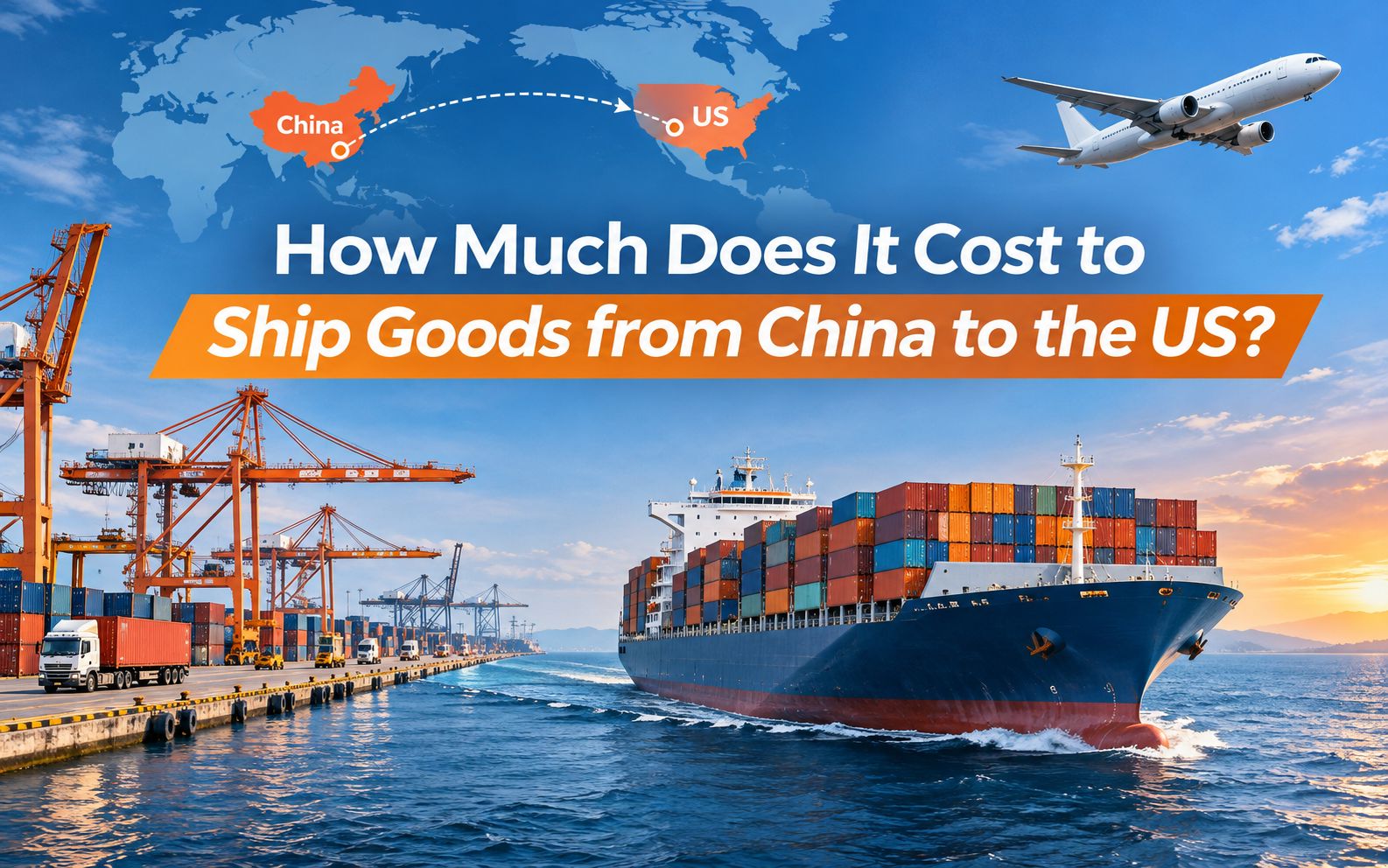
What Determines Shipping Costs from China to the USA?
Freight pricing is never a single number. Understanding how to calculate sea freight costs starts with a stack of charges that begins the moment cargo leaves the factory and ends when it clears US Customs.
Base freight is the headline rate carriers quote for moving your goods from origin port or airport to the destination. For ocean shipments, this is quoted per container or per cubic meter (CBM); for air, per kilogram. But base freight typically covers only the ocean or air leg - everything else is itemized separately.
Surcharges layer on top. The most common ones include:
|
Surcharge |
What It Covers |
Typical Impact |
|
Bunker Adjustment Factor (BAF) |
Fuel cost fluctuations |
Rises and falls with global oil prices |
|
Peak Season Surcharge (PSS) |
Capacity pressure during Aug–Oct shipping rush |
Adds roughly USD 1,600–2,000 per 40-ft container |
|
Currency Adjustment Factor (CAF) |
Exchange-rate volatility between USD and RMB |
Small but persistent |
|
Terminal Handling Charges (THC) |
Port loading/unloading at both ends |
Varies by port, USD 100–300 per move |
Then come origin charges in China - trucking from factory to port, customs declaration, document fees, and loading labor. On the US side, destination THC, customs clearance, duty payment, and inland drayage to your warehouse each add their own line items. Cargo delays can also result in additional demurrage and detention charges.
The new variable: US port fees on Chinese-built vessels. Starting October 14, 2025, the US Trade Representative (USTR) began charging fees on Chinese-owned, Chinese-operated, and Chinese-built ships calling at US ports. For Chinese-built vessels, the fee is the greater of USD 18 per net ton or USD 120 per discharged container, escalating annually to USD 250 per container by 2028. Carriers have signaled they will pass this cost to shippers, adding an estimated USD 89–163 per container depending on vessel size.
No single line item tells the whole story. The total cost of shipping is the sum of base freight, all surcharges, origin and destination handling, and whatever tariff regime applies - and each of those moves independently.
Ocean Freight Costs from China to the USA: FCL vs. LCL
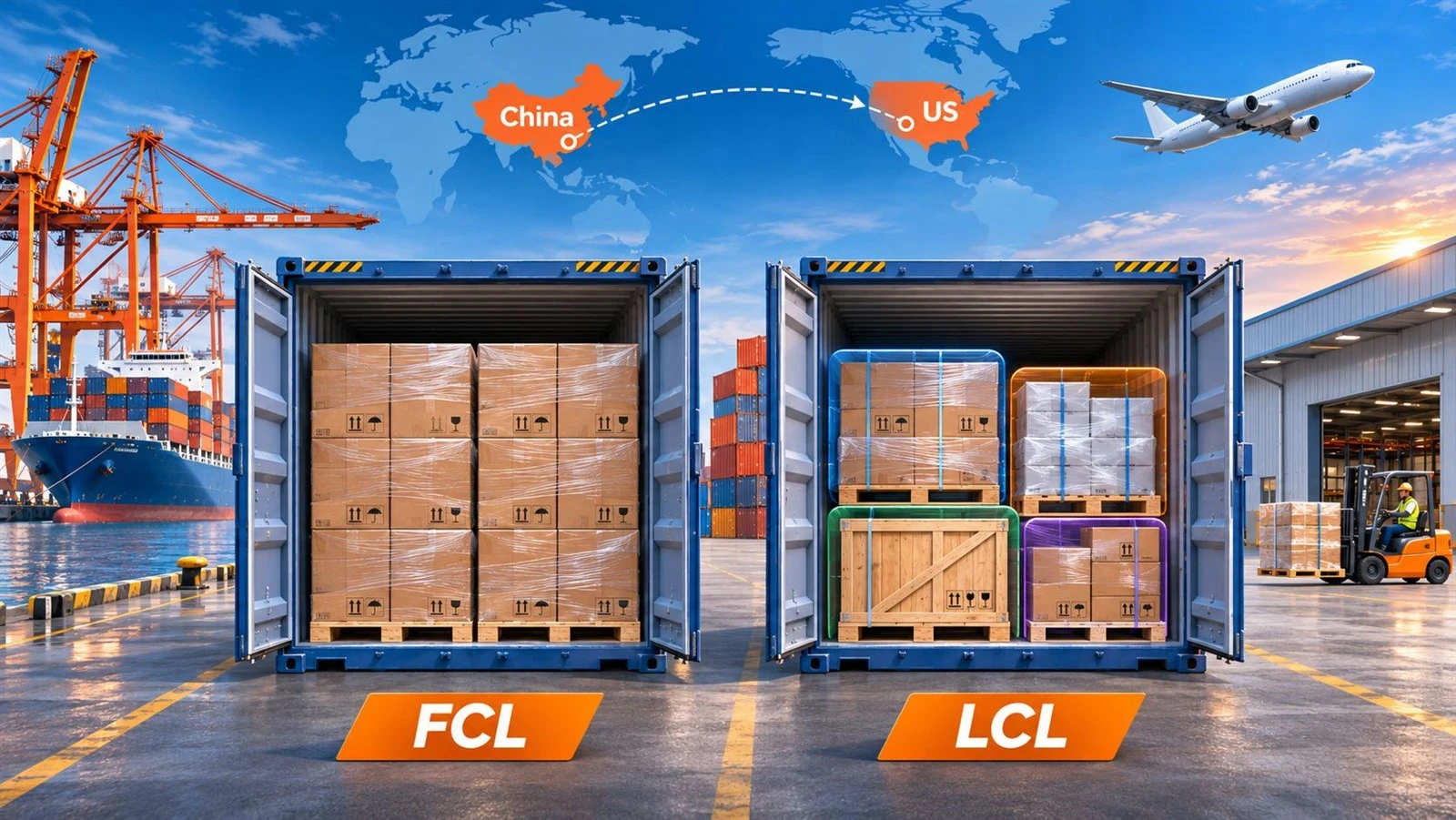
Sea freight from China to the USA is the backbone of China-to-US trade, carrying the majority of containerized goods across the Pacific. It comes in two forms.
Full Container Load (FCL) means you book an entire container - typically a 20-ft, 40-ft, or 40-ft High Cube (40HQ) - exclusively for your cargo. You pay a flat rate per container regardless of how full it is, which makes FCL the cheaper option once your volume fills roughly 60–70% of a container.
Less than Container Load (LCL) means your goods share container space with other shippers' cargo. You pay per cubic meter (CBM) or per ton, whichever is greater. LCL suits smaller shipments - typically under 8–10 CBM - but carries a higher per-unit rate and adds consolidation/deconsolidation fees at both ends.
Current sea freight rates from China to the USA fluctuate sharply. Based on freight market data and major carrier quotes through late 2026, the following ranges reflect what shippers are actually paying:
|
Route |
FCL (40HQ) Rate Range |
LCL Rate Range |
Typical Transit Time |
|
China to US West Coast (LA/Long Beach) |
USD 2,800–5,600 |
USD 90–180 per CBM |
13–20 days |
|
China to US East Coast (NY/Savannah) |
USD 4,200–8,700 |
USD 120–220 per CBM |
25–35 days |
|
China to US Inland (via rail/truck from port) |
Add USD 1,500–3,500 to above |
Add USD 30–60 per CBM |
+5–10 days |
These ranges are wide because the transpacific market has been volatile. In mid-2025, when the US and China announced a temporary tariff reduction, container bookings from China to the US surged roughly 277% within days, and spot rates on the Shanghai–Los Angeles route spiked from about USD 2,900 to over USD 5,600 per FEU in weeks. Rates then fell back by over 60% within two months as demand cooled. By late 2026, rates remained roughly 2.8 times higher than the same period in 2025, according to freight market data.
For DDP (Delivered Duty Paid) shipping - where the shipper handles everything including US customs and duties - door-to-door 40HQ rates from China to the West Coast typically run USD 8,000–12,000, and to the East Coast USD 10,000–14,000, based on 2026 freight forwarder quotes.
FCL wins on cost-per-unit for any shipment large enough to fill most of a container. LCL makes sense for testing a new product line or shipping samples, but the per-CBM premium and consolidation time make it uneconomical at scale.
Air Freight Costs from China to the USA
Air freight from China to the US costs roughly USD 3.80–9.50 per kilogram in 2026, based on carrier and forwarder rate guides. Express courier service runs higher - about USD 5 per kilogram and up, with a typical door-to-door transit of 3–5 days.
The actual chargeable weight is the greater of actual weight or volumetric weight, calculated as length × width × height (cm) ÷ 6,000. A shipment of lightweight but bulky goods - say, plush toys or empty plastic containers - may be billed at two to three times its actual weight.
|
Factor |
Air Freight |
Express Courier |
|
Rate (2026) |
USD 3.80–9.50/kg |
USD 5–12/kg |
|
Transit time |
3–7 days (airport to airport) |
3–5 days (door to door) |
|
Min. charge |
~USD 45–100 per shipment |
~USD 50–80 per shipment |
|
Best for |
100kg+ urgent cargo |
Small parcels, samples, documents |
|
Fuel surcharge |
15–30% of base rate |
Built into quoted rate |
Air freight rates on the China–US lane have swung dramatically with tariff news. In May 2025, when tariff uncertainty peaked, air rates dropped to around USD 2.78/kg (CNY 20/kg) - below cost for some forwarders. By mid-2026, rates had rebounded to USD 7.63/kg on a freight market air index for China–North America.
Air freight is the right call when the cost of waiting exceeds the cost of flying. High-value electronics, time-sensitive fashion drops, and urgent replacement parts fit this profile. When comparing sea freight vs. air freight, both transportation costs and delivery speed matter. For everything else, ocean freight's per-unit economics are unbeatable.
Additional Shipping Costs, Import Duties, and Customs Fees
US Import Duties and Tariffs
The tariff layer is where many importers underestimate their true landed cost. Several tariff regimes now apply to Chinese goods simultaneously:
|
Tariff Type |
Rate Range |
Scope |
|
Section 301 tariffs |
7.5%–25% |
Roughly half of all Chinese exports to the US |
|
Section 232 tariffs |
25%–50% |
Steel, aluminum, autos and parts |
|
Reciprocal tariffs |
~10% |
Broad category, some exemptions |
|
Fentanyl-related tariffs |
~10% |
No exemptions |
|
New 301 tariff (July 2026) |
Additional 12.5% |
China, Hong Kong, and others - stacks on top of existing 301 duties |
The de minimis exemption - which previously allowed goods valued under USD 800 to enter the US duty-free - has been effectively eliminated for Chinese-origin shipments. Low-value parcels sent from China via postal systems now face a duty of 30% of value or USD 50 per item (increased from USD 25 in June 2025).
On the positive side, USTR extended 178 product-specific Section 301 exemptions through January 9, 2027, covering industrial components, medical supplies, and solar manufacturing equipment. If your product falls under one of these exclusion categories, the additional 301 duty does not apply - but you must verify your HTS (Harmonized Tariff Schedule) code against the exclusion list.
Customs Clearance and MPF
US Customs and Border Protection (CBP) charges a Merchandise Processing Fee (MPF) of 0.3464% of the shipment's entered value, with a minimum of USD 33.58 and a maximum of USD 651.50 as of October 2025. A customs broker typically charges USD 150–300 per entry for clearance services.
Insurance
Cargo insurance usually runs 0.1%–0.3% of the declared goods value. For a USD 50,000 shipment, that is USD 50–150 - small enough that skipping it is almost never worth the risk.
Inland Transportation
Once goods clear at a US port, getting them to your warehouse adds another cost layer. Drayage from port to a nearby rail ramp runs USD 300–600. Long-haul trucking from Los Angeles to a Midwest distribution center can add USD 2,000–4,000 per container. Rail intermodal is cheaper but slower.
How to Reduce Shipping Costs from China to the USA
Cost reduction is not about finding a cheaper carrier - it is about structuring your shipment to minimize the charges you can control. Several practical strategies can help businesses reduce ocean freight costs from China.
Consolidate to fill containers. The per-CBM math of LCL always costs more than FCL once you pass about 10 CBM. If your order volume is close to filling a 20-ft container (roughly 28 CBM), wait or combine orders to hit FCL.
Time your shipments. Shipping in the January–March lull after Chinese New Year can save 15–30% compared to the August–October peak. Booking 3–4 weeks ahead locks in rates before General Rate Increases (GRIs) hit.
Negotiate annual contracts. Shippers moving over 50 tons per year by air, or multiple containers per month by sea, can secure contract rates 8–15% below spot market. The trade-off is volume commitment.
Verify your HTS classification. Misclassifying goods at a lower duty rate invites CBP audits and penalties. But correctly identifying a product that qualifies for a Section 301 exclusion can eliminate 7.5%–25% of additional duty - the single largest cost saving available.
Choose the right Incoterm. FOB (Free on Board) gives you control over the ocean leg and lets you negotiate freight directly. DDP shifts all responsibility - and cost opacity - to the supplier. For importers with their own freight relationships, FOB almost always costs less.
2026 Shipping Cost Examples from China to the USA
|
Shipment Profile |
Method |
Estimated Total Cost (2026) |
Transit Time |
|
2 CBM, 200 kg (samples) |
LCL ocean |
USD 400–700 |
20–30 days |
|
2 CBM, 200 kg (urgent) |
Air freight |
USD 760–1,900 |
3–7 days |
|
28 CBM, 10,000 kg (full 20-ft) |
FCL ocean, West Coast |
USD 2,800–5,600 + duties |
13–20 days |
|
68 CBM, 18,000 kg (full 40HQ) |
FCL ocean, East Coast |
USD 4,200–8,700 + duties |
25–35 days |
|
500 kg electronics |
Air freight |
USD 1,900–4,750 |
3–7 days |
|
Small parcel, under USD 800 value |
Express courier |
USD 50–150 + 30% duty |
3–5 days |
Every shipment is a trade-off between cost, speed, and risk tolerance. The cheapest option is rarely the slowest - it is the one where cargo volume, timing, and tariff exposure are all aligned.
FAQ
What Is the Cheapest Way to Ship Goods from China to the USA?
Sea freight is generally the cheapest way to ship goods from China to the USA when transporting large volumes of non-urgent cargo. LCL shipping is suitable for smaller shipments, while FCL offers better cost efficiency for cargo that fills most of a container. Air freight is more expensive but can be worthwhile for urgent or high-value shipments.
How Much Does It Cost to Ship a 40HQ Container from China to the USA?
Based on the 2026 reference rates discussed above, shipping a 40HQ container from China to the US West Coast costs approximately USD 2,800–5,600, while East Coast shipments range from USD 4,200–8,700. These are estimated ocean freight rates and do not necessarily include customs duties, destination charges, or inland delivery.
How Is Air Freight Cost from China to the USA Calculated?
Air freight charges are based on chargeable weight, which is the greater of the shipment's actual weight or volumetric weight. Volumetric weight is commonly calculated by multiplying the package's length, width, and height in centimeters and dividing by 6,000. The final shipping cost also depends on the route, cargo type, available capacity, and applicable surcharges.
Does Shipping Cost from China to the USA Include Customs Duties?
Not necessarily. Standard sea freight and air freight quotes usually cover the specified transportation services but may exclude US import duties, customs clearance, and local delivery charges. Under DDP shipping terms, the seller is generally responsible for arranging delivery and paying applicable import duties and taxes. Always confirm the exact scope of a freight quote before booking.
What Information Do I Need to Get an Accurate Shipping Quote from China to the USA?
To obtain an accurate freight quote, provide your cargo description, quantity, total weight, dimensions, pickup location in China, destination in the USA, and preferred shipping method. You should also specify your Incoterms, expected shipping date, and any special handling requirements. These details help a freight forwarder estimate transportation charges, customs-related costs, and the overall shipment budget.
Conclusion
Shipping from China to the US costs anywhere from a few hundred dollars for a small LCL consolidation to over USD 14,000 for a door-to-door 40HQ container with duties paid. The method you choose, the season you ship in, and the tariff classification of your goods each shift that number by thousands of dollars.
Zhejiang Wilson Supply Chain Management Co., Ltd. is an experienced China-based international freight forwarder providing sea freight, air freight, customs clearance coordination, and door-to-door supply chain solutions for shipments from China to global markets, including the United States. Contact our logistics team to discuss your cargo, shipping route, and Incoterm preferences, and request a tailored freight quote to better understand your total landed cost before committing to an order.