Shipping goods from China to the UK by sea remains one of the most economical options for importers moving commercial cargo, especially for larger, heavier, or non-urgent shipments. Whether you are purchasing consumer goods, machinery, industrial equipment, automotive products, or regular wholesale inventory from Chinese suppliers, sea freight gives you the flexibility to choose between full container load, less-than-container load, and more specialized shipping solutions.
Zhejiang Wilson Supply Chain Management Co., Ltd. provides sea freight and supply chain services from major Chinese manufacturing regions and ports to key UK gateways, including Felixstowe, Southampton, and London Gateway. Established in 2011 and headquartered in Ningbo, Wilson also operates branches in Shanghai, Shenzhen, and Hong Kong, supporting customers with international freight forwarding, customs coordination, warehousing, multimodal transportation, and specialized logistics solutions.
For most China–UK ocean shipments, port-to-port transit may range from approximately 30 to 50 days, depending on the origin port, carrier, routing, transshipment arrangement, and current shipping conditions. Freight rates also change frequently according to vessel capacity, container availability, season, surcharges, and the services included in the quotation.
If you are planning a shipment, send us your supplier location, UK destination or postcode, cargo description, volume, weight, Incoterm, and cargo-ready date. Our team can recommend a suitable shipping option and provide an updated quotation.
Sea Freight Cost from China to the UK
The cost of shipping from China to the UK depends on much more than the ocean freight rate alone. The Chinese loading port, UK destination, container type, cargo volume, weight, shipping season, local handling, customs requirements, and inland delivery can all affect the final logistics cost.
Estimated Sea Freight Rates from China to the UK
The following figures can be used as a general planning reference for shipments from major Chinese ports to Felixstowe, Southampton, or other major UK gateways.
| Shipping Method | Indicative Freight Rate |
|---|---|
| 20GP FCL | US$1,700–2,200 per container |
| 40GP FCL | US$2,800–4,600 per container |
| 40HQ FCL | US$2,800–4,600 per container |
| LCL | US$45–90 per CBM |
These figures are indicative estimates rather than fixed quotations. Similar 2026 market references place a 20ft container at approximately US$1,700–2,200 and a 40ft container at approximately US$2,800–4,600, while LCL base freight may fall around US$45–90 per cubic metre.
Ocean freight prices can move considerably depending on the shipping week, capacity, fuel-related surcharges, peak-season demand, and routing conditions.
A quotation may include or exclude different items, so importers should always confirm whether the price covers:
- China pickup and inland trucking
- Origin terminal and warehouse handling
- Export customs clearance
- Ocean freight
- Documentation charges
- UK destination handling
- Import customs clearance
- Duty and VAT
- Port-to-door transportation
- Warehousing or final delivery
A low headline ocean freight rate does not necessarily mean the lowest total landed logistics cost.
FCL or LCL: Which Is More Economical?
FCL, or Full Container Load, gives one shipper the use of a complete container. It is usually preferred for larger shipments, regular commercial imports, and cargo for which fewer handling stages or dedicated container space are desirable.
LCL, or Less than Container Load, allows multiple shippers to share one container. It is generally suitable for smaller commercial shipments that do not justify booking a full container.
As a general rule of thumb, LCL can be economical for shipments up to roughly 13–15 CBM. When cargo approaches this volume, it is often worth comparing the total LCL cost with a 20GP FCL quotation because LCL also involves consolidation, deconsolidation, and local handling charges.
The actual break-even point varies by cargo density, route, destination charges, and the current freight market.
Sea Freight Transit Time from China to the UK
Ocean transit time should not be confused with total door-to-door lead time.
A carrier may quote the number of days between the Chinese loading port and the UK discharge port, while the complete shipment also requires time for supplier pickup, export procedures, loading, customs formalities, destination handling, cargo release, and final delivery.
Estimated Port-to-Port Transit Times
| Origin in China | Typical UK Gateway | Estimated Transit |
|---|---|---|
| Shenzhen / Guangzhou | Southampton / Felixstowe | 35–42 days |
| Shanghai | Felixstowe / London Gateway | 35–45 days |
| Ningbo | Felixstowe / Southampton | 38–46 days |
| Qingdao | Felixstowe | 40–50 days |
| Tianjin / Xingang | Felixstowe / Southampton | 42–52 days |
These are planning estimates rather than guaranteed carrier schedules.
Under regular routing conditions, China–UK ocean freight may fall around 30–40 days port to port. Where services are rerouted or schedules are affected by changing Red Sea, Suez Canal, or Cape of Good Hope conditions, actual transit can extend into the 35–45 day range or longer.
For general planning, one reference range places FCL at approximately 30–40 days port to port and 38–50 days door to door, while LCL may take around 32–45 days port to port and 42–55 days door to door because additional consolidation and deconsolidation are required.
What Can Affect Shipping Time?
China–UK transit times can change because of:
- Carrier routing and vessel rotation
- Direct sailing versus transshipment
- Red Sea and Suez routing conditions
- Port congestion
- Vessel overbooking or schedule changes
- Blank sailings
- Customs inspections
- Chinese New Year and other peak periods
- Adverse weather
- Container or equipment shortages
- UK inland delivery arrangements
LCL cargo normally requires additional handling because the shipment must be consolidated in China and separated from other cargo at destination. This is why LCL may take several days longer than a comparable FCL movement.
If your shipment must arrive before a specific project deadline, sales season, or inventory replenishment date, send us your cargo-ready date and required delivery date so we can evaluate suitable sailing options.
Our Sea Freight Services from China to the UK
Wilson supports both standard containerized cargo and more complex logistics requirements.
FCL Shipping
We arrange 20GP, 40GP, and 40HQ container shipments for importers requiring dedicated container space. FCL is particularly suitable for regular wholesale cargo, industrial goods, machinery, larger purchase orders, and shipments where simplified handling is preferred.
LCL Shipping
For smaller shipments, we can consolidate cargo from one or multiple Chinese suppliers and arrange LCL transportation to the UK.
Door-to-Door Shipping
Depending on the agreed service scope, we can coordinate supplier pickup in China, warehousing, export customs clearance, international sea freight, destination clearance arrangements, and final delivery.
EXW and FOB Shipment Coordination
If your supplier sells under EXW terms, we can arrange collection from the factory or warehouse and manage the China-side logistics process. For FOB cargo, we can take over the international freight and subsequent logistics according to your shipping requirements.
Specialized Ocean Freight
Wilson's ocean freight capabilities extend beyond standard FCL and LCL. The company also handles special containers, reefer cargo, breakbulk, oversized cargo, and project shipments.
This can be particularly useful for importers shipping:
- Machinery and industrial equipment
- Vehicles and automotive cargo
- Oversized or irregular cargo
- Temperature-sensitive goods
- High-value equipment
- Project cargo requiring loading or securing plans
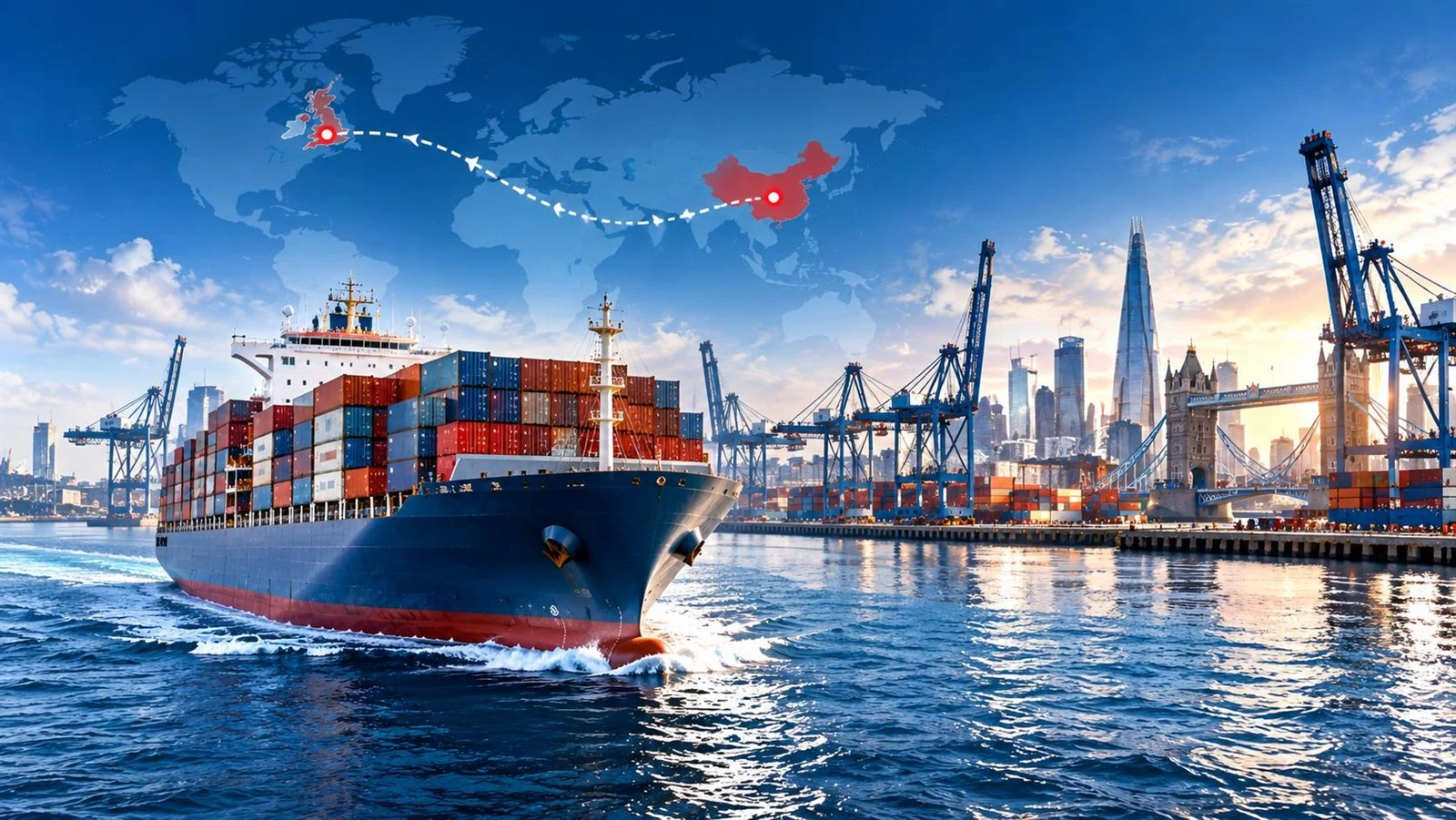
How Our Sea Shipping Service Works
Our China-to-UK sea freight process is designed to keep each stage clear and manageable.
1. Shipping Requirement Review
You provide the origin, UK destination, cargo description, dimensions, weight, quantity, Incoterm, cargo-ready date, and any special handling requirements.
2. Shipping Solution Design
We evaluate FCL, LCL, container type, origin port, routing, and other logistics requirements before recommending an appropriate solution.
3. Quotation and Booking
Once the service scope is confirmed, we provide a quotation and arrange the booking according to the selected carrier and sailing.
4. Supplier Pickup and Warehouse Handling
For shipments requiring China-side collection, we coordinate pickup from your supplier and, where required, arrange warehouse receiving, consolidation, checking, or temporary storage.
5. Loading and Export Customs
Cargo is prepared for shipment, loaded according to the selected transport method, and processed through the required export documentation and customs procedures.
6. Ocean Transportation and Tracking
After departure, we monitor important shipment milestones and provide status updates during the international transportation process.
7. UK Customs and Cargo Release
According to the agreed service scope, destination customs clearance and cargo release can be coordinated with the relevant UK-side service providers.
8. Final Delivery
The shipment can then be transferred to your nominated agent, warehouse, distribution centre, or delivery address.
This reflects Wilson's wider operating process, which covers requirement confirmation, solution design, booking, pickup, loading, documentation, tracking, and destination coordination.
Why Choose Wilson for Sea Freight from China to the UK?
Choosing a freight forwarder should involve more than simply comparing the lowest ocean freight number.
Major Carrier Resources
Wilson maintains business relationships with major global shipping lines including COSCO, Hapag-Lloyd, Maersk, MSC, and Evergreen, helping us match different shipment requirements with suitable schedules, equipment, and carrier options.
Coverage of Major Chinese Shipping Regions
Our service network covers important Chinese logistics nodes including Ningbo, Shanghai, Shenzhen, Guangzhou, Tianjin, and Qingdao, allowing us to coordinate cargo from major manufacturing areas.
Standard and Specialized Cargo Capability
In addition to normal FCL and LCL shipments, Wilson has operating experience with vehicles, engineering machinery, oversized cargo, reefer shipments, chemical cargo, and other complex logistics projects.
Cargo Protection and Risk Management
For equipment, vehicles, boats, and other non-standard or high-value cargo, proper loading and protection can be as important as the freight rate. Wilson's operating procedures can include loading planning, support, lashing, anti-slip measures, movement prevention, inspection, and photographic records where applicable.
End-to-End Coordination
Our service can extend from supplier communication and China pickup through warehousing, customs procedures, international freight, destination coordination, and delivery, reducing the number of logistics parties an importer needs to manage.
Experienced Freight Team
Wilson's team consists of experienced logistics professionals, with company materials indicating an average of more than eight years of industry experience.
Common Cargo Shipped from China to the UK
China-to-UK sea freight serves a broad range of commercial importers, from wholesalers and retailers to manufacturers, equipment buyers, and project contractors.
Common cargo categories suitable for ocean transportation include:
- Consumer and retail goods
- Furniture and household products
- Machinery and industrial equipment
- Electrical and electronic products
- Automotive parts
- Construction and engineering materials
- Textiles and packaged goods
- Refrigerated or temperature-sensitive cargo
- Vehicles and heavy equipment
- Oversized and project cargo
The appropriate shipping method depends on cargo characteristics rather than the product category alone. Smaller commercial orders may move by LCL, high-volume inventory may be better suited to FCL, temperature-sensitive products may require reefer equipment, and oversized machinery may need flat-rack, open-top, or project cargo solutions.

Importing Goods from China to the UK: Customs and Regulations
UK importers should review customs and product requirements before cargo leaves China. Incorrect or incomplete documentation can cause delays, storage costs, or additional customs procedures.
GB EORI and Customs Declaration
UK import shipments generally require the appropriate importer information, and a GB EORI number is an important part of the customs process. Import declarations are handled through HMRC's customs system, while the correct commodity classification determines the applicable customs treatment.
Commodity Code, Duty and Import VAT
The commodity code is used to determine customs duty rates and identify whether a product is subject to licences, restrictions, or additional requirements.
The standard UK VAT rate referenced for imports is 20%, although the treatment of specific goods and transactions can vary. Customs duty is not a single fixed percentage for all products; the applicable rate depends on the product's commodity classification.
Importers should therefore confirm their actual commodity code, duty treatment, VAT position, and any product-specific obligations before shipping.
Common Import Documents
Depending on the cargo, commonly required documents can include:
- Commercial invoice
- Packing list
- Bill of lading
- Commodity code
- Importer and consignee information
- Customs declaration information
- Certificate of origin where applicable
- Product certificates, licences, or safety documents where required
Consistency between documents is important. Differences in cargo description, quantity, weight, or value across invoices, packing lists, and shipping documents may create unnecessary customs questions or delays.
Wilson can assist with shipping document review and coordinate customs-related logistics within the agreed service scope, while product-specific regulatory requirements should be confirmed before shipment.
FAQ
Q: 1. How much does sea freight from China to the UK cost?
A: As an indicative guide, a 20GP may cost around US$1,700–2,200, while 40ft containers may fall around US$2,800–4,600. LCL base freight may be approximately US$45–90/CBM. Actual rates depend on route, carrier, sailing date, cargo, surcharges, and local charges.
Q: 2. How long does sea freight from China to the UK take?
A: Most shipments can be planned around approximately 30–50 days port to port, although specific routes may be shorter or longer. Door-to-door transportation requires additional time for pickup, customs, port handling, and final delivery.
Q: 3. Is FCL or LCL cheaper?
A: For small shipments, LCL is usually more practical because you pay only for the space you use. When cargo approaches roughly 13–15 CBM, it is worth comparing LCL with 20GP FCL because the full-container option may become more economical.
Q: 4. Which ports can you ship from in China?
A: We can coordinate shipments through major Chinese ports including Ningbo, Shanghai, Shenzhen, Guangzhou, Qingdao, and Tianjin, depending on your supplier location and shipping requirements.
Q: 5. Which UK ports can my cargo arrive at?
A: Common UK container gateways include Felixstowe, Southampton, and London Gateway. The most suitable port depends on the carrier service, routing, cargo, and your final delivery address.
Q: 6. Can Wilson collect goods from my supplier in China?
A: Yes. For shipments requiring China-side pickup, we can coordinate collection from suppliers, warehouse receiving, consolidation, export procedures, and delivery to the appropriate port.
Q: 7. Can you arrange door-to-door shipping to the UK?
A: Yes, depending on the shipment and agreed service scope. We can coordinate China pickup, sea freight, customs-related services, destination handling, and final delivery.
Q: 8. What information do I need to get an accurate quote?
A: Please provide your supplier or pickup location in China, UK destination or postcode, cargo description, number of packages, total gross weight, total CBM or dimensions, preferred container type if known, Incoterm, and cargo-ready date. The more complete the information, the more accurately we can compare routes, shipping methods, and total logistics costs.
Get a Sea Freight Quote from China to the UK
If you are importing from China and need a reliable sea freight solution to the UK, Wilson can help you compare FCL, LCL, port-to-port, and door-to-door options based on your cargo and delivery requirements.
Send us your supplier location, UK postcode, cargo description, weight, volume, Incoterm, and cargo-ready date. Our team will evaluate the suitable Chinese loading port, UK gateway, container option, sailing schedule, and related logistics services for your shipment.
Request Your China–UK Sea Freight Quote
Hot Tags: Sea Freight from China To Uk [Updated September 2026]