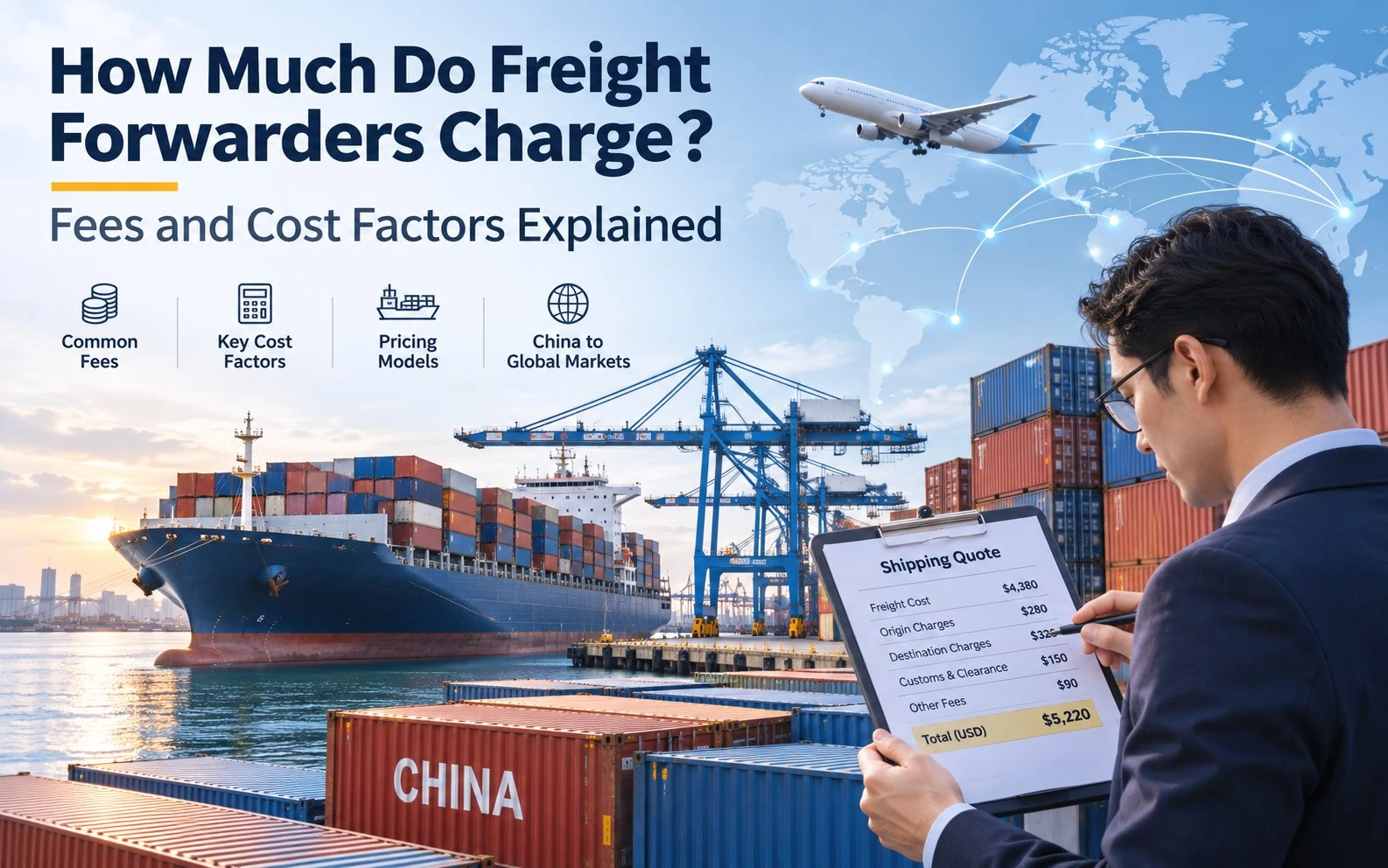
Freight forwarder charges are not a single line item. They are a stack of base freight rates, surcharges, handling fees, and service markups that vary by shipping mode, route, cargo type, and Incoterms. Understanding this freight forwarding cost structure is the fastest way to avoid overpaying and to compare quotes on equal footing.
What Do Freight Forwarders Charge For?
A freight forwarder is a logistics intermediary that arranges cargo movement from origin to destination on behalf of the shipper. The forwarder typically books capacity from carriers, handles documentation, manages customs, and coordinates inland transport rather than operating its own ships or planes. Its charges reflect all of these activities plus a service margin. Understanding what a freight forwarder does helps explain why these services contribute to the overall shipping cost.
The total freight forwarding cost typically breaks into three layers:
- Base freight - the carrier's transport rate for moving cargo from origin port/airport to destination port/airport.
- Surcharges and accessorials - fuel adjustments, currency adjustments, terminal handling, security, and other pass-through costs.
- Forwarder service fees - documentation, customs brokerage, warehousing, inland drayage, and the forwarder's own markup.
Most cost disputes arise not from the base freight but from the second and third layers. A quote that looks competitive on the headline rate can end up 20%–30% higher once all surcharges and handling fees are added. Always request an itemized freight forwarding cost breakdown before committing.
Freight Forwarding Rates by Transport Mode
Ocean Freight: FCL and LCL
Ocean freight is the dominant mode for trade from China, and it splits into two pricing structures. Understanding how to calculate sea freight costs can help importers evaluate the different charges involved in international ocean transportation.
Full Container Load (FCL) pricing is per container. A 20-foot standard container (20GP) and a 40-foot container (40GP/40HQ) carry different base rates, with 40-foot rates typically running 30%–50% higher than 20-foot rates on the same route. For shipments from China to major global destinations, 20-foot container base rates commonly range from approximately USD 1,000 to USD 3,000, while 40-foot containers range from roughly USD 2,000 to USD 5,000, depending on route, season, and carrier.
Less than Container Load (LCL) pricing is based on whichever is greater: actual weight or volume (measured in cubic meters, CBM). Rates per CBM can range from tens to over a hundred USD, and most carriers impose a minimum charge - often starting around 1–2 CBM. LCL makes sense for cargo under roughly 15 CBM; above that threshold, FCL usually becomes more economical per unit.
Choosing between these options requires comparing total costs rather than base rates alone. A detailed FCL vs LCL shipping comparison can help determine which container shipping method is more suitable for different shipment sizes.
Air Freight: Chargeable Weight Rules
Air freight charges are calculated by chargeable weight, which is the greater of actual gross weight and volumetric weight (also called dimensional weight). Volumetric weight is calculated by dividing the cargo's volume by a conversion factor - commonly 6,000 for air freight under IATA rules, meaning 1 CBM equals approximately 167 kg. For major international express courier services, the factor is typically 5,000 (1 CBM = 200 kg).
This rule hits hard for bulky but lightweight cargo. A large wooden crate of equipment with heavy padding can easily see its volumetric weight exceed actual weight by a full pricing tier, inflating the base air freight cost significantly.
Rail and Road Freight
China-Europe rail freight offers a middle ground between ocean and air on both cost and transit time. Pricing is typically calculated per ton based on weight, volume, distance, and cargo type, with rates ranging from several hundred to over a thousand USD per ton depending on the route. Road freight for cross-border moves (such as China to Southeast Asia) is priced similarly, factoring in distance, vehicle type, and border-crossing procedures.
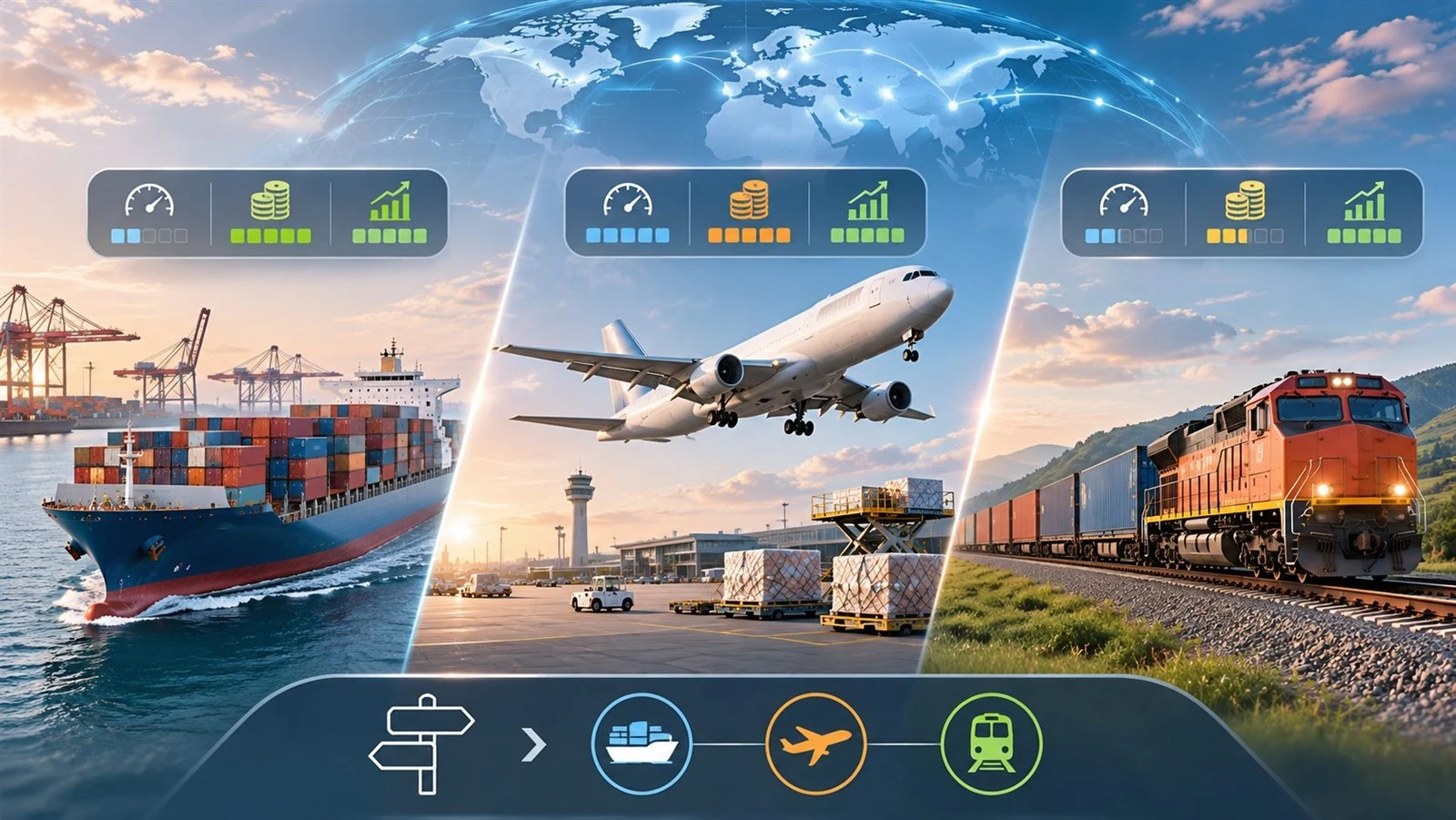
The table below compares the three main modes on cost, speed, and best-use scenarios:
Table 1: Freight Mode Comparison - Cost, Speed, and Suitability
|
Mode |
Typical Cost Level |
Transit Time (China to Major Destinations) |
Best Suited For |
|
Ocean (FCL/LCL) |
Lowest |
20–40 days |
Bulk goods, large volumes, non-urgent cargo |
|
Rail |
Medium |
12–20 days |
Mid-value goods needing faster delivery than ocean |
|
Air |
Highest |
3–7 days |
High-value, time-sensitive, or lightweight cargo |
For shipments where both budget and delivery time matter, comparing sea freight vs air freight costs can help identify the most practical shipping solution.
Common Freight Surcharges and Additional Charges
Base freight is only the starting point. Freight surcharges can add 10%–30% or more to the total freight forwarding cost, and they fluctuate with market conditions. The most common ones include:
Bunker Adjustment Factor (BAF) - a fuel surcharge tied to oil prices, typically around 12%–18% of base ocean freight. Carriers adjust it monthly or quarterly. For reference, on the Far East–Europe route, BAF has been observed at roughly USD 120 per container in certain periods.
Currency Adjustment Factor (CAF) - applied on some routes to offset exchange-rate movements between the carrier's billing currency and local currencies.
Terminal Handling Charge (THC) - covers loading/unloading, equipment use, and short-term yard storage at the port. At Chinese ports, THC for a 40-foot container may run roughly CNY 600–1,200 per container. Both origin and destination THCs apply, and they are separate from base freight.
Peak Season Surcharge (PSS) - imposed during high-demand periods such as the weeks before major holidays or retail buying seasons.
Security and documentation fees - include ISPS (port security), AMS/ENS filing fees for destination customs pre-arrival declarations, telex release fees (typically USD 35–75 per release), and bill of lading copy fees (USD 45–95 per copy).
Special cargo attracts additional surcharges. Dangerous goods (hazardous materials) can add 20%–50% or even double the base rate. Oversized or out-of-gauge cargo requires special equipment and stowage planning, adding further costs.
Freight Forwarder Service Fees and Value-Added Costs
Beyond carrier pass-throughs, freight forwarders charge service fees for their own logistics operations and value-added services:
- Customs clearance / brokerage - typically CNY 300–500 per shipment for standard export declarations at Chinese ports. Import clearance at destination varies by country and cargo complexity, generally ranging from USD 100–300 for routine entries, with special commodities potentially adding 30%–50%.
- Documentation fees - bill of lading issuance, certificates of origin, and other trade documents, commonly USD 10–30 per document.
- Inland drayage / trucking - moving containers from factory to port or port to warehouse, priced by distance, container type, and tonnage. A short drayage move (e.g., factory to Tianjin port) may run CNY 800–1,500 per container.
- Warehousing and storage - charged per day, with free-time limits typically 3–7 days before demurrage or storage fees apply.
- Cargo insurance - usually 0.3%–1% of declared cargo value, with higher coverage available for high-value goods.
The forwarder's own service margin - the markup on top of carrier rates and pass-through costs - is where freight forwarder pricing varies most between providers. First-tier forwarders that contract directly with carriers receive volume-based discounts of roughly 3%–5% that smaller agents cannot access, which is one reason freight forwarding quotes for the same shipment can differ significantly.
What Factors Affect Freight Forwarding Costs?
Cargo Characteristics
Weight and volume are the primary cost drivers across all modes. The "charge whichever is greater" principle means that dense cargo (machinery, metal parts) is priced by actual weight, while bulky cargo (furniture, foam products) is priced by volumetric weight. Cargo nature also matters - fragile, temperature-controlled, high-value, or dangerous goods require specialized handling, packaging, and insurance, all of which raise shipping costs.
Route and Distance
Longer routes cost more, but not linearly - per-unit costs often decrease with distance due to economies of scale. Routes from China to Europe or North America cost more than intra-Asia routes. According to UNCTAD's 2025 maritime report, geopolitical disruptions such as Red Sea/Suez Canal conflicts have forced carriers to reroute around the Cape of Good Hope, adding transit days and pushing costs up on affected lanes.
Seasonality and Market Conditions
Freight rates are highly cyclical. Demand spikes before Chinese New Year (January–February), major retail buying seasons, and year-end holidays push carriers to impose peak season surcharges and tighten available capacity. Conversely, slack seasons can offer negotiation leverage. Fuel price movements directly drive BAF adjustments, and currency fluctuations affect CAF on applicable routes.
Incoterms and Cost Responsibility
The Incoterms 2020 rules define exactly where the seller's cost responsibility ends and the buyer's begins. Under FOB (Free on Board), the seller covers costs up to loading on the vessel at the origin port; the buyer pays ocean freight, destination charges, and inland transport. Under CIF (Cost, Insurance, and Freight), the seller covers ocean freight and minimum insurance to the destination port. Under DDP (Delivered Duty Paid), the seller bears nearly all costs including import duties and taxes.
The chosen Incoterm does not change the total logistics cost of moving the cargo - but it shifts who pays each component. When comparing freight forwarder quotes, confirm the Incoterms basis so you are comparing the same scope of services. For example, door-to-door shipping from China to Europe may involve origin pickup, international transportation, customs coordination, and final delivery, depending on the agreed service terms.
Container Availability and Port Conditions
Equipment shortages (especially during peak season), port congestion, and labor disruptions can all inflate freight forwarding costs. When containers are scarce, carriers may impose equipment positioning surcharges. Port congestion extends dwell times and can trigger demurrage and detention charges that quickly exceed the base freight.
How to Compare Freight Forwarder Quotes
The most common mistake is comparing headline freight rates without accounting for the full cost stack. A forwarder quoting USD 1,200 for a 20-foot container to Rotterdam may look cheaper than one quoting USD 1,500 - but if the first quote excludes THC, documentation, and destination handling while the second is all-inclusive, the actual landed cost tells a different story.
Request freight forwarding quotes in a standardized format that itemizes every component:
Table 2: Freight Forwarder Quote Comparison Checklist
|
Cost Component |
Forwarder A |
Forwarder B |
Notes |
|
Base ocean/air freight |
|
|
Per container or per kg/CBM |
|
BAF (fuel surcharge) |
|
|
Check if included in base rate |
|
THC (origin + destination) |
|
|
Both ends |
|
Documentation fees |
|
|
B/L, certificates, filings |
|
Customs clearance |
|
|
Export + import |
|
Inland transport |
|
|
Door-to-port or port-to-door |
|
Insurance |
|
|
If arranged by forwarder |
|
Other surcharges |
|
|
PSS, security, special cargo |
|
Total landed cost |
|
|
The only number that matters |
Industry data suggests that approximately 37% of importers have experienced final costs exceeding initial quotes, with discrepancies ranging from 30% to as much as 150% in some cases. The gap is almost always in surcharges and handling fees that were not itemized upfront.
Hidden Freight Forwarding Charges and Common Mistakes
Several cost categories are routinely underestimated or overlooked:
Demurrage and detention - charges for keeping containers or equipment beyond free time. Port free time is typically 3–7 days; after that, daily charges accumulate quickly and can reach USD 50–150 per container per day depending on the port and carrier.
Customs inspection fees - if cargo is selected for physical inspection by customs authorities, the forwarder or broker charges for coordinating the inspection, plus any warehouse handling and labor costs. These are unpredictable but real.
Remote area delivery surcharges - destination addresses outside standard delivery zones incur additional fees. For express deliveries, these can run from several USD per kg with minimums per shipment.
Change fees - altering the consignee, destination, or routing after booking incurs amendment fees, typically USD 35–75 or more per change.
Exchange rate exposure - when freight is quoted in USD but paid in local currency, adverse exchange movements can add 0.3%–0.8% to the effective cost on larger transactions.
The single most effective safeguard against hidden freight forwarding fees is a written, itemized quote that specifies all charges, currency, validity period, and applicable Incoterms - before any cargo moves.
FAQ
Do Freight Forwarders Charge a Flat Fee?
Freight forwarders may charge fixed service fees for specific tasks, such as documentation or customs brokerage, but the total shipping cost is rarely a single flat fee. Most freight forwarding quotes combine base transportation rates, surcharges, handling charges, and service fees. The final amount depends on the shipment's route, cargo characteristics, shipping method, and required services.
How Much Does a Freight Forwarder Charge for Customs Clearance?
Customs clearance fees depend on the country, cargo type, and complexity of the declaration. For standard export declarations at Chinese ports, fees may range from approximately CNY 300–500 per shipment. Routine import clearance at the destination may cost around USD 100–300, while complex or regulated commodities can incur additional charges.
Is FCL or LCL Cheaper When Shipping from China?
LCL shipping is generally more economical for smaller shipments because you pay for the space your cargo occupies rather than an entire container. However, as cargo volume increases, FCL shipping often becomes more cost-effective per unit. Shipments exceeding approximately 15 CBM may benefit from comparing full-container rates against LCL charges, including destination handling fees.
How Are Air Freight Charges Calculated?
Air freight costs are primarily calculated using chargeable weight, which is the greater of actual gross weight and volumetric weight. A common international air freight conversion factor is 6,000, equivalent to approximately 167 kg per CBM. Fuel surcharges, security fees, customs clearance, and other handling charges may increase the final amount.
How Can I Avoid Hidden Freight Forwarding Fees?
The best way to avoid unexpected freight forwarding charges is to request a detailed, written quotation before booking. Confirm whether the quote includes origin and destination terminal charges, customs clearance, documentation, inland delivery, and applicable surcharges. You should also verify the quotation's validity period, payment currency, Incoterms, and potential demurrage or detention charges.
Conclusion
Freight forwarder charges are a layered structure of base freight, surcharges, and service fees - not a single number. For cargo moving from China, ocean FCL rates typically start around USD 1,000–3,000 per 20-foot container, air freight is driven by chargeable weight rules, and surcharges can add 10%–30% or more on top of any base rate. The biggest cost variables are cargo characteristics, route, seasonality, Incoterms, and how transparently the forwarder itemizes its quote. Comparing total landed cost - not headline rates - is the only reliable way to evaluate freight forwarder pricing.
Zhejiang Wilson Supply Chain Management Co., Ltd. is a China-based international freight forwarder providing sea, air, rail, and road transportation, customs clearance coordination, warehousing, and specialized logistics for containers, vehicles, heavy equipment, dangerous goods, and oversized cargo. If you are sourcing goods or equipment from China, contact our team to discuss your shipping requirements and request an itemized freight quote tailored to your cargo, destination, and delivery needs.