When your cargo is too tall, too wide, or simply too heavy for a standard dry container, two specialized options often come into consideration: the Flat Rack (FR) and the Open Top (OT). Choosing the wrong container can lead to costly re-stuffing, additional handling, cargo damage, or even booking rejection at the terminal.
This guide compares flat rack vs open top containers for heavy machinery, including dimensions, payload, loading methods, cargo protection, shipping costs, and the practical factors that determine which option is better for a specific machine. If you are unfamiliar with these equipment types, our guide to types of shipping containers, including Flat Rack and Open Top provides a broader overview of special-container options.
What Is a Flat Rack Container?
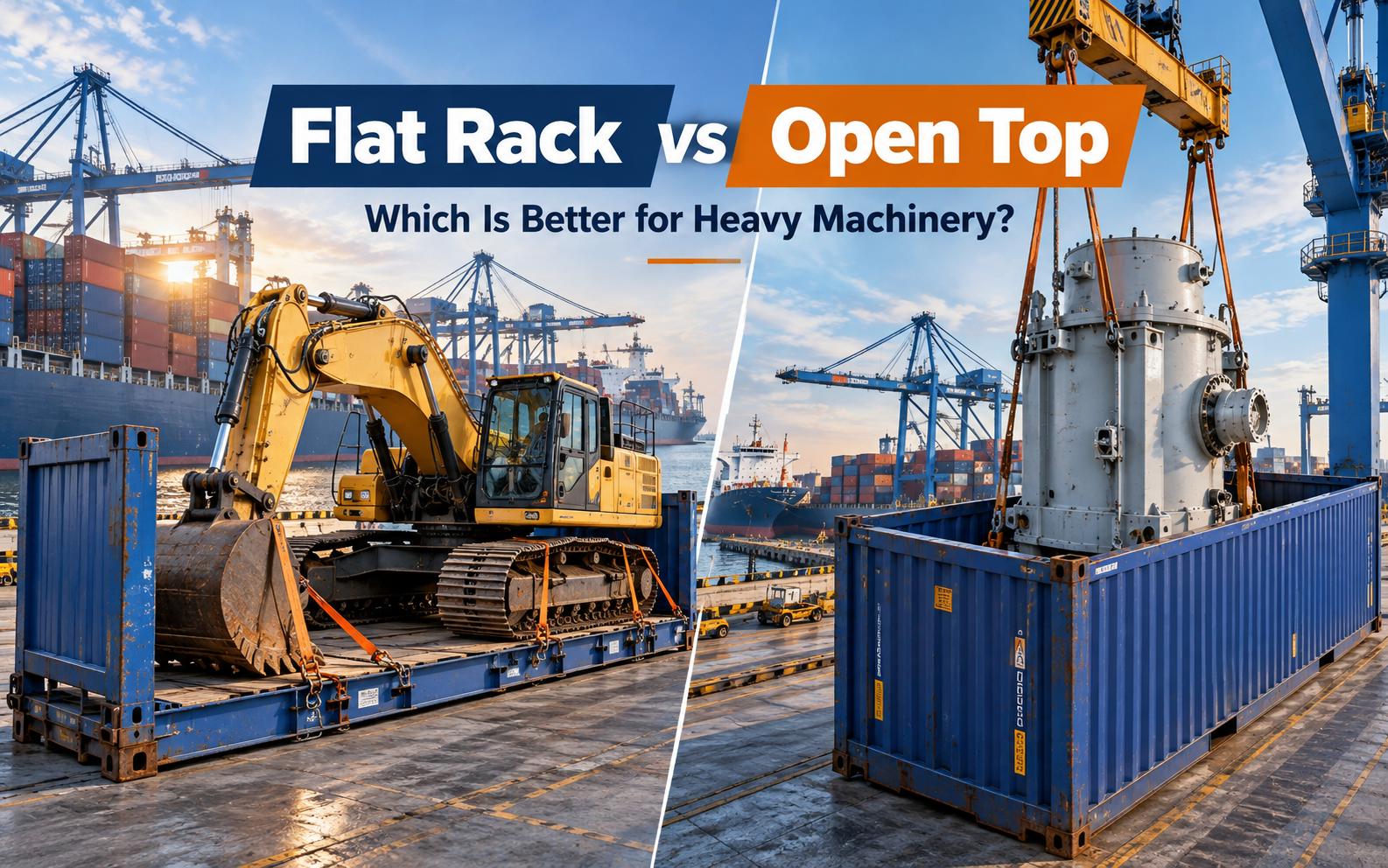
A flat rack container has no side walls and no roof-only a reinforced floor and two collapsible end walls, also called bulkheads. The end walls can fold flat so empty units can be stacked for repositioning, while the open structure allows oversized cargo to extend beyond the sides or top within carrier-approved limits.
Flat racks come in two common sizes, designated by the ISO type codes 20FR and 40FR. A 20FR typically offers an internal length of about 5.65–5.85 m, a width around 2.24 m, and a payload capacity of roughly 26–30 tonnes. A 40FR extends the internal length to about 11.65–11.76 m, with payload capacity approaching 39–45 tonnes depending on the carrier and specific equipment. Some carriers also offer 40FR high-cube variants with taller end structures.
Because the sides are completely open, flat racks are especially useful for oversized machinery shipping where cargo extends beyond the normal container footprint. Typical examples include wide excavators, bulldozers, large loaders, drilling equipment, generators, industrial machinery, and irregular steel structures that cannot fit inside a standard container.
Carriers may accept significant height or width overhang, but the permissible envelope is not universal. Equipment availability, route restrictions, vessel stowage, port handling capability, and carrier approval all need to be checked for each OOG cargo shipment.
For heavy machinery, physical dimensions are only the first test. Gross weight, center of gravity, lifting points, support locations, cargo securing, and whether major components can be removed can all change the best transport solution. Wilson's project experience includes 53-ton-class heavy cargo and crawler-mounted full-hydraulic geological exploration drilling equipment, as well as loading-plan design for complex machinery projects.
What Is an Open Top Container?
An open top container retains solid side walls and end doors like a standard dry container, but the fixed roof is replaced by removable cross-bars and a heavy-duty tarpaulin. Heavy equipment can therefore be lowered vertically through the top opening by crane, after which the tarpaulin is secured to help protect the cargo against rain and sea spray.
Open tops are commonly available as 20OT and 40OT. A 20OT has an internal length of roughly 5.89 m, a width of about 2.35 m, and a maximum payload around 28 tonnes. A 40OT measures about 12.03 m internally with a payload near 26–28 tonnes-generally lower than a comparable flat rack because of its enclosed structure. The top opening on a 40OT is approximately 11.62 m × 2.12 m, providing the practical opening through which cargo must be lowered.
The main advantage is vertical loading. If a machine is too tall to pass through standard container doors but remains within the container's internal width, an open top can allow it to be craned into position from above.
The solid side walls also provide more physical protection than an exposed flat rack and may simplify cargo securing. This makes an open top container for heavy machinery particularly useful for tall equipment that is not excessively wide or heavy.
Flat Rack vs Open Top: Key Differences
The table below highlights the practical differences that usually matter most when selecting a special container for heavy equipment.
|
Attribute |
Flat Rack (FR) |
Open Top (OT) |
|
Structure |
No roof or side walls; reinforced floor and end walls |
Solid side walls and end doors; removable tarpaulin top |
|
Loading method |
Top, side, or end loading; flexible access |
Mainly vertical crane loading through the open top |
|
Width capacity |
Cargo can overhang the sides subject to approval |
Generally confined to internal width of about 2.35 m |
|
Height capacity |
Can accommodate significant over-height cargo |
Cargo may protrude above the top rail subject to approval |
|
40-ft payload |
Approximately 39–45 tonnes |
Approximately 26–28 tonnes |
|
Weather protection |
Cargo requires independent protection |
Tarpaulin and solid side walls provide greater protection |
|
Best suited for |
Wide, irregular, or very heavy machinery |
Tall but relatively narrow equipment |
Payload and dimension figures vary by carrier and container manufacturer. Exact equipment specifications and OOG acceptance limits should always be confirmed at the booking stage.
A useful way to approach flat rack vs open top is to identify where the machinery exceeds normal container limits. Over-height alone often points toward an open top. Over-width, very high weight, irregular geometry, or the need for side loading more often points toward a flat rack.
However, being able to fit the machine is not the same as having a safe transport plan. The loading method, center of gravity, supporting points, lashing access, and destination handling capability must also work.
When to Choose a Flat Rack for Heavy Machinery
1. Wide or Irregular Cargo
If your machine-a tracked excavator, wheel loader with an oversized bucket, or wide bulldozer-exceeds the roughly 2.35 m internal width of a standard container, a flat rack is usually the more practical option.
Its open sides allow approved overhang and make it suitable for out of gauge cargo that cannot be enclosed within container walls. Excavators are one of the most common examples, and the same planning principles apply to used excavator shipping from China.
For irregular machines, measuring only overall length, width, and height may not be sufficient. Attachments, tracks, counterweights, booms, buckets, and protruding components should also be included in the loading assessment.
2. Very Heavy Single Units
A 40FR can carry close to 40 tonnes or more depending on the equipment specification, giving it considerably more payload capacity than many 40-foot open top containers.
This makes flat racks suitable for dense heavy cargo such as generator sets, press machines, industrial equipment, large engine assemblies, and certain types of construction machinery.
Weight alone, however, is not enough. Point loads and center of gravity matter because heavy machinery concentrates load through tracks, wheels, support feet, or a relatively small base area. Proper load distribution and support planning are therefore part of the container-selection process.
3. Loading from Multiple Directions
With no full side walls or roof, cargo can be loaded from the top, side, or end.
This flexibility is useful when a machine's geometry makes top-only loading difficult, when attachments prevent it from passing through a container opening, or when specialized cranes and forklifts need greater access during positioning.
For complex heavy-equipment projects, Wilson's operating approach considers the cargo's dimensions, weight, center of gravity, lifting method, loading position, and lashing points before the shipment is executed. For machinery such as mobile cranes, these factors are especially important; our guide on how to ship a crane from China explains how container, RoRo, and alternative transport methods may be compared.
4. Multi-Rack Platform Stowage
For exceptionally long cargo, two or more flat racks may be used as a platform under an approved loading arrangement, sometimes referred to as split stowage or bolster loading.
This method may be considered for very long steel structures, certain oversized vehicles, industrial components, and project cargo when no single special container can accommodate the full length.
Such arrangements require carrier approval and should be treated as a project-cargo solution rather than a routine container booking.
When to Choose an Open Top for Heavy Machinery
1. Tall but Relatively Narrow Equipment
If the cargo remains within the approximate 2.35 m container width but cannot pass through a normal container door because of its height, an open top may be the better choice.
Examples include tall CNC equipment, vertical pumps, industrial machinery with protruding control cabinets, and machines that cannot safely be tilted during loading.
This is one of the clearest situations where open top vs flat rack can be decided by geometry: if width is not the problem but vertical access is, an open top deserves consideration first.
2. Machinery That Needs More Weather Protection
The tarpaulin and solid side walls offer more protection than an exposed flat rack.
For heavy equipment with electronics, painted surfaces, hydraulic components, control systems, or corrosion-prone parts, this enclosed structure can reduce exposure during the ocean voyage.
The tarpaulin should not be treated as the only protection for sensitive equipment, however. Depending on the cargo and route, additional waterproof wrapping, shrink wrapping, corrosion protection, cushioning, or component covers may still be appropriate.
3. Easier Access to Internal Lashing Points
An open top retains the container's enclosed body and internal securing points, which can make some cargo-securing operations more straightforward.
For machinery that fits comfortably within the internal width, this can reduce the amount of customized external bracing required compared with a fully exposed flat rack.
Cargo securing should still be engineered around the machine itself. Wheel or track blocking, anti-slip materials, support points, lashing angles, and protection of sensitive contact areas all need to be considered. International guidance such as the IMO's Code of Safe Practice for Cargo Stowage and Securing (CSS Code) provides an authoritative framework for the safe stowage and securing of cargo at sea.
4. When the Lower Payload Is Sufficient
If the machinery weighs under roughly 26–28 tonnes and remains within the container width, an open top may be easier to source and can sometimes be less expensive or simpler to handle than a flat rack.
This makes it a practical option when you do not need the flat rack's greater payload capacity or unrestricted side access.
Flat Rack vs Open Top Shipping Costs
Both container types usually cost more than standard dry containers. Base freight may be 30–60% higher, with additional charges potentially applying for lashing materials, special equipment handling, surveys, OOG handling, and destination operations.
Flat racks often cost more than open tops of the same length because equipment supply may be tighter and the cargo handled on them is frequently heavier or more complex.
The cheapest container is the one that fits your cargo correctly the first time. Re-stuffing at a transit terminal-or having a booking rejected because the machinery does not comply with the approved dimensions-can cost much more than the initial difference in freight.
Additional costs can include pre-loading survey fees, protective wrapping, lifting, special trucking, lashing, OOG surcharges, terminal handling, port storage, destination unloading, and over-dimensional transport permits.
This is why flat rack vs open top cost should be compared on a total-logistics-cost basis, not ocean freight alone.
A machine may technically be dismantled enough to fit into an open top-or even a standard dry container-but that does not automatically make dismantling economical. Removal of a boom, cab, bucket, counterweight, wheels, or attachments can introduce labor, packing, reassembly, delays, and additional damage risk.
The better question is not simply:
Can this machine be dismantled?
It is:
Does dismantling reduce the total transport cost and risk from the factory in China to the final destination?
For a wider view of the factors that affect equipment transportation, including containerized OOG and alternative methods, see our guide on how to ship construction machinery from China.
How Wilson Handles Heavy Machinery and OOG Shipping
Selecting a flat rack or open top container is only one part of heavy machinery shipping from China. OOG cargo may also require carrier approval, lifting arrangements, loading supervision, lashing and securing, export documentation, port coordination, and destination handling.
Zhejiang Wilson Supply Chain Management Co., Ltd. was established in 2011 and is headquartered in Ningbo, with branches in Shanghai, Shenzhen, and Hong Kong. Its service scope includes international freight forwarding, supply chain management, and specialized logistics for heavy equipment, vehicles, OOG cargo, project cargo, and special containers. The company handles approximately 56,000 TEU annually with a 26-person professional team.
1. Container Selection and Loading Planning
Before booking, the practical starting point is the cargo itself.
For heavy machinery, we assess information such as:
- Overall dimensions and shipping weight
- Center of gravity
- Track, wheel, or support footprint
- Lifting points
- Lashing points
- Removable components
- Cargo value and protection requirements
- Origin and destination handling conditions
Based on these factors, the shipment can be evaluated for Flat Rack, Open Top, RoRo, Breakbulk, or another suitable project-cargo solution, rather than assuming that every oversized machine belongs on the same type of equipment.
For customers specifically sourcing or exporting equipment, Wilson also provides construction machinery shipping from China, covering transport planning for excavators, loaders, drilling rigs, engineering vehicles, and other heavy machinery.
2. OOG Booking and Carrier Coordination
Special-container bookings normally require more information than standard FCL cargo.
Dimensions, total weight, over-height or over-width measurements, cargo drawings or photos, and sometimes detailed loading information are submitted for carrier assessment.
Equipment availability and acceptable OOG dimensions can also vary between routes. Through Wilson's sea freight from China network, shipments can be coordinated with suitable ocean services, schedules, and special equipment according to route and cargo requirements.
Accurate shipment weight is also important for containerized ocean freight. Under SOLAS, packed containers are subject to Verified Gross Mass (VGM) requirements, making reliable weight information essential before vessel loading.
3. Loading, Lashing, and Cargo Protection
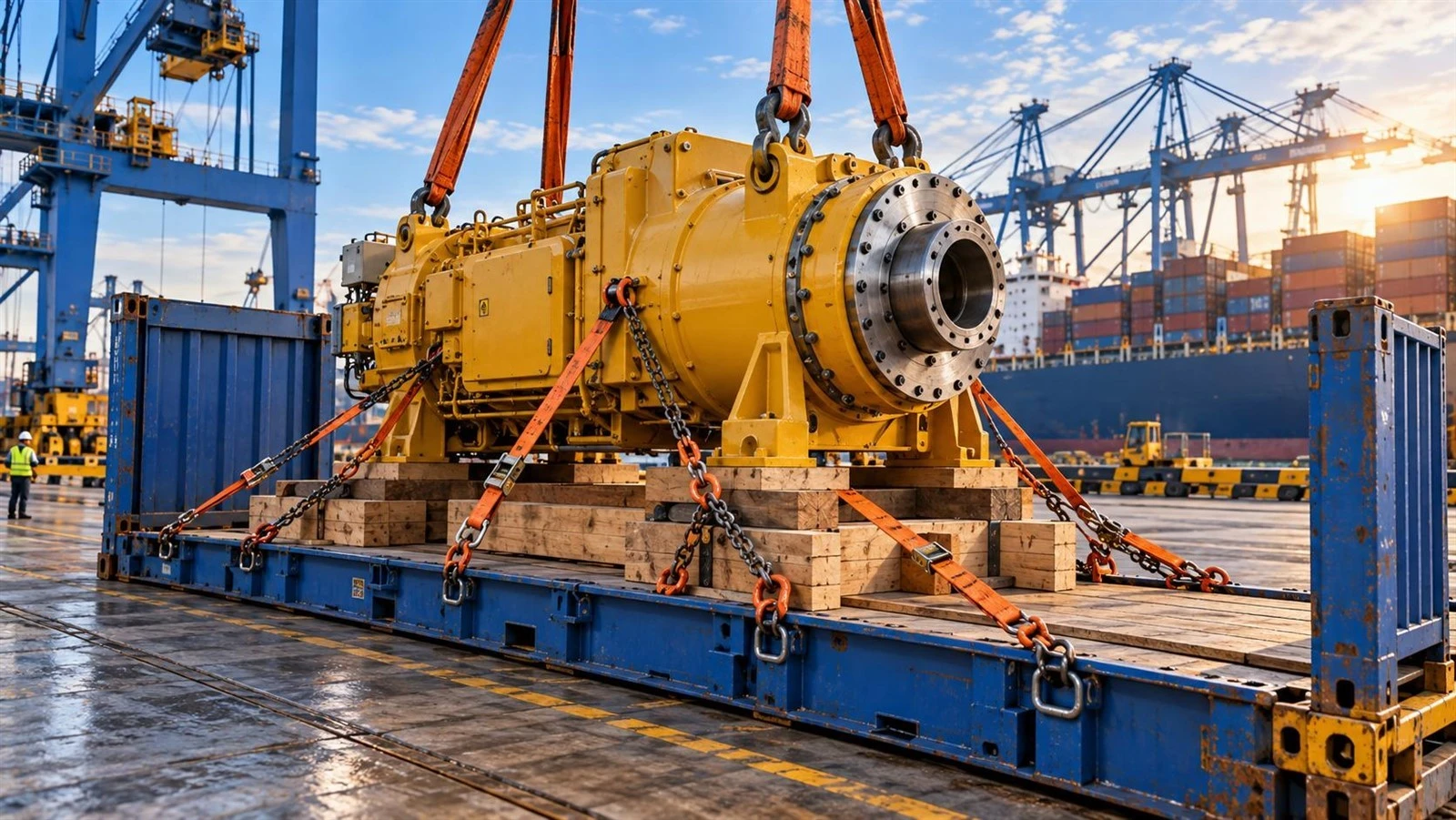
For heavy equipment shipping, getting the machine onto the flat rack or into the open top is only part of the job. It must remain stable throughout handling and the ocean voyage.
Depending on the project, loading control may include support, blocking, anti-slip measures, wheel or track restraint, equipment protection, lashing, and post-loading condition checks.
Wilson's complex-cargo workflow includes loading planning, on-site loading and unloading supervision, attention to lifting and support points, cargo securing, photographic records, and risk control.
For flat rack shipments in particular, cargo securing should be treated as part of transport engineering-not as an afterthought once the machine is already on the rack.
4. Customs Clearance and Destination Delivery
Where required, the shipment can also be coordinated beyond ocean freight, including pickup in China, warehousing, export customs procedures, destination clearance, and final delivery.
Wilson provides end-to-end supply chain services including customs clearance, warehousing, delivery, insurance support, and DDP solutions where suitable for the destination and agreed service scope. When using DDP, the respective responsibilities of seller and buyer should be understood according to the ICC's official Incoterms® rules.
For oversized machinery, destination conditions should be checked before the origin loading plan is finalized. Crane availability, local OOG trucking restrictions, terminal handling procedures, special permits, and final-site access can sometimes determine which container option is practical.
In other words, heavy machinery transport should often be planned backward from the destination-not only forward from the factory in China.
How to Choose Between Flat Rack and Open Top
If you are still comparing flat rack vs open top for heavy machinery, these questions provide a useful starting point:
|
Question |
If Yes → |
|
Does the cargo exceed approximately 2.35 m in width? |
Flat Rack - open sides can accommodate approved overhang |
|
Does the cargo weigh more than approximately 28 tonnes? |
Flat Rack - generally offers greater payload capacity |
|
Is the cargo tall but within standard container width and requires crane loading? |
Open Top - allows vertical loading |
|
Does the machine require more protection from weather and sea spray? |
Open Top - tarpaulin and solid walls provide greater coverage |
|
Is the cargo exceptionally long or highly irregular? |
Flat Rack - specialized platform arrangements may be possible |
These questions are a screening tool rather than a final booking rule.
Before selecting equipment, provide your freight forwarder with the machine dimensions, gross weight, photos, lifting points, center of gravity where available, removable components, pickup location, and final destination.
A machine that appears suitable for an open top based on dimensions alone may prove difficult to lift or secure inside the container. Conversely, a machine initially considered for flat rack shipping may become suitable for a less expensive transport method after safe removal of an attachment.
The best option is therefore the one that produces a workable origin-to-destination loading, securing, transport, and delivery plan, not simply the container with the lowest quoted ocean freight.
FAQs
Is a flat rack or open top better for shipping an excavator?
It depends on the excavator's dimensions, operating weight, attachments, and whether components can be removed. A wide excavator that exceeds normal container width is more likely to require a flat rack, while a taller but narrower machine may be suitable for an open top. Large excavators may also need to be evaluated for RoRo or breakbulk shipping.
Can cargo extend above an open top container?
Yes. Open top containers can carry over-height cargo, subject to carrier approval and route-specific limitations. The amount of allowed projection above the top rail can affect OOG surcharges, vessel stowage, and handling requirements.
Is a flat rack more expensive than an open top container?
It often is, but this is not guaranteed. Freight rates depend on route, equipment availability, cargo dimensions, weight, and carrier capacity. For oversized machinery shipping, lifting, lashing, special trucking, port handling, and destination costs should be compared along with the basic ocean freight rate.
What information is needed to quote heavy machinery shipping?
At minimum, provide the cargo name, exact length, width, height, weight, quantity, pickup location, destination, and clear photos. For complex machinery, information about the center of gravity, lifting points, lashing points, removable components, and final delivery conditions can significantly improve the accuracy of the transport plan.
When should I consider Breakbulk or RoRo instead of Flat Rack or Open Top?
Breakbulk shipping for oversized machinery may be worth evaluating when the equipment is too large, heavy, or irregular for practical containerized OOG shipping.
RoRo can be suitable for self-propelled or towable machinery on routes where appropriate services are available. For a broader explanation of the method, see RoRo shipping for heavy vehicles and machinery. Wilson also provides RoRo shipping from China for eligible vehicles and equipment.
The choice should compare total cost, schedule, cargo protection, handling risk, and destination capability.
Conclusion
There is no universal winner in the flat rack vs open top comparison. Flat racks are generally better for wide, irregular, very heavy, or side-loaded machinery, while open top containers are usually better for tall but relatively narrow equipment that benefits from solid side walls and greater weather protection. The final choice should also account for weight distribution, center of gravity, lifting, lashing, dismantling, carrier approval, destination handling, and total logistics cost.
For a specific heavy machinery or OOG cargo shipment from China, a professional China freight forwarder such as Zhejiang Wilson Supply Chain Management Co., Ltd. can assess your cargo dimensions, weight, photos, and delivery requirements and compare Flat Rack, Open Top, RoRo, Breakbulk, and other available solutions. Contact our team to discuss your equipment and develop a practical shipping plan before booking.