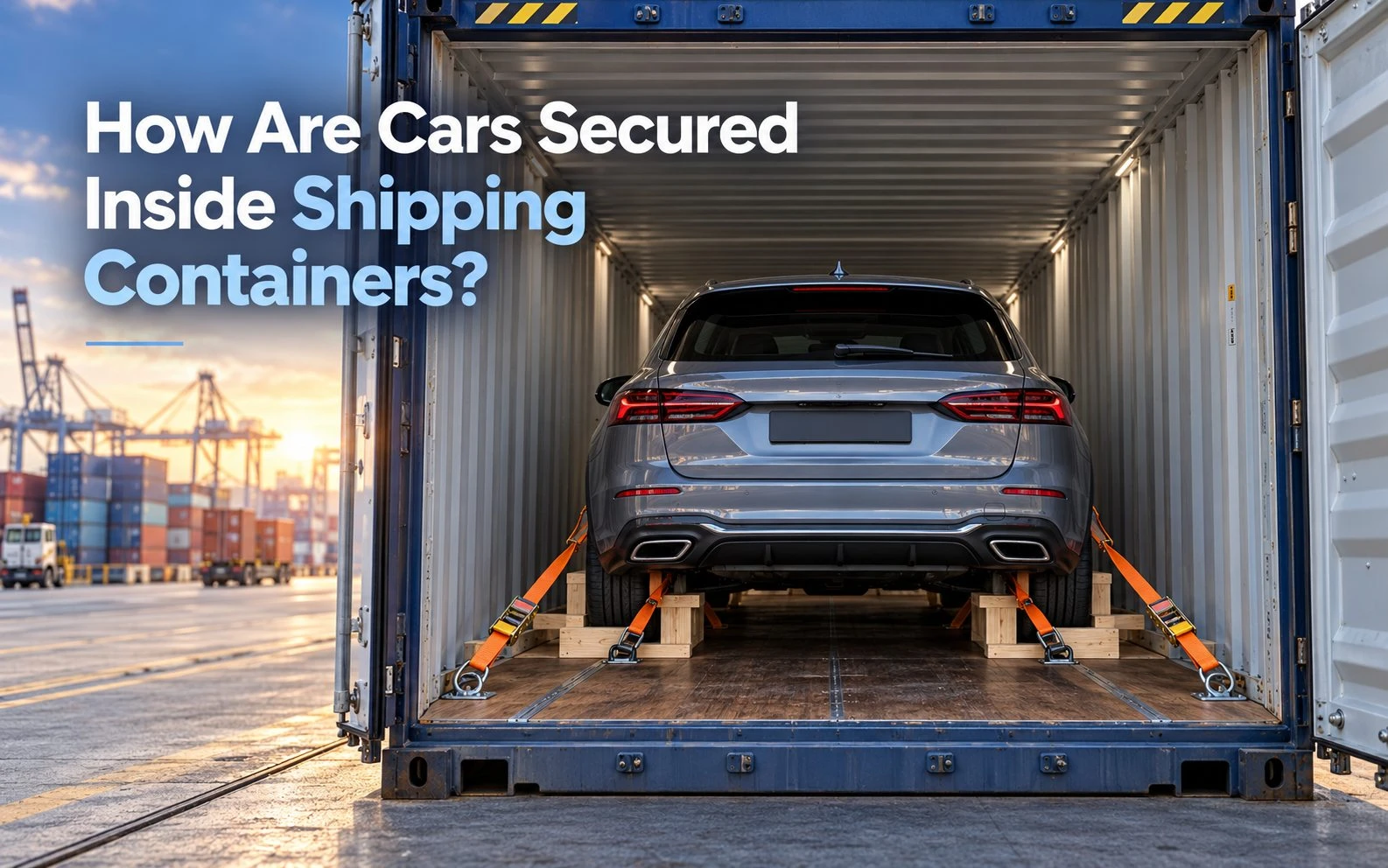
Shipping a car across an ocean is not as simple as driving it into a steel box and shutting the doors. During a typical ocean voyage, a vessel can encounter sea conditions that cause the ship to roll 20 to 30 degrees. Inside a container, the cargo experiences longitudinal accelerations of roughly 0.3 to 0.8 g. A vehicle weighing 1,500 to 2,000 kilograms, if left unrestrained, would become a destructive projectile inside a sealed steel box. Proper vehicle securing inside a shipping container is the difference between a vehicle arriving in showroom condition and a total loss.
If you are asking how cars are secured inside shipping containers, the answer involves more than ratchet straps alone. This guide covers container selection, wheel chocks, tie-down points, vehicle lashing, blocking and bracing, dunnage, final container loading inspection, international standards, and the damage-prevention measures used in containerized vehicle shipping.
Why Cars Must Be Secured Inside Shipping Containers
Before looking at how cars are secured, it helps to understand what they are being secured against. Ocean transport is not a smooth ride. A containership on a trans-Pacific or Asia-Europe route will spend weeks at sea, and rough weather is the norm rather than the exception.
When a ship rolls in heavy seas, every piece of cargo inside every container on board is subjected to dynamic forces in multiple directions simultaneously:
|
Force Direction |
What Happens |
|
Longitudinal (fore-aft) |
Vehicle surges forward and backward as the ship pitches |
|
Transverse (side-to-side) |
Vehicle slides laterally as the ship rolls |
|
Vertical (up-down) |
Vehicle bounces on its suspension as the ship heaves |
Source: Acceleration ranges based on industry lashing analysis and CTU Code guidance on dynamic forces in maritime transport.
A vehicle's own suspension makes things worse, not better. The springs and shock absorbers that smooth out a highway ride allow the body to bounce and shift inside the container, amplifying the dynamic loads on whatever restraints are holding it. This is why securing a car is fundamentally different from securing a pallet of boxed goods: the vehicle is heavy, it has a high center of gravity, and it sits on a compliant suspension system that works against the restraints.
Which Shipping Container Is Used for Car Shipping?
Not all shipping containers are the same, and the choice of container directly determines how many vehicles can be loaded and how the car shipping container securing plan is designed. Vehicle dimensions, weight, height, ground clearance, quantity, and loading access all affect the equipment and lashing layout. For a broader comparison of equipment dimensions and capacity, see our guide to 20GP vs 40GP vs 40HQ container sizes.
1. 20-Foot Standard Container
Internal dimensions of roughly 5.9 m long, 2.35 m wide, and 2.39 m high. Typically accommodates a single sedan or compact vehicle. The tight fit means the vehicle nearly fills the container, leaving limited clearance for securing access on the sides.
2. 40-Foot Standard Container
Internal length of about 12.0 m. Can hold two to four vehicles depending on their size and whether specialized car racks or stacking platforms are used. The most common choice for multi-vehicle shipments.
3. 40-Foot High Cube
Extra 30 cm of internal height (about 2.69 m). Essential when using two-tier car racks that stack vehicles vertically, or for taller vehicles such as SUVs and light commercial vans.
4. Flat Rack / Open Top
Used for oversized vehicles, heavy machinery, or vehicles that exceed standard container dimensions. Lashing is done to the flat rack's corner posts and floor rings, with the cargo exposed but heavily secured.
For standard passenger cars, the 40-foot container is the workhorse. With a well-designed loading plan, two standard sedans can be driven in and secured side by side, or up to four can be loaded using a two-tier racking system in a high-cube box. The key constraint is not just floor area but also weight distribution: the combined center of gravity of the cargo must stay close to the container's geometric center, with lateral deviation kept to a minimum.
That planning logic is also used in Wilson's vehicle export work. The team handles used cars, new-energy vehicles, SUVs, pickups, vans, trucks, dump trucks, tractors, buses, and other vehicle types. For customers planning used car container shipping from China, the transport method is selected according to vehicle dimensions, weight, drivability, destination requirements, and loading conditions rather than assuming a standard container is always the best option.
What Equipment Is Used to Secure a Car in a Container?
Securing a car inside a shipping container is not a one-device job. A professional vehicle securing plan combines wheel restraint, ratchet straps, suitable lashing points or tie-down points, wheel chocks, blocking and bracing, and dunnage. Each part addresses a different movement risk during ocean transport.
|
Equipment |
Function |
Typical Spec |
|
Ratchet lashing straps |
Primary restraint: tie each wheel to the container floor rings |
Breaking strength ≥ 20 kN; webbing width ≥ 50 mm |
|
Wheel chocks (wooden or rubber) |
Block wheels against rolling in fore-aft direction |
Treated timber (ISPM-15 compliant) or heavy rubber |
|
Wooden dunnage / blocking |
Fill gaps between vehicle and container walls; support framing |
Kiln-dried timber, moisture content < 12% |
|
Inflatable dunnage bags |
Fill voids between vehicles and between vehicle and container wall |
Heavy-duty polywoven or kraft paper with valve |
|
Corner protectors / edge guards |
Prevent strap webbing from cutting into vehicle body panels |
Rubber or plastic sleeves at contact points |
|
Steel chains (for heavy vehicles) |
High-strength restraint for trucks, heavy equipment |
Grade 8 or higher, with load binders |
Source: Lashing strap specifications based on industry standards for containerized vehicle transport; timber treatment per ISPM-15 phytosanitary requirements.
The ratchet lashing strap is the single most important piece of equipment. For passenger vehicles with a curb weight up to approximately 2,500 kg, industry practice calls for webbing straps with a minimum breaking force of 20 kN and a width of at least 50 mm. The straps must be equipped with proper hooks that fit the container's floor lashing rings, and contact points on the vehicle must be protected with rubber or fabric sleeves to prevent abrasion damage to the tire sidewalls or wheel rims.
A common failure mode is not the strap itself breaking, but the strap being attached to the wrong point on the vehicle. Straps must never be hooked to bumpers, suspension arms, exhaust components, or plastic body panels. The correct attachment is always around the tire, anchored to the container floor rings.
How to Secure a Car Inside a Shipping Container: Step by Step
A professional vehicle-loading operation follows a strict sequence. The securing plan should be designed before loading begins, using the vehicle dimensions, weight, quantity, container type, loading direction, clearance, and available lashing points. Skipping or reordering steps is where many vehicle-securing failures originate. Here is the process from container inspection to final seal.
1. Container Inspection
Before any vehicle enters, the container is inspected for structural integrity: no holes in the roof or side walls, doors that close and seal properly, a dry and clean floor free of oil or loose nails, and functional lashing rings on the floor rails.
A container with damaged floor rings is rejected because those rings are anchor points for the securing system. More broadly, the international framework governing container structural safety is established by the IMO's International Convention for Safe Containers (CSC).
2. Positioning and Weight Distribution
The vehicle is driven or winched into the container via a loading ramp and positioned according to the pre-planned loading diagram. The goal is to keep the combined center of gravity of all cargo as close as possible to the container's longitudinal and transverse center. Lateral weight deviation should be minimal, and longitudinal offset kept within acceptable limits.
In Wilson's operating process, this loading and stowage planning is completed before the physical securing work so that container type, vehicle position, access space, and restraint points are coordinated rather than improvised at the door.
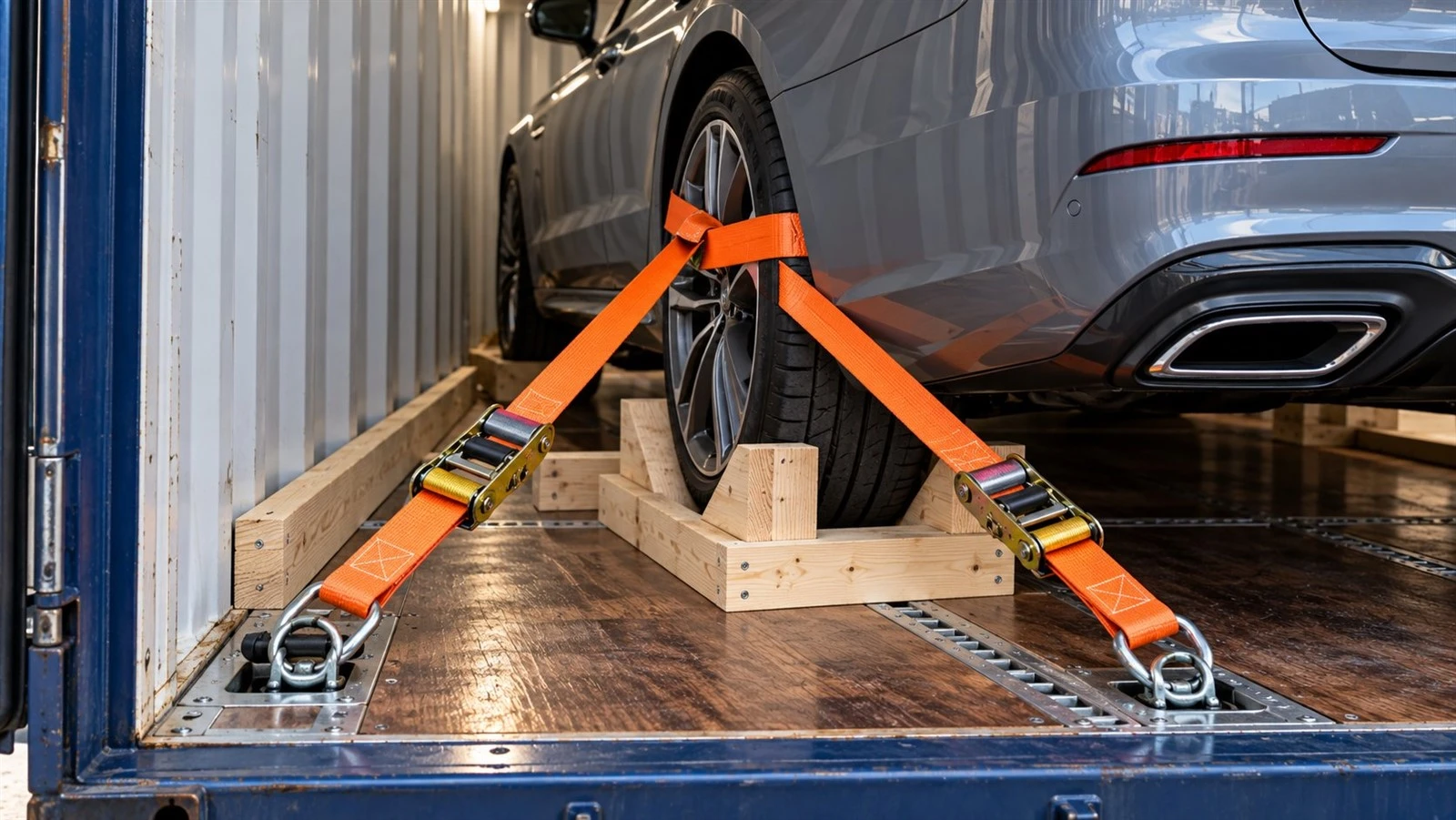
3. Wheel Chock Installation
Wooden or rubber chocks are placed tightly against the front and rear of each wheel, then nailed or bolted to the container floor. These chocks are the first line of defense against longitudinal movement. The timber used must be ISPM-15 heat-treated or fumigated to comply with international phytosanitary regulations.
4. Lashing Strap Application
A minimum of four lashing straps is applied, one per wheel. Each strap wraps over the tire and hooks into a floor lashing ring on either side.
The straps are arranged in a crossed or outward-splayed pattern so that the vehicle is restrained in both longitudinal and transverse directions simultaneously. Ratchet tensioners are tightened until the strap is firm but not over-tensioned, which could damage the suspension or deform the tire.
5. Void Filling and Side Support
Gaps between the vehicle and the container walls, or between adjacent vehicles in a multi-car load, are filled with inflatable dunnage bags or wooden blocking. This prevents lateral shifting.
The dunnage bags are inflated to the manufacturer's specified pressure, not over-inflated, and are checked for proper seating against the vehicle body without contacting painted surfaces directly.
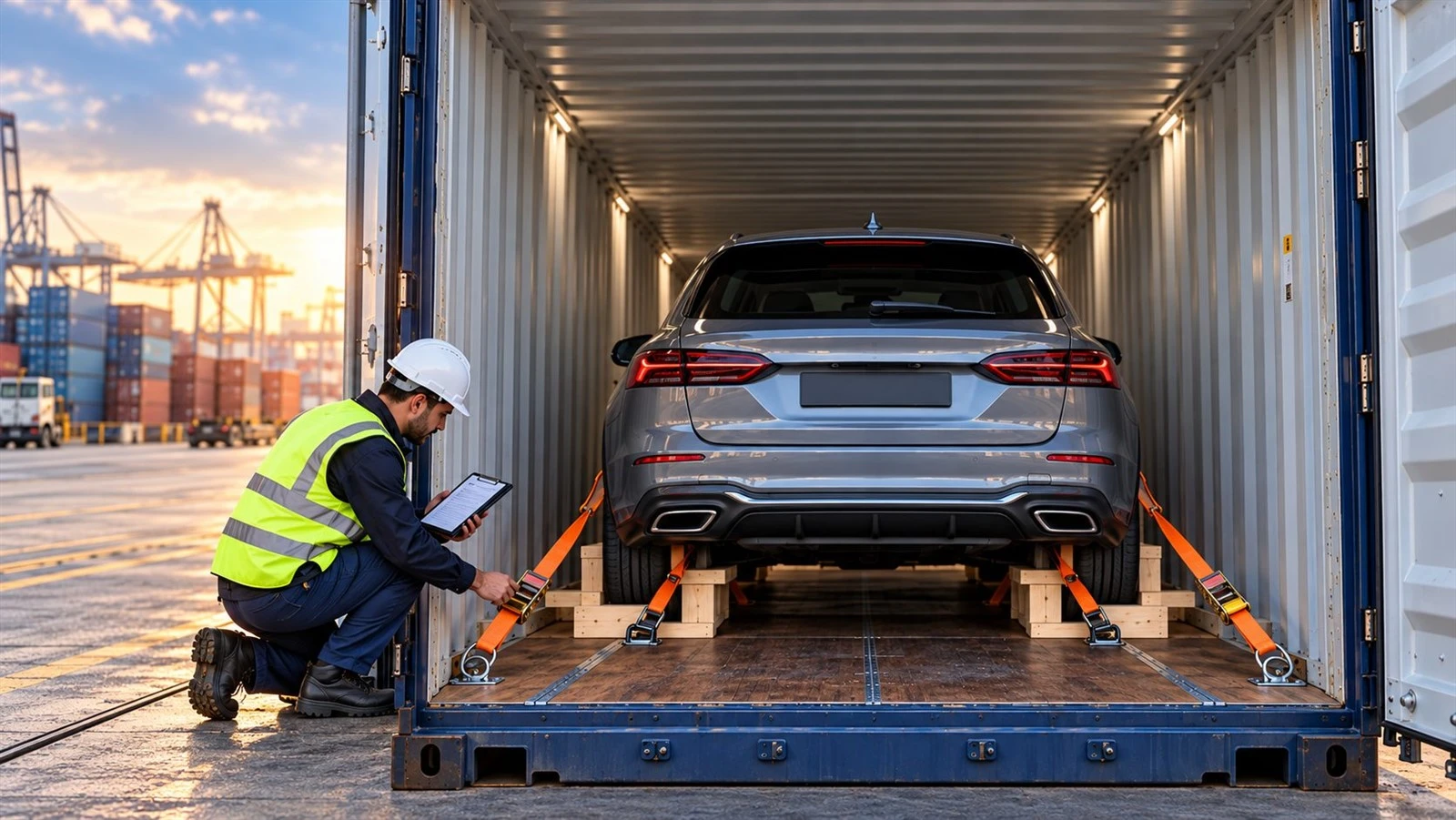
6. Final Inspection and Sealing
Every strap is checked for correct tension, every hook is verified to be seated in its ring, every chock is confirmed secure, and the container doors are checked for clearance.
A slight push or pull test on the vehicle confirms no detectable movement. Only then is the container sealed with a bolt seal and the seal number recorded on the bill of lading.
Inspection and photo records before loading, followed by confirmation of the secured condition, are also valuable risk-control steps. They help distinguish cargo securing from cargo protection and create a clear condition record if a problem is discovered later.
How Multiple Cars Are Secured in One Container
When multiple vehicles share a container, the complexity of vehicle lashing and car container loading increases significantly. The loading plan must account for vehicle dimensions, weight distribution, access for the crew to secure each vehicle, and minimum clearance between vehicles and between vehicles and container walls.
Industry guidelines recommend a minimum clearance of 60 mm between a vehicle and the container interior, though experienced operators prefer 100 mm or more to account for strap slackening during transit. In one documented case, a vehicle loaded with only 55 mm of clearance to the container door arrived with scratched paint after a road transport segment, even though the tires showed no visible displacement. The lashing straps had loosened just enough for the body to contact the container structure.
For two-tier loading in high-cube containers, purpose-built car racks are used. These are steel-framed platforms that allow a second vehicle to be parked above the first, effectively doubling the container's capacity. The rack itself is secured to the container floor with heavy-duty lashing, and the upper vehicle is secured to the rack using the same wheel-based lashing method.
This configuration requires careful weight calculation, as the combined weight of two vehicles plus the rack must stay within the container's maximum payload.
|
Container Type |
Vehicles (typical) |
Method |
|
20-foot standard |
1 sedan or compact car |
Direct drive-in, 4-point lashing |
|
40-foot standard |
2 sedans |
Direct drive-in, 4-point lashing per vehicle + dunnage |
|
40-foot high cube |
3–4 sedans |
Two-tier car rack system, lashing to rack and floor |
|
40-foot flat rack |
1 oversized or heavy vehicle |
Chain lashing to corner posts and floor rings |
Source: Typical loading configurations based on industry containerized vehicle shipping practices.
What Standards Apply to Vehicle Securing in Containers?
The securing of cargo inside shipping containers, including vehicles, is governed by an international framework that every shipper and freight forwarder should know. The cornerstone is the Code of Practice for Packing of Cargo Transport Units, commonly known as the CTU Code.
The CTU Code was jointly developed by three United Nations bodies: the International Maritime Organization (IMO), the International Labour Organization (ILO), and the United Nations Economic Commission for Europe (UNECE). While it is a non-mandatory instrument, it has become the de facto global standard for container packing and cargo securing. Shipping lines reference it in their booking terms, marine insurance underwriters use it to assess claims, and port state control authorities inspect against it.
The CTU Code covers the full lifecycle of container packing: pre-packing visual checks of the container, principles of weight distribution and center-of-gravity control, methods of securing such as lashing, blocking, bracing, and filling, and special provisions for dangerous goods.
For vehicle transport specifically, it provides guidance on lashing angles, the importance of using all available lashing points, and the principle that restraints must counter forces in all three directions. The broader international maritime safety framework is established by the SOLAS Convention, which remains a core reference for the safe carriage of cargo at sea.
The CTU Code identifies four fundamental cargo-securing methods: lashing (using straps, chains, or wires to tie the cargo down), filling (using dunnage or air bags to fill voids), supporting (using structural bracing against container walls), and blocking (using timber or steel blocks to prevent movement). A proper vehicle securing plan typically combines at least three of these four methods.
Beyond the CTU Code, several other standards are relevant to containerized vehicle transport:
|
Standard / Code |
Scope |
|
IMO Resolution A.714(17) - Code of Safe Practice for Cargo Stowage and Securing |
General principles of cargo securing on ships, including containerized cargo |
|
ISO 1496 (Series) - Container Standards |
Defines container dimensions, structural strength, and lashing fitting specifications |
|
EN 12195-1:2010 - Load Restraint on Road Vehicles |
Calculation of lashing forces; widely referenced for lashing capacity requirements |
|
ISPM-15 - International Phytosanitary Measure |
Mandatory heat treatment or fumigation of wooden dunnage and chocks used in international transport |
Source: Standard designations and scopes based on IMO, ISO, CEN, and IPPC published instrument references.
China's national standard GB/T 48309-2026, titled "Technical Specification for Loading and Safety Inspection of Container Rail-Water Intermodal Transport," was approved by the State Administration for Market Regulation in October 2026 and takes effect on January 1, 2027.
It codifies the four securing methods-lashing, filling, supporting, and blocking-into quantified technical requirements covering lashing material selection, lashing angles, air bag filling, door protection, and wedge fixation. While it specifically targets rail-water intermodal transport, its principles align with and reinforce the CTU Code framework.
How to Protect Cars from Damage Inside Containers
Securing the vehicle against movement is only half the battle. Cargo securing controls movement; cargo protection prevents scratches, contact damage, contamination, and handling damage even when the vehicle does not shift.
A car can be securely tied down and still be poorly protected. The other half of safe car shipping is therefore protecting the vehicle from the securing process itself and from the transport environment.
Body Protection
Corner protectors and rubber sleeves are placed at every point where a strap, chain, or dunnage contacts the vehicle body. Side mirrors are folded or removed. Antennas are retracted. Any protruding trim that could catch on the container doorway during loading is taped or removed.
Floor Protection
The container floor must be clean, dry, and free of oil, loose debris, or protruding nails. A contaminated floor can stain tires and undercarriage components. Some shippers lay a protective sheet or cardboard over the floor before driving the vehicle in.
Humidity and Condensation
Steel containers undergo significant temperature swings between day and night and between climate zones. Condensation can form on the container ceiling and drip onto the vehicle.
Desiccant bags are hung inside the container, and vehicles with fabric or leather interiors may have their windows left slightly open with a moisture-absorbing insert, though this must be balanced against dust ingress.
Battery and Fluids
For longer voyages, the vehicle battery is typically disconnected to prevent drain and reduce fire risk. Fuel tanks are kept at a low level, typically a quarter tank or less, to reduce flammable cargo weight and comply with applicable carrier requirements.
For electric vehicles, additional precautions can apply because of lithium-ion battery considerations.
Common Failures and How to Avoid Them
Industry data from cargo inspections across multiple countries reveals a sobering picture: of the cargo transport units inspected, over 10 percent were found to have deficiencies, including improper documentation, inadequate marking, poor packing, and insufficient cargo securing. While not all of these involved vehicles, the rate underscores how common securing failures are.
Based on documented incidents and claims analysis, the most frequent vehicle-securing failures fall into a few categories:
|
Failure Mode |
Consequence |
Root Cause |
|
Straps attached to chassis or bumper instead of wheels |
Strap cuts into body panel; vehicle shifts on suspension |
Inexperienced crew; no loading diagram |
|
Insufficient number of straps (fewer than four) |
Vehicle rotates or slides in transverse direction |
Cost-cutting; underestimation of sea forces |
|
Dunnage bags under-inflated or missing |
Lateral movement; vehicle contacts container wall or adjacent vehicle |
Rushed packing; pressure not verified |
|
Wooden chocks not nailed to floor |
Chocks dislodge during first heavy roll; vehicle rolls freely |
Crew skipped nailing step; assumed straps alone suffice |
|
Inadequate clearance to container door |
Vehicle body contacts door structure; paint and panel damage |
Loading plan did not account for strap slackening |
Source: Failure modes based on documented cargo damage cases and industry claims analysis.
The pattern is clear: most failures are not caused by equipment failure but by procedural shortcuts. The straps were strong enough, the chocks were the right size, and the dunnage bags were available. What failed was the execution: a step skipped, a shortcut taken, or a check not performed.
This is why professional packing and supervision rely on written loading diagrams, checklists, condition records, and a final inspection before sealing.
That discipline matters especially in repeat vehicle-export programs. Wilson has recent operating experience with used cars, pickups, buses, and other vehicle exports, and in 2020 became a logistics partner for a major Chinese automotive group. The practical lesson is that repeatable loading plans, vehicle protection, photo records, and securing checks matter as much as the ocean freight rate itself.
For importers who are still at the sourcing and export-planning stage, our guide on how to ship a used car from China covers the broader process beyond container securing.
How EVs and Heavy Vehicles Are Secured Differently
Electric vehicles (EVs) deserve special mention because their risk profile differs from internal combustion vehicles. The lithium-ion battery pack adds significant weight concentrated low in the chassis, which lowers the center of gravity but also means that battery condition and carrier acceptance requirements need additional attention.
International maritime requirements for dangerous goods are governed through the IMO's IMDG Code framework, and the exact treatment of a vehicle shipment depends on its condition, battery characteristics, carrier policy, and applicable classification.
For containerized EV transport, the physical securing method is essentially the same wheel-based vehicle lashing, but with additional precautions. The preferred approach combines wheel lashing straps, four-wheel chocks, and lateral air bags as a three-part restraint system rather than relying on chassis-based tie-downs alone.
The battery management system should be in a transport-safe state, and some shipping lines may impose additional conditions. Wilson also provides used new energy vehicle shipping from China for projects that require vehicle-specific export and transport planning.
For heavy vehicles, construction equipment, and oversized machinery that exceed standard container dimensions, flat rack containers are used. Securing shifts from webbing straps to steel chains with load binders, anchored to the flat rack's corner posts and lashing rings.
The lashing angle becomes critical: the optimal angle is between 25 and 55 degrees from horizontal, with 45 degrees considered ideal for maximizing both downward and lateral restraint. Heavy vehicles may require six or more chain lashings, and a calculated lashing plan with a certified strength assessment.
FAQ
How many straps are used to secure a car in a shipping container?
For a typical passenger vehicle, the article's securing method uses a minimum of four lashing straps, one per wheel. The straps work together with wheel chocks, blocking, bracing, or dunnage so the vehicle is restrained in more than one direction.
Are wheel chocks enough to keep a car from moving?
No. Wheel chocks mainly help prevent rolling in the fore-aft direction. Safe vehicle securing in a shipping container uses a layered system that also includes ratchet straps or other lashings, suitable tie-down points, and lateral restraint such as blocking or dunnage.
Can more than one car be shipped in a container?
Yes. A 40-foot or 40-foot high-cube container can be used for multi-vehicle loading when the vehicle sizes, combined weight, clearance, securing access, and loading plan allow it. Two-tier rack systems may also be used for some high-cube configurations.
Is container shipping always better than RoRo for cars?
Not necessarily. The better method depends on the vehicle dimensions, weight, value, drivability, destination, route availability, and protection requirements.
Before booking, compare the advantages and limitations of RoRo vs container shipping for vehicles rather than forcing every vehicle into the same transport mode.
How are electric vehicles secured inside shipping containers?
The physical restraint method is broadly similar to other vehicles: wheel-based lashings, wheel chocks, and lateral restraint are used to control movement. EV shipments can also involve additional battery-related carrier requirements, so the vehicle condition and shipping-line acceptance rules should be checked before loading.
Conclusion
Cars are secured inside shipping containers by combining the right container and loading plan with wheel chocks, wheel-based lashings, blocking or bracing, dunnage, adequate clearance, and a final inspection. The safest result comes from treating vehicle securing as a complete system and treating cargo protection as a separate but equally important part of the job.
For importers, exporters, and traders, the main practical judgment is simple: plan before loading, restrain movement in multiple directions, protect the vehicle from contact damage, and document its condition before the container is sealed.
If you are planning car shipping from China, Zhejiang Wilson Supply Chain Management Co., Ltd. can help review container choice, loading layout, vehicle protection, and the wider export logistics plan. Founded in 2011, Wilson has a 26-person experienced logistics team and handles about 56,000 TEU annually across its broader freight operation; contact us to discuss the vehicle type, quantity, destination, and preferred shipping method for your project.