The short answer is yes, but only under certain conditions. Roll-on/Roll-off (RoRo) shipping is designed around vehicles being driven onto and off the vessel under their own power. When a vehicle cannot move normally, the loading and unloading process changes, and not every carrier, port, or route is willing or equipped to handle it.
A non-running vehicle is not necessarily a non-movable vehicle. A car with a dead battery or engine fault may still roll, steer, and brake safely, while an accident-damaged vehicle with locked wheels or failed steering presents a very different handling problem. For non-running vehicle RoRo shipping, the key question is therefore not simply whether the engine starts, but whether the vehicle can be safely moved, controlled, loaded, secured, and discharged.
For exporters shipping used cars, salvage vehicles, project vehicles, or machinery from China, understanding these differences before booking can help avoid rejected cargo, unexpected handling charges, and delays at the port.
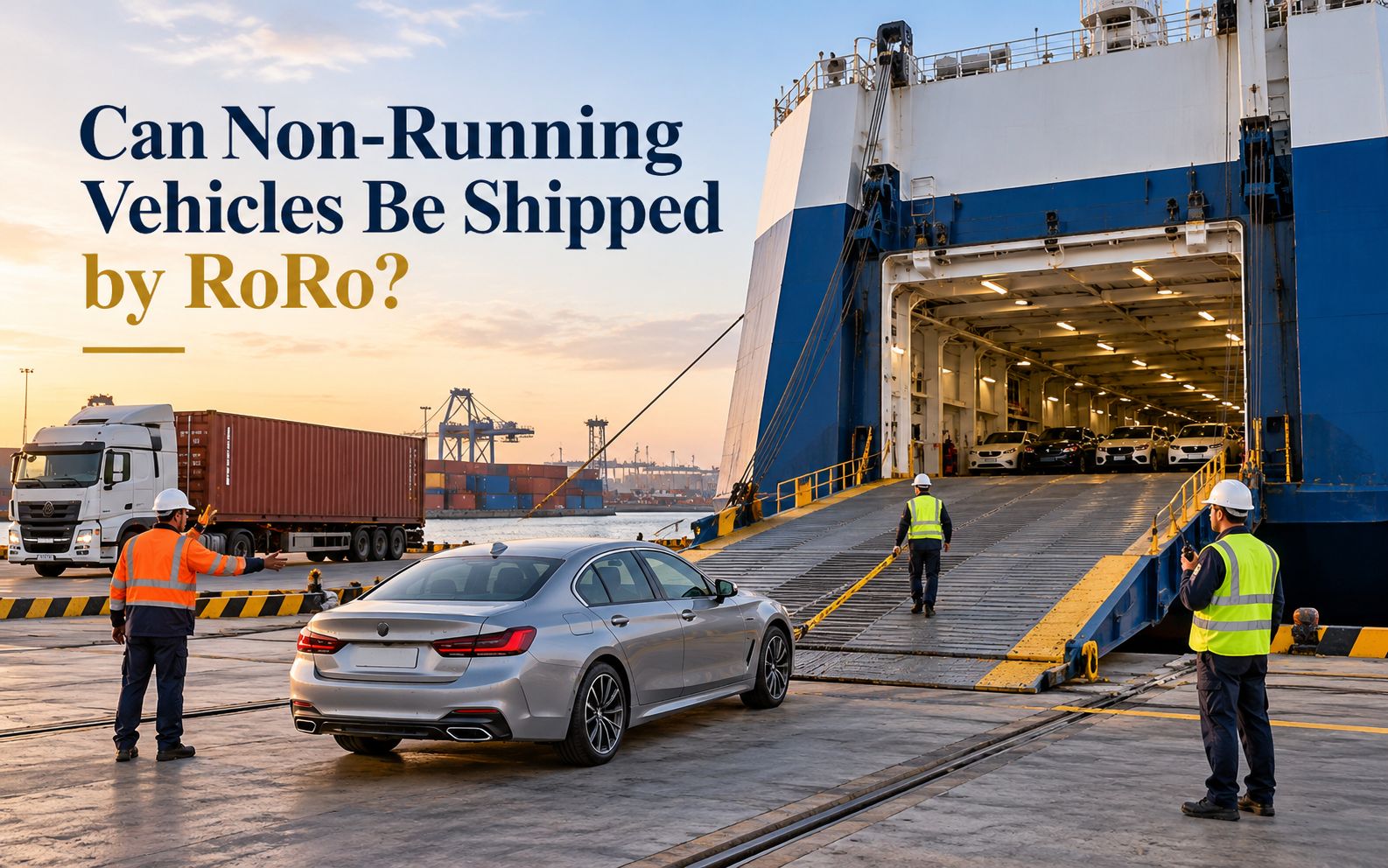
How RoRo Vehicle Shipping Works
RoRo vessels are designed with internal ramps and multiple deck levels that allow wheeled cargo to move directly into the ship's hold. A RoRo vessel operates much like a large floating parking structure: vehicles enter through a stern or side ramp, are positioned on designated decks, and are secured using approved lashing systems.
If you are new to this transport mode, this guide to how RoRo shipping works provides a broader explanation of the process, suitable cargo types, and common operating procedures.
This design offers three important advantages for vehicle shipping:
|
Advantage |
What It Means for You |
|
Speed |
Loading and unloading is generally faster than container or lift-on/lift-off handling |
|
Cost efficiency |
For running vehicles in standard dimensions, RoRo is often an economical ocean freight option |
|
Protection |
Vehicles are normally stowed inside the vessel's cargo decks and protected from direct weather and sea spray during transit |
The operating model, however, normally assumes that a vehicle can either move under its own power or be safely moved under controlled conditions.
When that assumption no longer applies, RoRo vehicle shipping requirements become much more important.
Why Non-Running Vehicles Are More Difficult to Ship by RoRo
A non-running vehicle may be unable to start, unable to move under its own power, or unable to steer normally. These conditions create several practical challenges during RoRo handling.
Loading and unloading may require special equipment. Standard RoRo loading involves driving a vehicle up the vessel ramp and positioning it on deck. An inoperable vehicle may instead need to be pushed, towed, winched, or moved using specialized equipment. Suitable handling equipment must be available at both the origin and destination ports.
Securing may become more complicated. Vehicles need suitable and accessible securing points so they can be properly lashed during ocean transportation. If accident damage, a damaged chassis, missing wheels, or other structural problems prevent normal securing, the vehicle may not meet the carrier's cargo acceptance requirements.
Cargo securing is not simply a carrier preference. Safe stowage and carriage are part of the wider international maritime safety framework established through SOLAS requirements for the safe carriage of cargo.
Steering and braking are particularly important. Even if a vehicle can be towed, it may still need to be controlled while moving on ramps and through vessel decks. Locked steering, seized wheels, or ineffective brakes can turn an otherwise towable vehicle into a serious handling risk.
This is why non-running does not automatically mean non-RoRo. A useful distinction is:
- Non-running but movable: the engine does not start, but the vehicle rolls, steers, and brakes.
- Non-running and non-movable: the vehicle cannot roll freely, steer safely, brake properly, or be handled using normal towing procedures.
The first category may still qualify for RoRo on some services. The second often requires another shipping method.
What RoRo Carriers Usually Require for Non-Running Vehicles
Policies for inoperable vehicle shipping by RoRo vary significantly between carriers, terminals, routes, and vessel types. Some international RoRo operators accept only very limited categories of non-running units, while others may consider towable vehicles subject to prior approval.
Typical requirements include:
|
Condition |
Detail |
|
Advance notification |
The non-running condition should be declared during the booking process rather than when the vehicle reaches the terminal |
|
Special handling |
Towing, winching, forklift assistance, or other handling may generate additional charges |
|
Port capability |
Both origin and destination terminals must be capable of handling the vehicle |
|
Steering and braking |
Towable vehicles will generally need adequate steering, braking, and free-rolling wheels for controlled handling |
|
Carrier approval |
Acceptance must be confirmed for the specific cargo, route, terminal, and sailing |
The practical lesson is simple: never assume a standard RoRo booking automatically covers a non-running vehicle.
Before booking, the freight forwarder should confirm the exact vehicle condition and then check the relevant carrier and terminal acceptance requirements. This is especially important when arranging RoRo car shipping from China, because acceptance rules can vary by route, vessel, and destination terminal.
When a Non-Running Vehicle May Still Be Shipped by RoRo
Despite the restrictions, some non-running vehicles can still be moved by RoRo.
Vehicles With Minor Starting Problems
A vehicle may not start because of a dead battery, minor electrical issue, missing key, or similar fault while remaining mechanically movable.
If the wheels roll freely and the steering and braking systems remain functional, the vehicle may be towable or otherwise movable using suitable port equipment, subject to carrier approval.
Vehicles That Can Be Safely Towed
If a car cannot start but:
- rolls freely,
- can be steered,
- has functioning brakes,
- has intact wheels and tires, and
- has suitable securing points,
RoRo may still be considered.
This is an important distinction for anyone researching non-running car shipping. The engine itself is only one part of the acceptance decision. Safe cargo handling matters just as much.
Heavy Equipment and Wheeled Machinery
Some RoRo services are designed for high-and-heavy cargo, including construction equipment, agricultural machinery, trucks, industrial vehicles, and other wheeled equipment.
Machinery that is not road-registered or cannot operate normally may still be accepted if it can be safely towed or repositioned and the vessel and terminals are equipped to handle it.
Wilson's vehicle and heavy-equipment logistics services cover used vehicles, SUVs, pickups, trucks, buses, engineering machinery, and other equipment, with transportation options including RoRo, containers, Flat Rack, Open Top, and Breakbulk depending on cargo condition and dimensions. For broader vessel and cargo options, customers can also review Wilson's RoRo transport services.
Cargo Moving on RoRo/Lo-Lo Services
Some vessels or project services combine roll-on/roll-off operations with lift-on/lift-off capability.
For oversized or non-functional units that cannot use a vessel ramp safely, crane loading may sometimes provide an alternative. Whether this is available depends on the vessel, terminal facilities, cargo dimensions, and specific route.
When RoRo Is Not Suitable for a Non-Running Vehicle
For many severely damaged or completely immobilized vehicles, RoRo is not the best solution.
Severely Damaged or Dismantled Vehicles
A vehicle with missing wheels, significant structural damage, a bent chassis, or partial dismantling may be difficult to move and secure safely.
In these situations, container shipping for non-running cars, Flat Rack transportation, or another specialized shipping solution may be more practical.
Vehicles Without Functional Steering or Brakes
A vehicle that cannot be steered or controlled during movement creates a substantial safety problem on a RoRo ramp and inside the vessel.
Even where towing equipment is available, the inability to control the unit may make the shipment unsuitable for conventional RoRo operations.
Classic, Luxury, or High-Value Vehicles
Even when a high-value non-running vehicle can technically be towed onto a RoRo vessel, container shipping may offer a more controlled handling environment.
For fragile, modified, collectible, or high-value vehicles, the decision should consider not only ocean freight cost but also:
- handling frequency,
- cargo protection,
- loading method,
- securing requirements,
- potential damage exposure, and
- the cost of an incident.
A cheaper base freight rate does not necessarily produce the lowest total logistics cost once special handling, waiting time, equipment charges, storage, or abnormal operations are included.
Vehicles Requiring Parts or Additional Cargo to Move Together
RoRo operators commonly restrict loose cargo, spare parts, tools, and personal belongings from being carried inside vehicles.
Where the shipment needs to combine a vehicle with additional permitted cargo, container shipping may provide greater flexibility, subject to customs rules and carrier requirements.
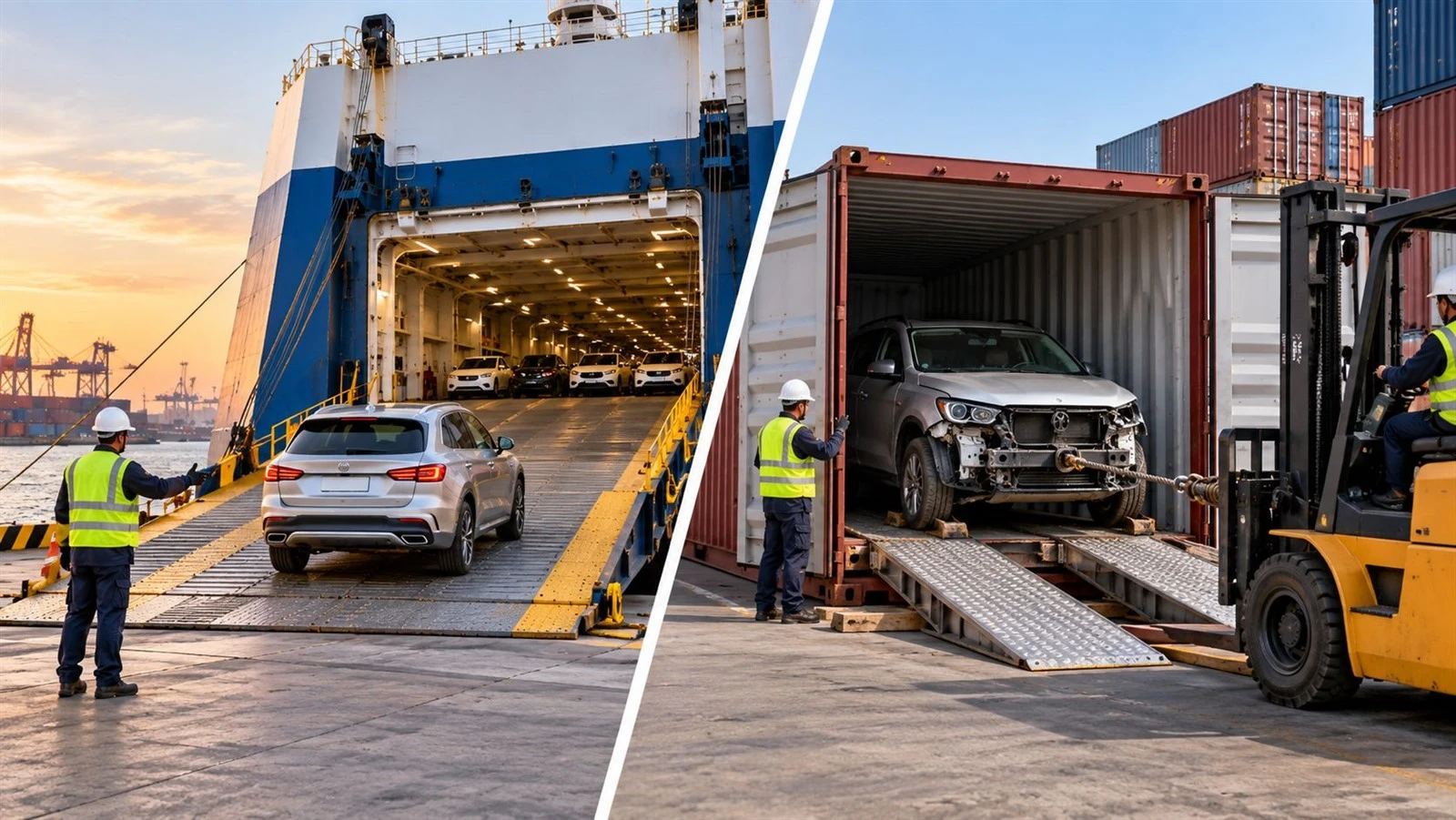
Container Shipping for Non-Running Vehicles
When RoRo cannot accommodate an inoperable vehicle, container shipping is one of the most common alternatives-and in some cases, it is the better choice from the beginning.
A standard 20-foot container can normally accommodate one vehicle, while a 40-foot container may accommodate multiple vehicles depending on their dimensions and the loading plan.
Non-running vehicles can be loaded using ramps, winches, forklifts, or other suitable equipment and then secured inside the container with wheel chocks, straps, braces, or other approved securing methods.
|
Factor |
RoRo |
Container |
|
Non-running acceptance |
Limited and carrier-dependent |
Generally more flexible |
|
Cost |
Often lower for standard running vehicles |
Higher base cost in many cases |
|
Protection |
Protected during vessel stowage, but vehicle handling remains separate |
Cargo remains inside the container after loading |
|
Additional cargo |
Usually restricted |
Greater flexibility, subject to customs and carrier rules |
|
Loading method |
Driven, towed, or otherwise moved onto the vessel |
Ramp, winch, forklift, or specialized container loading |
|
Best suited for |
Standard vehicles that can be safely handled |
Non-running, high-value, damaged, modified, or specially handled vehicles |
For a non-running vehicle, containerization can eliminate the need to move the vehicle along the vessel's RoRo ramp. Instead, the vehicle is loaded and secured before the container enters the vessel-handling system.
That can be particularly useful when the vehicle itself cannot be safely driven through a RoRo terminal. Wilson also provides used car container shipping from China for vehicles better suited to containerized transportation.
How to Choose Between RoRo and Container Shipping
Before booking RoRo shipping for a non-running vehicle, work through the following questions with your freight forwarder.
Can the vehicle roll, steer, and brake?
If the engine does not run but the wheels move freely and the vehicle can still be controlled, RoRo may remain possible subject to carrier approval.
Can the vehicle be safely towed or winched?
A towable vehicle is very different from a vehicle with locked wheels, severe accident damage, or failed steering.
What does the carrier accept?
Non-running vehicle policies vary between international RoRo operators. Acceptance should be confirmed for the actual cargo and sailing rather than based on general assumptions.
Can both ports handle the vehicle?
Origin-terminal acceptance alone is not enough. The destination terminal must also be capable of discharging and moving the vehicle safely.
How valuable or fragile is the vehicle?
High-value vehicles may justify the additional protection and controlled loading available through container shipping.
What are the dimensions, weight, and physical condition?
These factors may determine whether RoRo, a standard container, Flat Rack, Open Top, or Breakbulk is the better solution.
What is the total cost rather than just the ocean freight rate?
Special handling charges, terminal fees, equipment use, storage, waiting time, loading costs, and possible abnormal-operation charges can change the economics significantly.
For readers comparing the two principal methods in more detail, this guide to RoRo vs container shipping for vehicles explains their differences in cost, handling, protection, and cargo suitability.
For complex vehicle shipments, Wilson evaluates cargo based on factors including dimensions, weight, center of gravity, value, whether the cargo can move under its own power, and destination requirements before selecting the shipping method.
This leads to a useful rule for non-running vehicle logistics:
Do not treat a non-running vehicle as a RoRo booking problem. Treat it as a transport-mode selection problem.
The objective is not to force the vehicle onto RoRo, but to determine whether RoRo, container shipping, Flat Rack, Open Top, or Breakbulk offers the best combination of safety, feasibility, and total cost.
How Wilson Handles Vehicle Shipping From China
Zhejiang Wilson Supply Chain Management Co., Ltd. provides international freight forwarding and specialized logistics services for vehicles, heavy equipment, oversized cargo, and other complex shipments moving from China to global markets.
For vehicle projects, the first step is to understand the actual cargo condition rather than simply label it "running" or "non-running." Relevant information includes the vehicle type, dimensions, weight, mechanical condition, wheel condition, steering and braking capability, origin, destination, and any special handling requirements.
Wilson's vehicle export experience includes used cars, pickups, buses, trucks, and other vehicle projects. The company can evaluate multiple shipping modes-including RoRo, container, Flat Rack, Open Top, and Breakbulk-instead of relying on a single transport method.
Where special handling is required, the same assessment also considers loading planning, securing points, vehicle protection, anti-movement measures, documentation, carrier requirements, and destination-port coordination.
For customers still planning the broader purchase and export process, our guide on how to ship a used car from China covers the main steps beyond transport-mode selection.
Wilson has been operating since 2011 and has a professional logistics team serving customers across Southeast Asia, the Middle East, India-Pakistan, Africa, Europe, the Americas, and other markets. As a China freight forwarding company, Wilson coordinates international transportation together with customs, warehousing, cargo handling, and related supply-chain services where required.
For customers shipping non-running cars or other difficult vehicle cargo from China, the practical value is having the vehicle condition assessed before booking, so an unsuitable transport method can be avoided before the cargo reaches the terminal.
FAQ
Can a Car With a Dead Battery Be Shipped by RoRo?
Potentially, yes. A dead battery does not necessarily make a vehicle unsuitable for RoRo. If the vehicle can roll, steer, brake, be safely moved, and meets the carrier's acceptance requirements, RoRo may still be possible.
Carrier approval should always be obtained before delivery to the terminal.
Does a Vehicle Have to Run to Be Shipped by RoRo?
Not always.
Some RoRo services may accept towable or specially handled vehicles, but the rules vary significantly. A vehicle that does not start but still rolls, steers, and brakes has a better chance of acceptance than one that is completely immobilized.
Can a Damaged Car Be Shipped by RoRo?
It depends on the extent of the damage.
Minor mechanical problems may still allow RoRo transportation. Severe accident damage, missing wheels, structural damage, locked steering, or failed brakes can make RoRo unsuitable.
In these cases, container shipping, Flat Rack, or another specialized method should be evaluated.
Is RoRo or Container Shipping Better for a Non-Running Vehicle?
RoRo can be economical if the vehicle remains safely movable and the carrier accepts it.
Container shipping generally offers greater flexibility for vehicles that cannot move normally, require special loading, are high-value, or need additional protection.
The best choice depends on vehicle condition, dimensions, route, carrier restrictions, handling requirements, and total shipping cost.
What Information Is Needed to Quote Shipping for a Non-Running Vehicle?
A freight forwarder will normally need the:
- vehicle make and model,
- vehicle type,
- dimensions,
- weight,
- origin and destination,
- photos,
- reason the vehicle does not run,
- wheel and tire condition,
- steering condition,
- braking condition, and
- confirmation of whether the vehicle can be safely towed or winched.
Providing accurate condition information at the beginning makes it much easier to determine whether RoRo or an alternative shipping method is suitable.
Final Thoughts
Can non-running vehicles be shipped by RoRo? Yes, in some cases-but "non-running" alone is not enough to determine eligibility. The more important questions are whether the vehicle can roll, steer, brake, be safely moved and secured, and whether the carrier and both terminals accept its condition.
For vehicles that cannot meet those requirements, container shipping, Flat Rack, Open Top, or Breakbulk may provide a safer and more practical alternative.
If you are shipping a non-running vehicle from China, Zhejiang Wilson Supply Chain Management Co., Ltd. can assess the vehicle condition, route, handling requirements, and available transport options before booking. Contact our team with your vehicle details and destination, and we can help you compare RoRo with alternative shipping solutions for your specific project.