China remains the world's largest exporter, with international maritime freight volume accounting for roughly one-third of the global total and container throughput at major Chinese ports exceeding 350 million TEU annually. For overseas importers, traders, and B2B buyers, understanding how to ship goods from China efficiently - and how shipping from China works in practice - is the difference between a healthy supply chain and costly delays. This guide walks through every layer of the process, from choosing the right shipping method to preparing documents, estimating costs, and navigating customs clearance.
Shipping Methods from China
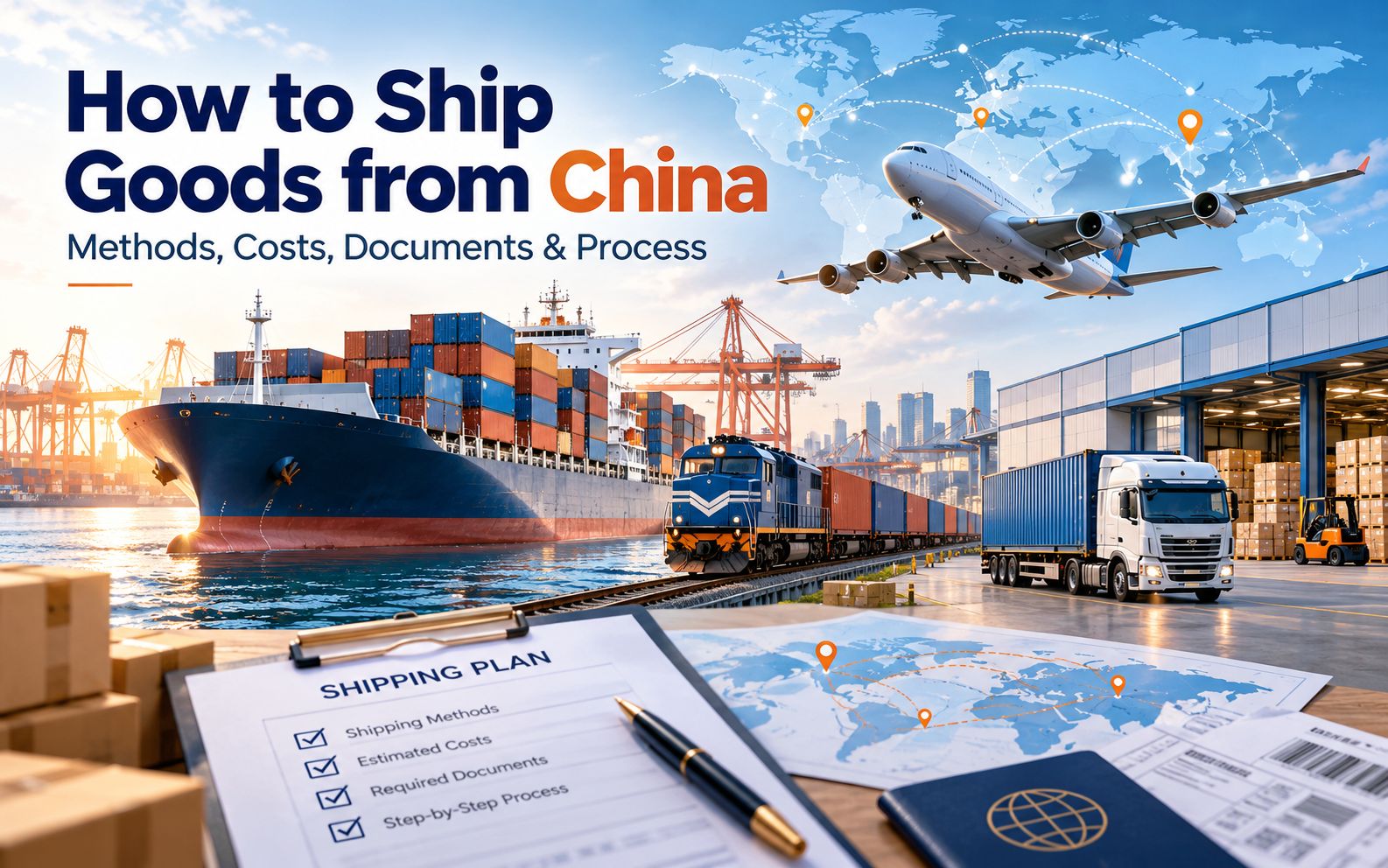
Choosing the right shipping method is the foundation of any international logistics strategy. Each option balances cost, speed, and cargo type differently. Below is a breakdown of the four primary methods for shipping goods from China.
Sea Freight (FCL & LCL)
The most common and cost-effective method for bulk shipments. Full Container Load (FCL) dedicates an entire container to one shipper, ideal for large volumes. Less than Container Load (LCL) consolidates multiple shippers' goods into one container, suitable for smaller orders. Sea freight handles the vast majority of China's export volume and is the default choice for B2B cargo where transit time is flexible.
Air Freight
The fastest option for time-sensitive or high-value goods. Air cargo from China reaches major global destinations in approximately 3 to 10 days, depending on route and service level. It is significantly more expensive than sea freight but indispensable for electronics, pharmaceuticals, fashion seasonal launches, and urgent replenishment. Major gateways include Shanghai Pudong (PVG), Guangzhou Baiyun (CAN), and Shenzhen Bao'an (SZX).
Rail & Multimodal
The China-Europe Railway Express offers a middle ground between sea and air - faster than ocean freight (roughly 13 to 18 days to Europe) and far cheaper than air cargo. Multimodal transport combines rail, sea, and road to optimize cost and speed, increasingly used for shipments to Central Asia, Russia, and European inland cities. The UN's adoption of the Negotiable Cargo Document Convention in December 2025 is expected to further streamline multimodal documentation.
Express Courier
For small parcels and samples, major international express courier services deliver door-to-door in 3 to 7 days. While the per-kilogram cost is the highest, it requires minimal documentation and is the go-to for urgent samples, replacement parts, and low-volume e-commerce orders.
Method Comparison at a Glance
|
Method |
Transit Time |
Cost Level |
Best For |
|
Sea Freight (FCL) |
20–40 days |
Low |
Large-volume B2B cargo |
|
Sea Freight (LCL) |
25–45 days |
Low–Medium |
Small to medium orders |
|
Air Freight |
3–10 days |
High |
Time-sensitive, high-value goods |
|
Rail (China–Europe) |
13–18 days |
Medium |
European inland destinations |
|
Express Courier |
3–7 days |
Highest |
Samples, small parcels |
Transit times are approximate ranges based on major routes (China to North America, Europe, Middle East) and vary by season, port congestion, and routing.
Understanding Shipping Costs
Shipping costs from China are not a single line item - they are a composite of freight rates, surcharges, destination charges, and ancillary fees. Understanding each component of freight shipping from China helps importers budget accurately and avoid surprise charges.
Key Cost Components
|
Component |
Description |
Typical Impact |
|
Base Freight Rate |
Core ocean or air rate from origin to destination |
60–75% of total |
|
Bunker Adjustment (BAF) |
Fuel surcharge, fluctuates with oil prices |
5–15% of total |
|
Terminal Handling (THC) |
Origin/destination port handling charges |
USD 100–300 per container |
|
Customs Duties & VAT |
Import taxes at destination country |
Varies by HS code & country |
|
Documentation Fees |
Bill of lading, certificate of origin, etc. |
USD 30–100 per shipment |
|
Insurance |
Cargo insurance (typically 0.1–0.5% of cargo value) |
0.1–0.5% of value |
Cost ranges are indicative and subject to market conditions, seasonality, and route specifics.
Sea freight costs dropped significantly in 2025 as the Red Sea situation stabilized and carriers returned to Suez Canal routing. Asia–Europe container rates fell to roughly USD 4,000 per FEU, down from crisis-period peaks.
What Drives Cost Variation
Several factors cause shipping rates to fluctuate week to week and route to route:
|
Factor |
How It Affects Cost |
|
Seasonality |
Peak season (Aug–Oct before Christmas) drives rates up 20–40% |
|
Fuel Prices |
Directly reflected in BAF surcharges |
|
Container Availability |
Shortages at origin push up FCL rates |
|
Route & Distance |
Longer routes and transshipment increase base rate |
|
Cargo Type |
Dangerous goods, reefer, oversized cargo carry premiums |
|
Trade Policy |
Tariffs and port fees (e.g., US Section 301 vessel fees from Oct 2025) add cost |
3–10 days
Air freight transit, China to major global destinations
Essential Shipping Documents
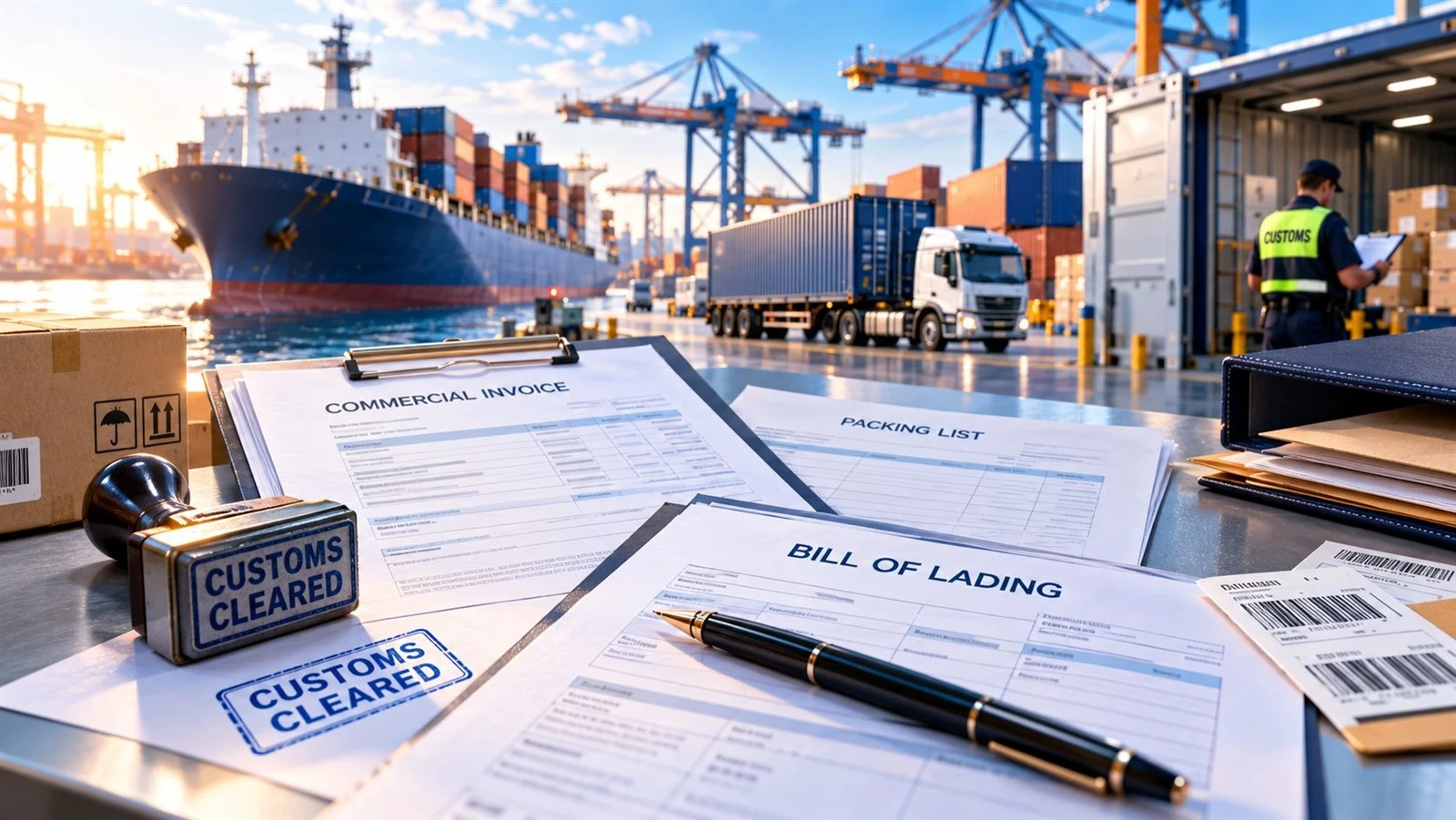
Documentation is the backbone of international trade. Missing or incorrect paperwork is the single most common cause of customs delays, fines, and shipment rejection. Below are the essential shipping documents from China required for most shipments, plus those needed for specific cargo or destination-country scenarios.
Core Documents (Every Shipment)
|
Document |
Purpose |
Issued By |
|
Commercial Invoice |
Declares transaction value, HS code, terms of sale; basis for duty calculation |
Exporter / Seller |
|
Packing List |
Details cargo contents, weight, dimensions, packaging per package |
Exporter / Seller |
|
Transport contract, receipt of goods, title document for sea freight |
Carrier / Freight Forwarder |
|
|
Customs Declaration |
Official export declaration filed via China Single Window system |
Customs Broker / Exporter |
Conditional & Special Documents
|
Document |
When Required |
|
Certificate of Origin (CO) |
When the destination country offers preferential tariff treatment (e.g., FTA, RCEP) |
|
Inspection / Quarantine Certificate |
For food, pharmaceuticals, chemicals, and goods subject to commodity inspection |
|
Dangerous Goods Declaration (MSDS) |
For hazardous materials - lithium batteries, chemicals, flammable goods |
|
Export License |
For controlled goods - rare earths, ozone-depleting substances, certain vehicles |
|
Phytosanitary Certificate |
For plant, wood, and agricultural products |
|
ATA Carnet |
For temporary imports - exhibitions, commercial samples, professional equipment |
China's customs authorities have progressively implemented paperless declaration. Since 2025, the Single Window system allows electronic submission of most accompanying documents, and customs declaration forms can be self-printed after clearance. However, the physical bill of lading and certain certificates may still be required by destination-country customs.
The Shipping Process Step by Step
A typical shipping process from China follows a structured sequence. Understanding each step helps importers coordinate with suppliers, a China freight forwarder, and customs brokers to keep cargo moving without bottlenecks.
Step 1: Inquiry & Quotation
The importer provides cargo details (type, volume, weight, origin, destination, Incoterms) to a freight forwarder. The forwarder issues a quotation covering freight, surcharges, and estimated transit time. At this stage, the Incoterm (e.g., FOB, CIF, DDP) defines who bears which costs and risks.
Step 2: Booking & Space Allocation
Once the quote is accepted, the forwarder books space with the carrier (shipping line, airline, or rail operator). A booking confirmation is issued, locking in the vessel or flight schedule. For FCL, a container is allocated; for LCL, cargo is scheduled for consolidation.
Step 3: Cargo Ready & Stuffing
The supplier prepares goods for export. For FCL, the container is delivered to the factory or warehouse for loading (or cargo is delivered to a designated CFS for LCL consolidation). Proper packing, labeling, and marking are critical - especially for dangerous goods and oversized cargo.
Step 4: Export Customs Declaration
The customs broker files the export declaration through China's Single Window system, submitting the commercial invoice, packing list, contract, and any required licenses or certificates. Per customs regulations, export declaration must be filed after goods arrive at the customs supervision zone and at least 24 hours before loading.
Step 5: Loading & Departure
Once customs releases the cargo, the container is loaded onto the vessel (or cargo onto the aircraft/train). The carrier issues the bill of lading or air waybill. The forwarder sends shipping advice and document copies to the importer.
Step 6: Transit & Tracking
Cargo is in transit. Modern forwarders provide real-time tracking via carrier APIs. For sea freight, typical transit to North America's West Coast is about 14–20 days; to Europe, 30–40 days via Suez Canal. Air freight reaches most global hubs in 3–7 days.
Step 7: Destination Customs Clearance
Upon arrival, the importer (or their broker) files the import declaration with destination-country customs. Duties, VAT, and any applicable excise taxes are paid. The bill of lading, commercial invoice, packing list, and certificate of origin are submitted. Customs may inspect the cargo before release.
Step 8: Last-Mile Delivery
After customs release, the cargo is picked up from the terminal and delivered to the importer's warehouse or designated address. For DDP shipments, the forwarder manages this entire destination leg, including duty payment and delivery.
Incoterms & DDP Shipping
Incoterms - the international commercial terms published by the International Chamber of Commerce (ICC), currently in the Incoterms 2020 edition - define the allocation of costs, risks, and responsibilities between buyer and seller. Choosing the right Incoterm is one of the most important decisions in international shipping.
Most Common Incoterms for China Exports
|
Incoterm |
Seller's Responsibility |
Buyer's Responsibility |
|
EXW (Ex Works) |
Makes goods available at factory |
Export clearance, freight, import clearance, all transport |
|
FOB (Free On Board) |
Delivers goods loaded on vessel at origin port |
Ocean freight, insurance, import clearance, duties |
|
CIF (Cost, Insurance & Freight) |
Freight + insurance to destination port |
Import clearance, duties, inland transport |
|
DAP (Delivered At Place) |
Delivers to named destination (import duties unpaid) |
Import clearance and duties |
|
DDP (Delivered Duty Paid) |
All costs, risks, and duties to final destination |
Takes delivery - no customs or duty obligation |
DDP (Delivered Duty Paid) places maximum responsibility on the seller - covering export and import customs clearance, all transport, insurance, and payment of duties and taxes at destination. Under Incoterms 2020, DDP is the only term where the seller handles import clearance. For B2B importers who want a hassle-free, door-to-door experience, DDP is the most convenient option - the forwarder manages the entire chain from the Chinese factory to the buyer's warehouse, including duty payment and last-mile delivery.
Why Choose DDP?
Simplified Logistics
The buyer deals with a single point of contact. The forwarder handles origin pickup, export declaration, international freight, destination customs clearance, duty payment, and final delivery - all under one contract.
Predictable Landed Cost
Because duties and taxes are pre-calculated into the quote, the buyer knows the total landed cost upfront - no surprise charges at destination.
Faster Clearance
Experienced forwarders with local customs broker partnerships at destination ports can clear cargo faster, reducing demurrage and detention risk.
Reduced Risk
The seller/forwarder bears all transit risks until delivery. For high-value or fragile cargo, this transfers risk away from the buyer.
However, DDP requires the seller or forwarder to have the legal ability to complete import clearance in the destination country. Some countries restrict foreign entities from filing import declarations - in those cases, DAP may be the practical alternative.

Specialized Cargo Solutions
Not all cargo fits standard containers. Zhejiang Wilson Supply Chain Management Co., Ltd. is a China-based international freight forwarder and supply chain company with practical experience in vehicles, construction machinery, chemical and dangerous goods, oversized/project cargo, special containers, reefer cargo, and high-value yacht and boat logistics.
|
Cargo Type |
Key Considerations |
|
Vehicles & Construction Machinery |
RoRo (Roll-on/Roll-off) or flat-rack containers; oversized dimensions require special permits and route surveys |
|
Dangerous Goods (DG) |
IMDG Code classification, MSDS, UN packaging, segregation rules; lithium batteries require UN38.3 test reports |
|
Oversized & Project Cargo (OOG) |
Open-top or flat-rack containers; breakbulk for extremely large items; port and route compatibility checks |
|
Reefer / Temperature-Controlled |
Reefer containers with climate monitoring; critical for food, pharmaceuticals, and chemicals |
|
Bulk & Breakbulk |
Breakbulk options for heavy equipment, oversized/project cargo, and non-containerized industrial cargo; lifting, securing, port handling, and route feasibility require advance planning |
Practical Tips for Importers
Plan Ahead
Book space 2–4 weeks before cargo ready date, especially during peak season (August–October). Last-minute bookings face higher rates and limited capacity.
Verify HS Codes
Correct HS classification determines duty rates and document requirements. Wrong codes cause customs holds, fines, and delayed clearance.
Choose the Right Incoterm
If you lack customs expertise at destination, DDP simplifies everything. If you have an established broker and want cost control, FOB or CIF may be more economical.
Insure Your Cargo
Cargo insurance (typically 0.1–0.5% of goods value) is a small cost that protects against total loss. Never assume the carrier's liability covers your cargo value.
Work with an Experienced Forwarder
An experienced China freight forwarder with destination-country partnerships can be one of the most valuable partners in your supply chain. They coordinate bookings, customs, documents, rates, cargo tracking, and exceptions before they become costly delays.
Consolidate When Possible
If ordering from multiple suppliers, consolidate at a Chinese warehouse before international shipping. This reduces per-unit freight cost and simplifies customs declaration.
FAQ
What is the cheapest way to ship goods from China?
For most large or non-urgent B2B shipments, sea freight from China is usually the lowest-cost option. FCL is often more economical when cargo volume is high enough to use most of a container, while LCL can be more practical for smaller shipments that do not justify a full container.
How much does shipping from China cost?
Shipping costs from China depend on the origin, destination, transport mode, cargo weight and volume, container type, season, fuel surcharges, customs duties, destination charges, and any special handling requirements. An accurate freight quote should therefore be based on your actual cargo details rather than a single fixed rate.
What documents are required to ship goods from China?
Most shipments require a commercial invoice, packing list, transport document such as a bill of lading or air waybill, and customs declaration documents. Depending on the product and destination, you may also need a certificate of origin, export license, inspection certificate, dangerous goods documents, or other product-specific certificates.
How long does shipping from China take?
Transit time depends on the shipping method and route. Air freight typically takes a few days, rail to Europe can take around two to three weeks, and sea freight commonly takes several weeks. Port congestion, peak season, customs inspections, and transshipment can extend the total lead time.
Do I need a freight forwarder to ship from China?
A freight forwarder is not mandatory for every shipment, but it is often useful for B2B importers that need help with supplier pickup, consolidation, booking, export customs, documentation, international freight, destination clearance, DDP shipping, or final delivery. A qualified forwarder can also help compare FCL, LCL, air freight, rail, and multimodal options.
Final Thoughts
The best way to ship goods from China depends on your cargo size, urgency, budget, destination, Incoterm, and customs requirements. Sea freight is generally the preferred choice for large-volume B2B cargo, air freight suits urgent or high-value shipments, rail can provide a middle ground for selected routes, and a complete set of shipping documents plus a well-planned customs process is essential for avoiding delays and unexpected costs.
Need Help Shipping from China?
Founded in 2011 and headquartered in Ningbo, Zhejiang Wilson Supply Chain Management Co., Ltd. provides sea, air, rail, road and multimodal freight forwarding, customs clearance, warehousing, DDP, and specialized logistics support from China to global markets. Contact our team to discuss your cargo details and receive a tailored shipping solution or freight quote.
Contact Wilson for a Quote
- Ministry of Transport of China: 2025 China port container throughput data
- Industry logistics reference: 2025 China–US air freight transit time reference
- Industry logistics reference: China-to-Italy logistics guide and China–Europe railway transit time
- United Nations General Assembly: Adoption of the Negotiable Cargo Document Convention, Dec 2025
- Industry freight-market reference: 2025 logistics freight forecast and Asia–Europe container rate trends
- China Council for the Promotion of International Trade: US Section 301 vessel fees effective Oct 14, 2025
- China Ministry of Commerce: Export License Catalogue 2025
- China Customs: ATA Carnet 2025 statistics
- Customs policy reference: customs declaration self-printing nationwide rollout, Dec 2025
- Customs regulation reference: customs declaration regulations and 24-hour pre-loading rule
- International Chamber of Commerce: Incoterms 2020 rules
- ICC Academy: Incoterms 2020 DDP guidance on import clearance
- Industry technical reference: 2025 export documentation and UN38.3 lithium battery test requirements