A bill of lading (B/L) is one of the most important documents in international sea freight. It serves as a receipt for the cargo, evidence of the contract of carriage between the shipper and carrier, and, for a negotiable B/L, a document of title that may be used to control delivery of the goods.
So, what documents are needed for a bill of lading in sea shipping?
The most important input is usually the Shipping Instructions (SI), which tells the carrier what information should appear on the B/L. However, the SI does not stand alone. A typical shipment also relies on the booking confirmation, commercial invoice, packing list, customs declaration information, and, where applicable, certificates or specialised cargo documents.
The exact documents required for bill of lading issuance therefore depend on the cargo type, trade terms, carrier requirements, export formalities, destination-country rules, and whether the shipment involves special cargo such as dangerous goods or oversized equipment. If you are looking at the broader paperwork required throughout the shipment, our guide to documents required for sea freight from China explains how the main commercial, transport and customs documents fit together.
A good documentation process should focus not only on having the required paperwork, but also on making sure the shipment data is consistent across every document.
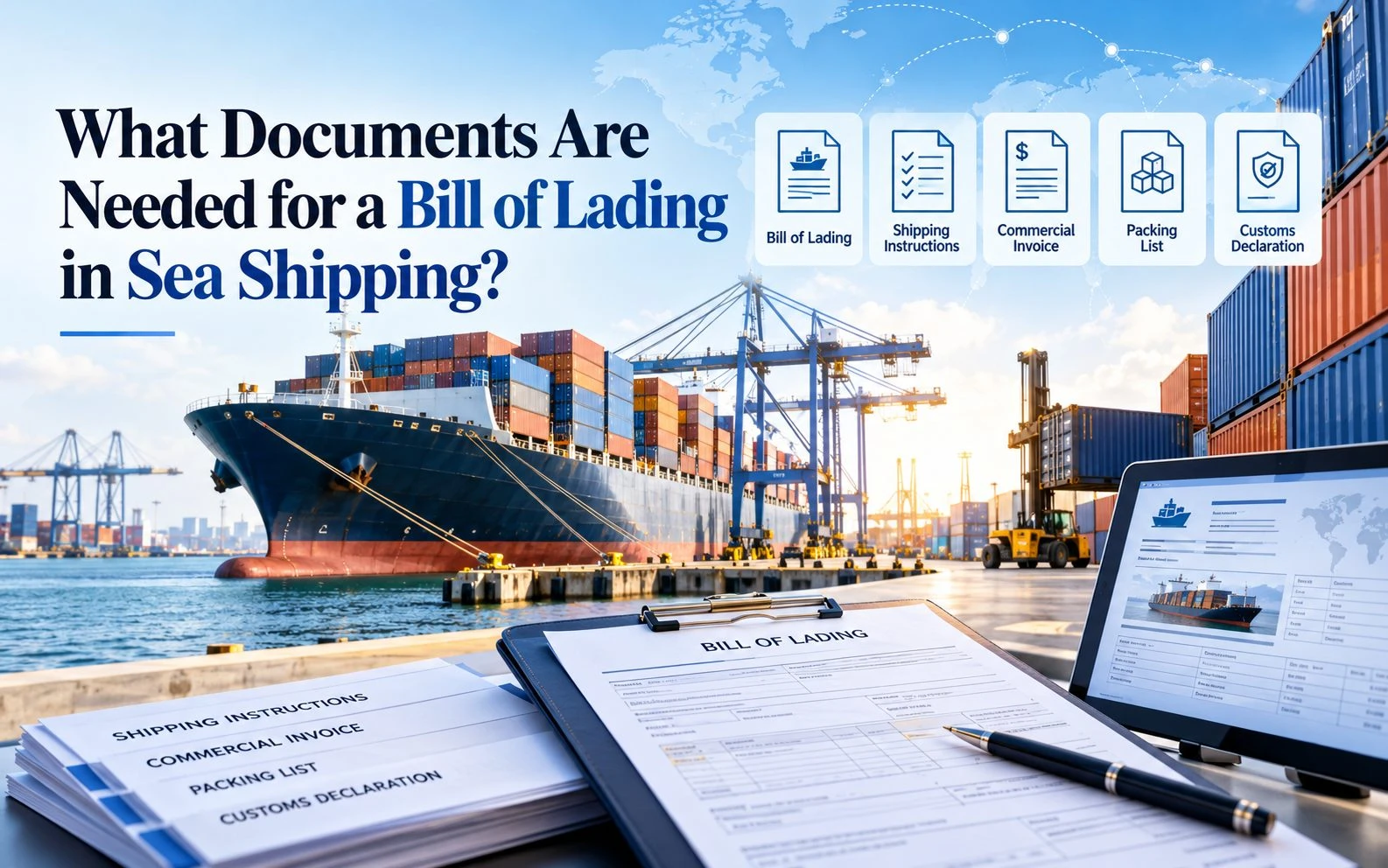
Core Documents Needed to Prepare a Bill of Lading
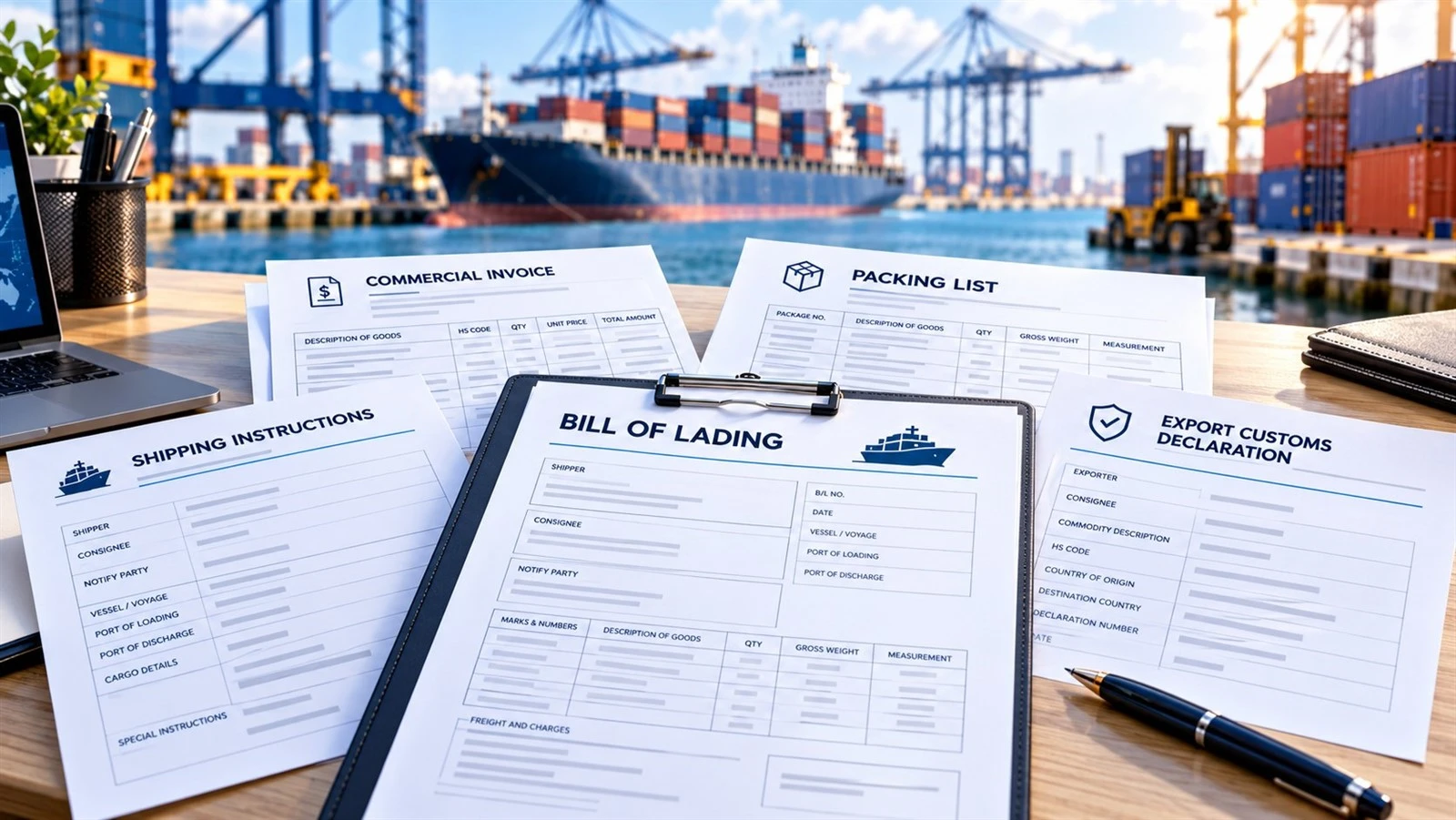
A shipping line or freight forwarder acting as an NVOCC cannot prepare an accurate B/L without shipment information from the shipper. The following documents normally form the core documentation set for sea freight from China.
|
Document |
Purpose |
Who Provides It |
|
Booking Note / Shipping Order (S/O) |
Confirms key booking information such as vessel schedule, equipment, port of loading and port of discharge |
Carrier issues it after the shipper or freight forwarder initiates the booking |
|
Shipping Instructions (SI) |
Tells the carrier what information should appear on the B/L |
Shipper or freight forwarder |
|
Commercial Invoice |
Provides trade-party and cargo information used to verify the shipment description |
Shipper / exporter |
|
Packing List |
Provides package quantity, gross and net weight, volume, shipping marks and packing details |
Shipper / exporter |
|
Export Customs Declaration |
Confirms the cargo has been declared for export and provides customs-related shipment data |
Exporter or customs broker on its behalf |
The key point is that a B/L should not be treated as an isolated shipping document. Its contents should be checked against the commercial invoice, packing list, booking details, customs information and any cargo-specific documents before final issuance.
Booking Note and Shipping Order
The process begins when the shipper or freight forwarder submits a booking request to the carrier. Typical booking information includes:
- Container type and quantity
- Port of loading
- Port of discharge
- Planned sailing date
- Cargo description
- Cargo weight and volume
- Special handling or equipment requirements
Once space and equipment are confirmed, the carrier normally issues a Shipping Order (S/O) or equivalent booking confirmation.
The S/O usually contains the booking reference together with vessel, voyage, equipment and cut-off information. It becomes an important reference throughout the subsequent sea freight documentation process.
For FCL ocean freight, it is generally required before the shipper can proceed with container pickup, stuffing and terminal delivery under the confirmed booking.
Shipping Instructions
The Shipping Instructions, often abbreviated as SI, are normally the most important information source used to prepare the bill of lading.
The SI typically includes:
|
B/L Field |
Information to Provide |
|
Shipper |
Full legal name and address of the exporter or shipping party |
|
Consignee |
Name and address of the receiver, or an appropriate "To Order" wording for a negotiable B/L |
|
Notify Party |
Party to be notified when the shipment approaches or arrives at destination |
|
Vessel / Voyage |
Vessel name and voyage information |
|
Port of Loading |
Port where the cargo is loaded |
|
Port of Discharge |
Destination discharge port |
|
Cargo Description |
Commodity description, package quantity, gross weight, volume and other required cargo data |
|
Container / Seal Numbers |
Actual container and seal numbers after stuffing, where applicable |
|
Freight Terms |
Freight Prepaid or Freight Collect, according to the shipment arrangement |
|
Trade Terms |
Relevant Incoterms where needed for operational reference |
The applicable Incoterms® Rules define how transport responsibilities, costs and risks are allocated between seller and buyer. While Incoterms are not themselves instructions for preparing a B/L, they can influence freight terms, insurance responsibilities and other parts of the shipping arrangement.
Accuracy at the SI stage is critical because much of the information shown on the draft B/L originates from the Shipping Instructions.
A misspelled consignee name, incorrect container number, inaccurate package count or mismatched cargo weight can later cause customs queries, amendments, cargo-release delays or documentary discrepancies.
For this reason, the SI should be prepared using confirmed shipment data rather than estimates wherever possible.
Commercial Invoice
The commercial invoice records the transaction between the exporter and importer and usually contains:
- Seller and buyer information
- Product description
- Quantity
- Unit price and total value
- Currency
- Payment terms
- HS code, where applicable
- Trade terms
The commercial invoice is an important reference when preparing and checking the cargo description on a bill of lading.
The B/L does not normally need to reproduce all invoice information, and cargo value is generally not printed on a standard B/L unless specifically required. However, the commodity description and related shipment data should not contradict the invoice.
The HS code used for customs purposes is based on the international Harmonized System (HS) Nomenclature. If you need a practical explanation of how the classification works, see our guide on how to find the right HS code.
The commercial invoice is also important for customs clearance, valuation and trade compliance, making consistency across the document set essential.
Packing List
While the commercial invoice explains what has been sold, the packing list explains how the cargo is physically prepared for shipment.
It normally includes:
- Number of cartons, pallets, crates or other packages
- Gross weight
- Net weight
- Total volume in CBM
- Shipping marks and numbers
- Packing method
- Container allocation, where applicable
These details are commonly used to verify the package count, gross weight, measurement and marks shown on the bill of lading.
One of the most important documentation principles in sea shipping is data consistency. The commercial invoice, packing list, Shipping Instructions, customs declaration and final B/L should describe the same shipment.
Even a relatively small discrepancy in quantity or weight may lead to additional checks or amendment requests, particularly when customs or other parties compare the documents electronically.
Export Customs Declaration
For exports from China, customs information is filed electronically by the exporter or an appointed customs broker through the China International Trade Single Window.
The declaration normally records information such as:
- HS code
- Commodity description
- Declared value
- Origin and destination
- Trade mode
- Quantity and weight
- Container information
- Applicable customs supervision requirements
Customs release confirms that the goods have completed the required export declaration process.
Key data should therefore be checked against the Shipping Instructions and draft bill of lading. Cargo description, shipper information, quantity, gross weight and container data should be aligned wherever the relevant documents require the same information.
This document consistency is particularly important for export sea freight from China, where booking information, customs declarations, container details and carrier documentation all need to correspond before and after loading.
Additional Documents Required for Special Cargo or Trade Terms
Not every shipment needs the same set of ocean freight documents.
Additional paperwork may be required because of the nature of the cargo, destination-country regulations, export controls, payment terms or buyer requirements.
|
Document |
When It May Be Required |
Typical Source |
|
Certificate of Origin (COO) |
When the importer needs proof of origin or preferential tariff treatment |
Chamber of Commerce, customs authority or other authorised issuing body |
|
Dangerous Goods Declaration (DGD) / SDS |
For hazardous cargo subject to maritime dangerous-goods requirements |
Shipper, manufacturer and relevant authorised parties |
|
Export Licence |
When the product is subject to export-control or licensing requirements |
Relevant competent authority |
|
Inspection / Quarantine Certificate |
When the commodity requires inspection, sanitary, phytosanitary or similar documentation |
Relevant inspection or government authority |
|
Insurance Policy / Certificate |
When the seller is responsible for arranging cargo insurance under the trade terms |
Insurance provider |
|
Letter of Credit |
When payment is made under documentary credit and the B/L must comply with specific banking terms |
Issuing bank |
The practical rule is simple: there is no universal bill of lading document checklist for every sea shipment.
Standard FCL or LCL cargo can have a relatively straightforward documentation process, while dangerous goods, vehicles, heavy equipment, reefer cargo, OOG cargo and high-value equipment may require additional information and approval before booking or loading.
Certificate of Origin
A Certificate of Origin (COO) certifies where the goods were manufactured or substantially processed.
It may be required when:
- The importer needs proof of origin
- Customs requests origin documentation
- Preferential duty treatment is claimed under an applicable trade agreement
- The buyer requires it as part of the commercial document set
A Certificate of Origin is not always a document required specifically to issue a B/L. However, it can be critical for destination customs clearance.
The commodity information, origin information and other relevant data on the COO should therefore be consistent with the commercial invoice, customs declaration and other shipping documents.
This distinction is important: some documents are used directly to create the bill of lading, while others are needed to support the wider export and import process.
Dangerous Goods Declaration and SDS
Dangerous goods require a more stringent documentation process than ordinary cargo.
Depending on the product and classification, the shipper may need to provide a Dangerous Goods Declaration (DGD) together with an SDS - Safety Data Sheet, also commonly referred to as an MSDS in commercial practice.
The documentation may include:
- UN number
- Proper Shipping Name
- Hazard class
- Packing group
- Flash point, where relevant
- Packaging information
- Emergency information
- Chemical properties and handling precautions
Sea transport of hazardous materials is governed by the International Maritime Dangerous Goods (IMDG) Code, which sets out classification, packaging, marking, documentation and stowage requirements for dangerous goods carried by sea.
The dangerous-goods description provided for booking, declaration and shipping documentation must be consistent with the approved cargo classification. For a broader explanation of these requirements, see our guide to dangerous goods shipping documentation.
This is one area where documentation should be reviewed before cargo loading rather than after vessel departure. Incomplete SDS information, an incorrect dangerous-goods classification or a mismatch between the DGD and booking information may result in carrier rejection, terminal problems or safety risks.
Wilson has operational experience with chemical and dangerous-goods cargo and places particular emphasis on SDS review, cargo classification, carrier acceptance requirements and compliance documentation.
The same principle applies to other complex cargo. For heavy machinery or oversized shipments, accurate weight, dimensions, equipment selection, loading planning and documentation need to be coordinated before shipment.
Letter of Credit Requirements
When payment is made by a documentary letter of credit, the B/L must comply with both the shipment requirements and the terms specified in the L/C.
Under UCP 600, marine bills of lading presented under documentary credits are subject to specific requirements.
|
UCP 600 Article 20 Requirement |
What It Means for the B/L |
|
The B/L must identify the carrier and be signed by the carrier, master or properly identified agent |
The capacity of the signing party must be clear |
|
The document must indicate that the goods were loaded on board a named vessel |
A dated on-board notation may be required depending on the form of the B/L |
|
Port of loading and port of discharge must comply with the credit |
Differences can create documentary discrepancies |
|
The required original set must be presented |
The shipper must provide the number of originals specified by the B/L and L/C |
|
The B/L should not contain clauses expressly declaring defective cargo or packaging |
A clean B/L is generally required |
The risk is not limited to cargo movement.
A shipment may already be at sea while payment is delayed because the B/L does not match the letter of credit. Shippers using documentary credit should therefore compare the draft B/L against the L/C before approving issuance.
How a Bill of Lading Is Issued Step by Step
Understanding the B/L issuance workflow helps exporters and importers know when different sea freight shipping documents are needed.
Step 1 - Booking
The shipper or freight forwarder submits the booking request.
After space, equipment and sailing arrangements are confirmed, the carrier issues a booking confirmation or Shipping Order.
Step 2 - Cargo Preparation and Stuffing
The shipper prepares and loads the cargo.
For container sea freight, the actual container and seal numbers are recorded, and the packing information is finalised according to the goods actually loaded.
Step 3 - Customs Declaration
The exporter or appointed customs broker submits the export declaration and completes the required customs procedures.
Cargo data should be checked against the invoice, packing list and booking information.
Step 4 - Shipping Instructions Submission
The shipper or freight forwarder submits the SI before the carrier's SI cut-off or documentation cut-off.
The Shipping Instructions should be prepared from confirmed information contained in the commercial invoice, packing list, booking record and other relevant documents.
Step 5 - Draft B/L Confirmation
The carrier issues a draft bill of lading for review.
Before approval, the shipper should check:
- Shipper
- Consignee
- Notify Party
- Vessel and voyage
- Port of loading
- Port of discharge
- Cargo description
- Package count
- Gross weight and measurement
- Container and seal numbers
- Freight terms
- Any special B/L wording
This is one of the most important stages in the process.
Correcting information at the draft stage is normally much easier than requesting an amendment after the final B/L has been issued.
Step 6 - Formal B/L Issuance
After the draft has been confirmed and applicable carrier requirements have been completed, the formal B/L is issued.
The release method may include:
|
Release Method |
Form |
How Cargo Is Released |
|
Original B/L |
One or more signed paper originals according to the carrier's issuance format |
The required original document set is surrendered according to destination procedures |
|
Telex Release / Surrendered B/L |
Original B/L is surrendered or released electronically according to carrier procedures |
The consignee normally collects the cargo without presenting the physical originals |
|
Sea Waybill |
Non-negotiable transport document |
Cargo is released to the named consignee according to carrier verification procedures |
The appropriate method depends on payment terms, trust between buyer and seller, documentary-credit requirements, cargo-control needs and destination procedures.

Common Bill of Lading Documentation Mistakes and How to Avoid Them
Even experienced shippers can run into problems when supporting documents are prepared separately without a final cross-check.
Inconsistent Data Across Documents
The cargo description, quantity, package count and weight should be consistent wherever those fields appear across the:
- Commercial invoice
- Packing list
- Shipping Instructions
- Customs declaration
- Bill of lading
For example, if the packing list shows 12,500 kg while the B/L shows 12,000 kg, the difference may trigger a question from customs, the carrier, consignee or other parties.
Cross-check these figures before the SI is submitted.
Incorrect Consignee or Notify Party
A spelling error in the legal company name or an outdated address may make destination clearance or cargo release more difficult.
For shipments under a letter of credit, even a small inconsistency between the L/C and the B/L may create a documentary discrepancy.
Use the consignee's confirmed legal details rather than copying data from an old shipment.
Missing or Incorrect On-Board Information
When documentary-payment terms require evidence that the cargo has been loaded, the B/L must contain the appropriate on-board information in accordance with the applicable requirements.
The shipper should verify this before presenting the B/L to a bank or other documentary party.
Dangerous Goods Not Declared Correctly
Dangerous goods should be classified and declared before shipment.
Missing SDS information, an incomplete DGD or an incorrect hazard classification can result in:
- Booking rejection
- Terminal rejection
- Delayed loading
- Additional documentation requirements
- Serious safety risks
The dangerous-goods documentation process should therefore begin before the container reaches the terminal.
Late Presentation Under a Letter of Credit
When a shipment is subject to an L/C, the documents must be presented within the period specified in the credit.
A B/L presented after the permitted period may be considered stale and may be rejected even when the shipment itself has been completed correctly.
How Zhejiang Wilson Supply Chain Management Supports the B/L Process
Zhejiang Wilson Supply Chain Management Co., Ltd. combines international freight forwarding with customs coordination, warehousing, supply-chain management and specialised cargo logistics.
Rather than treating the B/L as a separate paperwork task, the documentation process is coordinated with booking, cargo preparation, customs declaration, loading and destination requirements.
|
Service |
How Wilson Supports the Process |
|
Booking and S/O Management |
Coordinates vessel space, equipment, schedules and booking information |
|
SI Preparation and Draft B/L Review |
Compiles and checks Shipping Instructions and reviews draft B/L fields against available shipment data |
|
Customs Documentation Coordination |
Coordinates export declaration requirements and checks key shipment data for consistency |
|
Specialised Cargo Documentation |
Assists with SDS/DG documentation, certificates, inspection requirements and other cargo-specific compliance information where applicable |
|
L/C Documentation Review |
Helps compare relevant shipping-document information against the documentary requirements provided by the customer |
Wilson was established in 2011 and has developed a 26-person professional logistics team with annual handling volume of approximately 56,000 TEU. Its business covers international freight forwarding, supply-chain management and specialised logistics, including vehicles, heavy equipment, dangerous goods, OOG cargo, reefer shipments and high-value boats.
This experience supports an important practical principle: the most expensive documentation problems often start as small data inconsistencies.
A wrong package count, outdated consignee address or unverified cargo description can move from the SI into the draft B/L, customs documents and destination-clearance process. Checking the data early is usually more effective than correcting it after sailing.
FAQ
What documents are required for a bill of lading?
The main documents and information normally include the Shipping Instructions, booking confirmation or Shipping Order, commercial invoice, packing list and relevant customs declaration information.
Additional documents may be required for dangerous goods, controlled products, origin requirements, inspections or letter-of-credit shipments.
Is a commercial invoice required to issue a bill of lading?
A commercial invoice is an important source for verifying buyer, seller and cargo information, although the carrier primarily relies on the Shipping Instructions when drafting the B/L.
The invoice should be consistent with the B/L and other customs and shipping documents.
Is a packing list required for sea shipping?
A packing list is commonly required for international shipping and customs procedures because it provides the package count, gross and net weight, volume, shipping marks and packing details.
It is also an important reference when checking the corresponding information on the bill of lading.
When should Shipping Instructions be submitted?
Shipping Instructions should be submitted before the carrier's SI cut-off or documentation cut-off.
The exact deadline varies by carrier, route, port and shipment type, so the shipper should confirm the cut-off when the booking is issued rather than waiting until the vessel is about to depart.
What happens if the B/L does not match the commercial invoice or packing list?
A discrepancy may result in amendment requests, customs questions, bank discrepancies under an L/C, clearance delays or cargo-release problems.
The best practice is to compare the draft B/L against the invoice, packing list, booking information, customs data and any special-cargo documents before final approval.
Conclusion
For most sea shipments, the key documents needed for a bill of lading are the Shipping Instructions, booking confirmation, commercial invoice, packing list and relevant customs information. Special cargo, destination requirements and payment terms may add certificates, dangerous-goods documents, licences or other supporting paperwork.
The more important issue is not simply whether every document exists, but whether the information is accurate and consistent across the entire shipment. Reviewing the data before booking, loading and final B/L issuance can reduce amendments, clearance problems and avoidable delays.
If you are preparing a shipment from China and are unsure which sea freight shipping documents or B/L requirements apply to your cargo, Zhejiang Wilson can review your shipment details and help coordinate the documentation process. Contact our team to discuss your cargo, route and specific shipping requirements.