If you have ever opened an ocean Bill of Lading and wondered which fields actually matter, this guide explains how to read a Bill of Lading, what each key section means, what information you should cross-check, and which mistakes to catch before you approve the B/L draft.
A Bill of Lading is not just a cargo receipt. It is evidence of the contract of carriage and, depending on its form, may also function as a document of title.
What a Bill of Lading Does
A Bill of Lading (B/L) generally serves three important functions. It acts as a receipt confirming that the carrier has received or loaded the goods as described. It provides evidence of the contract of carriage between the relevant parties. And, when issued in negotiable form, it can function as a document of title, allowing rights to the cargo to be transferred through proper endorsement and delivery of the document.
International legal frameworks also address the role of transport documents in carriage of goods. For example, the UNCITRAL Rotterdam Rules on transport documents provide useful background on transport documents and electronic transport records, although the law governing a particular B/L depends on the applicable contract, jurisdiction, and carriage terms.
Because these functions are concentrated in one shipping document, the information shown on an ocean Bill of Lading can directly affect cargo release, customs procedures, payment arrangements, and communication at destination. Errors in the consignee, container number, routing, cargo description, or other key Bill of Lading fields may lead to amendments, additional document checks, or delays.
Quick check: Before approving any B/L draft, compare the shipper, consignee, notify party, ports, vessel and voyage, container and seal numbers, cargo description, weight, freight terms, and release method against your approved shipping instructions and supporting documents.
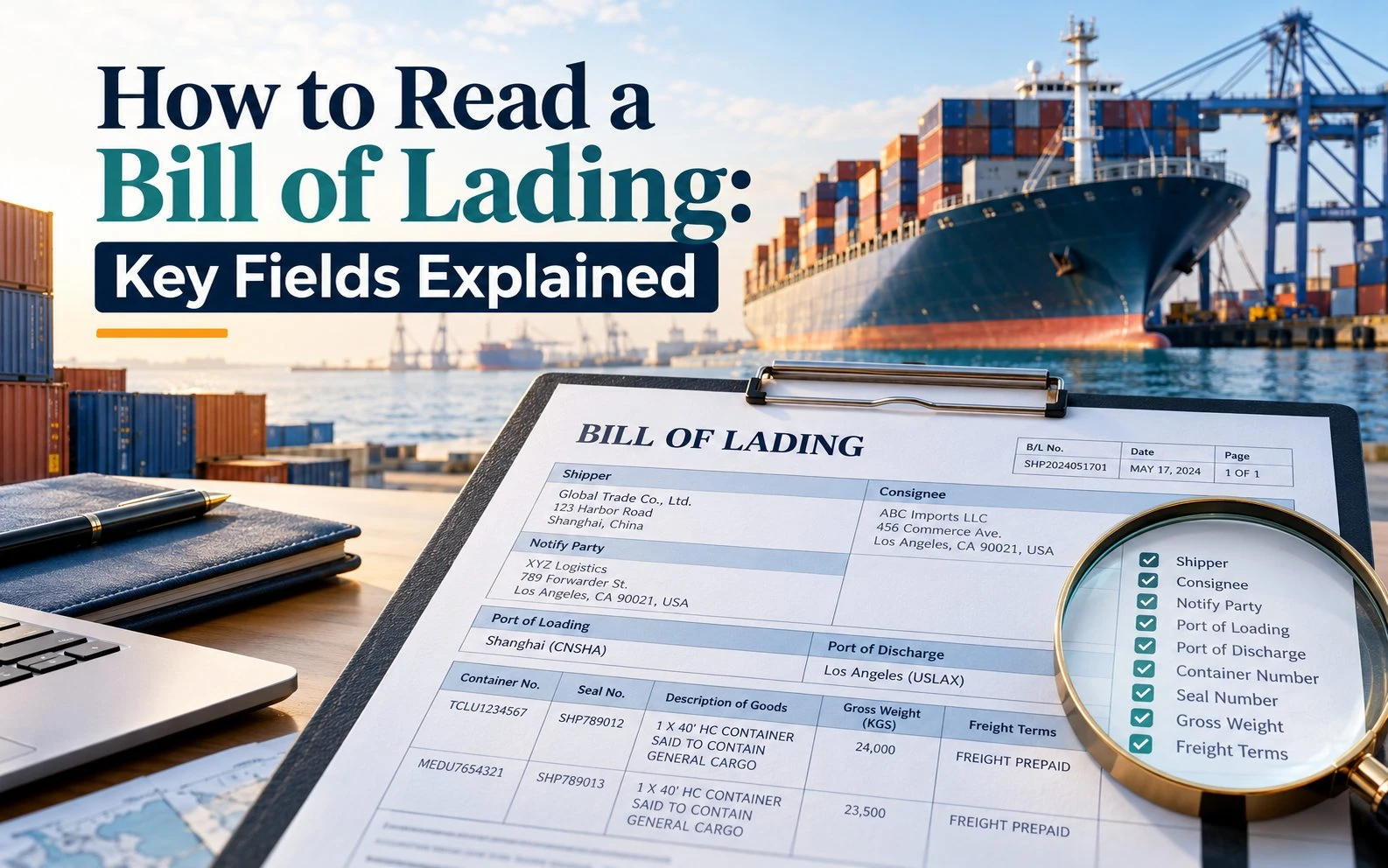
Key Bill of Lading Fields Explained
The following Bill of Lading fields appear on most ocean freight documents. Understanding what each field means is the first step in learning how to check a Bill of Lading correctly. If you are preparing a shipment for the first time, it is also useful to understand the broader set of documents required for sea freight from China so that the B/L can be reviewed against the rest of the shipping paperwork.
1. B/L Number
B/L No.
The B/L number is the unique reference assigned by the carrier or freight forwarder to the transport document. It is commonly used for shipment tracking, documentation, communication with the carrier or forwarder, and destination handling.
If a freight forwarder issues a House Bill of Lading (HBL) while the ocean carrier issues a Master Bill of Lading (MBL), the two documents will normally have different B/L numbers. Make sure you know which document is being used for your commercial, customs, banking, and cargo-release procedures. For more background on the forwarder's role in coordinating documents and carriers, see what a freight forwarder does.
2. Shipper
Shipper / Consignor
The shipper is the party shown as sending the goods, commonly the exporter, seller, manufacturer, or another authorized party. The company name and address should be consistent with the agreed shipping instructions and related commercial documentation.
For shipments involving a letter of credit, the wording should also be reviewed against the applicable L/C requirements. If a third party is shipping on behalf of the seller, the documentation should accurately reflect that arrangement.
3. Consignee
Consignee
The consignee field identifies the party named to receive the goods or, depending on the form of the B/L, the party through whom rights to the cargo are controlled. This is one of the most important Bill of Lading fields because the wording can affect cargo release and whether the document is negotiable.
The consignee's legal name, address, and other required details should be checked carefully against the importer's information and the intended B/L type.
4. Notify Party
Notify Party
The notify party is the party that should receive notice when the shipment approaches or arrives at destination. It may be the importer, customs broker, local freight forwarder, or another nominated agent.
The notify party is not necessarily the owner of the cargo. However, incorrect contact information can delay arrival notices and destination arrangements, increasing the risk of storage, demurrage and detention charges, or other avoidable costs.
5. Vessel and Voyage
Ocean Vessel / Voyage No.
The vessel name and voyage number connect the shipment to a particular ocean movement. These details are useful for tracking the shipment, checking sailing information, and confirming the applicable transport record.
Routes can change because of transshipment, vessel substitution, operational adjustments, or carrier scheduling. Where applicable, the final shipping document should reflect the transport information required for the shipment.
6. Port of Loading and Port of Discharge
Port of Loading / Port of Discharge
The Port of Loading is the port where the cargo is loaded onto the ocean vessel for the relevant leg of carriage, while the Port of Discharge is the port where it is discharged from that vessel.
For door-to-door or multimodal shipments, the Bill of Lading may also show a Place of Receipt and Place of Delivery. These fields identify locations before and after the main ocean transport and should be checked against the booked routing.
For shipments moving by sea freight from China, routing details should also be checked against the booking confirmation, particularly when the shipment involves transshipment or multiple inland and ocean legs.
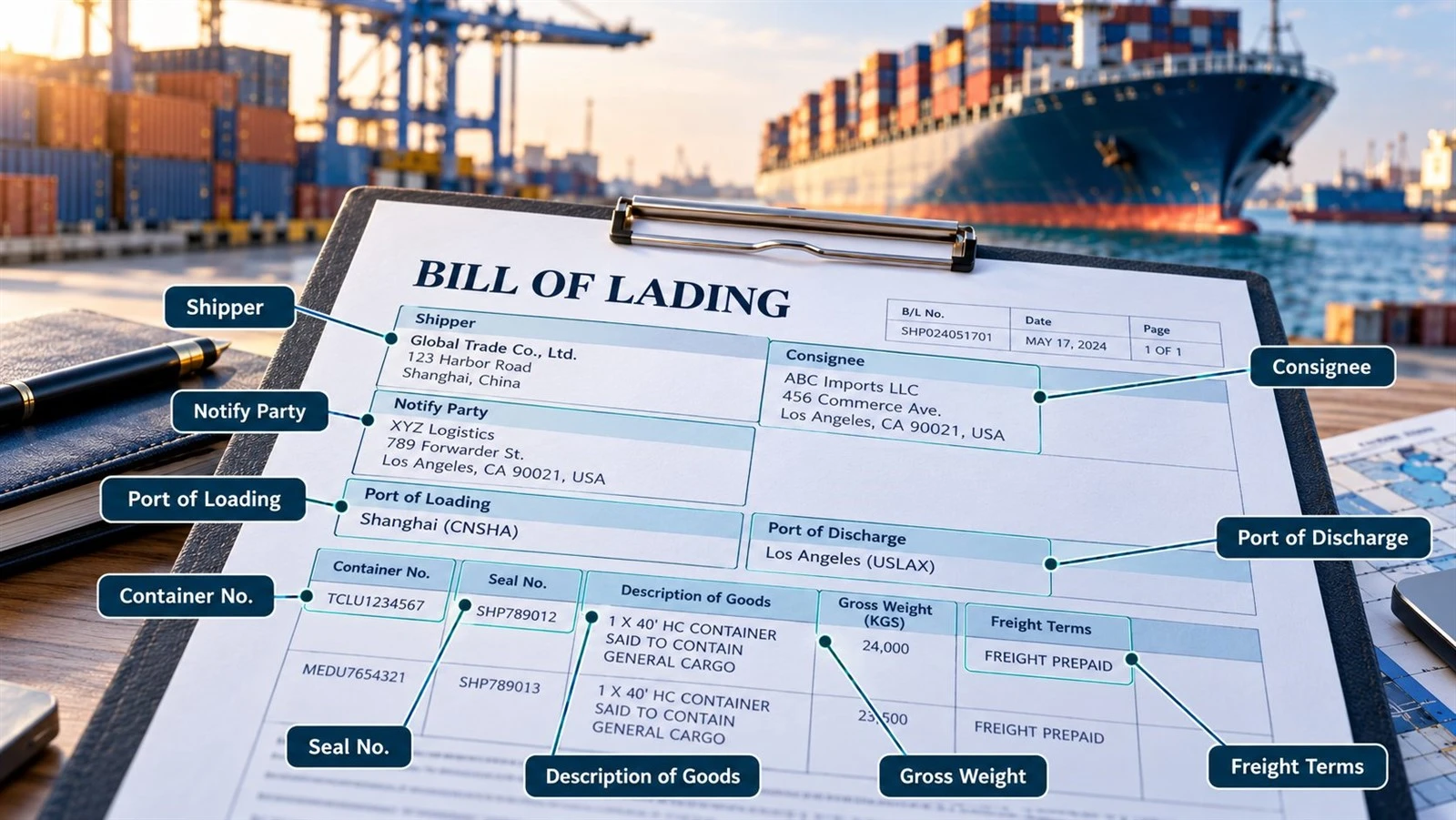
7. Container and Seal Numbers
Container No. / Seal No.
The container number is the unique identifier of the container used for the shipment. The seal number identifies the security seal applied after stuffing.
Both numbers should be cross-checked against loading records, warehouse records, or other shipment documents. A seal discrepancy at destination does not automatically mean the container was improperly opened, as customs inspection or authorized resealing may occur, but any mismatch should be investigated and properly documented.
For containerized shipments, the same checks apply whether you are using FCL ocean freight or consolidated cargo arrangements.
8. Marks and Numbers
Marks & Nos.
Shipping marks help identify cartons, pallets, crates, or other packages. They may include the buyer's name, destination, purchase order reference, package sequence, or other identifying information.
The marks shown on the B/L should be consistent with the packing list and physical cargo where applicable, especially for shipments containing multiple packages or products.
9. Cargo Description
Description of Goods
The cargo description identifies what is being shipped and may include the commodity name, quantity, package type, and other information required for the shipment. Depending on the trade lane and documentation requirements, an HS code or other classification details may also be shown. If you are unsure about commodity classification, review how to find the right HS code before finalizing shipping and customs documents.
A clear and accurate description of goods on the Bill of Lading helps reduce unnecessary document queries and makes it easier to reconcile the B/L with the commercial invoice, packing list, customs declaration, and other shipping records.
This becomes particularly important for special cargo. For chemical and dangerous-goods shipments, the description must be reviewed together with the cargo classification, SDS, carrier acceptance requirements, and applicable dangerous-goods documentation. The International Maritime Organization's International Maritime Dangerous Goods (IMDG) Code provides the core international framework for the safe carriage of dangerous goods by sea.
In Wilson's day-to-day operations, these document checks are treated as part of the shipment planning process rather than something to address only after the cargo reaches the port.
10. Weight and Measurement
Gross Weight / Net Weight / Measurement (CBM)
Gross weight generally includes the goods and their packaging, while net weight refers to the goods themselves. Measurement represents cargo volume, usually stated in cubic meters (CBM).
These figures may affect freight calculations, cargo declarations, loading plans, and transport arrangements. For packed containers, shippers should also be aware of the IMO's SOLAS Verified Gross Mass (VGM) requirements, which require the verified gross mass of a packed container to be provided before loading onto a ship.
Weight and dimensions deserve even more attention when shipping heavy equipment, oversized cargo, vehicles, or project cargo. Wilson's handling process for complex shipments considers cargo dimensions, total weight, center of gravity, loading position, lifting requirements, and securing arrangements before the shipment moves.
11. Freight Terms
Freight Prepaid / Freight Collect
Freight Prepaid generally indicates that the main freight charges shown under the carrier's arrangement are payable at origin, while Freight Collect indicates payment at destination.
The wording should be consistent with the agreed freight-payment arrangement and commercial terms. For example, under a CIF sale the seller is responsible for arranging and paying the main carriage to the named destination port, while under FOB the buyer normally arranges and bears the cost of the main carriage. The International Chamber of Commerce's official Incoterms® rules are the authoritative reference for understanding how common trade terms allocate transport-related responsibilities between buyer and seller.
Do not rely on the B/L freight notation alone to interpret every cost responsibility under an Incoterm. The sales contract, booking arrangement, and carrier or forwarder invoice should be reviewed together.
12. Number of Originals
No. of Original B(s)/L
This field states how many original Bills of Lading were issued, with three originals being common in traditional document sets.
For an original negotiable B/L, cargo release normally requires presentation and surrender of an appropriately endorsed original in accordance with the carrier's procedures. Once cargo is released against one valid original, the remaining originals in the set generally cease to have effect for release purposes. Exact procedures vary by carrier and jurisdiction.
If an original B/L is lost, replacement or cargo-release procedures can be time-consuming and may require indemnities, guarantees, or other security. This is one reason the release method should be confirmed before final documents are issued.
How the Consignee Field Controls Cargo Release
The consignee field deserves special attention because different wording creates different document-control arrangements.
|
Consignee Wording |
B/L Type |
What It Means |
|
"ABC Trading Co." |
Straight B/L |
The named consignee is identified to receive the cargo. A Straight B/L is generally non-negotiable. |
|
"To Order" |
Order B/L |
Rights under the document may be transferred through proper endorsement and delivery of the original B/L. |
|
"To Order of [Bank]" |
Order B/L |
The named bank controls endorsement of the document, commonly in documentary payment or letter-of-credit arrangements. |
For open-account or prepaid transactions between parties with an established relationship, a non-negotiable release arrangement may be suitable. Where document control is required until payment or another commercial condition is satisfied, an Order B/L may be more appropriate.
The correct choice depends on the sales contract, payment method, banking requirements, carrier procedures, and destination-country rules rather than on convenience alone.
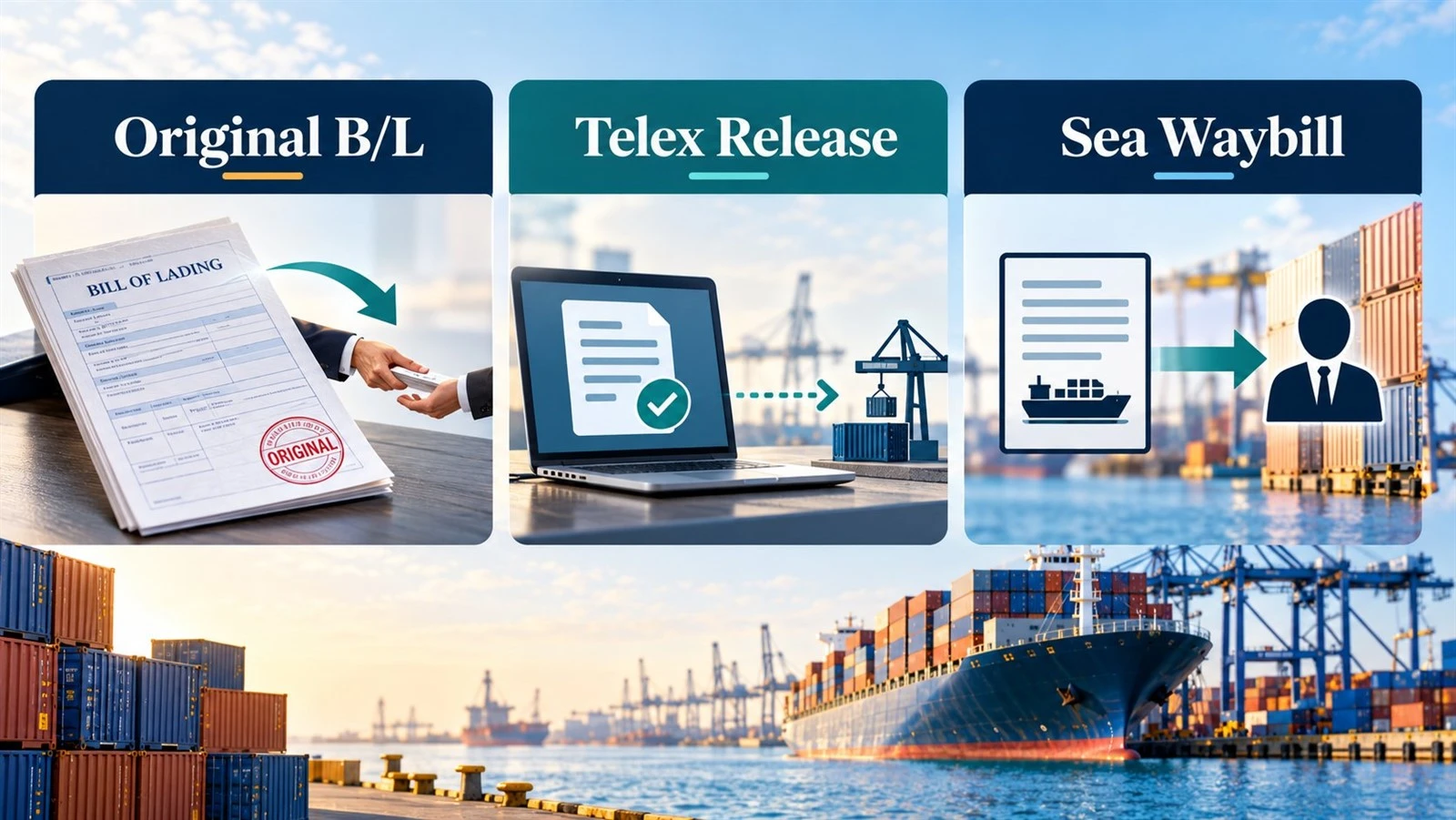
Original B/L, Telex Release, and Sea Waybill
In addition to understanding individual Bill of Lading fields, importers and exporters should know how the cargo will actually be released. Three commonly encountered arrangements are an Original B/L, Telex Release, and Sea Waybill. If you need more detail on the paperwork behind each option, see this guide to the documents needed for a Bill of Lading.
|
Type |
How Cargo Is Released |
Typical Use Case |
|
Original B/L |
An original document is presented and surrendered according to the carrier's release procedure. |
Transactions where document-of-title control is required, including many letter-of-credit arrangements. |
|
Telex Release / Surrendered B/L |
The original B/L is surrendered at origin and the carrier or its agent authorizes release at destination without presentation of the physical original there. |
Established trading relationships or shipments where couriering originals could delay cargo release. |
|
Sea Waybill |
No negotiable original is required for cargo release; delivery is made to the named consignee subject to the carrier's release procedures. |
Affiliated companies, established customers, and transactions where document-of-title control is unnecessary. |
Risk note: A Sea Waybill is generally not a document of title. It should therefore be used when the commercial parties do not need the transport document itself to control transfer of title or payment.
Bill of Lading Errors That Commonly Delay Cargo Release
Some B/L mistakes create more operational problems than others. The following issues are among the items worth checking most carefully before a draft Bill of Lading is approved.
Consignee Name Mismatch
A consignee name that does not correspond with the importer's legal or registered information can trigger additional verification, document amendments, customs questions, or destination-agent review. Check the legal company name, address, registration details, and any destination-specific requirements before approval.
Container or Seal Number Errors
An incorrect container number makes it difficult for carrier, terminal, customs, and destination systems to match the document with the physical container. Container and seal numbers should be checked against loading, warehouse, or equipment records before the B/L is finalized.
Cargo Description Is Too Vague
Descriptions such as "general merchandise" or "parts" may be insufficient for certain customs or carrier requirements. Use an appropriate and specific commodity description and make sure it remains consistent with the shipping instructions and supporting commercial documents.
For dangerous goods and other regulated cargo, additional classification and documentation requirements may apply.
Weight or Quantity Discrepancy
If package quantity, gross weight, or cargo measurement shown on the Bill of Lading conflicts with the packing list, shipping declaration, or other records, the shipment may require additional verification or amendment.
This is particularly important for heavy equipment, OOG cargo, vehicles, machinery, and other non-standard shipments where accurate dimensions and weights also influence equipment selection, loading plans, lifting operations, and cargo securing.
Bill of Lading Review Checklist Before Approval
The most useful rule when checking a B/L is simple: never review the Bill of Lading in isolation. Compare the draft with your shipping instructions, commercial invoice, packing list, booking information, and any other documents required for the shipment.
Wilson's standard freight process follows the same principle. Documentation such as the B/L, commercial documents, product information, certificates, and dangerous-goods documents is reviewed as part of the overall shipment process so that discrepancies can be identified before they create problems later in the transport chain.
|
Check |
What to Verify |
|
B/L number |
Correct reference for the shipment and relevant HBL or MBL |
|
Shipper |
Matches approved shipping instructions and commercial documentation |
|
Consignee |
Correct legal name and wording for the intended B/L type |
|
Notify party |
Correct company and contact information for arrival notice |
|
Vessel & voyage |
Consistent with the applicable sailing information |
|
Ports |
Port of Loading, Port of Discharge, and any receipt/delivery locations match the booked routing |
|
Container & seal |
Numbers match loading and shipment records |
|
Cargo description |
Commodity, quantity, and package type are accurate and consistent with supporting documents |
|
Weight & CBM |
Match the approved shipping information and packing records |
|
Freight terms |
Prepaid or Collect is consistent with the agreed freight-payment arrangement |
|
Originals count |
Number of originals meets commercial, banking, or contract requirements |
|
Release method |
Original B/L, Telex Release, or Sea Waybill matches the agreed cargo-release arrangement |
For routine LCL ocean freight or full-container shipments, this check may take only a few minutes. For chemical cargo, vehicles, heavy equipment, OOG shipments, reefer cargo, or other specialized logistics, the B/L should also be reviewed together with the technical, compliance, loading, and destination requirements relevant to that cargo.
FAQ
What information should I check first on a Bill of Lading?
Start with the parties and routing: shipper, consignee, notify party, vessel and voyage, Port of Loading, and Port of Discharge. Then check the container and seal numbers, package quantity, cargo description, gross weight, freight terms, and release method. These are the Bill of Lading details most directly connected with cargo identification and release.
What documents should I compare a draft Bill of Lading with?
At minimum, compare the draft B/L with the approved shipping instructions, commercial invoice, packing list, and booking confirmation. Depending on the shipment, you may also need to review the sales contract, letter of credit, customs documentation, certificate of origin, dangerous-goods documents, or other cargo-specific records.
What is the difference between a House Bill of Lading and a Master Bill of Lading?
A House Bill of Lading (HBL) is typically issued by a freight forwarder or NVOCC to its customer, while a Master Bill of Lading (MBL) is issued by the ocean carrier for the corresponding carrier-level shipment. The shipper and consignee shown on the two documents may therefore be different. When reviewing a B/L, confirm which document is relevant to your customs, banking, and cargo-release process.
Can a Bill of Lading be corrected after it has been issued?
Many Bill of Lading errors can be amended, but the process depends on the carrier, shipment status, customs or manifest filing deadlines, and destination requirements. Amendments may require approval and can result in additional fees. Correcting the B/L at the draft stage is usually easier than requesting changes after final issuance or vessel arrival.
Is an Original B/L always required to collect cargo?
No. Cargo can also be released under arrangements such as Telex Release or a Sea Waybill when permitted by the carrier and agreed by the parties. The appropriate release method depends on payment terms, document-control requirements, the commercial relationship, and destination procedures.
Conclusion
Knowing how to read a Bill of Lading is mainly about checking four things: who controls and receives the cargo, where the shipment is moving, whether the cargo details are accurate, and how freight and cargo release will be handled. The safest approach is to review the B/L draft against your shipping instructions and supporting documents before approving the final version.
Zhejiang Wilson Supply Chain Management Co., Ltd. provides international freight forwarding and supply chain services from China, including FCL and LCL ocean freight, customs clearance, warehousing, DDP solutions, and specialized logistics. Our 26-member professional team handles approximately 56,000 TEU annually and supports document coordination as part of the shipment process.
If you have questions about a Bill of Lading, shipping documents, or a specific export sea freight shipment from China, contact Wilson to discuss your cargo and routing requirements. Our team can help review the transport arrangement and coordinate the documentation needed for smoother international shipping.