When you source goods, equipment, or industrial products from China, one of the first logistics decisions you face is choosing between port-to-port and door-to-door shipping. These two international shipping service models differ in scope, responsibility, cost structure, and how much of the logistics process you need to manage yourself.
Choosing the wrong service can lead to unexpected destination charges, customs-clearance delays, additional trucking costs, or responsibilities your team was not prepared to handle. The better choice depends not simply on which freight quote looks cheaper, but on your cargo, destination, internal logistics capability, desired level of control, and tolerance for operational risk.
This guide explains the difference between port-to-port shipping and door-to-door shipping, what each service normally covers, how their total costs compare, and which model may fit your sea freight from China shipment.
What Is Port-to-Port Shipping?
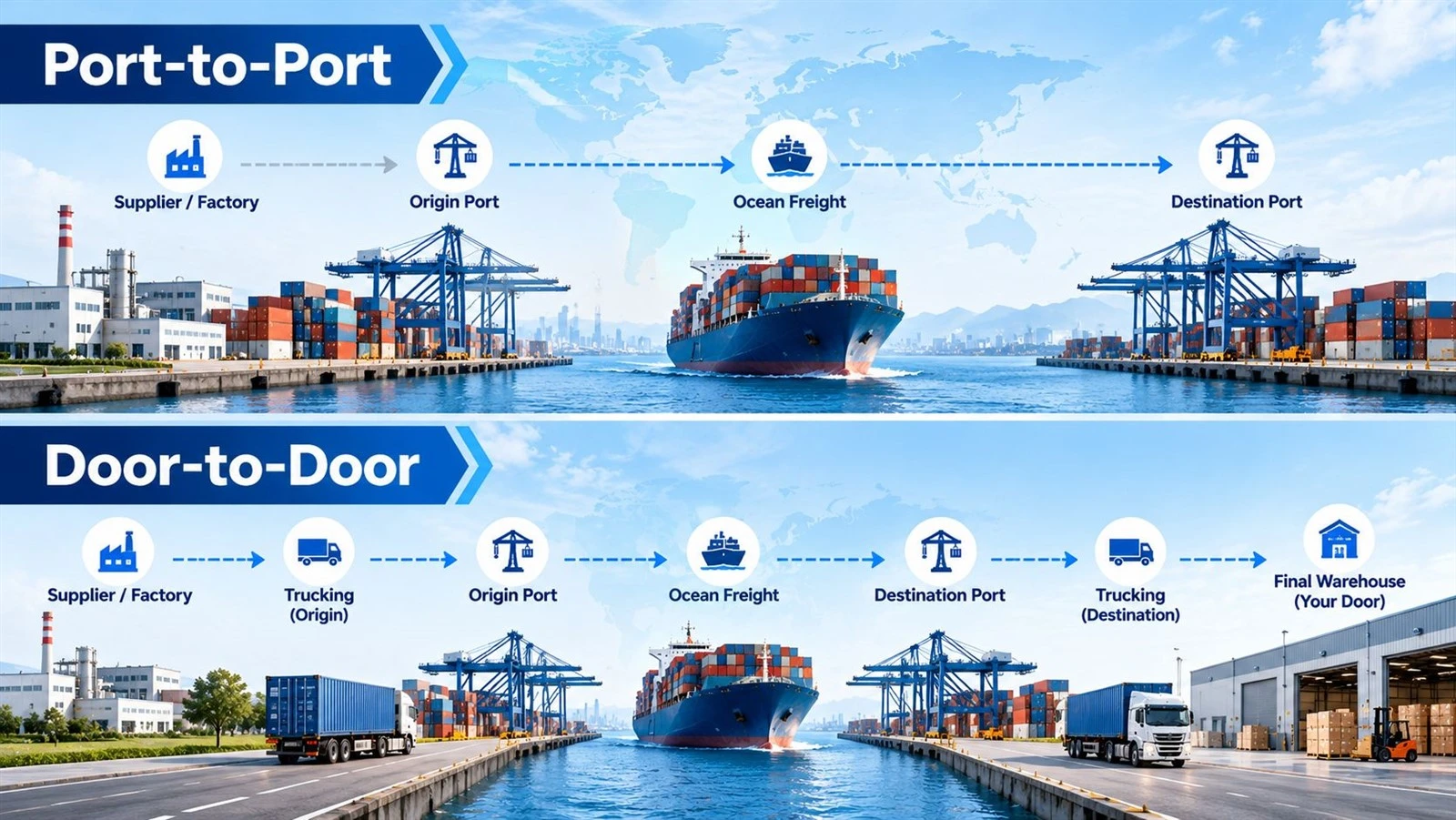
Port-to-port shipping, sometimes referred to as P2P shipping, covers the main international transportation leg between the agreed origin and destination ports or terminals.
For ocean freight, the freight forwarder or carrier typically manages the movement from the port of loading to the port of discharge. Activities before the cargo reaches the origin port and after it arrives at the destination usually remain with the shipper, consignee, or their appointed service providers unless additional services are included in the quotation.
In practice, responsibilities may look like this:
|
Task |
Who Typically Handles It |
|
Factory-to-port delivery, trucking, stuffing |
Shipper or appointed provider |
|
Export customs declaration |
Shipper, forwarder, or customs broker |
|
Origin terminal and documentation charges |
According to agreed quotation and Incoterm |
|
International ocean or air freight |
Forwarder / Carrier |
|
Destination terminal charges |
Consignee or appointed provider |
|
Import customs clearance and duty payment |
Consignee or appointed customs representative |
|
Port-to-warehouse inland delivery |
Consignee or local transport provider |
Port-to-port freight is often attractive to experienced importers because the quoted international freight portion appears lower and the importer retains greater control over destination customs clearance, drayage, warehousing, and final delivery.
It can work particularly well if your company already has:
- An established customs broker at destination
- Reliable local trucking partners
- An experienced import or supply chain team
- Regular cargo volume moving through the same ports
- The ability to negotiate individual logistics segments separately
However, port-to-port shipping cost should not be confused with total landed logistics cost. Once the cargo reaches the destination port, terminal handling, customs-broker fees, storage, demurrage, drayage, inspection, and last-mile trucking can all become your responsibility.
For this reason, the important question is not simply, "How low is the ocean freight rate?" It is, "How efficiently can my team manage everything outside the international freight leg?"
Port-to-port shipping is also separate from the Incoterm used in the sales contract. For example, under FOB, risk normally transfers when the goods are loaded on board the vessel at the named port of shipment, rather than when the shipment arrives at destination. The logistics service scope and the buyer/seller responsibilities under the official Incoterms® rules should therefore be reviewed separately.
Customs classification is another area that can affect clearance time and cost. If your cargo is misclassified under the Harmonized System (HS) classification, the shipment may face additional document review, duty reassessment, or customs queries.
What Is Door-to-Door Shipping?
Door-to-door shipping is a broader freight-forwarding service in which one logistics provider coordinates the shipment from an agreed pickup location to the final delivery address.
For cargo shipped from China, a typical international door-to-door shipping process may include:
|
Step |
Typical Service Coverage |
|
Origin pickup |
Cargo collected from supplier, factory, or warehouse |
|
Export customs |
Export documentation and customs declaration coordinated |
|
International transport |
FCL, LCL, air freight, rail, road, or multimodal transport |
|
Destination handling |
Arrival formalities and cargo release coordinated |
|
Import customs clearance |
Arranged according to the agreed service scope |
|
Duties and taxes |
Responsibility depends on the Incoterm and quotation |
|
Last-mile delivery |
Cargo delivered to warehouse, factory, project site, or other agreed address |
The main advantage of door-to-door freight forwarding is not merely convenience. It reduces the number of logistics handoffs the importer needs to coordinate.
Instead of separately managing a Chinese supplier, origin trucker, carrier, customs broker, destination agent, warehouse, and last-mile trucking company, the importer has one primary logistics coordinator.
That can reduce what is often overlooked in international trade: coordination cost.
Emails, port-release procedures, customs paperwork, truck appointments, document corrections, storage deadlines, and exception handling all consume internal resources even when they do not appear as individual line items on a freight invoice.
If you want a more detailed explanation of each stage, see our guide to how door-to-door shipping works.
Door-to-Door Shipping Is Not the Same as DDP
One important distinction is that door-to-door shipping and DDP are not interchangeable terms.
Door-to-door describes the physical scope of the logistics service.
DDP, DAP, FOB, FCA, and similar terms are Incoterms that define responsibilities between the seller and buyer, including delivery obligations, risk transfer, customs responsibility, and certain cost obligations.
For example:
Door-to-Door under DAP: the shipment may be transported to the named destination, while import clearance and import duties/taxes remain the buyer's responsibility under the Incoterm.
Door-to-Door under DDP: the seller assumes significantly broader obligations, including import clearance and applicable import duties and taxes, subject to local legal and operational requirements.
If you are comparing these arrangements, our guide to DDP shipping explains the responsibilities, cost structure, advantages, and limitations in more detail.
Therefore, when you request a door-to-door shipping quote, always confirm exactly whether customs clearance, duties, taxes, destination handling, and final delivery are included.
The words "door-to-door" alone do not guarantee that every customs or tax expense is included.
Port-to-Port vs Door-to-Door Shipping: Key Differences
The following comparison shows the practical differences between the two service models:
|
Comparison Dimension |
Port-to-Port |
Door-to-Door |
|
Service scope |
Mainly port/terminal to port/terminal |
Pickup location to final delivery address |
|
Origin pickup |
Usually separate or optional |
Usually coordinated |
|
Customs clearance |
Importer manages some or most customs arrangements |
Can be coordinated as part of the service |
|
Duties and taxes |
Usually handled by importer |
Depends on Incoterm and quotation |
|
Inland delivery |
Not normally included |
Usually included |
|
Headline freight price |
Lower |
Higher because more services are included |
|
Unexpected cost risk |
Higher if local charges are not known in advance |
Usually easier to budget when charges are itemized |
|
Number of service providers |
Potentially several |
Primarily coordinated through one forwarder |
|
Operational control |
Higher for importer |
More responsibility delegated |
|
Best suited for |
Experienced importers with established local logistics resources |
Importers seeking a coordinated end-to-end solution |
The biggest difference is therefore not simply price.
It is where you want the freight forwarder's responsibility to begin and end.
Port-to-port gives you more control but also requires more destination-side capability. Door-to-door transfers more coordination work to the freight forwarder.
Which Is Cheaper: Port-to-Port or Door-to-Door Shipping?
One of the most common mistakes in international freight is comparing a port-to-port freight rate directly with a door-to-door all-in price and assuming the first option is automatically cheaper.
The two quotations may cover very different parts of the logistics chain.
A port-to-port ocean freight quote may exclude some or all of the following:
- Origin trucking from the factory to port
- Export customs-broker charges
- Destination terminal handling and port fees
- Import customs-broker charges
- Import duties and VAT/GST
- Customs inspection expenses
- Demurrage and storage if clearance is delayed
- Container detention
- Destination drayage
- Warehouse handling
- Last-mile delivery
When all these components are added, the real total cost of a port-to-port shipment can be 30% to 50% higher than the initial freight quote, and potentially more if significant demurrage or storage occurs.
If you want to understand where each charge comes from, see our guide on how sea freight costs are calculated.
Delays at the destination can also create costs that were not visible in the original ocean freight rate. Importers unfamiliar with free-time rules should pay particular attention to demurrage and detention charges, because these expenses can accumulate quickly when cargo or equipment remains beyond the allowed period.
A door-to-door quotation bundles more of these logistics stages into one service scope. Depending on the agreed Incoterm and quotation, it can include origin pickup, export clearance, international freight, destination handling, customs coordination, and final delivery.
That is why the more useful comparison is:
Total Port-to-Port Logistics Cost vs. Total Door-to-Door Logistics Cost
rather than:
Port-to-Port Freight Rate vs. Door-to-Door Freight Rate
Port-to-port can genuinely be cheaper when an importer has established destination resources and sufficient shipping volume to manage each logistics segment efficiently.
For a small or mid-sized importer entering a new market, however, door-to-door shipping may offer a comparable total cost with lower administrative complexity and less exposure to unexpected destination expenses.
A cheap freight rate is only valuable if the rest of the logistics chain can also be managed efficiently.
When to Choose Port-to-Port vs Door-to-Door Shipping
A useful way to make the decision is to evaluate four factors:
Cost, Control, Capability, and Risk.
|
Your Situation |
Recommended Service |
Why |
|
You have an experienced logistics team and a reliable customs broker at destination |
Port-to-Port |
You can manage individual logistics stages and negotiate them independently |
|
You are entering a new destination market and do not have local logistics partners |
Door-to-Door |
Reduces the need to build a local customs and trucking network |
|
You ship high-volume standard containers regularly through the same ports |
Port-to-Port |
Scale can make independently managed destination services more economical |
|
You ship machinery, vehicles, hazardous goods, or oversized cargo |
Door-to-Door or Extended Project Service |
Complex cargo benefits from coordinated handling across multiple stages |
|
You need predictable landed logistics costs |
Door-to-Door |
More transport components can be included in one quotation |
|
Your commercial arrangement requires you to manage freight from an origin port |
Port-to-Port may fit |
You retain control over the main transport and destination arrangements |
|
You want a single logistics coordinator |
Door-to-Door |
Reduces the number of suppliers and handoffs |
|
You already manage customs, duties, trucking, and warehousing efficiently |
Port-to-Port |
Allows you to retain direct control of local operations |
A simple practical test is to ask:
- Do you already have a reliable customs broker in the destination country?
- Do you have a trucking provider familiar with the destination port?
- Does your team understand local port charges, customs documents, free-time limits, and cargo-release procedures?
If the answer to all three is yes, port-to-port shipping may give you more flexibility and control.
If several answers are no, door-to-door freight shipping can be easier to manage and may reduce both administrative work and operational risk.
How Cargo Type Affects Your Shipping Service Choice
Not every shipment should be evaluated in the same way.
Standard General Cargo
Consumer goods, packaged products, components, and other standard cargo can usually move effectively under either service model.
For these shipments, the decision often comes down to:
- Total logistics cost
- Importer's local logistics capability
- Volume and shipment frequency
- Desired control
- Convenience
For full-container shipments, FCL ocean freight may work well under either port-to-port or door-to-door arrangements, depending on who manages the origin and destination legs.
For smaller shipments, LCL ocean freight can also be arranged under both service models.
For LCL shipping in particular, importers should carefully review destination CFS handling, deconsolidation, documentation, terminal charges, and local delivery fees before choosing a seemingly inexpensive port-to-port quotation.
Industrial Equipment, Vehicles, and Construction Machinery
Industrial machinery and vehicles often require more than a simple freight booking.
Depending on dimensions and weight, transportation may involve:
- Flat Rack containers
- Open Top containers
- RoRo transport
- Breakbulk transport
- Special lifting
- Cargo securing
- Route planning
- Heavy-haul trucking
For these shipments, a broader logistics service can reduce the number of operational handoffs.
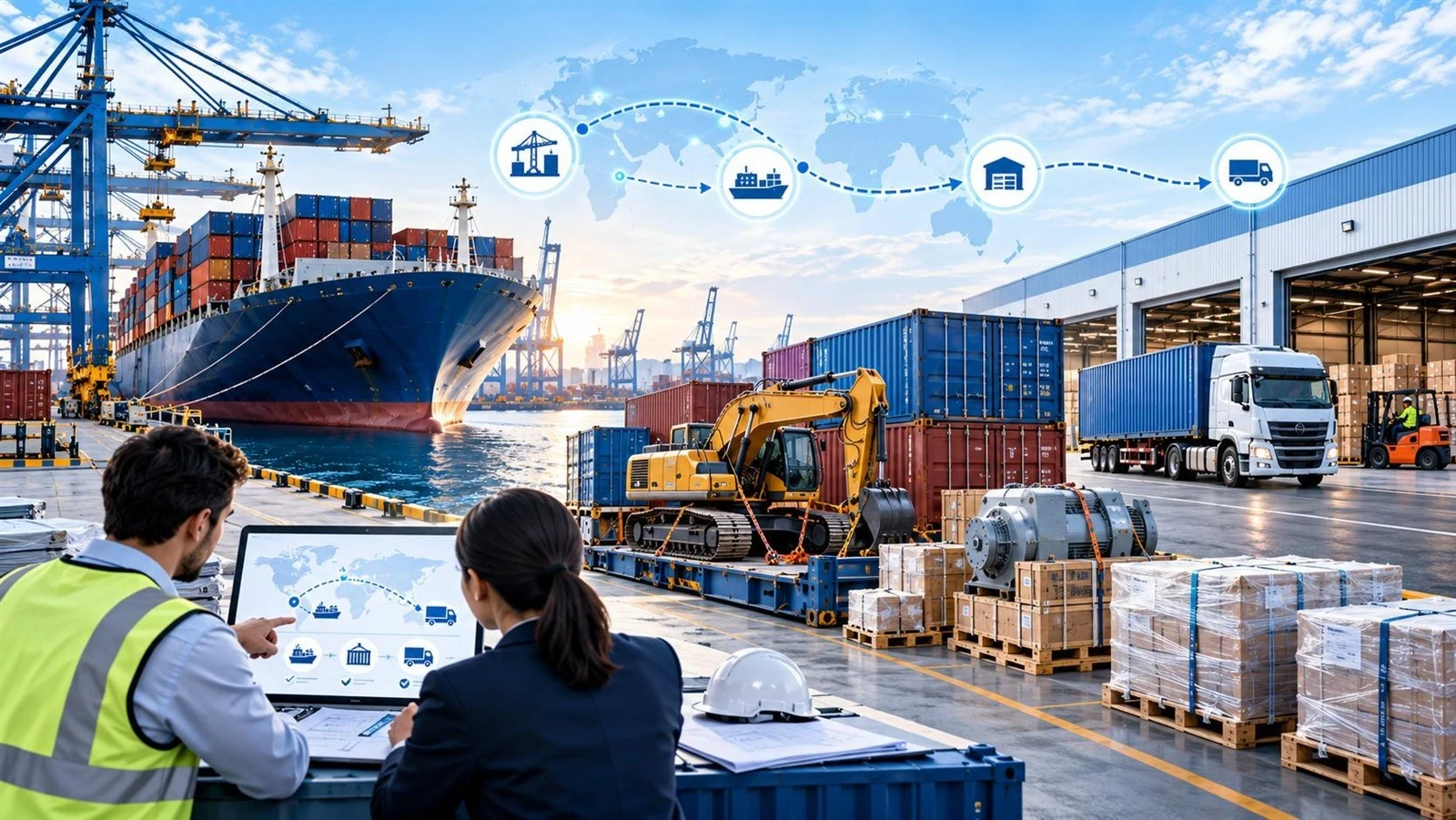
Wilson has practical experience handling vehicles, construction machinery, drilling equipment, oversized cargo, and heavy equipment, including projects involving cargo of approximately 53 tons.
For this type of shipment, the service decision should therefore consider not only freight price but also loading engineering, equipment selection, securing, inland transportation, and destination handling.
Dangerous Goods and Chemical Cargo
Dangerous goods require additional compliance throughout the transportation process.
Depending on the cargo and mode of transport, the logistics process may involve:
- SDS review
- Dangerous-goods classification
- Carrier acceptance
- DG declarations
- Appropriate packaging and labeling
- Destination import requirements
- Specialized inland transportation
For air freight, regulated dangerous goods are subject to the IATA Dangerous Goods Regulations (DGR), while sea shipments are subject to the applicable maritime dangerous-goods requirements.
A port-to-port solution remains possible if the importer already has qualified destination partners.
However, when multiple compliance stages must be coordinated, an experienced door-to-door freight forwarder or integrated logistics provider can reduce the risk of disconnected documentation or operational arrangements.
Wilson has practical experience with chemical and dangerous-goods cargo and places particular emphasis on SDS documentation, cargo classification, carrier requirements, customs compliance, and advance document review.
Oversized, Project, and High-Value Cargo
Oversized and high-value cargo introduces another consideration: handoff risk.
Every time responsibility moves from one logistics provider to another, there is potential for:
- Incomplete instructions
- Inconsistent cargo-handling standards
- Incorrect equipment preparation
- Damage during lifting or transfer
- Delays in arranging onward transportation
- Disputes over responsibility when problems occur
For high-value or non-standard cargo, the value of door-to-door or extended project logistics is therefore not simply convenience. It can also be a form of risk management.
Wilson's complex-cargo procedures include transport-plan design, loading and stowage planning, onsite loading supervision, securing and cargo protection, compliance review, cargo-condition confirmation, shipment tracking, and contingency handling.
The company has also handled high-value boat shipments, heavy equipment, specialized containers, and other non-standard cargo, giving us practical experience in situations where the logistics chain requires closer coordination than ordinary container freight.
How Zhejiang Wilson Supply Chain Can Help
Zhejiang Wilson Supply Chain Management Co., Ltd. provides both international freight forwarding and broader supply chain services, allowing the transport scope to be matched to the customer's actual operating capability rather than forcing every shipment into the same model.
Established in 2011 and headquartered in Ningbo, Wilson has branches in Shanghai, Shenzhen, and Hong Kong. The company has a 26-person experienced logistics team and handles approximately 56,000 TEU annually.
Our relevant services include:
- International sea freight, including FCL, LCL, reefer, special containers, breakbulk, OOG, and project cargo
- International air freight
- Rail, road, and multimodal transportation
- Origin pickup and supplier coordination
- Export customs and destination customs-clearance coordination
- Warehousing, consolidation, sorting, labeling, inspection, and distribution
- Door-to-door and DDP logistics support where applicable
- Cargo insurance and claims assistance
- Specialized logistics for vehicles, machinery, chemical and dangerous goods, oversized cargo, reefer cargo, yachts, and other high-value shipments
As a China freight forwarding company, Wilson can support customers who only need a competitive port-to-port ocean freight service, as well as importers who prefer a broader door-to-door solution involving pickup, customs coordination, international freight, warehousing, and final delivery.
The objective is not to make every importer buy the largest possible service package. It is to identify where your own logistics capability ends and where professional coordination creates additional value.
FAQ
Is door-to-door shipping always more expensive than port-to-port shipping?
The quoted price is usually higher because door-to-door shipping includes more logistics stages. However, this does not necessarily mean the total shipping cost is higher.
With port-to-port shipping, destination terminal charges, customs brokerage, storage, drayage, and last-mile delivery may still need to be added. Importers should compare the complete cost from supplier pickup to final delivery rather than comparing headline freight rates alone.
Does door-to-door shipping include customs clearance?
It can, but you should never assume customs clearance is automatically included simply because a quotation says "door-to-door."
Ask the freight forwarder to specify whether the service includes export customs, import customs clearance, customs brokerage, duties, taxes, inspections, and destination delivery.
Is DDP the same as door-to-door shipping?
No.
Door-to-door shipping describes the physical transportation scope, while DDP (Delivered Duty Paid) is an Incoterm defining seller and buyer responsibilities.
A shipment can therefore be delivered door-to-door without being shipped under DDP terms.
Can FCL and LCL both be shipped door-to-door?
Yes. Both FCL door-to-door shipping and LCL door-to-door shipping are commonly arranged.
The forwarder can coordinate origin pickup, export procedures, international ocean freight, destination handling, customs-clearance support, and final delivery according to the agreed service scope.
For LCL cargo, reviewing destination handling and deconsolidation charges in advance is especially important.
Who should choose port-to-port shipping?
Port-to-port shipping generally fits experienced importers that already have reliable destination customs brokers, trucking providers, warehousing resources, and an internal logistics team.
If you prefer to control each logistics segment separately and have enough volume to negotiate local services efficiently, port-to-port can provide greater flexibility.
Conclusion
There is no universally better choice between port-to-port vs door-to-door shipping.
Port-to-port usually fits importers that already have the infrastructure, local partners, experience, and shipment volume needed to manage customs clearance and destination transportation themselves. Door-to-door shipping is generally better suited to importers who value predictable logistics coordination, fewer handoffs, and a single point of contact from pickup through final delivery.
The best decision should be based on total cost, control, logistics capability, and risk-not the lowest freight rate alone.
If you are unsure which service model fits your next shipment from China, Zhejiang Wilson Supply Chain Management Co., Ltd. can compare port-to-port, door-to-door, and other suitable logistics options based on your cargo, destination, Incoterm, and operational requirements. Contact our team with your shipment details, and we can discuss a practical transport plan and quotation for your project.