Shipping from China to the United States takes anywhere from 2 to 45 days, depending on the shipping method you choose. Ocean freight to the West Coast runs roughly 15–25 days; East Coast deliveries can stretch to 30–40 days. Air freight takes 5–10 days, and international express couriers deliver in 2–7 days. The right answer depends on your cargo type, budget, and deadline.
What Determines Shipping Time from China to the US?
Before breaking down each method, it helps to understand what "shipping time" actually includes. Most first-time importers assume transit time equals the number of days a vessel or plane is in motion. In practice, door-to-door shipping time from China to the USA is the sum of several linked segments:
- Origin handling: factory pickup, export customs declaration, container loading or cargo tendering at the origin port or airport
- Main carriage: the ocean voyage or flight itself
- Destination handling: import customs clearance, terminal pickup, drayage
- Last-mile delivery: trucking or rail to the final warehouse or distribution center
Any one of these segments can add days - sometimes weeks - to your schedule. A container that reaches Los Angeles in 14 days can still sit at the terminal another 5–7 days waiting for customs release and a trucking appointment.
Port-to-port transit time is the narrowest measure and the one most freight forwarders quote first. Door-to-door time is what you should actually plan around, because that is the number your customer or warehouse cares about.
Ocean Freight Shipping Time from China to the US
Sea freight shipping from China to the USA is the backbone of China-US trade. It carries the vast majority of containerized goods - consumer electronics, furniture, apparel, machinery, building materials - and offers the lowest cost per cubic meter for any shipment large enough to fill or partly fill a container.
Two service types dominate the market. Understanding the differences in FCL vs LCL shipping can help importers choose the right option for their cargo:
- FCL (Full Container Load): you rent an entire 20-foot or 40-foot container exclusively for your cargo. The container is sealed at the factory and stays sealed until it reaches the destination. No consolidation, no deconsolidation at the origin - faster and more secure.
- LCL (Less than Container Load): your cargo shares container space with other shippers' goods. The forwarder consolidates multiple shipments into one container at the origin and deconsolidates at the destination. LCL costs less for small volumes but adds 3–7 days for consolidation and deconsolidation.
Shipping Time from China to the US West Coast
Shanghai, Shenzhen (Yantian), and Ningbo are the primary departure ports. Los Angeles and Long Beach handle the largest share of arrivals; Oakland and Seattle are secondary options. These major gateways are among the busiest ports in the United States.
Direct sailing to the West Coast is the fastest ocean route. Standard vessels typically take 15–25 days port to port. Premium express ocean services from Shanghai to Long Beach can make the crossing in 11–14 days, using dedicated terminals that cut berthing wait time to roughly 24–48 hours after arrival.
The West Coast advantage is simple geography: the Pacific crossing is shorter, the ports are closer to Asian departure points, and the route avoids the Panama Canal bottleneck entirely.
Shipping Time from China to the US East Coast
East Coast destinations - New York/New Jersey, Savannah, Norfolk - involve a much longer voyage. Vessels either transit the Panama Canal or sail around via the Suez Canal, adding significant distance.
Direct sailings to East Coast ports typically take 25–35 days. Indirect routes with transshipment at intermediate ports like Busan or Singapore can extend to 35–45 days.
An alternative that has grown in popularity is sea-rail intermodal: cargo ships to a West Coast port (14–18 days), then transfers to rail for the cross-country move to East or Midwest destinations (3–7 days). Total transit time runs 20–28 days - faster than all-water East Coast service, though at a higher cost.
Ocean Freight Transit Time Summary
Table 1: China to US Ocean Freight Transit Times (Port to Port)
|
Route |
Service Type |
Typical Transit Time |
Key Ports |
|
China → West Coast |
Premium express ocean service |
11–14 days |
Shanghai/Ningbo → Long Beach |
|
China → West Coast |
Standard direct FCL |
15–25 days |
Shenzhen/Shanghai → Los Angeles/Long Beach |
|
China → West Coast |
LCL |
18–28 days |
Same ports + consolidation delay |
|
China → East Coast |
Direct all-water |
25–35 days |
Shanghai → New York/Savannah |
|
China → East Coast |
Transshipment |
35–45 days |
Via Busan/Singapore |
|
China → East/Midwest |
Sea-rail intermodal |
20–28 days |
West Coast port → rail to Chicago/NY |
LCL adds 3–7 days to any route for consolidation and deconsolidation. Door-to-door time is typically 5–10 days longer than port-to-port figures shown above, once customs clearance and inland delivery are included. For smaller shipments, dedicated LCL shipping from China to the USA services can provide a practical alternative to booking an entire container.
Ocean freight is the default choice for bulk shipments where cost matters more than speed. A 40-foot container can carry roughly 55–60 cubic meters of cargo at a fraction of the per-kg cost of air freight - but only if your timeline can absorb 25–40 days of transit.
Air Freight Shipping Time from China to the US
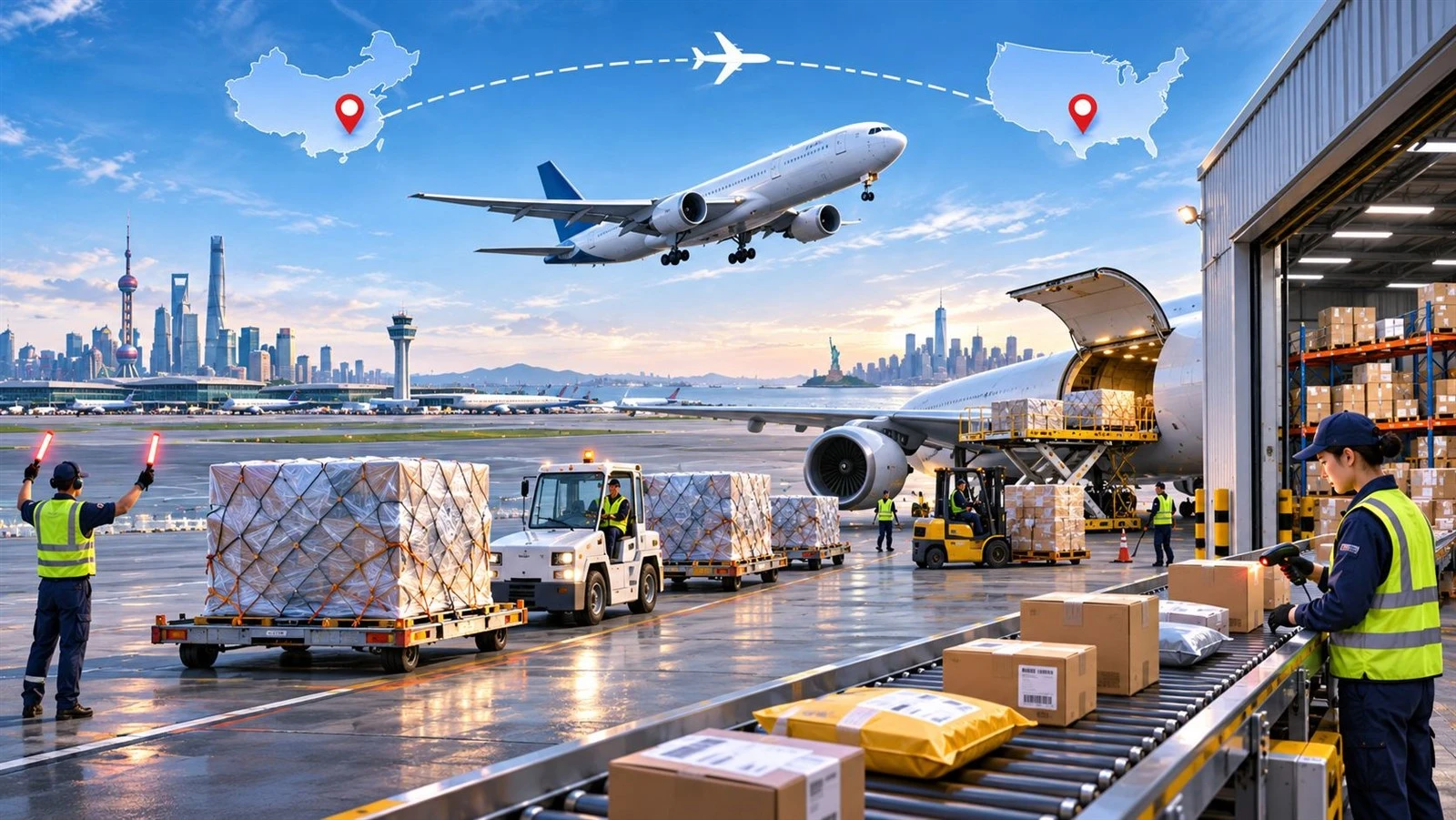
Air freight occupies the middle ground between ocean and express courier. It moves larger shipments - typically 45 kg and up - via cargo aircraft or the belly hold of passenger flights, with transit times of 5–10 days door to door.
Major origin airports include Shanghai Pudong (PVG), Shenzhen (SZX), Guangzhou (CAN), and Hong Kong (HKG). Common US arrival airports are Los Angeles (LAX), Chicago (ORD), New York (JFK), and Miami (MIA). For shipments entering the US West Coast, air freight from China to Los Angeles is one route-specific option to consider.
Air freight transit breaks down roughly as follows:
- Origin pickup and tendering: 1–2 days
- Flight time: 1–2 days (often including a layover)
- Destination customs clearance: 1–3 days
- Last-mile delivery: 1–2 days
Total door-to-door time usually lands in the 5–10 day range, though peak season congestion or customs inspection can push it to 12–15 days.
Air freight costs significantly more than ocean - often 4–6 times higher per kg - but for mid-weight shipments that are too heavy for express courier pricing yet too time-sensitive for ocean, it fills a practical niche. Machinery parts, electronics components, and seasonal goods with tight launch windows are common air freight cargo.
Express Courier Shipping Time from China to the US
For small parcels, samples, documents, and urgent low-weight shipments, international express couriers are the fastest option. Major global express providers operate dedicated air networks with integrated customs clearance, meaning the courier handles the entire door-to-door chain.
Typical delivery times from China to the US:
Table 2: Express Courier Transit Times from China to the US
|
Service Category |
Service |
Typical Delivery Time |
Best For |
|
Premium express |
Worldwide express service |
3–5 business days |
Urgent small parcels, documents |
|
Priority express |
International priority service |
4–6 business days |
Time-sensitive shipments, West Coast faster |
|
Economy express |
International economy service |
5–8 business days |
Less urgent, cost-sensitive |
|
Premium express |
US-bound express service |
3–5 business days |
US-bound shipments, strong domestic network |
|
Expedited express |
International expedited service |
5–7 business days |
Heavier small parcels |
Premium express courier services generally offer the fastest and most consistent transit to US destinations, with delivery to major West Coast cities in as few as 2–3 business days. Other major express providers have strong domestic US delivery networks, which can make the last-mile leg more reliable for remote or inland destinations.
Express courier pricing is weight-based and becomes prohibitively expensive above roughly 20–30 kg. For shipments above that threshold, air freight becomes more economical; above 100 kg, ocean freight usually wins on cost.
Why Shipping from China to the US Gets Delayed
Transit time benchmarks assume smooth conditions. In reality, several variables can add days or weeks to any shipment.
Port Congestion
This is the single most disruptive factor for ocean freight. During peak import season - typically August through November, when US retailers stock up for the holiday period - vessels at Los Angeles and Long Beach can wait 3–7 days for a berth. In severe congestion events, that wait has stretched to two weeks or more.
Extended terminal stays may also increase the risk of demurrage and detention charges, making port delays a concern for both transit time and total shipping costs.
East Coast ports face similar pressure, and the Panama Canal has experienced periodic draft restrictions due to low water levels, forcing some vessels to reduce cargo loads or reroute entirely.
Customs Clearance
US Customs and Border Protection (CBP) processes the vast majority of shipments within 1–3 days for air freight and 2–5 days for ocean freight, assuming documentation is complete and accurate.
The risk is inspection. CBP's overall examination rate is roughly 5%, but certain product categories - electronics, food, items with intellectual property concerns - face higher scrutiny. A customs hold can add 7–15 days while the shipment is examined at a Centralized Examination Station.
Accurate documentation is the single most effective way to avoid delays: correct HTS (Harmonized Tariff Schedule) classification, detailed commercial invoices, and properly filed ISF (Importer Security Filing, required 24 hours before vessel loading for ocean freight).
Seasonal Demand
The August–November peak season compresses capacity across all modes. Ocean carriers reduce sailing frequency in some lanes while demand surges, air freight rates spike as cargo space tightens, and express couriers impose peak-season surcharges. Transit times during this period typically extend 5–15 days beyond off-season baselines.
Chinese factory shutdowns around the Lunar New Year (January–February) create a different bottleneck: production stops before the holiday, and a surge of pre-holiday shipments crowds ports and airports in the weeks leading up to it.
Weather Disruptions
Typhoon season in the Western Pacific (June–October) can delay vessel departures from Chinese ports. Hurricane season in the Atlantic (June–November) affects East Coast arrivals and Panama Canal transit. Winter storms periodically disrupt trucking and rail connections at US destination ports.
Trade Policy and Tariffs
Tariff changes and trade policy shifts can indirectly affect shipping times by triggering sudden surges in shipping volume - importers rush to move goods before a new tariff takes effect, overwhelming port and customs capacity. Monitoring trade policy developments and adjusting shipping schedules accordingly has become a routine part of supply chain planning.
How to Choose the Right Shipping Method from China to the US
The decision comes down to three variables: how fast you need it, how much it weighs, and what your budget allows. A detailed sea freight vs air freight comparison can help you evaluate the trade-offs between shipping speed, cost, and cargo requirements.
Table 3: Shipping Method Selection Guide
|
If Your Shipment Is... |
Recommended Method |
Typical Time |
Cost Level |
|
Under 20 kg, urgent |
International express courier |
2–7 days |
High |
|
20–100 kg, time-sensitive |
Air freight |
5–10 days |
Medium-high |
|
100+ kg, flexible timeline |
Ocean freight (FCL or LCL) |
15–45 days |
Low |
|
Full container, deadline-driven |
Premium express ocean service to West Coast |
11–14 days port-to-port |
Medium |
|
Large volume, East Coast destination |
Sea-rail intermodal |
20–28 days |
Medium |
For most importers running a regular supply chain, the practical approach is a mix: ocean freight for bulk replenishment, air freight or express courier for urgent top-up shipments and samples.
How to Plan Your Shipping Timeline from China to the US
A realistic shipping plan builds in buffer time rather than relying on best-case transit figures. For ocean freight, add 7–10 days to the port-to-port estimate to account for customs, terminal handling, and inland delivery. During peak season, extend that buffer to 10–15 days.
Book ocean freight 2–3 weeks before your desired sailing date to secure space, especially during peak season. File the ISF at least 24 hours before the vessel loads - late filings trigger CBP penalties and increase inspection likelihood.
For air freight and express courier, the buffer is smaller - add 2–3 days to the quoted transit time during normal conditions, 3–5 days during peak season.
The most common planning mistake is treating the freight forwarder's transit quote as a delivery date. It is an estimate under normal conditions, not a guarantee. Build your inventory and sales commitments around the door-to-door timeline with buffer, not the port-to-port benchmark.
Working with a reliable logistics partner can also help reduce coordination risks. Before arranging regular shipments, it is worth understanding how to choose a freight forwarder in China that can support your cargo requirements, shipping schedule, and customs procedures.
FAQ
How long does sea freight from China to the USA take?
Sea freight from China to the USA typically takes 15–25 days to West Coast ports such as Los Angeles and Long Beach. Direct all-water services to East Coast ports such as New York and Savannah generally take 25–35 days, while routes involving transshipment can take 35–45 days. These estimates primarily refer to port-to-port transit times, not final warehouse delivery.
How long does air freight from China to the USA take?
Air freight from China to the USA generally takes 5–10 days door to door, including origin handling, international transportation, customs clearance, and final delivery. During peak shipping seasons or customs inspections, the total transit time may increase to 12–15 days.
Does LCL shipping take longer than FCL shipping from China to the US?
Yes. LCL shipping typically takes 3–7 days longer than FCL shipping because multiple shipments must be consolidated at the origin and deconsolidated at the destination. FCL shipping is generally faster for larger shipments because the cargo does not require these additional handling steps.
How long does door-to-door shipping from China to the USA take?
Door-to-door shipping time depends on the transportation method, origin, destination, and customs procedures. For ocean freight, door-to-door delivery typically requires an additional 5–10 days beyond the port-to-port transit time to account for customs clearance, terminal handling, and inland transportation. Air freight generally takes 5–10 days door to door under normal conditions.
What is the fastest way to ship goods from China to the United States?
International express courier services are generally the fastest option for small, urgent shipments, with delivery times of approximately 2–7 days. For larger commercial shipments, air freight offers a practical alternative with typical door-to-door transit times of 5–10 days. Premium express ocean services can also provide faster shipping for full-container cargo to the US West Coast, with port-to-port transit times as short as 11–14 days.
Conclusion
Shipping from China to the United States ranges from as fast as 2 days by express courier to as long as 45 days by ocean freight to the East Coast. Ocean freight to the West Coast typically takes 15–25 days; East Coast all-water service runs 25–35 days; air freight takes 5–10 days; and express couriers deliver in 2–7 days. The right method depends on your cargo size, urgency, and budget - and every timeline should include buffer for customs, congestion, and seasonal variability.
Zhejiang Wilson Supply Chain Management Co., Ltd. is a China-based international freight forwarder providing FCL and LCL ocean freight, air freight, customs clearance coordination, warehousing, and end-to-end supply chain solutions for shipments from China to global markets, including the United States. Contact our team to discuss your cargo details, destination, and delivery requirements for a tailored shipping plan and estimated transit time.