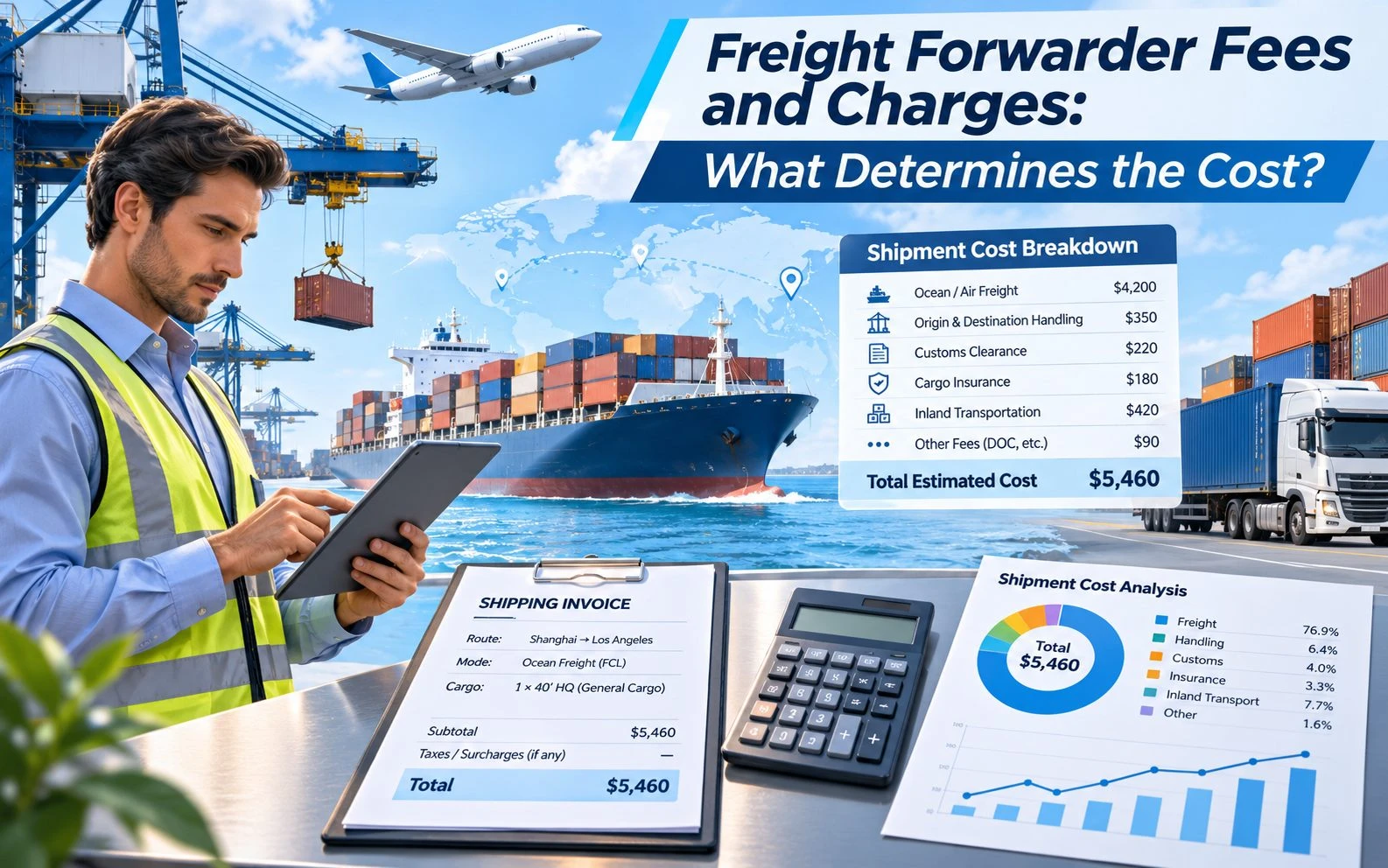
Freight forwarder fees are what you pay an intermediary to arrange the movement of goods from a Chinese supplier to your destination country. These fees cover booking, documentation, customs coordination, and physical cargo handling. Understanding what drives these freight forwarding charges is the difference between a predictable logistics budget and a series of unpleasant surprises on the final invoice.
What Are Freight Forwarder Fees?
A freight forwarder is a logistics intermediary that organizes the shipment of goods on behalf of the shipper. The forwarder does not own the ships or planes but contracts with carriers, ports, customs brokers, and trucking companies to move cargo door-to-door or port-to-port. Freight forwarder fees are the total amount you pay for this coordination service plus the underlying transportation and handling costs passed through from third parties.
These fees fall into three broad categories:
|
Category |
What It Covers |
Typical Range |
|
Service fees |
Booking, documentation, coordination, communication |
USD 50–200 per shipment |
|
Pass-through costs |
Carrier rates, port charges, government fees |
Varies by route and mode |
|
Accessorial charges |
Liftgate, residential delivery, hazmat handling, storage |
USD 50–300+ per event |
The forwarder's own service fee is typically USD 100–500 per shipment, while pass-through costs represent the largest share of the total bill. Base transport alone accounts for roughly 60–80% of the overall freight forwarding cost.
What Is Included in a Freight Forwarding Quote?
A freight forwarding quote is a formal estimate issued by a forwarder that itemizes every charge you will pay for a given shipment. Reading one correctly requires knowing what each line item means and whether it is fixed or variable.
Carrier Freight Charges
This is the base transportation cost charged by the shipping line, airline, or trucking company. For ocean freight, it is quoted per container (FCL) or per cubic meter (LCL). For air freight, it is quoted per kilogram based on chargeable weight - the greater of actual gross weight or volumetric weight. Forwarders typically apply a 5–15% markup on carrier rates as their margin for arranging the booking.
Terminal Handling Charge (THC)
The terminal handling charge (THC) covers the physical loading and unloading of containers at the port, yard storage, and use of port equipment. It is assessed at both origin (OTHC) and destination (DTHC). Based on industry data, THC typically runs USD 150–400 per container for FCL and USD 100–250 for LCL shipments. It is a pass-through cost collected by the forwarder on behalf of the terminal operator.
Customs Clearance Fee
The customs clearance fee covers the cost of processing goods through customs - preparing and submitting entry documents, paying duties on the importer's behalf, and coordinating with customs authorities. Typically it ranges from USD 75–250 per entry. Sensitive or regulated cargo (electronics, chemicals, food products) may carry higher clearance costs due to additional documentation and inspection requirements.
Documentation Fee
This fee covers the preparation of transport documents: bill of lading (B/L) for ocean shipments, airway bills for air freight, and commercial invoices. Typically USD 25–75 per set. Some forwarders charge this per shipment; others per container. It is a small but consistent line item that appears on virtually every freight quote.
Origin and Destination Handling
These charges cover the physical handling of cargo at warehouses or container freight stations (CFS) - receiving, sorting, consolidating, devanning, and temporary storage. Origin handling typically costs USD 50–200 per shipment; destination handling is similar. For LCL cargo, devanning (unpacking the consolidated container at destination) is a separate charge.
Cargo Insurance
Cargo insurance is optional but strongly recommended. It is typically priced at 0.3–0.8% of the declared cargo value. For high-value electronics or machinery, the premium sits at the upper end of that range.
Ocean Freight Charges: FCL vs. LCL
Ocean freight charges are the dominant cost component for most importers shipping from China. The choice between Full Container Load (FCL) and Less than Container Load (LCL) has the single largest impact on your ocean freight bill.
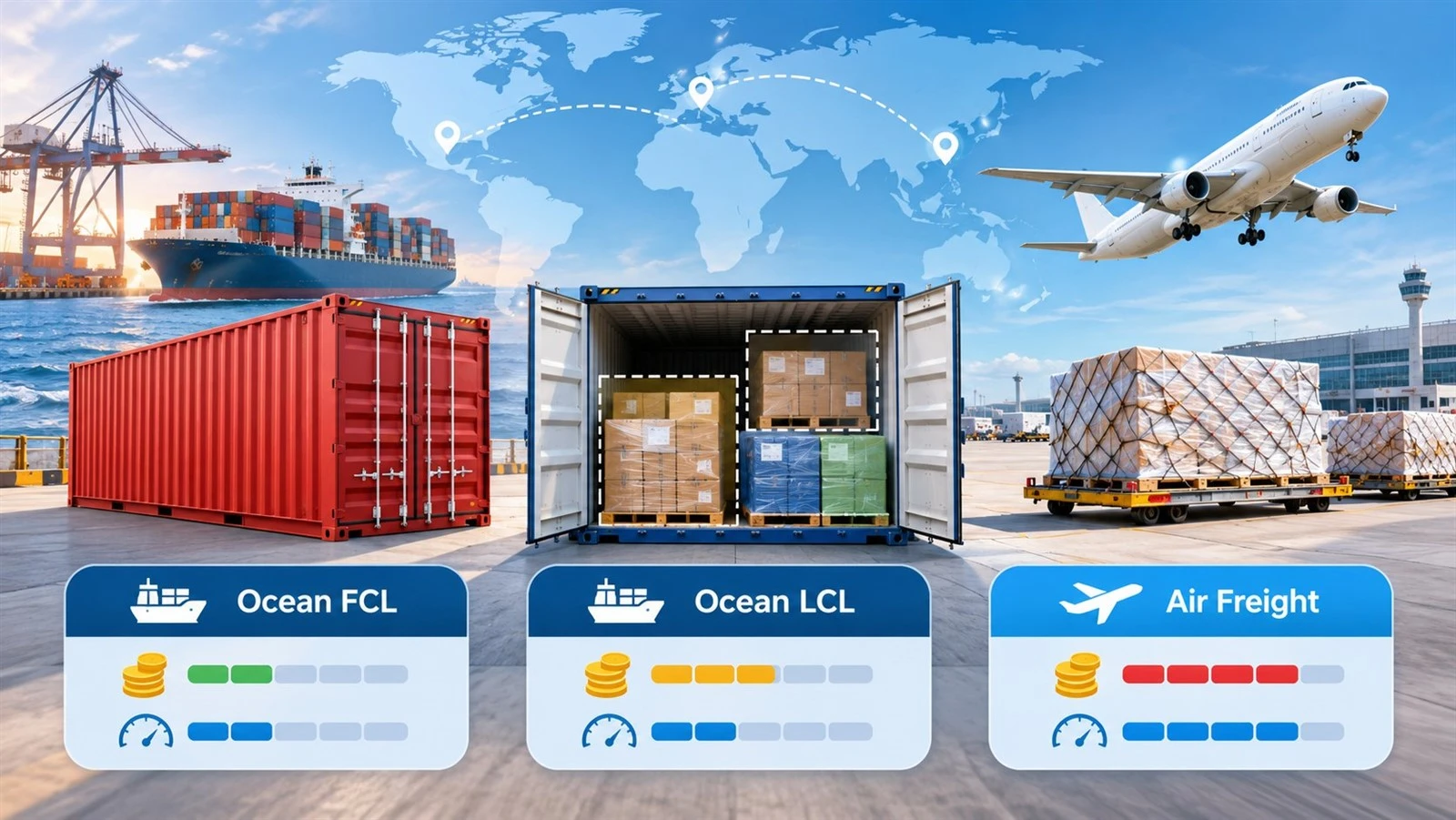
FCL ocean freight means you rent an entire container - typically a 20-foot, 40-foot, or 40-foot high-cube unit - exclusively for your cargo. LCL shipping means your goods share container space with other shippers' cargo, and you pay per cubic meter (CBM) or per ton, whichever is greater.
Based on 2026 industry data, the typical shipping cost ranges are:
|
Mode |
Pricing Unit |
Typical Cost (2026) |
Best For |
|
Ocean FCL |
Per container |
USD 1,500–8,000 per container |
Shipments over 10–15 CBM |
|
Ocean LCL |
Per CBM |
USD 50–120 per CBM |
Shipments under 10–15 CBM |
|
Air freight |
Per kg |
USD 2.50–8.00 per kg |
Urgent or high-value cargo |
The cost crossover between LCL and FCL typically falls around 10–15 CBM. Below that threshold, LCL is more economical. Above it, booking a full container costs less per unit of cargo and eliminates the handling charges associated with consolidation and devanning.
Ocean freight surcharges can add 15–30% on top of the base rate. The most common ones:
- BAF (Bunker Adjustment Factor) - fuel cost adjustment, typically 10–25% of base freight, fluctuating with global oil prices.
- CAF (Currency Adjustment Factor) - exchange rate risk buffer, applied on certain trade lanes.
- PSS (Peak Season Surcharge) - seasonal capacity surcharge, typically applied July–October.
- PCS (Port Congestion Surcharge) - triggered when vessels queue at congested ports.
- EBS (Emergency Bunker Surcharge) - temporary fuel cost recovery mechanism.
These surcharges are not optional. They are imposed by carriers and passed through to the shipper. The base ocean freight rate you see in an initial quote rarely reflects the full amount you will pay.
Air Freight Rates: When Speed Justifies the Cost
Air freight rates are quoted per kilogram based on chargeable weight, which follows IATA rules: the greater of actual gross weight or volumetric weight (calculated as length × width × height in centimeters divided by 5,000 for most international carriers). For dense, heavy cargo like machinery parts, actual weight governs. For lightweight, bulky cargo like stuffed toys or empty plastic containers, volumetric weight governs - and the effective rate per kilogram can be significantly higher than expected.
Air freight is generally 8–12 times more expensive per kilogram than ocean freight but 20–40 times faster. A shipment that takes 30–45 days by sea from China to Europe or North America reaches its destination in 5–10 days by air. Based on mid-2026 industry data, global air cargo spot rates held around USD 2.98–3.40 per kg, though rates on specific lanes - particularly those affected by airspace restrictions or capacity constraints - ran higher.
Air freight makes economic sense when one or more of these conditions apply:
- Cargo value is high relative to weight (electronics, pharmaceuticals, luxury goods).
- Time sensitivity is critical (seasonal product launches, urgent spare parts).
- Inventory carrying cost makes the longer ocean transit more expensive than the air freight premium.
- Cargo volume is small enough that LCL handling charges erode the ocean freight savings.
For most industrial equipment, machinery, and bulk commodity imports from China, ocean freight remains the default choice. Air freight is a tactical tool for specific shipments, not a replacement for sea freight. Understanding the differences between sea freight and air freight can help importers balance transportation costs against delivery speed.
What Factors Determine Freight Forwarding Costs?
Beyond the base rate, several variables push the final international shipping costs up or down. Understanding these factors affecting freight costs helps you anticipate where your budget is most vulnerable.
Fuel Prices and Bunker Costs
Fuel is the single largest operating cost for both ocean carriers and airlines. When global oil prices rise, carriers adjust the BAF for ocean freight and the fuel surcharge for air freight. These adjustments can happen monthly. Based on industry tracking, fuel surcharges for ocean freight typically run 12–18% of the base rate, and air freight fuel surcharges add USD 1–2 per kg on top of the base rate.
Route and Port Conditions
Longer distances mean higher carrier rates and more fuel consumption. But distance is not the only factor - port congestion, canal transit restrictions, and geopolitical disruptions all add cost. The Red Sea situation that forced carriers to reroute via the Cape of Good Hope added roughly 10–14 days of transit time on Asia–Europe lanes and significantly increased fuel costs. These costs were passed through to shippers in the form of surcharges and rate increases.
Cargo Characteristics
The physical properties of your cargo directly affect pricing:
|
Factor |
Cost Impact |
|
Weight and volume |
Determines chargeable weight for air freight and CBM for LCL |
|
Dangerous goods (hazmat) |
Requires special handling, documentation, and stowage; adds USD 75–300+ per shipment |
|
Out-of-gauge (OOG) cargo |
Oversized or overweight cargo requires special equipment and stowage planning |
|
Reefer (refrigerated) cargo |
Requires temperature-controlled containers and power supply |
|
High-value cargo |
Increases insurance premium and may require additional security measures |
Seasonality
Shipping rates fluctuate with demand cycles. The peak season for Asia–North America and Asia–Europe lanes runs roughly from July through October, driven by holiday season inventory buildup. During peak season, carriers impose PSS (Peak Season Surcharge) and space becomes tight - bookings made late may be rolled to the next sailing. Booking 4–6 weeks ahead during peak season is the practical minimum.
Incoterms and Cost Responsibility
Incoterms (International Commercial Terms) are standardized trade terms published by the International Chamber of Commerce that define which party - buyer or seller - is responsible for each segment of the freight forwarding cost and at what point risk transfers. The Incoterm you agree on in your purchase contract determines which charges appear on your forwarder's invoice versus your supplier's.
|
Incoterm |
What Buyer Pays For |
Risk Transfer Point |
|
EXW (Ex Works) |
All transport from supplier's premises, export clearance, everything |
Supplier's warehouse |
|
FOB (Free on Board) |
Ocean freight, insurance, destination charges, import clearance |
Loaded on vessel at origin port |
|
CIF (Cost, Insurance, Freight) |
Destination handling, import clearance, duties (freight and insurance prepaid by seller) |
Loaded on vessel at origin port |
|
DDP (Delivered Duty Paid) |
Only the agreed price - supplier handles everything including duties |
Buyer's premises |
Under EXW, you bear the maximum logistics cost and complexity. Under DDP shipping, your supplier absorbs it - but the price you pay for the goods will reflect that. There is no free lunch; the question is whether you or your supplier has better control over the freight spend.
Additional Freight Forwarding Charges to Watch For
Accessorial charges are event-triggered fees that apply when cargo requires services beyond standard pickup and delivery. These additional freight forwarding charges are the most common source of invoice shock because they do not appear in the base freight quote.
|
Accessorial |
Typical Cost |
When It Applies |
|
Liftgate service |
USD 50–150 |
Delivery location lacks a loading dock |
|
Residential delivery |
USD 75–200 |
Delivering to a non-commercial address |
|
Hazardous materials handling |
USD 75–300+ |
Cargo classified as dangerous goods |
|
Storage / demurrage |
USD 50–150 per day |
Container exceeds free time at port or warehouse |
|
Detention |
USD 50–150 per day |
Container kept beyond free time at receiver's facility |
Demurrage and detention deserve particular attention. Carriers grant a limited "free time" window - typically 7–14 days - for picking up and returning containers. Every day beyond that window incurs a per-day charge that compounds quickly. A container stuck in customs for three extra days can add USD 150–450 in demurrage alone, on top of any storage fees the warehouse charges.
The practical defense against accessorial surprises is to ask your forwarder for an all-in quote that lists every potential charge, not just the base freight rate. A quote that looks cheap almost always excludes the surcharges and accessorial fees that will appear on the final invoice.
How to Read and Compare Freight Forwarder Quotes
Comparing freight forwarding quotes from different forwarders is straightforward if you normalize them to the same structure. The trap is comparing base rates while ignoring everything else.
A proper comparison should line up these elements side by side:
- Base freight rate (per container, per CBM, or per kg).
- All surcharges (BAF, CAF, PSS, PCS, EBS - listed individually).
- Origin charges (OTHC, documentation, handling, trucking to port).
- Destination charges (DTHC, D/O fee, devanning, handling).
- Customs clearance fee.
- Accessorial charges (only those likely to apply to your shipment).
- Forwarder service fee.
An "all-in" quote bundles these into a single number. A "split" quote itemizes each line. Neither is inherently better, but comparing an all-in quote from one forwarder against a base-rate-only quote from another is where most importers lose money. The base rate might be USD 200 lower, while the destination charges are USD 400 higher.
For businesses looking to reduce ocean freight costs, reviewing the complete cost breakdown is an important step toward identifying unnecessary charges and improving transportation efficiency.
FAQ
How Much Does a Freight Forwarder Charge per Shipment?
Freight forwarder fees vary depending on the shipping route, transportation method, cargo characteristics, and services required. The forwarder's own service fee is typically USD 100–500 per shipment, while carrier freight charges, customs clearance, terminal handling, and other logistics expenses are calculated separately. The total freight forwarding cost depends on the shipment's specific requirements.
Are Freight Forwarding Fees the Same as Freight Charges?
No. Freight charges generally refer to the transportation costs charged by carriers for moving cargo by sea, air, road, or rail. Freight forwarding fees include the forwarder's service charges for booking, documentation, and shipment coordination, along with transportation costs and other charges included in the freight forwarder's invoice. Understanding this distinction helps importers evaluate shipping quotations more accurately.
Is FCL or LCL Shipping More Cost-Effective?
LCL shipping is generally more economical for smaller shipments, particularly those below 10–15 CBM, because shippers only pay for the container space they use. FCL shipping typically becomes more cost-effective for larger cargo volumes, as the cost per unit decreases and certain consolidation and handling charges can be avoided. However, the best option depends on the shipping route, cargo volume, and total origin and destination charges.
How Can I Avoid Hidden Freight Forwarding Charges?
The most effective way to avoid unexpected freight charges is to request a detailed, itemized freight forwarding quote before confirming your shipment. Make sure it includes base transportation costs, origin and destination handling, customs clearance, documentation fees, applicable surcharges, and potential accessorial charges. Pay particular attention to demurrage, detention, storage fees, and the free-time conditions at the destination port.
Who Pays Freight Forwarder Fees Under Different Incoterms?
Responsibility for freight forwarding charges depends on the Incoterms agreed upon by the buyer and seller. Under EXW, the buyer generally handles most transportation costs from the supplier's premises. Under FOB, the buyer typically pays for international freight and destination-related expenses. Under CIF, the seller arranges and pays for the main freight and insurance, while the buyer covers destination-related obligations. Under DDP, the seller is responsible for delivering the goods to the agreed destination, including applicable duties.
Final Thoughts
Freight forwarder fees and charges are determined by more than the base transportation rate. Port handling, customs clearance, documentation, fuel surcharges, additional services, and the forwarder's coordination fees all contribute to the total shipping cost. Transportation routes, cargo characteristics, seasonal demand, and Incoterms further influence the final amount.
Understanding these cost components and comparing fully itemized freight quotes can help importers avoid unexpected charges, manage logistics budgets, and make better shipping decisions. The lowest freight quote is not always the lowest total shipping cost.
At Zhejiang Wilson Supply Chain Management Co., Ltd., we provide international freight forwarding and supply chain solutions from China, including FCL and LCL ocean freight, air freight, customs coordination, and specialized cargo transportation. Contact our team to discuss your shipping requirements and receive a detailed freight quote tailored to your cargo, route, and delivery needs.