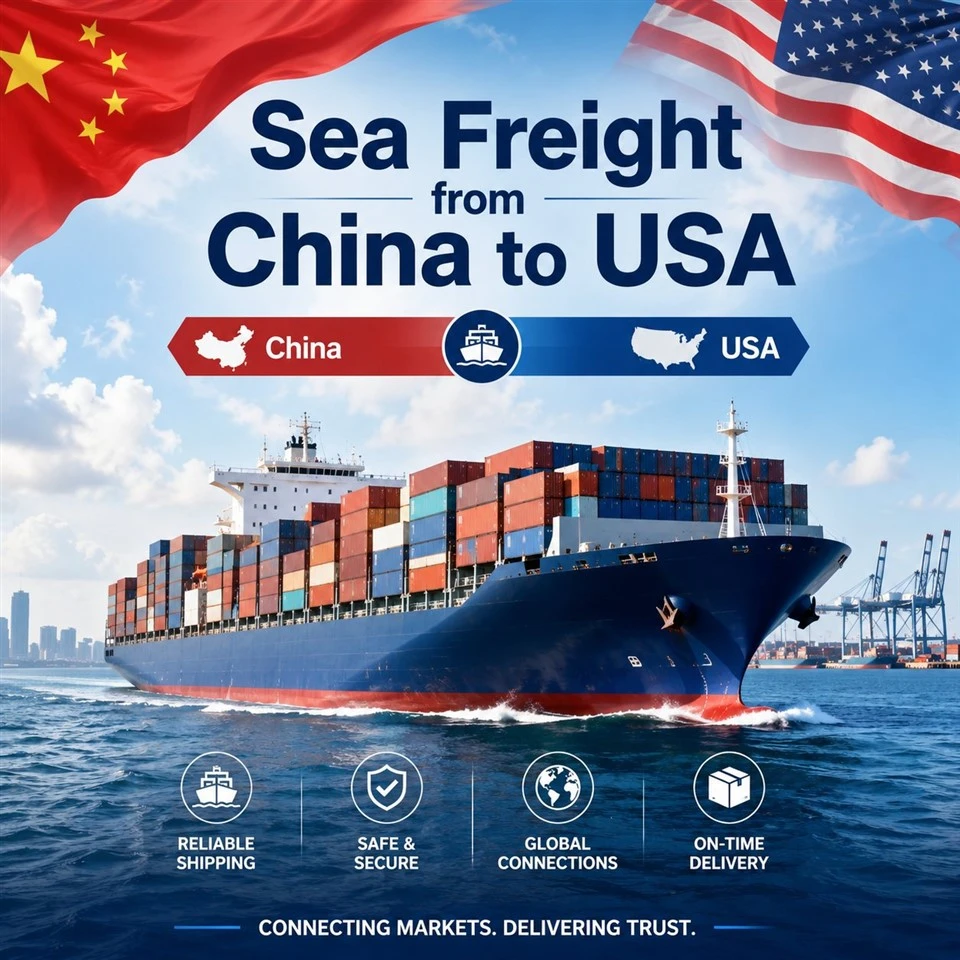
Sea freight from China to the USA is one of the most practical transportation options for importers moving commercial quantities of goods. It offers substantial capacity and a lower cost per unit than air freight, making it suitable for machinery, electronics, furniture, building materials, chemicals, automotive products, consumer goods and other containerized cargo.
Major Chinese departure ports include Shanghai, Ningbo, Shenzhen, Yantian, Qingdao, Tianjin and Xiamen. In the United States, common destination ports include Los Angeles, Long Beach, Oakland, Seattle, New York, Newark, Savannah, Norfolk and Houston.
Under normal shipping conditions, estimated port-to-port transit time is approximately:
- 15–25 days to the U.S. West Coast
- 28–40 days to the U.S. East Coast
- 35–45 days to the U.S. Gulf Coast
Reference LCL rates may range from approximately USD 80 to USD 180 per CBM, while FCL ocean freight may range from approximately USD 2,000 to USD 8,000 per container, depending on the container size, route, carrier capacity, season and services included.

Zhejiang Wilson Supply Chain Management Co., Ltd. has provided international freight forwarding and supply chain services since 2011. Headquartered in Ningbo, with branches in Shanghai, Shenzhen and Hong Kong, Wilson coordinates FCL, LCL, door-to-door shipping, export customs clearance, U.S. import-clearance support, special containers, oversized cargo and selected chemical or dangerous-goods shipments.
Our professional team has an average of more than eight years of logistics experience, and Wilson handles approximately 56,000 TEUs annually across its service network.
To receive an accurate China-to-USA sea freight quotation, provide:
- Product name and HS or HTS code, if available
- Number and type of packages
- Gross weight and cargo volume
- Package dimensions
- Supplier or pickup location in China
- U.S. destination port, city or ZIP code
- Preferred shipping date
- Incoterm, such as EXW, FOB, CIF or DDP
- FCL, LCL or special-equipment requirements
- Details of any chemical, dangerous, oversized or temperature-sensitive cargo
Sea Freight Costs from China to the USA
The cost of sea freight from China to the USA depends on more than the basic ocean rate. The final amount may include pickup in China, export handling, ocean freight, carrier surcharges, U.S. destination charges, customs brokerage, import duties and inland transportation.
Estimated FCL and LCL Shipping Rates
| Shipping Option | Estimated Reference Cost |
|---|---|
| LCL shipping | USD 80–180 per CBM |
| 20GP to the U.S. West Coast | USD 2,000–4,500 |
| 40GP or 40HQ to the U.S. West Coast | USD 3,500–6,500 |
| 20GP to the U.S. East Coast | USD 3,000–5,500 |
| 40GP or 40HQ to the U.S. East Coast | USD 4,500–8,000 |
These figures are general market estimates rather than fixed Wilson quotations. Actual rates depend on the shipment date, origin port, U.S. destination, carrier, container availability, cargo type, weight and market conditions.
A port-to-port quotation may not include:
- Factory pickup in China
- Export customs declaration
- Origin terminal handling
- Documentation fees
- Cargo insurance
- U.S. destination charges
- Customs brokerage
- Import duties and additional tariffs
- Customs inspection fees
- Chassis or drayage charges
- Rail or truck delivery
- Warehousing
- Demurrage and detention
Customers should therefore confirm the exact service scope before comparing quotations.
How LCL Shipping Is Calculated
LCL means Less than Container Load. Cargo from several shippers is consolidated into one container, and each customer pays for the space or chargeable weight used.
LCL freight is commonly calculated according to:
- Cubic meters
- Revenue tons
- Chargeable volume or weight
- Origin and destination handling
- Consolidation and deconsolidation
- Container Freight Station charges
LCL is normally suitable for several cartons, crates or pallets that do not justify booking a full container.
However, the ocean freight rate per CBM is only part of the total LCL cost. Warehouse handling, consolidation, documentation and destination charges can make LCL relatively expensive as the shipment becomes larger.
When Is FCL Cheaper Than LCL?
FCL means Full Container Load. One shipper has exclusive use of the container, even when the container is not completely full.
For many shipments, FCL may become more economical once the cargo reaches approximately 12–15 CBM. This is not a fixed rule because the decision also depends on:
- Cargo weight
- Number of packages
- Destination charges
- Product fragility
- Loading requirements
- Available container rates
- Delivery urgency
FCL usually involves less cargo handling and avoids the additional consolidation and deconsolidation stages required for LCL. It may therefore be preferable for fragile, high-value, heavy or time-sensitive cargo even when the container is not filled to its maximum capacity.
Main Components of a Sea Freight Quotation
Base Ocean Freight
This is the carrier charge for moving a container or LCL cargo between the Chinese port and the U.S. destination port.
FCL is normally charged per container, while LCL is charged according to cargo volume or weight.
Terminal Handling Charges
Terminal Handling Charges cover the movement of cargo or containers through the port terminal. Origin and destination terminals may apply separate charges.
Fuel and Low-Sulfur Surcharges
Carriers may apply fuel-related charges such as a Bunker Adjustment Factor or Low Sulfur Surcharge. These amounts can change according to fuel prices and carrier policy.
Peak Season Surcharge
Peak Season Surcharges may apply when demand increases, particularly before major retail seasons, Chinese New Year or other periods of limited capacity.
Documentation Charges
Documentation charges may cover the Bill of Lading, shipping instructions, export documents and other administrative work.
Customs Brokerage and Import Duties
Customs brokerage, import duties and additional tariffs are separate from the ocean freight unless specifically included in a door-to-door or DDP quotation.
The duty amount depends on the HTS classification, customs value, country of origin and any applicable additional trade measures.
Inland Transportation
If the final destination is not close to the arrival port, the cargo may require drayage, truck transportation, rail transportation or a combination of these services.
The lowest ocean freight rate does not always produce the lowest total landed cost. For example, an East Coast port may have a higher ocean rate but a lower inland delivery cost for cargo going to an eastern U.S. destination.
Factors That Affect China-to-USA Sea Freight Rates
The most important pricing factors include:
- Chinese departure port
- U.S. destination port
- Final delivery address
- Container type
- Cargo volume and weight
- FCL or LCL service
- Commodity and customs classification
- Dangerous-goods or special handling requirements
- Direct or transshipment service
- Shipping line
- Vessel capacity
- Container availability
- Peak season
- Port congestion
- Fuel prices
- Customs inspection
- Free-time requirements
- Port-to-port or door-to-door service scope
Ocean freight rates change frequently. A quotation should always state its validity period and clearly identify what is included and excluded.
Sea Freight Transit Time from China to the USA
Sea freight is slower than air freight, but it provides a more economical solution for large or regular shipments.
The total shipping time depends on the departure port, destination port, vessel rotation, transshipment arrangements, customs clearance and inland delivery.
Estimated Port-to-Port Transit Times
| Route | Estimated Transit Time |
|---|---|
| China to Los Angeles or Long Beach | 15–25 days |
| China to Oakland or Seattle | 16–28 days |
| China to New York or Newark | 28–40 days |
| China to Savannah or Norfolk | 30–40 days |
| China to Houston | 35–45 days |
| Door-to-door shipping | Approximately 25–50 days |
These estimates are not guaranteed delivery schedules.
U.S. West Coast Shipping
Los Angeles, Long Beach, Oakland and Seattle are common gateways for cargo serving the western United States.
West Coast routes generally offer:
- Shorter ocean transit
- More frequent sailings
- Competitive container rates
- Convenient access to western U.S. markets
- Rail connections to inland destinations
However, congestion at major West Coast ports can affect vessel berthing, container availability and final delivery.
U.S. East Coast Shipping
New York, Newark, Savannah and Norfolk are common options for cargo serving the eastern and southeastern United States.
East Coast routes generally involve:
- Longer ocean transit
- Higher ocean freight than many West Coast routes
- Shorter inland delivery distances for eastern destinations
- Reduced dependence on cross-country trucking or rail
For cargo going to eastern states, using an East Coast port may reduce the total inland cost even when the ocean freight is higher.
U.S. Gulf Coast Shipping
Houston is an important destination for cargo serving Texas, the Gulf region and parts of the central United States.
Transit time is normally longer than direct West Coast services. The route may still be attractive for machinery, industrial cargo, chemicals and goods destined for nearby markets.
Port-to-Port vs. Door-to-Door Transit Time
Port-to-port transit only measures the main ocean transportation period.
Door-to-door shipping may also include:
- Factory pickup
- Warehouse receiving
- Cargo consolidation
- Export customs clearance
- Waiting for the vessel departure
- Port handling
- U.S. customs clearance
- Customs inspection
- Port pickup
- Rail or truck delivery
- Final warehouse appointment
Importers should therefore distinguish between vessel transit time and the complete supply-chain lead time.
What Can Cause Shipping Delays?
Possible causes include:
- Typhoons, storms, fog or severe weather
- Port congestion
- Vessel schedule changes
- Rolled bookings
- Transshipment delays
- Container shortages
- Customs examinations
- Incorrect or incomplete documents
- Late ISF information
- Port labor or equipment problems
- Public holidays
- Chinese New Year
- Peak retail seasons
- Delays in rail or trucking capacity
Wilson monitors major shipment milestones and communicates schedule changes when information becomes available, but carrier schedules and customs-release times remain subject to external conditions.

Our Sea Freight Services from China to the USA
Wilson provides standard and specialized ocean freight solutions for importers, manufacturers, distributors, retailers and project customers.
FCL Shipping
Our FCL services include:
- 20GP containers
- 40GP containers
- 40HQ containers
- Factory loading
- Warehouse loading
- Port-to-port shipping
- Door-to-door coordination
- U.S. rail and truck delivery
FCL is suitable for larger shipments, heavy cargo, fragile goods and cargo that should remain separated from other shipments.
LCL Shipping
Our LCL services are designed for smaller commercial shipments.
Wilson can coordinate:
- Supplier pickup
- Warehouse receiving
- Multi-supplier consolidation
- Export packaging coordination
- Consolidation into shared containers
- Destination deconsolidation
- Customs-clearance support
- Final delivery
For LCL cargo, packaging should be strong enough to withstand additional warehouse handling and stacking.
Door-to-Door Shipping
Door-to-door service can include:
- Pickup from the supplier in China
- Cargo consolidation
- Export customs declaration
- Ocean freight
- U.S. import-clearance coordination
- Port pickup
- Rail or truck transport
- Delivery to the consignee's warehouse or commercial address
The exact scope must be confirmed in the quotation. Importer-of-record responsibilities, duty payment and product compliance must be agreed before shipment.
Cargo Consolidation
Importers often purchase products from several suppliers located in different Chinese cities.
Wilson can collect these orders into one warehouse, coordinate receiving, check package information and combine the cargo into one LCL or FCL shipment.
Consolidation can:
- Reduce repeated export handling
- Improve container utilization
- Simplify shipment management
- Reduce the number of Bills of Lading
- Support more efficient inventory planning
Special Container Shipping
Standard containers are not suitable for every product.
Wilson can arrange special equipment such as:
- Open-top containers
- Flat-rack containers
- Refrigerated containers
- Other equipment subject to carrier availability
Open-top and flat-rack containers may be used for machinery or cargo that exceeds standard container dimensions. Refrigerated containers may be used for products requiring controlled temperatures.
Oversized and Project Cargo
Wilson has experience coordinating transportation for:
- Industrial machinery
- Large equipment
- Vehicles
- Long, wide or high cargo
- Heavy cargo
- Project shipments
- Cargo requiring lifting and lashing plans
Customers should provide technical drawings, dimensions, weights, loading photographs and lifting-point information before a solution is prepared.
Chemical and Dangerous Goods Shipping
Wilson has practical experience in chemical logistics and selected classes of dangerous goods.
Previous operational categories include products such as ammonium sulfate, calcium chloride, hydrogen peroxide, potassium nitrate and refrigerants.
Acceptance depends on:
- Correct cargo classification
- UN number, where applicable
- Hazard class
- Packing group
- Material Safety Data Sheet
- Packaging type
- Dangerous Goods Declaration
- Carrier approval
- Route restrictions
- Port requirements
Chemical cargo is not automatically classified as dangerous goods. Each product must be reviewed according to its composition, transport classification and supporting documents.
Customs and Documentation Support
Wilson can coordinate:
- Chinese export customs declaration
- HS-code information review
- Commercial invoice review
- Packing-list review
- Bill of Lading instructions
- Certificate-of-origin coordination
- AMS information preparation
- ISF data coordination
- Communication with qualified U.S. customs brokers
- Customs-inspection support
Wilson does not replace the importer's legal responsibilities or the role of a licensed U.S. customs broker. The importer should confirm product eligibility, tariff classification, bond requirements and applicable regulations before shipment.
Cargo Insurance and Claims Support
Carrier liability is normally limited and may not cover the full commercial value of the goods.
Cargo insurance is recommended for:
- High-value goods
- Fragile cargo
- Machinery
- Project equipment
- Chemicals
- Time-sensitive inventory
- Goods exposed to water, theft or handling risks
Wilson can assist with insurance arrangements and supporting documentation if a covered loss occurs. Final compensation remains subject to the insurance policy, coverage conditions and exclusions.
Shipment Tracking
Wilson's logistics management system supports shipment visibility and milestone updates.
Customers may receive information about:
- Booking confirmation
- Container loading
- Customs release
- Vessel departure
- Transshipment
- Updated estimated arrival
- Port discharge
- Customs status
- Final delivery
How Our Sea Shipping Service Works
Step 1: Submit Your Cargo Information
Provide the product name, package count, weight, volume, pickup location, U.S. destination and expected shipping date.
For machinery, chemicals or special cargo, also provide dimensions, photographs, MSDS documents and loading requirements.
Step 2: Select FCL, LCL or Special Equipment
Wilson reviews the cargo and recommends:
- LCL for smaller shipments
- 20GP, 40GP or 40HQ for standard FCL cargo
- Open-top or flat-rack equipment for oversized cargo
- Refrigerated equipment for temperature-sensitive cargo
The recommendation considers both cost and operational risk.
Step 3: Choose the Route and U.S. Port
The route is selected according to:
- Supplier location
- Final delivery address
- Ocean freight
- Vessel schedule
- Port congestion
- Inland transportation
- Cargo type
- Required delivery date
We may compare West Coast, East Coast and Gulf Coast options before recommending a route.
Step 4: Confirm the Quotation and Booking
The quotation identifies:
- Shipping route
- Carrier or service option
- Container type
- Estimated departure
- Estimated arrival
- Included charges
- Excluded charges
- Rate validity
- Payment terms
After approval, Wilson coordinates the booking with the selected carrier.
Step 5: Arrange Pickup and Cargo Preparation
Cargo can be collected from the supplier or delivered to a designated warehouse.
For multi-supplier orders, Wilson coordinates receiving and consolidation. Special cargo may require additional packing, lashing, loading or inspection arrangements.
Step 6: Prepare Export and Shipping Documents
Common documents include:
- Commercial Invoice
- Packing List
- Bill of Lading instructions
- Sales contract
- Export-declaration information
- Certificate of Origin, where required
- Product specifications
- MSDS, where applicable
- Dangerous-goods documents
- Product-specific certificates
Product descriptions, package counts, weights, values and consignee details should be consistent across all documents.
Step 7: Complete Export Customs Clearance
Wilson coordinates export customs declaration in China and assists with inspection procedures when required.
After export release, the cargo is delivered to the terminal and loaded onto the scheduled vessel.
Step 8: Coordinate AMS and ISF Information
U.S.-bound sea freight requires accurate advance cargo information.
Wilson coordinates shipment data with the carrier, importer and customs broker. The importer should ensure that ISF information is filed within the required deadline before loading.
Late, incomplete or inaccurate information may lead to penalties, customs holds or additional inspection.
Step 9: Track Ocean Transportation
During transit, Wilson monitors major milestones, including:
- Actual departure
- Transshipment
- Vessel changes
- Schedule updates
- Estimated arrival
- Port congestion notices
Any ETA remains subject to carrier updates and operating conditions.
Step 10: Complete U.S. Customs Clearance
Before arrival, the importer or appointed customs broker should prepare:
- Customs entry information
- HTS classification
- Customs bond
- Commercial documents
- Import permits, if required
- Duty payment arrangements
- Product-agency documentation
Cargo may be released after document review, payment of applicable charges and completion of any required inspection.
Step 11: Arrange Final Delivery
After release, the container or LCL cargo can be collected from the port or deconsolidation warehouse.
Wilson can coordinate:
- Port drayage
- Local trucking
- Intermodal rail
- Transloading
- Warehouse delivery
- Final delivery appointments
For FCL cargo, the empty container must be returned within the allowed free time to avoid detention charges.
Why Choose Wilson for Sea Freight from China to the USA?
Established Since 2011
Zhejiang Wilson Supply Chain Management Co., Ltd. was established in 2011 and is headquartered in Ningbo.
Our long-term freight-forwarding and supply-chain experience supports regular container shipments, one-time imports and complex cargo projects.
Offices in Major Chinese Shipping Regions
Wilson operates through offices in:
- Ningbo
- Shanghai
- Shenzhen
- Hong Kong
This network supports cargo pickup, consolidation, documentation and port coordination across major manufacturing and export regions in eastern and southern China.
Approximately 56,000 TEUs Handled Annually
Wilson handles approximately 56,000 TEUs annually across its international service network.
This volume supports practical container-operating experience, regular communication with carriers and familiarity with different shipping scenarios.
Long-Term Carrier Cooperation
Wilson works with major global shipping lines, including:
- COSCO
- Hapag-Lloyd
- Maersk
- MSC
- Evergreen Marine
Carrier coverage allows our team to compare schedules, routing options and market-based freight rates.
No single shipping line is suitable for every cargo. The preferred carrier depends on the route, shipment date, equipment requirements and cargo classification.
Experienced Logistics Team
Wilson has a professional team of 26 experienced employees, with an average of more than eight years of industry experience.
The team supports:
- Route planning
- Container selection
- Documentation
- Customs coordination
- Chemical logistics
- Special cargo
- Shipment tracking
- Exception management
Standard and Specialized Cargo Capability
Customers can manage several cargo categories through one logistics provider.
Wilson's service scope includes:
- FCL
- LCL
- Standard containers
- Open-top containers
- Flat-rack containers
- Refrigerated containers
- Machinery
- Vehicles
- Project cargo
- Chemicals
- Selected dangerous goods
End-to-End Supply Chain Support
Wilson upgraded its supply-chain management capabilities in 2015.
Our service scope can extend beyond ocean booking to include:
- Procurement coordination
- Factory pickup
- Warehousing
- Cargo consolidation
- Export customs declaration
- Ocean freight
- Import-clearance coordination
- Inland distribution
- Insurance support
- Claims-document assistance
- Logistics planning
Compliance and Qualification Framework
Wilson reports logistics and compliance credentials including NVOCC qualification, AEO and ISO certifications, together with FIATA- and IATA-related credentials.
The applicable certificate, legal entity and service scope should be confirmed for each project.
Shipment Visibility
Our logistics-management tools support centralized order handling and milestone tracking.
Customers receive regular updates rather than having to communicate separately with suppliers, carriers, warehouses and multiple service providers.
Sustainable Logistics Planning
Wilson is committed to building an efficient and responsible global logistics network.
We help customers evaluate:
- Cargo consolidation
- Container utilization
- Alternative ports
- Inland transportation distance
- Shipment frequency
- Inventory planning
Improving container utilization and reducing unnecessary movements can support both cost control and more efficient transportation.
China–USA Trade and Common Cargo
China–USA shipping supports a wide range of industrial, retail and supply-chain activities.
Because current annual trade values and rankings change according to reporting period and tariff conditions, this section does not quote an unverified current bilateral trade total. The following cargo categories are a general industry overview rather than a current official statistical ranking.
Common Goods Shipped from China to the USA
Common containerized cargo categories include:
- Electrical and electronic products
- Machinery and industrial components
- Furniture and home products
- Textiles and apparel
- Lighting products
- Toys and sporting goods
- Plastic and rubber products
- Tools and hardware
- Automotive parts
- Construction materials
- Batteries and energy-related products
- Chemicals
- Medical and laboratory products
- E-commerce and retail inventory
Product regulations differ considerably. For example, food, cosmetics, medical devices, electronics, chemicals, batteries and children's products may require additional documents, testing, registration or agency review.
Common Goods Shipped from the USA to China
The return lane may carry:
- Agricultural commodities
- Industrial machinery
- Chemical products
- Medical and scientific equipment
- Automotive products
- Raw materials
- Recyclable or secondary materials, subject to regulation
- Other industrial or commercial cargo
Wilson can also discuss return, re-export or reverse-logistics shipments where service and regulatory conditions permit.
How Cargo Type Affects the Shipping Plan
The commodity influences:
- Container type
- Packing method
- Customs classification
- Import duty
- Product permits
- Carrier acceptance
- Insurance
- Inspection risk
- Final delivery method
A suitable logistics plan should therefore begin with a clear and accurate product description.
How to Import Goods from China to the USA
1. Confirm That the Product Can Be Imported
Before placing the final order, determine whether the goods are prohibited, restricted or regulated.
Products that may require additional review include:
- Food
- Cosmetics
- Pharmaceuticals
- Medical devices
- Chemicals
- Dangerous goods
- Batteries
- Radio or telecommunications products
- Children's products
- Agricultural products
- Used vehicles
- Used machinery
- Temperature-controlled goods
2. Identify the Correct HTS Code
The HTS classification affects:
- Base import duty
- Additional tariffs
- Antidumping or countervailing duties
- Customs reporting
- Product restrictions
- Agency requirements
- Statistical reporting
Avoid vague invoice descriptions such as "parts," "samples," "accessories" or "equipment" without sufficient detail.
3. Estimate the Total Landed Cost
The landed cost may include:
- Product price
- Chinese domestic transportation
- Export customs charges
- Ocean freight
- Insurance
- U.S. destination charges
- Customs brokerage
- Duties and additional tariffs
- Customs examination
- Rail or truck delivery
- Warehousing
- Demurrage or detention
Importers should calculate the full landed cost instead of comparing only the supplier's product price or ocean freight.
4. Verify the Supplier
Confirm:
- Legal company information
- Product specifications
- Manufacturing capability
- Quality-control standards
- Export experience
- Packing method
- Production lead time
- Required certifications
Third-party inspection may be appropriate for large, customized or high-value orders.
5. Agree on the Incoterm
Common Incoterms include EXW, FOB, CIF and DDP.
The selected term affects cost control, responsibility and risk allocation.
6. Choose FCL, LCL or Special Equipment
Use LCL for small shipments.
Use FCL when the cargo reaches an economical container volume or requires reduced handling.
Use open-top, flat-rack or refrigerated equipment when standard dry containers are not suitable.
7. Prepare Suitable Packaging and Labels
Sea freight packaging must withstand:
- Long-distance transportation
- Container movement
- Humidity
- Vibration
- Stacking
- Warehouse handling
- Rail or truck transportation
Possible protective measures include pallets, export cases, waterproof wrapping, desiccants, anti-rust treatment, shrink wrapping, corner protection and internal bracing.
Wood packaging may need to comply with applicable treatment and marking requirements.
8. Prepare the Commercial Documents
Core documents normally include:
- Commercial Invoice
- Packing List
- Bill of Lading
- Certificate of Origin, where required
- Insurance Certificate, where applicable
- Import permit, where applicable
- Inspection or product certificate
- Chemical or dangerous-goods documents
All documents should use consistent descriptions, quantities, values, weights and consignee information.
9. Appoint a U.S. Customs Broker
A qualified customs broker can assist with:
- Entry filing
- HTS classification
- Customs bond
- Duty calculation
- Agency requirements
- Customs communication
- Examination procedures
The importer remains responsible for the accuracy of the information provided.
10. Arrange the Customs Bond
Commercial imports may require a single-entry or continuous customs bond, depending on the importer and shipment program.
The customs broker can advise on the appropriate bond arrangement.
11. Complete ISF Preparation
The Importer Security Filing must be arranged within the required deadline for U.S.-bound ocean cargo.
Importers should provide accurate supplier, manufacturer, buyer, consignee, container-stuffing and product information to the filing party.
12. Book Shipping in Advance
Booking two to four weeks before the expected cargo-ready date can improve planning.
Additional time may be needed before:
- Chinese New Year
- China's National Day holiday
- U.S. retail peak season
- Major promotional periods
- Periods of equipment shortage
13. Complete Customs Clearance and Delivery
After arrival, the cargo may require document review, duty payment and inspection before release.
Once released, the shipment can be collected or delivered by truck or rail.
U.S. Import Regulations and Important Shipping Terms
Import requirements depend on the product, customs classification and current regulations. Importers should verify the latest requirements with a qualified customs broker and relevant government agencies before shipping.
CBP
U.S. Customs and Border Protection administers customs entry, cargo security, duty collection and import enforcement.
Importer of Record
The Importer of Record is responsible for the accuracy of the customs entry, classification, value, duty payment and compliance with applicable import requirements.
Customs Broker
A customs broker is a licensed professional or company authorized to transact customs business on behalf of importers.
HTS Code
The Harmonized Tariff Schedule code is used to classify imported products and determine the applicable duty treatment.
Customs Bond
A customs bond provides financial assurance that the importer will comply with customs requirements and pay duties, taxes and charges.
AMS
The Automated Manifest System is used for advance transmission of cargo and transportation information.
The filing arrangement normally involves the carrier, NVOCC or another authorized filing party.
ISF 10+2
Importer Security Filing applies to U.S.-bound ocean shipments.
The required data must be prepared and transmitted within the applicable deadline. Incorrect or late filing may lead to penalties or additional customs action.
Section 301 Tariff
Certain products of Chinese origin may be subject to additional Section 301 duties.
The applicable rate depends on the product classification and current trade measures. Importers should verify the tariff treatment at the time of entry.
Antidumping and Countervailing Duties
Some products may be subject to additional duties intended to address dumping or government subsidies.
These duties can be substantially higher than ordinary customs duties and should be checked before ordering.
FDA, FCC, CPSC and EPA
Some products may fall under the authority of other U.S. agencies, including:
- Food and Drug Administration
- Federal Communications Commission
- Consumer Product Safety Commission
- Environmental Protection Agency
Agency requirements depend on the product and intended use.
Bill of Lading
The Bill of Lading is the main ocean-transport document. It records shipment details and, depending on the type, may function as a document of title.
Sea Waybill
A sea waybill is a non-negotiable transport document that normally allows cargo release to the named consignee without presentation of original Bills of Lading.
Telex Release
Telex release is an instruction allowing destination cargo release after the original Bill of Lading has been surrendered at origin.
Shipping Order
The Shipping Order normally includes booking and container-handling information, such as the vessel, voyage, terminal and cutoff dates.
CFS
A Container Freight Station is a warehouse used for receiving, consolidating and deconsolidating LCL cargo.
BAF
Bunker Adjustment Factor is a fuel-related carrier surcharge.
LSS
Low Sulfur Surcharge may be applied to recover costs associated with compliant marine fuel.
PSS
Peak Season Surcharge may apply during periods of high shipping demand.
GRI
General Rate Increase is a carrier-announced adjustment to freight rates.
Demurrage
Demurrage applies when a container remains inside the terminal beyond the permitted free period.
Detention
Detention applies when a container is kept outside the terminal beyond the permitted free period.
Free Time
Free time is the allowed period before demurrage or detention charges begin.
EXW
Under EXW, the buyer assumes responsibility from the seller's premises, including pickup and most export-logistics arrangements.
FOB
Under FOB, the seller generally completes export clearance and delivers the goods on board the vessel at the agreed Chinese port.
The buyer controls the main ocean freight and subsequent transportation.
CIF
Under CIF, the seller arranges ocean freight and minimum cargo insurance to the named destination port.
Destination charges, import clearance, duties and final delivery are generally not automatically included.
DDP
Under DDP, the seller assumes broad responsibility for delivering the goods to the named destination, including agreed import duties and clearance.
DDP requires careful confirmation of:
- Importer-of-record arrangements
- Customs bond
- Product eligibility
- Duty payment
- Import permits
- Tax obligations
- Final delivery scope
Not every product or shipment is suitable for DDP.
Frequently Asked Questions
How much does sea freight from China to the USA cost?
Reference LCL freight may range from approximately USD 80 to USD 180 per CBM.
A 20GP container may range from approximately USD 2,000 to USD 5,500, while a 40GP or 40HQ container may range from approximately USD 3,500 to USD 8,000.
Actual rates depend on the route, container type, cargo, carrier, season and service scope.
How long does sea freight from China to the USA take?
Port-to-port shipping normally takes approximately 15–25 days to the West Coast and 28–40 days to the East Coast.
Gulf Coast routes may take approximately 35–45 days.
Door-to-door shipping may take approximately 25–50 days.
How much does a 20-foot container cost?
A 20GP container may cost approximately USD 2,000–4,500 to the West Coast or USD 3,000–5,500 to the East Coast.
These are general market estimates rather than fixed quotations.
How much does a 40-foot container cost?
A 40GP or 40HQ container may cost approximately USD 3,500–6,500 to the West Coast or USD 4,500–8,000 to the East Coast.
The final rate depends on carrier capacity and market conditions.
Should I use FCL or LCL?
Use LCL for smaller shipments that do not justify a complete container.
Consider FCL when the cargo reaches approximately 12–15 CBM, when LCL destination charges become too high or when reduced handling is important.
Which U.S. port should I choose?
The best port depends on the final delivery address, total cost, transit-time requirement, port congestion and available inland transportation.
West Coast ports are normally faster from China. East Coast ports may reduce inland costs for eastern U.S. destinations.
What documents are required?
Common documents include:
- Commercial Invoice
- Packing List
- Bill of Lading
- Certificate of Origin, where required
- ISF information
- Customs entry information
- Product-specific certificates
- Dangerous-goods documents, where applicable
Does the ocean freight rate include import duty?
Normally, no.
Import duty, additional tariffs, customs brokerage, inspection fees and inland delivery are separate unless specifically included in the quotation.
What is ISF 10+2?
ISF is an advance security filing for U.S.-bound ocean cargo.
The importer should provide accurate shipment information to the authorized filing party within the required deadline before loading.
Can Wilson arrange door-to-door shipping?
Yes, subject to the cargo type, destination and compliance requirements.
The service may include pickup in China, export clearance, sea freight, U.S. import-clearance coordination and final delivery.
Can Wilson consolidate cargo from several Chinese suppliers?
Yes.
Wilson can coordinate supplier pickup, warehouse receiving, package checking and consolidation into one LCL or FCL shipment.
Can Wilson ship chemicals or dangerous goods?
Wilson has experience with chemical logistics and selected classes of dangerous goods.
Acceptance depends on classification, packaging, documentation, carrier approval and route requirements.
Can Wilson ship machinery and oversized equipment?
Yes.
Wilson can arrange standard containers, open-top containers, flat-rack containers and project-cargo solutions according to the dimensions, weight and loading method.
Does Wilson provide cargo insurance?
Wilson can assist with cargo-insurance arrangements and claims-document preparation.
Coverage, limits and exclusions are subject to the insurance policy.
What information is required for a quotation?
Provide:
- Product name
- HS or HTS code, if available
- Package count
- Weight
- Volume
- Package dimensions
- Pickup location
- U.S. destination
- Incoterm
- Cargo-ready date
- Special handling requirements
Request a Sea Freight Quote from China to the USA
A reliable shipping plan should balance ocean freight, transit time, customs compliance, destination charges and inland delivery.
Zhejiang Wilson Supply Chain Management Co., Ltd. provides FCL, LCL, door-to-door transportation, cargo consolidation, export customs declaration, U.S. clearance coordination, special-container shipping, chemical logistics, insurance support and shipment tracking.
Send us your cargo information to receive a route comparison, container recommendation, estimated transit time and itemized quotation for sea freight from China to the USA.
Contact Wilson today to plan your next China-to-USA ocean shipment.
All rates and transit times on this page are general estimates for reference only. They are not fixed quotations or guaranteed schedules. Actual costs and delivery times depend on cargo details, origin and destination, carrier capacity, sailing date, port conditions, customs clearance and inland transportation.
Hot Tags: Sea Freight from China to the USA [Updated September 2026]