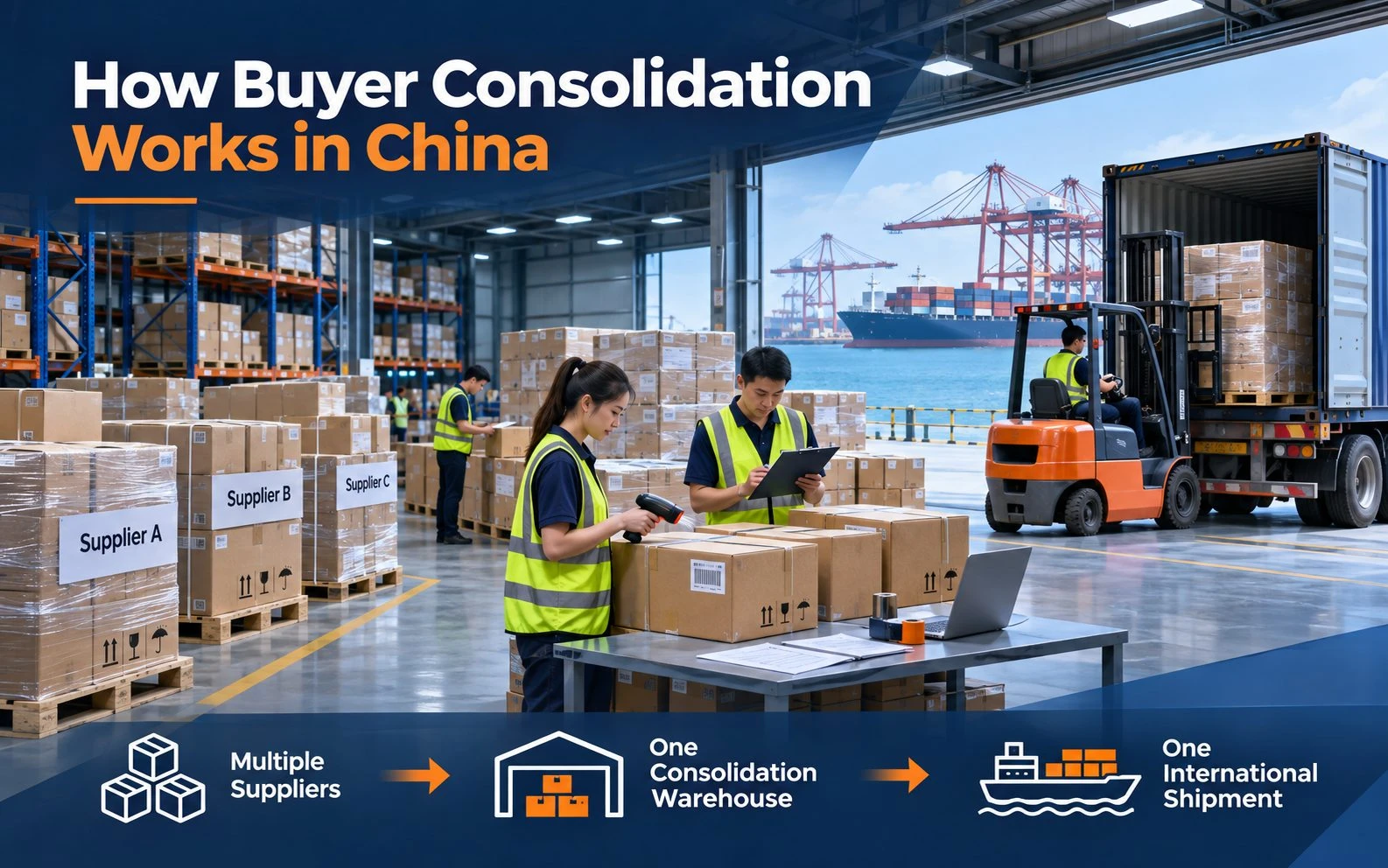
Buyer consolidation in China lets an overseas importer collect goods from multiple Chinese suppliers at one warehouse, combine them into a single shipment, and export them under one set of shipping documents. Instead of receiving ten small parcels from ten factories, the buyer receives one consolidated shipment - with one bill of lading, one customs declaration, and one freight invoice.
For companies sourcing products from multiple factories, a buyer consolidation service can simplify supplier coordination, reduce fragmented shipping costs, improve cargo visibility, and provide an opportunity to inspect goods before they leave China.
What Is Buyer Consolidation?
Buyer consolidation, sometimes called buyer's consolidation or buyer-consol, is a logistics arrangement in which a single buyer - rather than multiple sellers - drives the consolidation process.
Goods from several suppliers are delivered to a designated China consolidation warehouse, inspected, repacked if needed, and then loaded into one shipment destined for that buyer's warehouse or distribution center abroad.
This differs from standard LCL (Less than Container Load) shipping in one critical respect: in a conventional LCL shipment, the freight forwarder consolidates goods from different buyers heading to the same destination port. In buyer consolidation, all goods being consolidated belong to one buyer.
The final shipment may move as a full FCL container or as consolidated LCL cargo, depending on total volume. The consolidation logic is buyer-driven rather than forwarder-driven.
The distinction matters because it changes who controls the shipment. With buyer consolidation, the buyer or their appointed consolidator decides when the shipment is ready, how goods are packed, and which suppliers are included. That control is one of the main reasons importers use buyer consolidation services in China.
How Buyer Consolidation Works in China
Step 1: Suppliers Ship to the Consolidation Warehouse
Each supplier delivers goods to a designated consolidation warehouse, typically located near a major Chinese port such as Shenzhen, Guangzhou, Shanghai, or Ningbo. Depending on the agreed delivery terms, the consolidator may also arrange trucking and inland road freight in China to collect goods from factories and move them to the warehouse.
The buyer instructs each factory to use the warehouse address as the delivery destination on the domestic shipping order.
Goods usually arrive over a window of several days or weeks. The warehouse logs each incoming shipment, checks carton counts against the supplier's packing list, and assigns a unique inbound reference number to track it.
This multi-supplier consolidation process allows the buyer to manage cargo from several factories through one logistics point instead of arranging separate international shipments for each supplier.
Step 2: Inspection and Quality Check
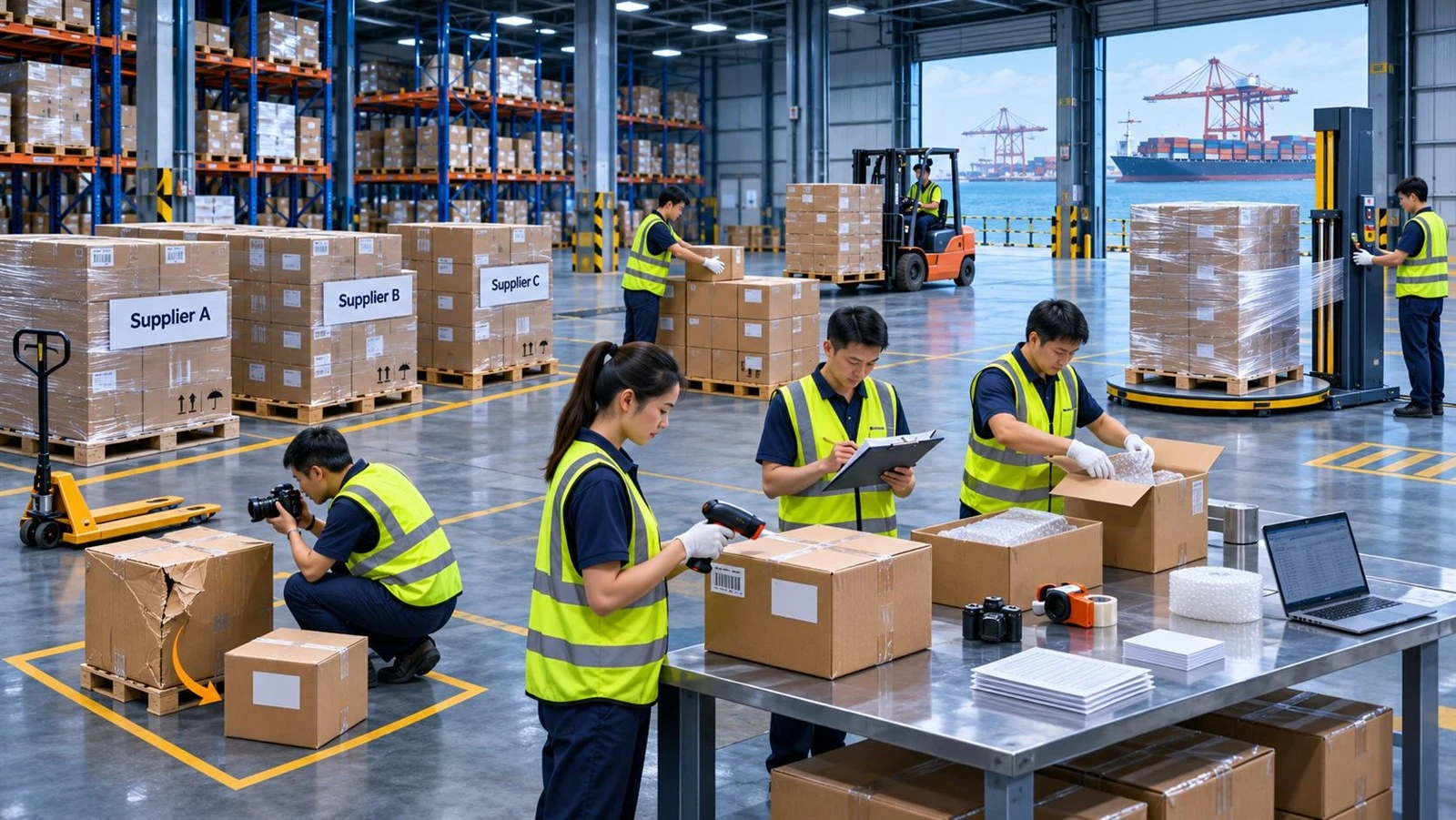
Once goods are in the warehouse, the consolidator performs a physical inspection. This is where buyer consolidation can add value that direct factory-to-port shipping may not provide.
|
Inspection Item |
What Gets Checked |
Why It Matters |
|
Carton count |
Actual quantity vs. packing list |
Catches short shipments before loading |
|
Product appearance |
Visible defects, damage, wrong items |
Prevents defective goods from entering the shipment |
|
Labeling and marks |
Shipping marks, barcodes, country of origin |
Helps support destination customs compliance |
|
Packaging integrity |
Crushed boxes, inadequate protection |
Reduces transit damage risk |
Buyers can request photo or video evidence of the inspection. Some consolidators also offer pre-shipment quality control reports with pass/fail ratings per SKU.
From industry documentation, this inspection step typically catches discrepancies in roughly 10–15% of inbound shipments, though the rate varies significantly by product category and supplier maturity.
Step 3: Repacking and Consolidation
After inspection, goods are repacked for export efficiency when necessary. Loose cartons may be palletized, shrink-wrapped, or re-boxed to improve cargo protection and maximize container space utilization.
The consolidator then measures the final volume and weight. These figures help determine the international freight cost.
The consolidation step is where potential cost savings begin to materialize. By combining goods from multiple suppliers into one shipment, the buyer may avoid paying for several separate LCL shipments, each of which can carry its own minimum charge, documentation cost, and handling fee.
For importers regularly shipping goods from multiple suppliers in China, consolidating cargo can also reduce the administrative burden of managing several independent shipments.
Step 4: Customs Declaration and Export
The consolidator coordinates the China export customs declaration. Goods may be declared through the appropriate export entity using documentation covering the products included in the consolidated shipment.
Required documents typically include:
- Commercial invoice
- Packing list
- Customs declaration form
- Certificate of origin, if required by the destination country
Because consolidated shipments may contain products from several suppliers, accurate product classification is particularly important. Importers and exporters can refer to the World Customs Organization's explanation of the Harmonized System and HS codes when reviewing product classifications.
For goods requiring special compliance, additional requirements may apply. Wood packaging materials used in international trade may need to meet ISPM 15 requirements, while batteries and other regulated cargo may be subject to international dangerous goods transport requirements.
The consolidator should identify these requirements before loading so that the appropriate certificates, packaging, declarations, and carrier approvals can be arranged.
Step 5: Loading and International Shipping
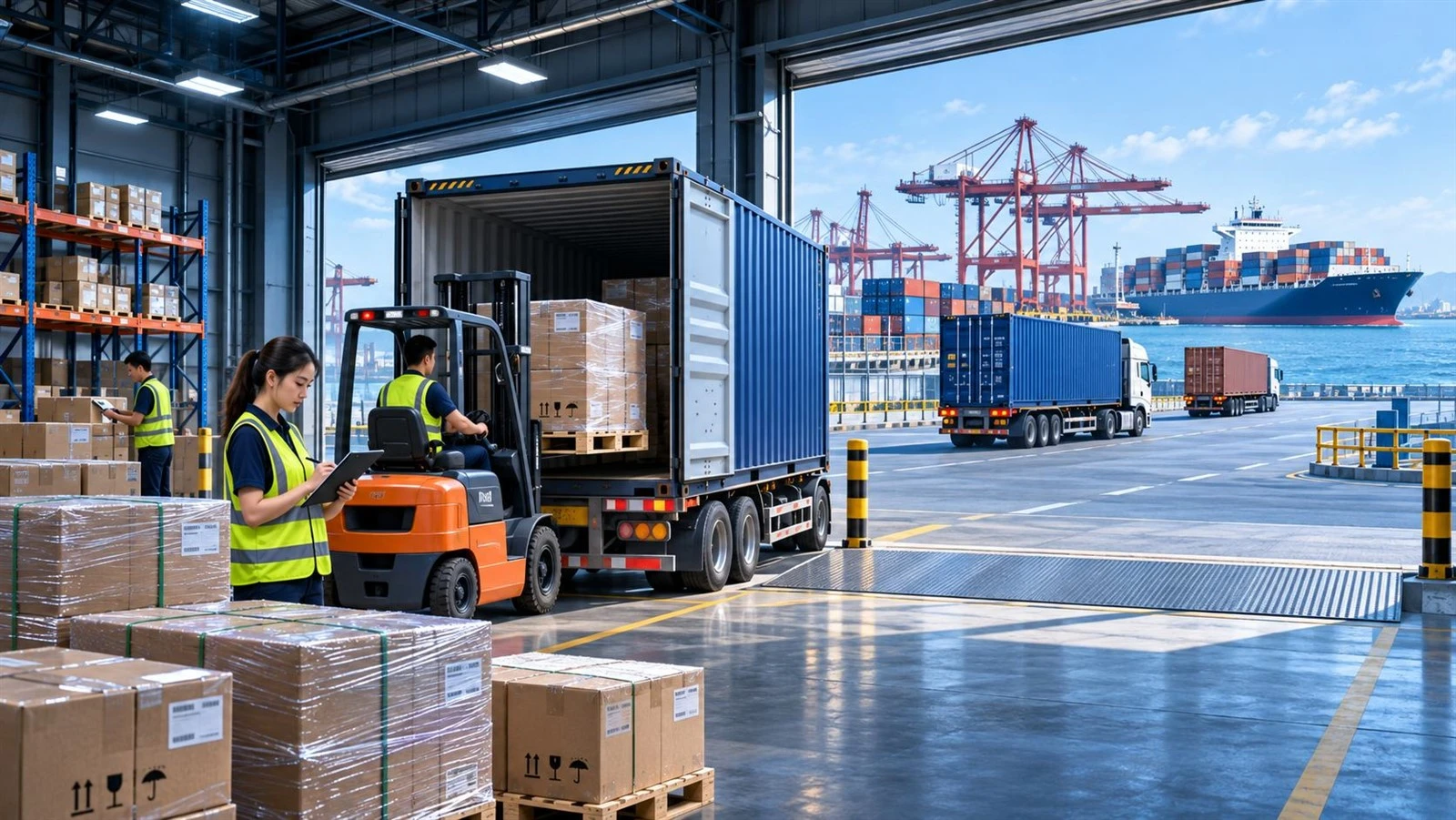
Goods are loaded into the container at the warehouse or transported to the port for stuffing. The container is sealed, and the carrier issues the applicable bill of lading.
For most buyer consolidation shipments, sea freight from China is the primary international transportation option.
Depending on the buyer's shipment volume and urgency, cargo may move as:
|
Shipping Mode |
Typical Volume |
Transit Time to Major Ports |
Best For |
|
FCL (20ft/40ft) |
28–68 CBM |
14–35 days |
Large consolidated volumes |
|
LCL (shared) |
1–15 CBM |
20–45 days |
Smaller consolidated volumes |
|
Air freight |
Under 1 CBM |
3–7 days |
Urgent, high-value goods |
For larger consolidated volumes, FCL ocean freight may provide better container control and unit economics. Smaller volumes may instead move through LCL ocean freight from China.
Urgent or high-value cargo can also be considered for air freight from China.
Transit times vary by destination, carrier, and routing. The figures above reflect common ranges seen on major trade lanes from China to Europe, North America, and Australia. Actual schedules depend on the specific carrier, routing, and port pair.
A freight forwarder may compare FCL, LCL, and air freight options based on total cargo volume, delivery deadline, cargo characteristics, and destination costs.
Step 6: Destination Delivery
At the destination port, the shipment is cleared through local customs and delivered to the buyer's warehouse according to the agreed shipping terms.
For a dedicated FCL buyer consolidation shipment, the buyer can receive the sealed container directly after customs and terminal procedures, avoiding the destination deconsolidation normally associated with standard LCL cargo.
This can reduce unnecessary handling and may lower the risk of cargo loss or damage during destination-side sorting.
Buyers who prefer one logistics provider to coordinate origin pickup, international transportation, customs clearance, and final delivery may also consider door-to-door shipping from China.
When Buyer Consolidation in China Makes Sense
Buyer consolidation is not the right choice for every shipment. It works best when a buyer sources from multiple Chinese suppliers and the combined volume justifies the additional warehouse and handling costs.
Strong fit:
- Importers sourcing from 3+ suppliers per order cycle
- Buyers who need pre-shipment inspection before goods leave China
- Companies importing mixed product categories that require coordinated export documentation
- Buyers who want a single point of contact for logistics coordination
- Importers looking to consolidate shipments from multiple suppliers in China
- Companies that want to combine several supplier orders into one FCL or LCL shipment
Weak fit:
- Single-supplier purchases with enough volume for a direct FCL shipment
- Urgent orders where warehouse dwell time, typically 3–10 days, is unacceptable
- Very small orders under 1 CBM where LCL minimum charges already apply
The break-even point between buyer consolidation and separate LCL shipments usually falls around 3–5 CBM of combined volume. Below that threshold, the consolidation warehouse fee may eat into the freight savings. Above it, the per-cubic-meter cost advantage becomes clearer.
The best decision should therefore be based on total logistics cost rather than ocean freight alone.
Buyer Consolidation Costs in China
Buyer consolidation pricing is not a single line item. Buyers should expect several cost components when using a China cargo consolidation service.
|
Cost Component |
Basis |
Typical Range |
|
Warehouse receiving fee |
Per carton or per shipment |
USD 0.50–2.00 per carton |
|
Storage fee |
Per CBM per day, with free days often included |
USD 0.10–0.50 per CBM/day |
|
Inspection / QC fee |
Per carton or per SKU |
USD 0.30–1.50 per carton |
|
Repacking / palletizing |
Per carton or per pallet |
USD 2–8 per pallet |
|
Export customs declaration |
Per shipment |
USD 30–80 flat |
|
Ocean freight (FCL) |
Per container |
USD 1,500–4,500 per 40ft |
|
Destination charges |
Per shipment |
Varies by port and term |
These ranges are drawn from publicly available freight forwarding rate sheets and logistics service documentation. Actual costs depend on the consolidator, port, season, cargo type, and negotiated terms.
During peak shipping seasons - typically September through January - rates can rise 20–40% above baseline levels.
When comparing buyer consolidation costs, importers should consider the complete logistics chain, including domestic pickup, warehouse receiving, storage, repacking, customs clearance, international freight, destination charges, and final delivery.
A lower ocean freight quote does not necessarily mean a lower total landed logistics cost. Understanding how sea freight costs are calculated can make it easier to compare quotations on a total-cost basis rather than focusing only on the basic ocean rate.
Buyer Consolidation vs. Standard LCL and Direct FCL
Choosing between buyer consolidation, standard LCL, and direct FCL depends mainly on cargo volume, supplier structure, cost, and the level of control the importer needs. A broader FCL vs LCL shipping comparison can also help buyers understand the trade-offs between the two main container shipping methods.
|
Factor |
Buyer Consolidation |
Standard LCL |
Direct FCL |
|
Who controls loading |
Buyer / consolidator |
Forwarder |
Single supplier |
|
Pre-shipment inspection |
Yes, at warehouse |
Rarely |
At factory only |
|
Number of bills of lading |
Usually consolidated |
Often shipment-based |
One |
|
Destination deconsolidation |
Not required for dedicated FCL |
Yes |
No |
|
Best for |
Multi-supplier buyers |
Small individual shipments |
Large single-supplier orders |
|
Typical cost efficiency |
High at scale |
Moderate |
Highest when container utilization is strong |
The core trade-off is control versus simplicity.
Buyer consolidation gives the importer greater control over cargo inspection, documentation, packing, supplier coordination, and shipping schedules, but it also requires additional coordination before departure.
For businesses that regularly source products from several suppliers in China, that additional control can justify the warehouse and handling cost.
Standard LCL remains practical for small independent shipments, while direct FCL is often the simplest option when one supplier can already provide enough cargo to efficiently fill a container.
Common Buyer Consolidation Mistakes to Avoid
Unclear delivery terms with suppliers.
If the buyer's purchase order does not clearly specify EXW (Ex Works), FOB (Free on Board), or other agreed delivery responsibilities, suppliers may deliver to the wrong location or misunderstand who is responsible for transport to the consolidation warehouse. Confirm delivery terms in writing before production is completed.
Ignoring warehouse free-time limits.
Many consolidation warehouses offer 7–14 days of free storage. Goods that remain in the warehouse longer can incur daily storage fees that gradually reduce the savings achieved through shipment consolidation.
Coordinate supplier production and delivery schedules so cargo arrives within a reasonably compact window.
Skipping the inspection step.
Some buyers treat freight consolidation purely as a cost-saving exercise and skip cargo checks. This removes one of the most useful advantages of routing goods through a consolidation warehouse.
Defective, damaged, mislabeled, or missing goods are usually much more expensive to resolve after they have already been exported.
Underestimating destination charges.
Even with shipping consolidation from China, destination ports can impose terminal handling, customs brokerage, delivery, and other local charges.
Request a quotation that clearly defines both China-origin and destination-side charges rather than comparing freight rates alone.
Mixing cargo without checking compliance requirements.
Not every product can automatically be consolidated into the same shipment. Batteries, chemicals, dangerous goods, food products, temperature-controlled cargo, and other regulated products may require separate documents, packaging, carrier approval, or transportation arrangements.
Confirm cargo compatibility before suppliers deliver goods to the consolidation warehouse.
FAQ
Can I Consolidate Goods From Multiple Suppliers in China?
Yes. This is the main purpose of buyer consolidation. Goods from several suppliers can be collected at one consolidation warehouse, checked, stored temporarily, and combined into one international shipment.
The consolidator normally tracks each supplier's cargo separately until the final shipment is prepared.
Is Buyer Consolidation the Same as LCL Shipping?
No.
LCL describes a transportation method in which cargo shares container space with shipments belonging to other customers.
Buyer consolidation describes a supply chain arrangement in which goods from several suppliers belonging to the same buyer are collected and managed together.
A buyer consolidation shipment can ultimately move as either LCL or FCL depending on the total cargo volume.
How Many Suppliers Do I Need for Buyer Consolidation?
There is no fixed minimum, but buyer consolidation generally becomes more useful when an importer is purchasing from several suppliers during the same order cycle.
The cost advantage becomes more noticeable when the combined cargo volume is large enough to offset warehouse receiving, inspection, storage, and handling charges.
How Long Can Goods Stay in a China Consolidation Warehouse?
The exact storage period depends on the warehouse and service agreement.
Many warehouses provide a limited number of free storage days before daily storage fees begin. If suppliers have very different production schedules, the buyer should compare the cost of waiting for all cargo against the savings from consolidating everything into one shipment.
Can a Freight Forwarder Coordinate Directly With My Chinese Suppliers?
Yes. Understanding what a freight forwarder does is particularly useful in buyer consolidation because the forwarder may act as the coordination point between the overseas buyer, multiple Chinese suppliers, warehouses, carriers, customs brokers, and destination agents.
A China freight forwarder providing end-to-end supply chain support can coordinate pickup or warehouse delivery with suppliers, confirm cargo information, arrange warehouse receiving, prepare shipping documentation, book international transportation, track the shipment, and coordinate destination handoff according to the agreed service scope.
This is particularly useful for overseas buyers who do not have their own logistics staff in China.
Conclusion
Buyer consolidation in China works by routing goods from multiple suppliers through one consolidation warehouse, checking and organizing the cargo, and then combining it into a coordinated international shipment.
For overseas importers sourcing from several Chinese factories, the main benefits are simpler supplier coordination, greater control over cargo before export, fewer fragmented shipments, and the potential to reduce total logistics costs once the combined volume is large enough.
The process itself is straightforward, but successful buyer consolidation depends on accurate cargo information, coordinated supplier delivery schedules, appropriate warehouse handling, correct export documentation, and a freight forwarder that can manage the entire shipping process consistently. Before appointing a logistics partner, buyers may also want to review the main factors involved in choosing a freight forwarder in China.
Zhejiang Wilson Supply Chain Management Co., Ltd. is a China-based international freight forwarder and supply chain company providing supplier coordination, domestic pickup, warehousing, customs support, sea and air freight, shipment tracking, and destination logistics coordination. If you are sourcing from multiple suppliers in China, contact our team to discuss your cargo volume, supplier locations, destination, and shipping schedule so we can help evaluate a practical buyer consolidation solution for your supply chain.