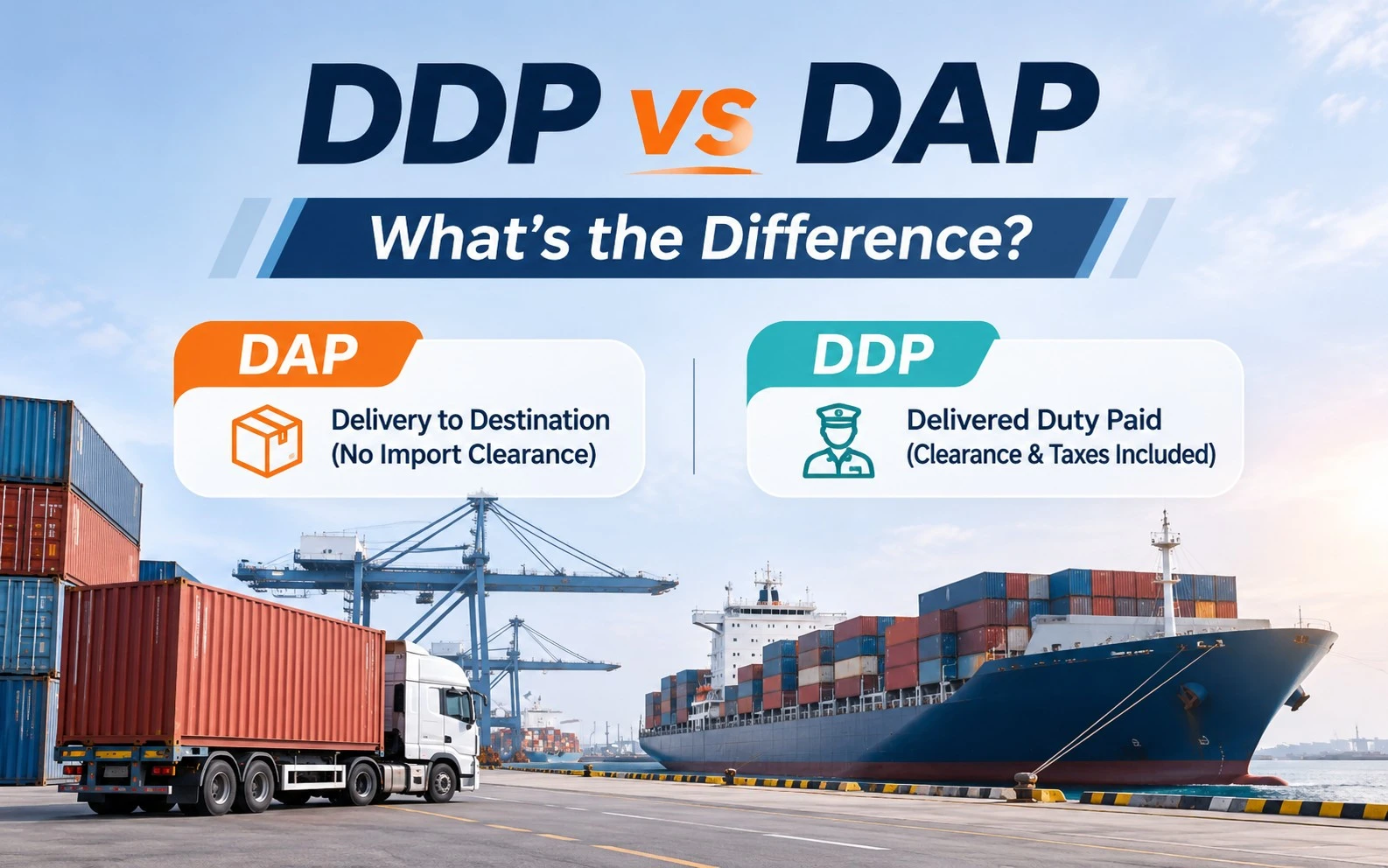
DDP (Delivered Duty Paid) and DAP (Delivered at Place) are two of the most commonly confused Incoterms 2020 rules. Both belong to Group D, where the seller delivers goods to a named destination. The main difference between DDP and DAP comes down to one important question: who handles import customs clearance and pays the import duties and taxes?
Under DAP, the buyer does. Under DDP, the seller does. That single distinction reshapes cost, customs responsibility, compliance requirements, and operational responsibility across the entire shipment.
For importers comparing DDP vs DAP, understanding this difference is essential when calculating landed costs, selecting a shipping arrangement, or deciding how much responsibility each party should assume.
What Is DAP (Delivered at Place)?
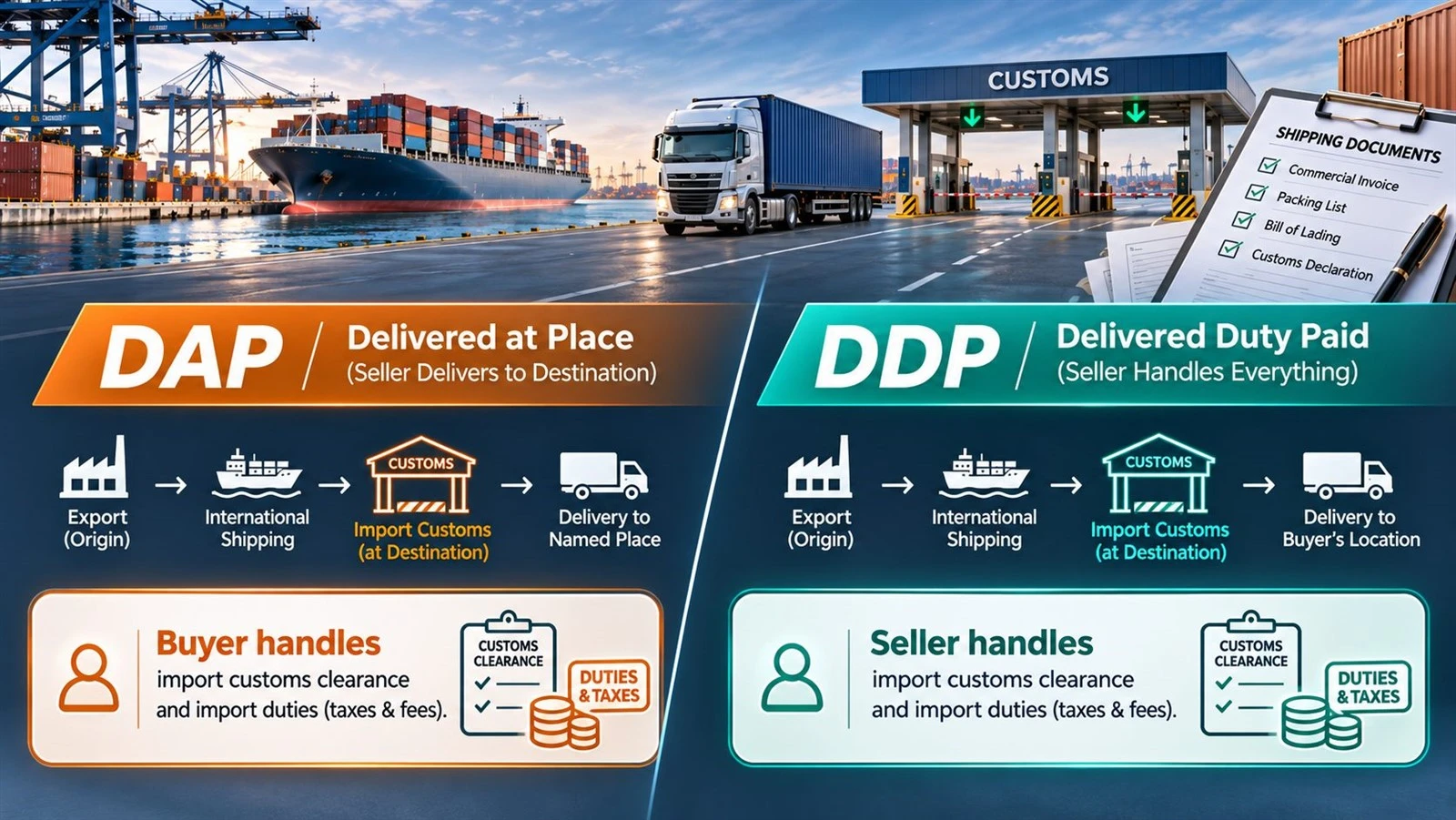
Delivered at Place (DAP) means the seller delivers the goods to a named place of destination, ready for unloading. The seller bears all costs and risks of bringing the goods to that point, including export clearance, main carriage, and on-carriage to the agreed location.
Once the goods arrive at the destination and are placed at the buyer's disposal on the arriving means of transport, risk transfers to the buyer.
Import customs clearance, import duties, and taxes remain the buyer's responsibility under DAP Incoterms. The seller is not obligated to clear the goods through the destination country's customs or to pay import-related charges.
If the buyer fails to arrange import clearance promptly, goods may remain at the port or in a bonded warehouse and incur storage fees. Those additional costs generally fall on the buyer rather than the seller.
DAP applies to any mode of transport, including multimodal shipments involving sea, air, rail, and road. It is widely used when the buyer has the capability to handle import procedures in their own country or prefers to control the customs process for regulatory or tax reasons.
For buyers who maintain their own import licenses and customs brokers, DAP shipping offers greater transparency. They can see the actual import duties and taxes and manage customs compliance according to their own requirements.
What Is DDP (Delivered Duty Paid)?
DDP, or Delivered Duty Paid, goes one step further than DAP. The seller delivers the goods to the named place of destination, cleared for import. This means the seller handles both export and import customs formalities, pays applicable import duties, VAT, GST, and other taxes, and bears the relevant costs and risks until the goods are placed at the buyer's disposal.
Among the 11 Incoterms 2020 rules, DDP Incoterms place the maximum level of responsibility on the seller. For the buyer, DDP shipping can provide an experience closer to doorstep delivery with minimal involvement in customs procedures.
This arrangement is attractive to buyers who lack import infrastructure or want a more predictable, all-inclusive shipping price with fewer unexpected destination charges. It shifts much of the cross-border logistics and customs responsibility to the seller.
However, DDP carries an important practical limitation. In some countries, foreign entities are restricted or prohibited from conducting import customs clearance directly. The seller may need to engage an authorized local customs broker or agent, and in certain jurisdictions, registering for VAT or obtaining an import license as a non-resident can be difficult or impossible.
These regulatory barriers mean that DDP shipping is not always legally or operationally feasible, regardless of what the sales contract states.
DDP vs DAP: Key Differences
The table below compares the main responsibilities under DDP and DAP:
|
Obligation |
DAP |
DDP |
|
Main carriage to destination |
Seller |
Seller |
|
Export customs clearance |
Seller |
Seller |
|
Risk transfer point |
On arrival, before unloading |
On arrival, before unloading |
|
Import customs clearance |
Buyer |
Seller |
|
Import duties and taxes (VAT/GST) |
Buyer |
Seller |
|
Unloading at destination |
Buyer |
Buyer |
|
Seller's overall obligation |
High |
Maximum |
The pattern is clear. Much of the transportation responsibility before arrival is similar under both terms.
The critical difference between DDP and DAP appears at import customs clearance. Under DAP, the buyer handles import clearance and related duties and taxes. Under DDP, those responsibilities shift to the seller.
That distinction can significantly affect landed cost, customs compliance risk, pricing, and operational complexity.
When to Choose DAP
DAP makes sense when the buyer has established import capabilities in the destination country.
Companies with in-house customs expertise, valid import licenses, established customs brokers, and familiarity with local tariff structures can often clear goods more efficiently and potentially at lower cost than a remote seller attempting to navigate an unfamiliar customs regime.
For shipments entering the European Union, importers can also use the official EU Customs Tariff (TARIC) system to review applicable tariff measures and customs requirements.
DAP also suits situations where the buyer wants to control the timing of duty payments for cash-flow reasons, or where specific goods are subject to quotas, anti-dumping duties, product approvals, or regulatory requirements that are best managed by the importer.
DAP is often the safer choice when the seller has no legal entity, import registration, or established customs infrastructure in the destination country. Attempting DDP without the necessary local capabilities can lead to customs delays, penalties, or cargo being held pending clearance.
For experienced importers, DAP shipping from China can therefore provide greater control over destination customs procedures and landed costs.
When to Choose DDP
DDP works best when the seller or its logistics partner has the infrastructure and legal capability to handle import customs clearance at the destination.
This can apply when an experienced freight forwarder has access to reliable destination agents and customs resources, when goods are being shipped to overseas fulfillment facilities, or when sellers have developed local compliance capabilities through established operations or partnerships.
For the buyer, DDP shipping offers a single quoted price with fewer customs-related surprises. This can be particularly valuable for first-time importers, companies entering a new market, or buyers that want to minimize the administrative burden associated with international customs procedures.
The trade-off is cost.
DDP prices typically incorporate factors such as estimated duty rates, taxes, customs brokerage fees, potential delays, and a margin for uncertainty. Buyers choosing DDP are paying not only for transportation, but also for additional convenience and the transfer of import-side responsibilities.
Depending on the destination country's tariff and tax structure, that premium can be significant.
DDP vs DAP: Cost and Risk Differences
The practical difference between DDP vs DAP costs is not simply about who makes the payment to customs. The chosen Incoterm can affect the entire commercial relationship.
Under DAP, the buyer bears the volatility associated with import duties. If the destination country raises tariffs while the shipment is in transit, the buyer generally absorbs the increase because duties are outside the seller's DAP price.
Under DDP, the same volatility affects the seller. A sudden tariff change between contract signing and cargo arrival can reduce margins or potentially turn a profitable shipment into a loss. Sellers quoting DDP often build a cost buffer into their pricing, but trade policy changes cannot always be predicted.
Customs-related risk also differs.
If goods are held, rejected, or delayed by destination customs under DAP, the buyer generally bears the consequences associated with the import clearance process.
Under DDP, the seller assumes responsibility for import clearance and therefore faces greater exposure to customs-related problems, including regulatory requirements that may not have been anticipated when the quotation was prepared.
In practical terms, the Incoterm you select determines which party absorbs many of the costs and responsibilities when problems occur during import clearance.
Common DDP and DAP Mistakes to Avoid
Several recurring mistakes can cause disputes and unexpected costs under either DDP or DAP:
- Using a vague destination. Writing "DAP Germany" without specifying the city, address, terminal, or agreed delivery point creates ambiguity about where delivery occurs and who pays for subsequent transportation. Always identify the precise named place.
- Assuming DDP includes every possible charge. Storage, demurrage, waiting time, special handling, inspections, or other exceptional destination charges may not automatically be covered unless specifically agreed between the parties.
- Ignoring VAT under DDP. Import VAT can exceed customs duty in many markets. Sellers that quote DDP without accounting for VAT or other applicable taxes may face costs significantly above their original estimates. For EU shipments, the European Commission provides detailed information on EU VAT rules.
- Using DDP where the seller cannot legally clear customs. If local regulations prevent a foreign entity from acting as the importer or completing the required import declarations, DDP may not be workable as written. The parties may need to use DAP or arrange import clearance through an authorized local party with clearly defined responsibilities.
- Confusing DAP with DPU. DPU (Delivered at Place Unloaded) requires the seller to unload the goods at the destination. DAP does not. Confusing these Incoterms can shift unloading responsibility to the wrong party.
How to Choose Between DDP and DAP
The decision between DDP and DAP should be driven primarily by capability rather than convenience alone.
The first question is whether the seller can legally and practically clear goods through customs in the destination country. If the answer is yes, DDP may provide the buyer with a simpler import experience. If the answer is no, or if the seller is uncertain about local import requirements, DAP may be the more practical choice.
Buyers should also consider whether the convenience of DDP justifies the additional cost incorporated into the quotation.
For high-volume, repeat shipments to the same destination, developing internal import capabilities and using DAP may result in lower total costs over time.
For one-off shipments, new markets, or importers without established customs resources, the more inclusive pricing structure of DDP may justify the premium. Buyers who want to understand how an end-to-end delivery model works can also review our guide to door-to-door shipping from China.
Ultimately, the right Incoterm aligns responsibility with capability by assigning each obligation to the party best equipped to manage it.
FAQ
What is the main difference between DDP and DAP?
The main difference between DDP and DAP is responsibility for import customs clearance and import duties.
Under DAP, the buyer handles import clearance and pays applicable duties and taxes. Under DDP, the seller assumes those responsibilities.
Is DDP more expensive than DAP?
DDP is often quoted at a higher price because the seller must account for import duties, taxes, customs brokerage, compliance requirements, and additional destination-side risks.
However, the lower quoted price of DAP does not necessarily mean the buyer's final landed cost will be lower because import duties, taxes, and clearance expenses still need to be paid separately.
Does DDP include customs clearance and import duties?
Under DDP Incoterms, the seller is responsible for arranging import customs clearance and paying applicable import duties and taxes required under the agreed delivery arrangement.
However, local laws may restrict a foreign seller's ability to act as an importer or complete customs procedures, so the feasibility of DDP should always be checked before shipment.
Is DAP considered door-to-door shipping?
DAP can involve transportation to the buyer's premises or another agreed destination, but the exact delivery point must be specified in the contract.
Unlike DDP, DAP does not make the seller responsible for import customs clearance, duties, or taxes.
Is DDP or DAP better when importing from China?
Neither Incoterm is automatically better for every shipment.
DDP shipping from China may be suitable for buyers who want a more streamlined delivery arrangement and have limited experience with destination customs. DAP shipping from China can be preferable for importers that already have local customs brokers, import licenses, or established clearance procedures and want greater control over import costs.
The best option depends on the destination country, cargo type, import regulations, shipment frequency, and the capabilities of both parties.
Conclusion
DDP and DAP share a similar delivery framework: the seller transports the goods to an agreed named destination. The key difference is import responsibility. DAP leaves import customs clearance, duties, and taxes to the buyer, while DDP places those obligations on the seller. Choosing between DDP and DAP therefore depends on who has the legal, operational, and financial capability to manage customs clearance at destination.
If you are importing goods, equipment, or industrial products from China, Zhejiang Wilson Supply Chain Management Co., Ltd. provides international freight forwarding and end-to-end supply chain services, including sea freight from China, air freight, rail and road transportation, customs clearance, warehousing, and DDP delivery solutions.
For shipments that require coordinated pickup, international transportation, import clearance, and final delivery, our door-to-door shipping from China services can help simplify the process. Contact our team to discuss your shipment, destination requirements, and whether DDP, DAP, or another Incoterm is more suitable for your project.
-
Incoterms 2020 - International Chamber of Commerce
- European Commission - VAT
- European Commission - EU Customs Tariff (TARIC)