When you move goods by road-whether from a port to an inland warehouse or across the United States to a fulfillment or distribution center-two trucking modes dominate the landscape: Full Truckload (FTL) and Less Than Truckload (LTL). Choosing the right mode can cut freight spend by 30 to 60 percent, shorten transit times by several days, and significantly reduce cargo damage exposure.
Choosing the wrong mode can do the opposite.
This guide explains the key differences in FTL vs LTL shipping, including freight costs, transit time, cargo handling, safety, and flexibility, and shows when Full Truckload or Less Than Truckload is likely to be the better option.
What Is FTL Shipping?
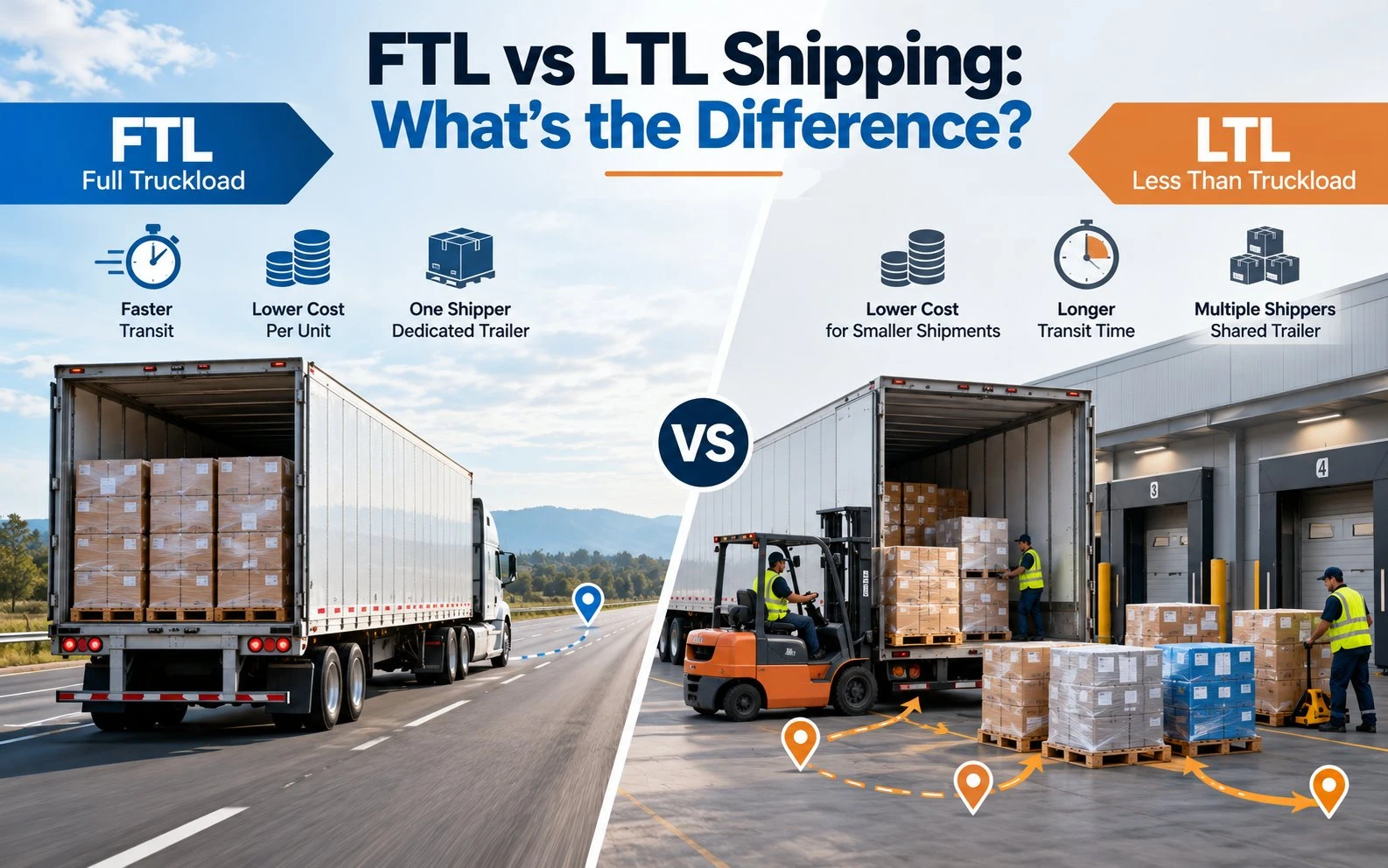
FTL shipping, or Full Truckload shipping, means your shipment occupies an entire truck by itself. A single 53-foot dry van trailer-the North American standard-typically holds 26 to 30 standard pallets, carries up to roughly 45,000 pounds of cargo, and offers about 3,000 to 4,000 cubic feet of usable volume. Actual legal operating limits depend on vehicle configuration and jurisdiction; U.S. shippers can refer to the Federal Highway Administration's guidance on truck size and weight limits. Whether you fill every inch or only half the trailer, you pay for the dedicated truck.
The defining characteristic of FTL freight is dedicated capacity. Your cargo is the only shipment occupying the trailer, and the freight typically moves directly from pickup to delivery without being transferred through an LTL terminal network. This reduces intermediate cargo handling and allows greater control over pickup and delivery scheduling.
FTL generally works best when your cargo volume is large-often more than 10 to 12 standard pallets or exceeding 15,000 pounds-or when the shipment is fragile, high-value, time-sensitive, temperature-controlled, or requires special handling.
However, shipment weight or pallet count should not be the only deciding factor. Cargo dimensions, value, handling sensitivity, delivery urgency, destination requirements, and total logistics cost can all change the best choice.
What Is LTL Shipping?
LTL shipping, or Less Than Truckload shipping, is similar to carpooling for freight. Multiple shippers share space on the same truck, and each customer pays primarily for the capacity required by their shipment rather than an entire trailer.
LTL shipments typically range from 100 to 10,000 pounds-roughly one to six pallets-and pricing is influenced by factors such as shipment weight, dimensions and density, route, distance, and freight classification. In North America, the National Motor Freight Classification (NMFC) is an important industry framework used in the classification and rating of many LTL shipments.
Because the truck carries freight for multiple customers, LTL freight generally moves through a hub-and-spoke network. Cargo may be picked up locally, consolidated at an origin terminal, transferred onto a line-haul truck, moved through one or more distribution centers, and then dispatched for final delivery.
This shared-capacity model makes Less Than Truckload shipping economical for smaller shipments, but the additional terminal transfers can make transit less direct and increase the number of times freight is handled.
FTL vs LTL Shipping: Key Differences
|
Dimension |
FTL (Full Truckload) |
LTL (Less Than Truckload) |
|
Cargo volume |
Entire truck, commonly 26–30 pallets and up to about 45,000 lbs |
Partial load, commonly 1–6 pallets and 100–10,000 lbs |
|
Pricing model |
Flat rate for dedicated truck capacity |
Pay based on space, weight, freight class, route, and other factors |
|
Transit time |
Faster-typically point-to-point, around 1–4 days cross-country |
Slower-terminal transfers can result in 3–7+ day transit |
|
Handling |
Usually loaded once and delivered with minimal intermediate handling |
May be unloaded and reloaded at several terminals |
|
Damage exposure |
Lower handling exposure |
Higher handling exposure because of repeated transfers |
|
Scheduling |
Greater control over pickup and delivery appointments |
Pickup and delivery generally follow carrier network schedules |
|
Best for |
Large, urgent, fragile, high-value, or handling-sensitive shipments |
Smaller, flexible, cost-sensitive shipments |
The most important point in a full truckload vs less than truckload comparison is that neither mode is automatically better. Each solves a different logistics problem.
A similar principle applies to international container shipping. Shippers deciding how much dedicated capacity they need may also benefit from understanding the difference between FCL vs LCL shipping, where full-container and shared-container models create comparable trade-offs in cost, handling, and shipment size.
FTL vs LTL Cost: How the Pricing Works
The cost logic of FTL and LTL is fundamentally different, and understanding it is essential when comparing FTL vs LTL shipping costs.
FTL charges a flat rate for the dedicated truck. Whether you load 12 pallets or 28, the basic truck cost may be similar. A cross-country FTL move in the United States might run from roughly USD 1,500 to USD 3,000 depending on the lane, season, capacity, and fuel surcharges. As the trailer fills, the cost per pallet or per unit generally decreases, which is why FTL can become more economical once a shipment reaches about 12 to 14 pallets.
LTL charges only for the portion of capacity you use. A shipment of five pallets to Los Angeles might cost around USD 1,200 via LTL compared with USD 2,800 for FTL on the same lane-a saving of roughly 30 percent or more.
However, an LTL base rate is not always the same as the final logistics cost. Residential delivery, lift-gate service, inside delivery, reclassification, detention, limited-access delivery, and fuel surcharges can all increase the final invoice.
The crossover point where FTL becomes cheaper than LTL often falls around 10 to 12 pallets. Below that threshold, the shared-space model frequently favors LTL. Above it, the dedicated FTL rate can provide a lower per-unit cost.
These thresholds should be treated as guidelines rather than rigid rules. A better freight decision compares the total logistics cost, including transportation charges, accessorial fees, potential delays, handling requirements, and cargo risk-not simply the first quoted freight rate.
This total-cost approach is also important in international logistics, where trucking may be only one part of a shipment involving ocean freight, customs clearance, warehousing, and final delivery.
FTL vs LTL Transit Time
FTL is generally faster because the shipment moves more directly from origin to destination without freight being transferred through multiple LTL terminals.
A cross-country FTL shipment in the United States typically takes about 1 to 4 days, depending on the route, driver requirements, weather, and operating conditions.
LTL takes longer because freight moves through a terminal network. A shipment may be collected by a local truck, delivered to an origin terminal, consolidated with other freight, transferred through regional hubs, and then dispatched for final-mile delivery. Each transfer can add time.
Cross-country LTL transit commonly runs around 3 to 7 days, and peak-season terminal congestion may extend that timeline.
For time-sensitive orders, production materials, replacement parts, project cargo, or shipments with strict delivery appointments, the real question is not simply whether FTL costs more. Shippers should also consider what a one- or two-day delay could cost their business.
This is especially relevant for importers shipping goods from China into the United States. After sea freight from China to the USA, the inland FTL or LTL leg can directly affect warehouse appointments, inventory availability, and final delivery timing.
FTL vs LTL Cargo Safety
FTL generally offers lower handling exposure. Freight is loaded at origin, transported in a dedicated trailer, and unloaded at destination with fewer intermediate handling events.
For fragile products, electronics, glassware, machinery, or other high-value cargo, reducing the number of times freight is lifted, repositioned, or transferred can significantly reduce exposure to scratches, dents, shifting, forklift contact, and other handling-related damage.
LTL involves more frequent cargo handling. At terminal transfers, pallets may be unloaded, sorted, repositioned, and reloaded alongside other customers' freight. Each additional touch creates another opportunity for damage or misplacement. While professional LTL carriers use established handling procedures to control these risks, LTL generally involves greater handling exposure than full truckload shipping.
For goods that are easily scratched, dented, unstable, irregularly shaped, or sensitive to vibration, proper blocking, bracing, and cargo securement are essential. U.S. operators can refer to the Federal Motor Carrier Safety Administration's cargo securement rules for regulatory guidance.
The same risk-based thinking is important for complex international freight. When planning transportation for vehicles, heavy equipment, oversized cargo, project freight, or high-value boats, factors such as dimensions, weight, center of gravity, cargo value, loading method, support points, securing requirements, and destination conditions can matter as much as the freight rate.
That principle also applies to FTL vs LTL freight: the value of reducing cargo handling increases as the value and handling sensitivity of the shipment increase.
When Should You Choose FTL Shipping?
Choose Full Truckload shipping when one or more of the following conditions apply:
|
Scenario |
Why FTL May Be the Better Choice |
|
Shipment exceeds 10–12 pallets or 15,000 lbs |
Per-unit cost can become more competitive at higher volumes |
|
Tight deadline or time-sensitive delivery |
More direct routing reduces terminal-related delays |
|
Fragile, high-value, or sensitive cargo |
Fewer handling events reduce cargo exposure |
|
Temperature-controlled goods |
Dedicated reefer capacity avoids a shared freight environment |
|
Hazardous or oversized freight |
Dedicated equipment can simplify cargo control and securing |
|
Precise pickup or delivery scheduling is required |
Dedicated truck capacity generally provides more scheduling control |
For hazardous cargo, transport decisions also need to account for classification, documentation, packaging, placarding, carrier acceptance, and other legal requirements. In the United States, the Pipeline and Hazardous Materials Safety Administration provides the applicable hazardous materials regulations.
For high-value or unusual cargo, the decision should also account for packaging, loading, securing, dimensions, weight distribution, and whether the freight can safely tolerate repeated handling.
When Should You Choose LTL Shipping?
Choose Less Than Truckload shipping when:
|
Scenario |
Why LTL May Be the Better Choice |
|
Shipment is 1–6 pallets and under 10,000 lbs |
You pay only for the capacity required rather than a dedicated truck |
|
Delivery timeline is flexible |
Longer transit can be acceptable in exchange for lower freight costs |
|
Goods are durable and lower-risk |
Additional handling exposure is easier to manage |
|
Multiple destinations are involved |
LTL networks can efficiently serve distributed delivery points |
|
Small shipments move regularly |
Predictable LTL lanes may support favorable contracted pricing |
LTL can be particularly effective for pallet shipping when individual orders are too small to justify paying for an entire trailer.
The lowest quoted rate, however, should not automatically determine the choice. Accessorial charges, freight classification, delivery conditions, handling sensitivity, and the cost of delays should all be included when comparing the final LTL freight cost with an FTL alternative.
For e-commerce importers, these decisions can become especially important when inventory is moving toward fulfillment centers. Businesses using international sourcing may also want to review how freight forwarding for Amazon FBA from China connects international transportation with downstream delivery requirements.
How to Choose Between FTL and LTL: Five Questions
Before booking, ask these five questions.
1. How much freight am I shipping?
Under 10 pallets generally leans toward LTL, while more than 12 pallets often makes FTL worth considering. The 10-to-12-pallet range is a gray zone where it makes sense to request pricing for both.
2. How quickly does the shipment need to arrive?
If the delivery window is tight, FTL's more direct routing can provide greater schedule control.
3. How fragile or valuable is the cargo?
High-value or damage-sensitive freight may benefit from the lower handling exposure of a dedicated truck.
4. What is the true total logistics cost?
Compare the LTL base rate plus likely accessorial charges with the complete FTL rate. Also consider inventory cost, delay risk, handling exposure, and possible damage-related expenses.
5. Does the destination have special delivery requirements?
Residential, limited-access, appointment-only, or difficult delivery locations can generate additional LTL charges. In some cases, dedicated truck transportation may be more practical.
A useful decision model is therefore:
Shipment size + cargo value + handling sensitivity + urgency + route + total logistics cost
-not shipment weight alone.
How Wilson Supports Road Freight Within International Supply Chains
Zhejiang Wilson Supply Chain Management Co., Ltd. coordinates road transportation as part of broader international freight and supply chain solutions rather than treating trucking as an isolated decision.
For customers importing from China, an inland trucking decision may be only one part of a longer movement:
Supplier pickup → consolidation or warehousing → international freight → customs clearance → destination transportation → final delivery
Depending on the shipment, Wilson can coordinate trucking and inland road freight together with international transportation and downstream logistics services.
For export-side movements, road transportation from China can connect suppliers, warehouses, ports, airports, rail terminals, and other logistics nodes before the international leg begins.
Wilson's broader service portfolio includes sea freight from China, air freight from China, rail freight, road transportation, multimodal logistics, customs services, warehousing, distribution, and DDP-related supply chain support.
This means the most suitable trucking approach can be evaluated in the context of the entire supply chain rather than simply comparing two domestic freight rates.
For example, customers using door-to-door shipping from China may need to coordinate supplier pickup, export handling, international freight, customs clearance, warehousing, and final-mile delivery as one integrated transportation plan.
This broader planning perspective is one of the main reasons importers use a freight forwarder: the objective is not simply to book one truck or one container, but to coordinate multiple transport stages, service providers, documents, and delivery requirements.
FAQ
Is FTL cheaper than LTL?
Not always. LTL is usually more economical for smaller shipments because several customers share truck capacity. As shipment volume approaches roughly 10 to 12 pallets or more, the flat cost of an FTL truck can become more competitive on a per-unit basis. Actual FTL vs LTL cost depends on the lane, weight, dimensions, freight class, capacity, fuel, and accessorial charges.
How many pallets should I ship before using FTL?
A common guideline is to start comparing FTL rates when a shipment approaches 10 to 12 pallets. Shipments of one to six pallets usually fit LTL more naturally, while larger loads increasingly favor Full Truckload. Pallet count alone should not determine the decision, especially for high-value, fragile, oversized, or time-sensitive cargo.
Is FTL faster than LTL?
Usually, yes. FTL freight generally moves directly from pickup to destination without being transferred through an LTL terminal network. LTL shipments may pass through several consolidation and distribution terminals, which can add transit time.
Is FTL safer for high-value or fragile cargo?
FTL generally reduces handling exposure because cargo remains in a dedicated trailer and undergoes fewer transfers. This can make it a better option for fragile, high-value, sensitive, or easily damaged freight. Proper packaging, loading, blocking, bracing, and securing remain important regardless of transportation mode.
What information is needed to compare FTL and LTL quotes?
Provide the origin and destination, cargo description, number of pallets or pieces, dimensions, total weight, cargo value, required delivery date, pickup and delivery conditions, and any special requirements such as temperature control, hazardous classification, appointment delivery, or limited-access service. Complete shipment information makes the FTL vs LTL freight comparison much more accurate.
Conclusion
The main difference between FTL and LTL shipping is not simply that one uses a full truck and the other uses shared capacity. FTL generally offers faster transit, fewer cargo touches, greater scheduling control, and better economics for larger loads. LTL provides flexible and cost-efficient transportation for smaller shipments when additional transit time and handling are acceptable.
The best choice comes from matching the freight mode to the shipment's size, value, urgency, handling sensitivity, route, and total logistics cost rather than defaulting to one option every time.
If your road freight is part of a larger shipment from China, Zhejiang Wilson can help evaluate the trucking leg alongside international freight, customs coordination, warehousing, and destination delivery. Contact our team with your cargo details, origin, destination, dimensions, weight, and delivery requirements to discuss the most practical logistics solution for your project.