Under DDP (Delivered Duty Paid), the seller pays the import duties and taxes. That is the short answer.
The longer answer involves understanding what "all" actually covers, where additional costs and risks may arise, and why DDP places more responsibility on the seller than any other Incoterms rule.
For buyers importing goods internationally-and especially businesses shipping from China-understanding DDP duties and taxes is important before accepting a delivered price. A properly structured DDP shipping arrangement can simplify customs clearance and landed-cost planning, while a poorly structured one can create unexpected expenses for the seller.
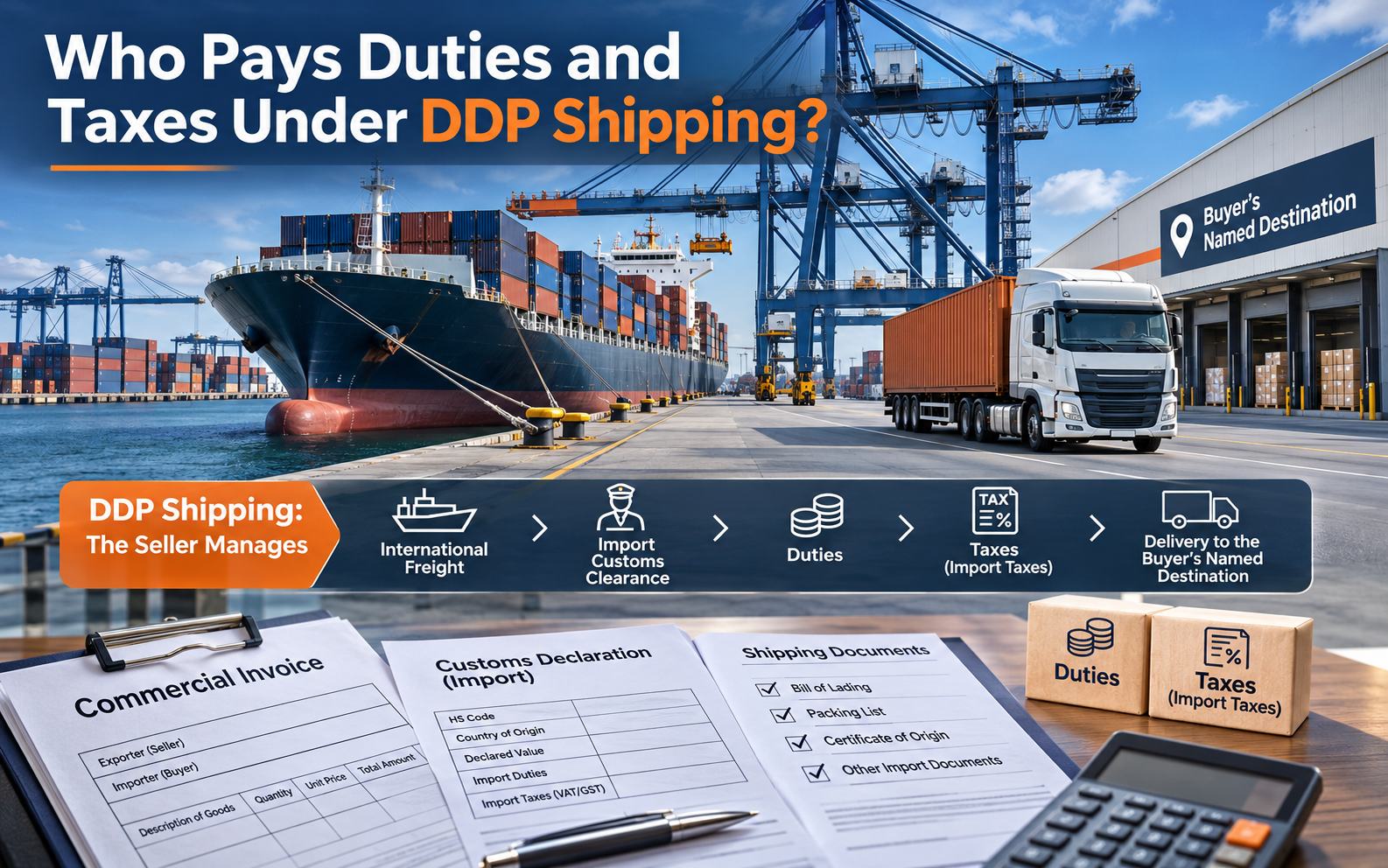
What Is DDP Shipping and Who Pays Duties and Taxes?
DDP stands for Delivered Duty Paid, one of the 11 trade terms defined in the International Chamber of Commerce's Incoterms 2020 rules. It represents the maximum responsibility a seller can assume in a commercial transaction.
For a more detailed introduction to the term, see our guide explaining what DDP shipping is.
Under DDP shipping, the seller is responsible for delivering goods to a named place in the buyer's country-not just to a port or terminal, but to the buyer's specified destination.
This includes export clearance, international transportation, import customs clearance, and payment of applicable import duties, taxes, and fees. The buyer, in contrast, generally receives the goods at the agreed location and pays the contract price.
Risk transfers to the buyer when the goods are placed at the buyer's disposal at the named destination, ready for unloading. Until that point, the seller carries the transportation risk and most costs associated with completing the delivery.
DDP is the only Incoterms 2020 rule under which the seller is responsible for import customs clearance and the payment of import duties and taxes. Other commonly used Incoterms leave at least part of those responsibilities to the buyer.
Who Pays Each Cost Under DDP Shipping?
The seller's cost obligations under DDP are comprehensive. The table below shows the typical DDP cost responsibility breakdown.
|
Cost Category |
Responsible Party |
|
Export clearance and fees |
Seller |
|
International freight (main carriage) |
Seller |
|
Transport insurance |
Seller, if arranged |
|
Import customs clearance |
Seller |
|
Import duties / customs duties |
Seller |
|
Import VAT or GST |
Seller |
|
Excise taxes, if applicable |
Seller |
|
Destination delivery to the named place |
Seller |
|
Unloading at destination |
Buyer, unless otherwise agreed |
The buyer's financial obligation is therefore largely limited to the contract price agreed in the sales contract.
Customs duties, value-added tax, goods and services tax, and other applicable import-related charges generally fall under the seller's DDP responsibilities.
This is what makes DDP fundamentally different from terms such as DAP (Delivered at Place) or the now-superseded DDU, where the seller may deliver the cargo to the destination but the buyer is responsible for import customs clearance and import taxes. You can also review our comparison of DDP vs DDU shipping for additional context.
For buyers comparing DDP shipping costs, the important question is whether the quoted price represents a true delivered or landed cost and clearly identifies any charges that are excluded.
What Duties and Taxes Does the Seller Pay Under DDP?
Customs Duties
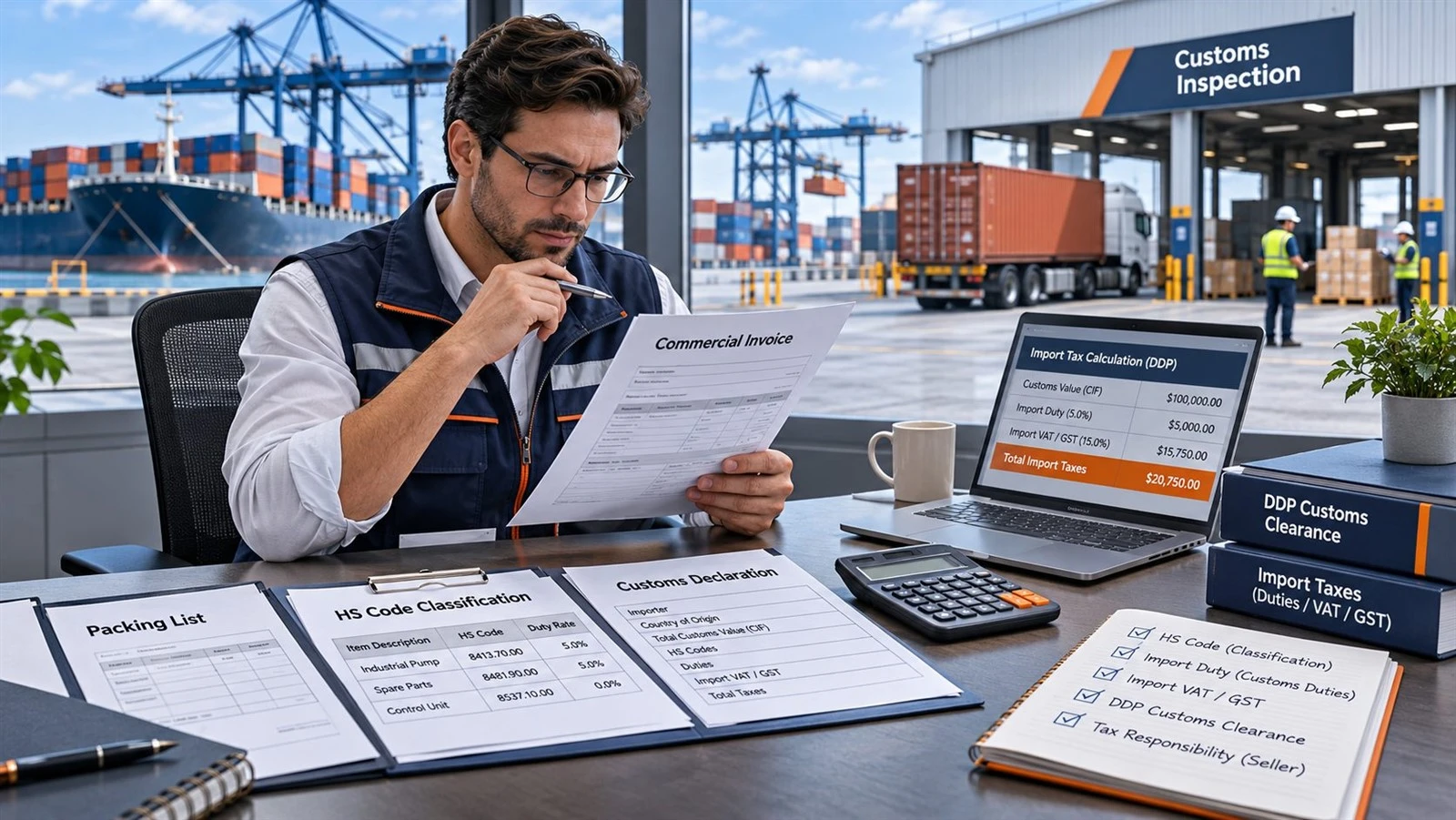
Customs duties are taxes levied by a country's customs authority on goods entering its territory. The applicable rate depends on factors such as the product's Harmonized System (HS) code, country of origin, and the destination country's tariff schedule.
Under DDP, the seller must ensure that the goods are properly classified, declare the shipment value to the destination customs authority, and arrange payment of the resulting customs duty.
The declared value is typically based on the CIF value-cost of goods plus insurance and freight-although customs authorities may reassess the declared value according to local customs valuation rules.
Accurate HS code classification is therefore particularly important when preparing a DDP quote. An incorrect classification can change the applicable duty rate and significantly affect the seller's final landed cost. If classification is uncertain, our guide on how to find the right HS code provides additional guidance.
Import VAT and GST
Value-Added Tax (VAT) or Goods and Services Tax (GST) is charged on imported goods in many major economies.
In the EU, standard VAT rates typically range from around 17% to 27% depending on the member state. The European Commission provides official information on EU VAT rates.
In Australia, the GST rate is 10%, with official guidance available from the Australian Taxation Office on the Australia GST system.
In Canada, the GST is 5%, with additional provincial taxes applying in some provinces.
These can represent significant amounts.
For example, a shipment with a CIF value of USD 50,000 destined for a country with a 20% VAT rate could generate roughly USD 10,000 in VAT alone before any customs duty is applied.
Under a DDP shipping arrangement, the seller bears this cost as part of the agreed delivery obligation.
Other Import Taxes and Fees
Depending on the product and destination, additional import-related charges may include:
- Excise duties on alcohol, tobacco, fuel, and certain other product categories
- Anti-dumping duties on specific products from particular origins
- Customs processing fees
- Customs brokerage fees
- Port or terminal handling charges at destination
- Inspection or quarantine fees for regulated products
Where these charges form part of delivering and clearing the goods under the agreed DDP terms, they generally fall within the seller's responsibility.
For this reason, sellers should understand more than the basic tariff rate before quoting DDP. Customs brokerage, regulatory inspections, destination handling, and product-specific taxes can materially change the final DDP landed cost.
DDP vs. DAP, FOB, and CIF: Who Pays Import Duties and Taxes?
The most important difference between DDP and several other commonly used Incoterms comes down to two questions:
Who handles import customs clearance, and who pays the import duties and taxes?
|
Term |
Import Clearance |
Import Duties & Taxes |
Delivery Point |
|
DDP |
Seller |
Seller |
Buyer's named destination |
|
DAP |
Buyer |
Buyer |
Buyer's named destination |
|
FOB |
Buyer |
Buyer |
Port of shipment, on board |
|
CIF |
Buyer |
Buyer |
Port of destination |
FOB and CIF are maritime-only terms. Under both terms, the buyer is responsible for import customs clearance and the corresponding import duties and taxes.
DAP brings the goods to the buyer's named destination but stops short of import customs clearance. The buyer handles import formalities and pays the applicable import taxes.
DDP goes further. The seller manages the transportation and import process through to the agreed destination while also taking responsibility for customs clearance and payment of the applicable duties and taxes.
For buyers comparing DDP vs. DAP, this difference in customs responsibility is often the most important factor when evaluating the total landed cost.
Why Is DDP Shipping High Risk for Sellers?
The seller's exposure under DDP extends well beyond simply paying a customs duty bill. Several practical challenges make DDP one of the most demanding Incoterms for sellers.
Customs Registration and Importer of Record Requirements
To clear goods through import customs, the seller may need customs registration, a local customs broker, or another compliant arrangement in the destination country.
Some countries require a local entity, tax identification number, or qualified party to act as the importer of record.
A seller based in China, for example, may not have a registered entity in the buyer's destination country and may therefore need to work with a freight forwarder, customs broker, or other qualified local service provider to complete the import process.
This introduces additional compliance risk.
If documentation is filed incorrectly, the goods are misclassified, or customs challenges the declared value, the seller may face additional assessments, delays, penalties, or other costs.
Before offering DDP shipping from China, sellers should therefore confirm whether the proposed customs clearance structure is legally and operationally workable in the destination country.
Changes in Duty and Tax Rates
Import duty rates and tax rates can change.
Governments may adjust tariffs in response to trade policy changes, anti-dumping investigations, or bilateral trade disputes.
A seller that calculates a DDP price based on a 10% duty rate may face a much higher cost if the applicable tariff rises to 25% before the shipment arrives.
Publicly available trade policy records have shown sudden tariff increases of 10 to 15 percentage points in recent years, particularly for certain goods moving between major trading partners.
Under DDP, the seller generally bears this pricing risk unless the sales contract includes an agreed mechanism allowing price adjustments when duty or tax rates change.
Product Compliance and Documentation Requirements
Different countries impose different product compliance requirements.
Electronics may require specific certification or conformity documentation in markets such as the United States or European Union. Food, cosmetics, chemicals, medical devices, vehicles, and machinery can face additional regulatory scrutiny.
If goods arrive without the required certification or documentation, customs or other regulatory authorities may hold, reject, or in some cases order disposal of the shipment.
Because the seller is responsible for arranging delivery under DDP, inadequate compliance planning can lead to significant additional costs and delays.
Payment Terms
Under DDP, the seller retains substantial responsibility for the shipment until final delivery.
This can complicate traditional payment arrangements that rely on control of shipping documents.
The seller's destination agent or customs representative may require shipping documents to complete customs clearance, making it less practical to use document release as the primary form of payment security.
For this reason, sellers commonly consider full prepayment or another secure payment arrangement when offering DDP terms.
When Should Buyers and Sellers Use DDP Shipping?
Despite the risks, DDP serves a clear purpose in international trade.
It can work particularly well when:
- The buyer has limited import experience or customs infrastructure and prefers a delivered price
- The seller has established logistics partners and customs brokers in the destination market
- The product's duty rate is relatively stable and predictable
- The shipment value justifies professional customs handling
- The seller wants to provide a simple door-to-door purchasing experience for customers in a new market
DDP is commonly used in cross-border e-commerce, where buyers expect a delivered price without unexpected import charges at the time of delivery.
It can also work well in B2B transactions where small and medium-sized buyers do not have dedicated customs or import departments. Businesses considering this type of service can also review how door-to-door shipping from China works across pickup, international transport, customs clearance, and final delivery.
For large and experienced importers that already have their own customs brokers, importer-of-record arrangements, and duty management procedures, DDP may be unnecessary and can sometimes cost more than handling import customs clearance directly.
The best choice therefore depends on the buyer's capabilities, the seller's destination-country resources, and the predictability of the total DDP shipping costs.
How Buyers and Sellers Can Manage DDP Shipping Costs and Risks
If you are a buyer being offered DDP terms, verify exactly what the delivered price includes before placing the order.
Ask the seller or logistics provider to clarify the major cost components, including:
- International freight
- Transport insurance, if applicable
- Import duties
- VAT or GST
- Customs brokerage fees
- Destination handling charges
- Final-mile delivery
- Any costs specifically excluded from the DDP quote
This makes it easier to determine whether the DDP quotation represents the true landed cost and to compare it with alternatives such as DAP.
For shipments moving by ocean, importers may also want to understand how import sea freight is coordinated with customs clearance and destination delivery.
If you are a seller considering DDP shipping, several steps can reduce pricing and compliance risks:
- Confirm the correct HS code and applicable duty rate before preparing the quotation
- Verify whether the destination-country customs rules allow the proposed importer-of-record and customs clearance structure
- Work with an experienced customs broker or freight forwarder familiar with the destination market
- Consider a contract clause addressing unexpected changes in duty or tax rates
- Confirm all required product certifications and compliance documents before shipping
- Clearly identify which destination charges are included in the quoted price
- Use an appropriate payment structure before dispatching the goods
A well-structured DDP arrangement can simplify the buying experience and make international sourcing more predictable.
A poorly structured DDP quotation, however, can create unexpected customs costs and significantly reduce the seller's margin.
FAQ
Does DDP Include Customs Duties?
Yes. Under DDP shipping, the seller is responsible for arranging import customs clearance and paying the applicable customs duties required to deliver the goods to the agreed destination.
The seller should therefore calculate the applicable tariff before providing a DDP price.
Does DDP Include VAT or GST?
Generally, import VAT or GST forms part of the seller's responsibilities under DDP.
However, VAT/GST registration, payment procedures, recoverability, and importer-of-record requirements differ between countries. Sellers should confirm the destination country's tax and customs rules before offering DDP terms.
Does the Buyer Pay Anything Under DDP Shipping?
The buyer generally pays the agreed contract price and is responsible for unloading the goods at the named destination unless the parties agree otherwise.
Additional costs can still arise if they are caused by the buyer, specifically excluded from the contract, or result from circumstances outside the originally agreed DDP service scope. The sales contract should clearly define what is included.
Who Is the Importer of Record Under DDP?
DDP requires the seller to arrange import customs clearance, but the practical importer-of-record structure depends on the laws of the destination country.
Some jurisdictions allow foreign sellers to arrange import clearance through approved representatives, while others require a locally registered importer, tax number, or other compliant structure.
This should be confirmed before the seller commits to a DDP quotation.
What Is the Main Difference Between DDP and DAP?
The key difference is import clearance and import taxes.
Under DDP, the seller handles import customs clearance and pays the applicable import duties and taxes.
Under DAP, the seller transports the goods to the named destination, but the buyer is responsible for import customs clearance and the related duties and taxes.
Conclusion
Under DDP shipping, the seller is responsible for import customs clearance and pays the applicable customs duties, import VAT or GST, and other import-related charges required under the agreed delivery terms. The seller also bears the transportation costs and risks up to the named destination, making DDP the Incoterm with the greatest overall seller responsibility.
For buyers, DDP can provide a more predictable door-to-door shipping experience. For sellers, however, accurate HS classification, customs planning, importer-of-record arrangements, tax calculations, destination charges, and local compliance requirements should all be confirmed before a DDP price is offered.
Zhejiang Wilson Supply Chain Management Co., Ltd. is a China-based international freight forwarder and supply chain company providing sea freight, air freight, customs clearance, warehousing, DDP door-to-door shipping, and related end-to-end logistics services from China to global markets. For cargo requiring a tailored DDP shipping and customs clearance solution, contact our team to discuss the shipment details, destination requirements, and suitable logistics plan.