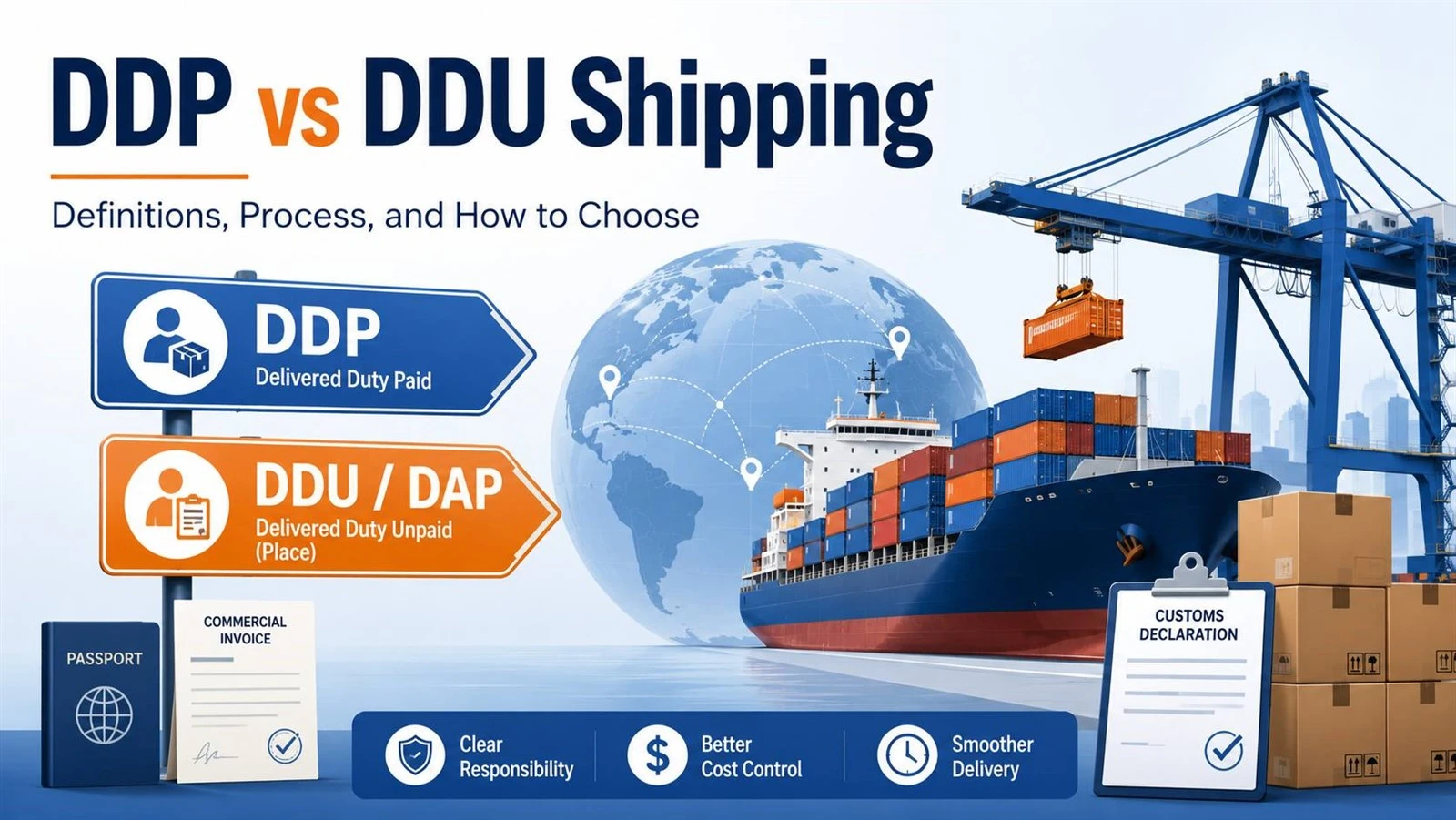
DDP and DDU define who handles import clearance, duties, taxes, and delivery responsibilities in international shipping. Under DDP, the seller manages the import side and delivers the goods to the named destination with duties paid. Under DDU, now generally handled under DAP, the buyer clears the goods and pays import charges. The better option depends on customs capability, cost visibility, product compliance, and the buyer's preferred level of control.
What Do DDP and DDU Mean in Shipping?
DDP, or Delivered Duty Paid, is an Incoterms® rule under which the seller arranges export clearance, international transport, import clearance, payment of import duties and taxes, and delivery to the agreed place. The buyer normally unloads the goods.
DDP is often described as an all-inclusive service, but it requires more than paying a customs bill. The seller must have a legal way to complete import clearance. Local rules may require a registered Importer of Record, fiscal representative, or other qualified local party.
DDU, or Delivered Duty Unpaid, is an older term. It was removed from the official Incoterms® rules in 2010. The closest current rule is DAP, or Delivered at Place.
Under DAP, the seller arranges export clearance and transport to the named destination. The buyer handles import clearance, duties, VAT, GST, and other import charges. "DDU" is still used informally, but formal contracts should state:
DAP [full delivery address], Incoterms® 2020
This prevents both sides from using the same abbreviation while expecting different services.
DDP vs DDU/DAP: Key Differences at a Glance
The main difference is the import side of the shipment. DDP keeps that responsibility with the seller. DAP transfers it to the buyer.
| Comparison | DDP | DDU/DAP |
|---|---|---|
| Export clearance | Seller | Seller |
| International transport | Seller | Seller |
| Import clearance | Seller | Buyer |
| Import duties | Seller | Buyer |
| Import VAT, GST, or similar taxes | Seller under the agreed DDP arrangement | Buyer |
| Delivery to the named place | Seller | Seller |
| Unloading at destination | Usually buyer | Usually buyer |
| Cargo insurance | Not mandatory | Not mandatory |
| Seller's financial exposure | Higher | Lower |
| Buyer's customs workload | Lower | Higher |
| Buyer's cost visibility | Usually higher | Depends on actual import charges |
DAP does not mean the seller can stop at the port unless that port is the named place. If the contract names the buyer's warehouse, the seller arranges transport there after the buyer clears the goods.
Neither rule requires cargo insurance. Risk normally transfers when the goods reach the named place on the arriving vehicle and are ready for unloading-not automatically at the port, customs release, or signature.
How the DDP and DDU/DAP Shipping Processes Work
Both processes begin in the same way. The shipment is prepared, export documents are issued, and the goods leave the origin country. The difference becomes critical when the cargo reaches the import country.
DDP Shipping Process
- The seller and buyer agree on DDP, the Incoterms® version, and the full delivery location.
- The seller confirms the product description, HS code, customs value, origin, and regulatory requirements.
- Commercial documents are prepared, including the invoice, packing list, transport document, and any required certificates or licenses.
- The seller completes export clearance in China and arranges sea freight from China, air freight from China, rail, road, courier, or multimodal transport.
- At destination, the seller or its appointed agent submits the import declaration.
- Import duties, VAT, GST, brokerage charges, and other agreed import costs are paid.
- Customs releases the shipment after document review, payment, and any required inspection.
- The seller arranges final delivery to the named place.
- The buyer unloads the goods.
The seller must confirm who can legally make the import declaration. DDP works only when a compliant destination-country clearance structure is established before departure.
DDU/DAP Shipping Process
- The parties agree on DAP, the Incoterms® version, and the named place.
- The seller prepares the goods and completes export clearance.
- The seller arranges international transport and sends the buyer the documents needed for import clearance.
- When the shipment arrives, the buyer or its customs broker files the import declaration.
- The buyer pays import duties, VAT, GST, customs brokerage, and other local charges.
- Customs releases the goods.
- The seller completes transport to the named destination if that point is beyond the port, terminal, or airport.
- The buyer unloads the shipment.
DAP runs smoothly when the buyer has an established customs team. Without a broker, import license, timely payment, or prompt responses, storage and delay costs can rise quickly.
DDP vs DDU Costs: Which One Is Really Cheaper?
DDP usually produces the higher initial quote because more destination charges are included. DAP often looks cheaper because the buyer pays part of the cost later.
That does not make DAP the cheaper option.
The correct comparison is the landed cost: the total amount required to move the goods from origin to the final delivery point and complete import formalities.
A landed-cost calculation may include:
- Pickup, origin handling, and export clearance
- International freight and surcharges
- Destination handling and customs brokerage
- Import duty, VAT, GST, or excise tax
- Final-mile delivery and insurance
- Inspection, storage, demurrage, detention, or re-delivery
- Internal customs-management costs
DDP quotes also carry uncertainty. Customs may change the HS code or value, request documents, or apply additional duties. Quotes should therefore state whether import charges are fixed or estimated and list exclusions such as inspection, storage, remote delivery, permits, and penalties.
Some freight forwarders add a contingency margin to higher-risk DDP shipments. A 10%–15% buffer may be reasonable in selected cases involving uncertain classification, volatile duties, or unstable exchange rates, but it should never be treated as a universal rule.
The cheapest quote is not always the lowest-cost shipment. A low DAP freight rate can become expensive after brokerage, tax, storage, and internal handling are added.
Advantages, Disadvantages, and Common Risks
DDP Advantages and Risks
DDP gives the buyer a simpler delivery experience. The buyer receives a more predictable landed cost and does not need to appoint a customs broker or arrange tax payment at arrival. This is useful for first-time importers, small businesses, and direct-to-consumer shipments.
For sellers, DDP reduces surprise charges and the chance of refusal caused by an unexpected customs bill.
The risks sit mainly with the seller:
- Import duties and taxes must often be funded before delivery.
- Incorrect HS classification can reduce or erase the seller's margin.
- Customs may increase the declared value or apply additional tariffs.
- The seller may not be eligible to act as the importer.
- Product certification, labeling, licensing, or registration may be incomplete.
- A low-cost "tax-included" route may rely on inaccurate declarations or an unsuitable importer arrangement.
A compliant DDP service identifies the importer structure, tax treatment, clearance method, and exclusions before shipment.
DDU/DAP Advantages and Risks
DAP gives experienced buyers control over brokers, import accounts, duty relief, tax deferment, and VAT recovery. The seller avoids most import-side tax exposure.
The disadvantages are more visible when the buyer is unprepared:
- Duties and taxes may be higher than expected.
- Missing documents can delay release.
- Customs notices may be ignored or sent to the wrong contact.
- Storage, demurrage, or detention charges may build up.
- A consumer may refuse the parcel after seeing the tax bill.
- "Door-to-door" may be mistaken for "duty-paid door-to-door."
DAP is not a weak service. It is often the better structure for a buyer that already manages imports professionally. It becomes risky when it is used only to make the seller's quote appear lower.
How to Choose Between DDP and DDU/DAP
The decision should be based on capability, not habit.
Start with six questions:
- Does the buyer have legal import qualifications in the destination country?
- Who has the stronger customs broker relationship?
- Who can classify the product and estimate import taxes more accurately?
- Does the cargo require a license, registration, quota, or product approval?
- Does the buyer need to use its own tax account or recover import VAT?
- Is the priority a fixed delivered cost or control over the import process?
Choose DDP When
DDP is usually the stronger choice when:
- The buyer has little import experience.
- The buyer wants a clear delivered cost.
- The shipment goes to a consumer, small company, or first-time importer.
- The seller has a reliable and compliant destination-country clearance solution.
- The product can be classified and taxed with reasonable accuracy.
- Delivery experience matters more than showing the lowest initial freight price.
DDP is also useful when the buyer does not want to coordinate a broker, tax payment, and last-mile delivery across several service providers.
Choose DDU/DAP When
DAP is usually better when:
- The buyer has an import license and established customs broker.
- The buyer needs to use its own VAT, GST, or tax account.
- The buyer qualifies for duty relief, tax deferment, or another customs program.
- Import permits must be held by the local buyer.
- The cargo is part of a regular B2B supply chain.
- The seller cannot legally or efficiently manage destination clearance.
Choose DDP for convenience and cost visibility; choose DAP for import control and local tax management.
DDP vs DDU/DAP for E-commerce and B2B Shipments
E-commerce and Direct-to-Consumer Shipping
For e-commerce, the choice affects checkout, successful delivery, complaints, and repeat purchases.
DDP can show the customer a more complete price before purchase. The total may look higher, but the buyer is less likely to receive a separate tax request before delivery. This reduces surprise charges, refused parcels, and complaints about hidden fees.
DAP may create a lower checkout total, but the carrier or broker may request payment later. An unprepared buyer may abandon the parcel rather than the shopping cart.
Sellers should track successful delivery, refusal, return-to-origin, complaints, and repeat purchases-not only conversion.
The checkout page should clearly state whether duties and taxes are included. A vague "international shipping included" notice is not enough.
B2B and Regulated Cargo
B2B buyers often prefer DAP because they already have customs brokers, import registrations, and tax procedures. They may also need to use their own license, quota, bond, deferment account, or VAT recovery structure.
This matters for chemicals, food, medical goods, batteries, cosmetics, automotive parts, and branded products. The local buyer may be the only party qualified to hold the required approval.
DDP works for regulated cargo only after confirming the importer, registration, permit holder, and compliance process.
The transport mode does not decide the Incoterm. DDP and DAP can both be used for FCL and LCL shipping, air freight, rail freight, road transport, courier shipments, and multimodal transport.
What to Check Before Accepting a DDP or DDU Quote
A quotation should define the service in operational terms, not just show three letters.
Before accepting it, confirm:
- The Incoterms® version
- The full named place or delivery address
- Who completes export and import clearance
- Who acts as the Importer of Record
- Whether duty is included
- Whether VAT, GST, or excise tax is included
- Whether customs brokerage and destination handling are included
- Who pays for inspection, storage, demurrage, and detention
- Whether remote-area or special-delivery fees apply
- Whether unloading is included
- Whether cargo insurance is included
- Who bears additional duty after customs reclassification or revaluation
- Who provides permits, certificates, and product registrations
- What happens if the goods are refused, returned, or destroyed
A forwarder will also need accurate shipment data to compare DDP and DAP properly:
- Pickup and delivery locations
- Product name, material, and intended use
- HS code, if available
- Country of origin
- Declared value
- Package count, dimensions, weight, and volume
- Preferred transport mode and delivery deadline
- Battery, liquid, powder, chemical, or dangerous-goods details
- Buyer's import qualifications
Incomplete cargo information produces unreliable tax estimates. For DDP, that can turn into a direct loss for the seller.
Frequently Asked Questions About DDP and DDU
Is DDU Still a Valid Incoterm?
No. DDU was removed in 2010. DAP is the closest current rule, although "DDU" is still used informally for recipient-paid import charges.
Is DDP More Expensive Than DDU?
DDP usually costs more upfront. DAP may cost more overall after duties, taxes, brokerage, storage, and internal clearance costs.
Does DDP Include VAT?
Under standard DDP responsibility, the seller bears import taxes required for clearance. VAT recovery, registration, and invoicing depend on local law, so the quote must state whether VAT or GST is included.
Who Is the Importer of Record Under DDP?
The seller is responsible for import clearance, but local law determines who may act as Importer of Record. A local importer or representative may be required.
Does DDP Include Insurance and Unloading?
No. DDP does not require the seller to buy cargo insurance. The buyer normally unloads the goods at the named destination unless the contract states otherwise.
Can DDP and DAP Be Used for Sea and Air Freight?
Yes. Both apply to sea, air, rail, road, courier, and multimodal transport. The named destination and responsibility split matter more than the mode.
DDP or DDU: Making the Final Choice
DDP places import clearance, duties, and delivery coordination mainly on the seller. It is the stronger option when the buyer needs a predictable landed cost and the seller has a compliant destination-country import solution.
DDU, now generally handled as DAP, leaves import clearance and taxes with the buyer. It suits experienced importers that already have local brokers, permits, and tax arrangements.
The right choice depends on who can manage the import process legally, accurately, and at the lowest total risk.
Zhejiang Wilson Supply Chain Management Co., Ltd. provides DDP and DAP shipping solutions from China by sea, air, rail, and multimodal transport. Send us your cargo details and destination, and our team will compare the responsibilities, landed costs, and clearance requirements for your shipment.