If you are importing vehicles from China-whether sedans, SUVs, pickup trucks, or electric vehicles-one of the first questions you will face is: how many cars fit in a 40HQ container?
There is no single number that works for every shipment. The actual 40HQ container car capacity depends on vehicle dimensions, the loading method, whether a vehicle racking system is used, available clearance for securing, and applicable weight limits at both origin and destination.
For practical car container shipping, the question is not simply how many vehicles can physically be squeezed into the box. The better question is how many vehicles can be loaded, secured, transported, and unloaded safely while keeping the cost per vehicle competitive.
This guide explains the main factors so you can choose a realistic vehicle loading plan before booking your container.
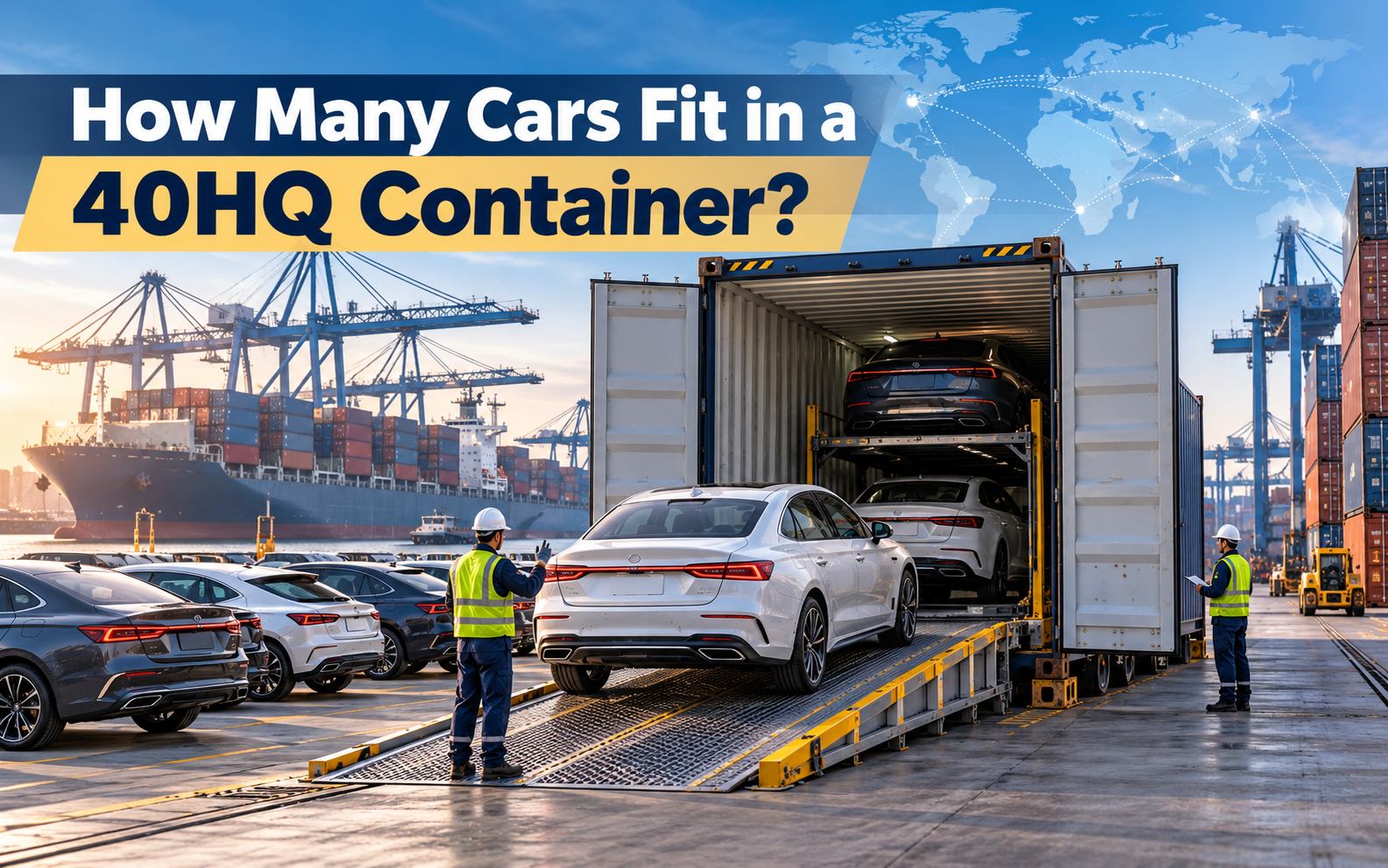
Quick Answer: How Many Cars Fit in a 40HQ Container?
Here is the short answer:
|
Loading Method |
Typical Capacity |
Best For |
|
Single-level, no rack |
2–3 cars |
Standard sedans and compact SUVs |
|
Double-deck with racking |
4–6 cars |
Batch export of compact cars |
|
Specialized double-height equipment |
Up to 8 cars |
High-volume vehicle shipments |
For a standard 40HQ container, the most common practical configurations are 2–3 cars on a single level or 4–6 compact vehicles when a suitable double-deck racking system is used.
The "up to 8 cars" figure applies to specialized purpose-built equipment rather than a normal ISO 40HQ container.
This distinction matters. The theoretical maximum is not automatically the best loading plan. Maximizing vehicle count only makes sense when adequate clearance, safe support, proper lashing, equipment limits, and unloading requirements can still be maintained.
What Is a 40HQ Container?
A 40HQ, also written as 40HC, 40' High Cube, or 40ft high cube container, is a standard freight container that is approximately one foot taller than a regular 40GP container.
That additional height makes the 40HQ especially useful for vehicle container shipping, particularly when handling SUVs, taller vehicles, or specialized car-loading systems.
If you are comparing different equipment options, our guide to 20GP vs 40GP vs 40HQ containers explains the key differences in dimensions, capacity, and typical use cases.
Key 40HQ Container Dimensions
|
Parameter |
External |
Internal |
|
Length |
12.192 m (40 ft) |
~12.032 m |
|
Width |
2.438 m (8 ft) |
~2.352 m |
|
Height |
2.896 m (9 ft 6 in) |
~2.69 m |
|
Door opening |
- |
~2.34 m wide × ~2.58 m high |
|
Theoretical volume |
- |
~76.4 m³ |
|
Practical usable volume |
- |
~68 m³ |
|
Maximum gross weight |
30,480 kg |
- |
|
Tare weight |
~3,700–4,200 kg |
- |
|
Maximum payload |
- |
~26,500 kg |
Minor variations may exist between individual containers or manufacturers, so the actual container specification should still be confirmed before finalizing a vehicle loading plan.
For cars, CBM alone is not enough. Vehicle loading is largely a geometry problem involving usable length, width, height, door opening, vehicle dimensions, loading angle, and the space required for securing.
Why Use a 40HQ Instead of 40GP for Car Shipping?
A standard 40GP container has an internal height of about 2.39 m, which is sufficient for many sedans but can become restrictive for vehicles with roof accessories, raised suspension, or taller SUV bodies.
A 40HQ provides roughly 30 cm of additional internal height. That extra space can make loading easier and gives planners greater flexibility when using vehicle racks or handling taller vehicles.
However, a 40HQ is not automatically the best container simply because it is taller. Vehicle dimensions and the complete loading configuration should be evaluated first.
Factor 1: Vehicle Size Determines 40HQ Car Capacity
The biggest variable affecting how many cars can fit in a 40HQ container is the size of the vehicles themselves.
Different vehicle combinations can produce very different results even when the total volume appears similar. That is why a professional loading plan should work from the dimensions and weight of each individual vehicle rather than from vehicle count alone.
Length Is Usually the Main Constraint
Most sedans are approximately 4.0–4.8 meters long. SUVs may range from about 4.5 to 5.0 meters, while full-size pickups and vans can exceed 5.3 meters.
Because the usable internal length of a 40HQ is around 12 meters:
- Two cars end-to-end: Two vehicles at around 5 m each use approximately 10 m, leaving useful clearance for positioning, access, and lashing.
- Three cars: Three vehicles generally need to be relatively short. Vehicles around 3.8–4.0 m require careful positioning because available clearance becomes limited.
- Four cars on a single level: Generally impractical in a standard 40HQ because there is not enough usable internal length for normal passenger cars plus safe clearance.
The vehicle mix often matters more than the headline number. Three identical compact cars are a very different loading problem from one sedan, one SUV, and one pickup truck.
Width Limits Cars to a Single File
A 40HQ has an internal width of approximately 2.35 m.
A typical sedan is around 1.7–1.9 m wide. Even with mirrors folded, two normal cars cannot be loaded side-by-side inside the container.
For standard vehicle loading, cars therefore sit in a single line. Length and height-not width-normally determine whether the vehicle count can be increased.
Height Makes the 40HQ More Flexible
Typical sedan height is around 1.4–1.5 m, while SUVs can reach approximately 1.7–1.9 m.
With an internal height of roughly 2.69 m, a 40HQ offers considerably more vertical space than a 40GP. For suitably sized cars, a purpose-built racking system and appropriate loading geometry can make double-deck vehicle loading possible.
The important point is that available height must be assessed as part of the entire loading system. The rack itself, vehicle roof profile, suspension, clearance, loading angle, and securing method all consume usable space.
Factor 2: Loading Method Determines How Many Cars Fit
The vehicle loading method in a 40HQ container has a major effect on practical capacity.
There are three main approaches.
Method A: Single-Level Loading Without Racking
Cars are driven or winched into the container one at a time, positioned end-to-end, and secured to suitable lashing points.
- Capacity: 2–3 cars
- Pros: Simple setup, lower equipment cost, faster loading, suitable for many vehicle types
- Cons: Does not make full use of the container's vertical space
- Best for: Mixed vehicle types, one-off shipments, SUVs, vans, and vehicles unsuitable for stacking
For two standard sedans around 4.7 m long, loading is relatively straightforward. Each vehicle may occupy around 5 m of usable length once clearance is considered.
A third vehicle is generally only practical when the cars are considerably shorter and the complete loading arrangement leaves sufficient space for securing.
For importers planning regular used car container transportation from China, confirming the exact model dimensions before booking is one of the simplest ways to avoid wasted container space or last-minute loading changes.
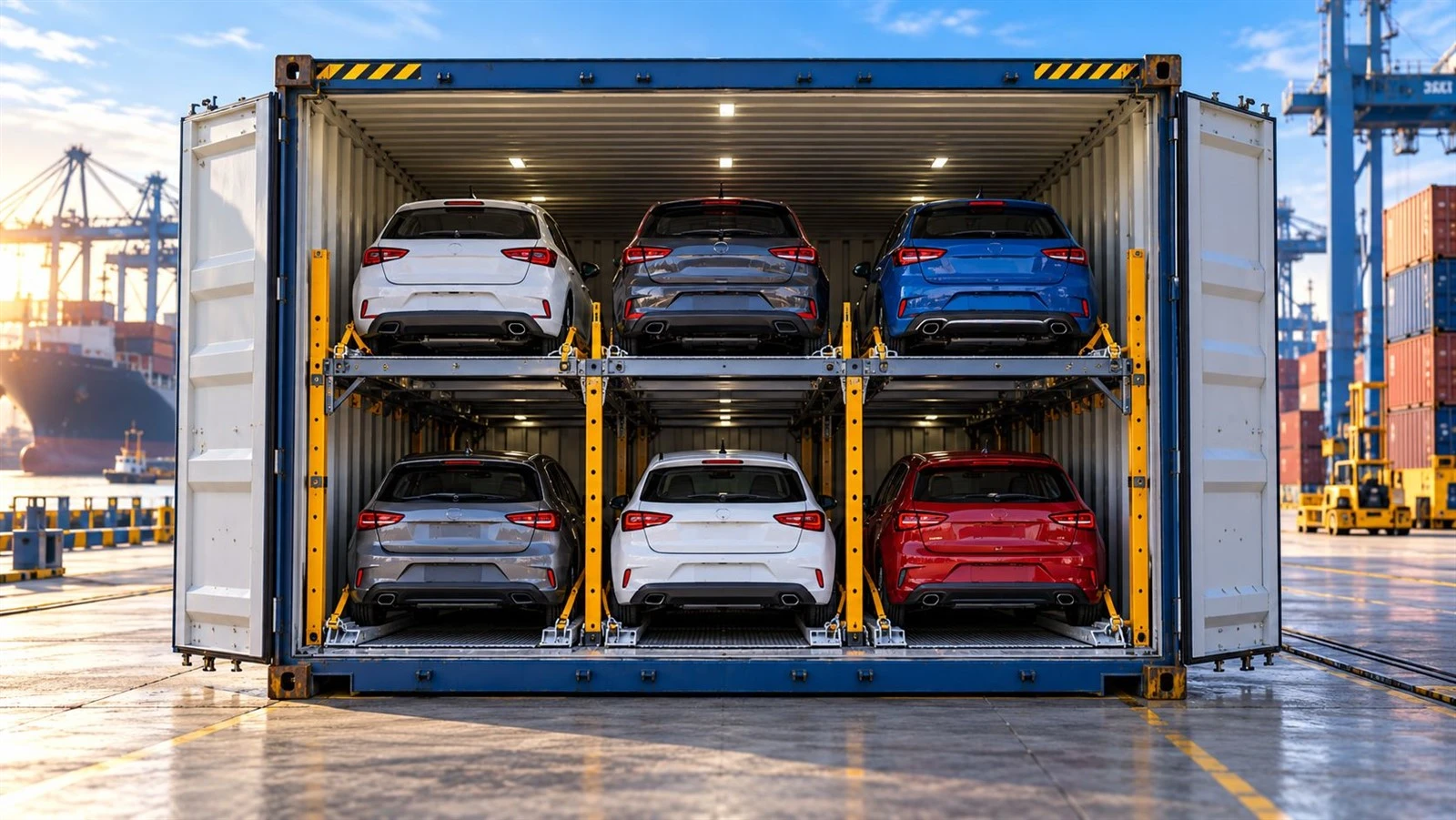
Method B: Double-Deck Loading With a Racking System
A purpose-designed car racking system creates additional usable loading positions inside the 40HQ.
Depending on rack design, vehicle dimensions, and loading geometry, vehicles can be arranged on lower and upper positions.
- Capacity: 4–6 cars
- Pros: Significantly improves container utilization and can reduce ocean freight cost per vehicle
- Cons: Requires suitable equipment and careful loading design; loading takes longer; vehicle height becomes more restrictive
- Best for: Batch exports of compact or suitably sized vehicles
For compact sedans, a four-car configuration may use two lower and two upper positions. With sufficiently short vehicles and a compatible racking system, six-car arrangements may be possible.
This is also where an important commercial distinction appears: maximum vehicle capacity is not always the lowest-risk or lowest-total-cost solution. Adding another vehicle may reduce freight cost per car, but that advantage disappears if it creates insufficient clearance, increases loading risk, or requires expensive specialized equipment.
Method C: Specialized Double-Height Vehicle Containers
Some logistics operators use purpose-built equipment taller than a standard 40HQ, sometimes exceeding four meters in external height. These may include integrated multi-level vehicle-loading systems.
- Capacity: 4–8 cars depending on vehicle size and equipment design
- Pros: Maximum loading density
- Cons: Non-standard equipment, limited availability, higher equipment cost, and possible restrictions at particular terminals or transport legs
These units demonstrate what is technically possible for high-density car transport, but they should not be confused with a standard ISO 40HQ container.

Factor 3: Check Payload and Road Weight Limits
Space is only one part of 40HQ vehicle loading. Weight must also be checked.
A 40HQ has a maximum gross weight of approximately 30,480 kg. With a tare weight of roughly 3,700–4,200 kg, usable payload is around 26,500 kg.
Consider the following examples:
- Six mid-size sedans at 1,500 kg each = 9,000 kg
- Six EVs at 2,200 kg each = 13,200 kg
Both are well below the nominal container payload.
Weight becomes more important when:
- larger SUVs or heavy vehicles are loaded;
- a racking system adds 500–1,000 kg or more;
- road, chassis, axle, or local transport regulations impose lower operating limits;
- additional equipment is carried inside the container.
The container's rated payload therefore should not be treated as the only allowable limit. The inland transport rules at both origin and destination must also be considered before loading.
For U.S.-bound shipments, the U.S. Federal Bridge Formula and vehicle weight limits provide an authoritative reference for federal truck weight restrictions that may affect inland container transport.
For vehicle exporters, this is another reason to calculate the total logistics cost per car, rather than looking only at the ocean freight rate for one container.
Factor 4: Secure and Lash Every Vehicle Correctly
Every vehicle inside a shipping container must be restrained against movement caused by rolling, pitching, vibration, braking, handling, and other forces during transportation.
Common vehicle securing methods include:
- Wheel chocks: Positioned around the wheels to help prevent rolling.
- Lashing straps: Used to restrain vehicles against movement through appropriate securing points.
- Chain and tensioner assemblies: Suitable for certain heavier vehicles where greater restraint strength is needed.
- Wooden blocking and bracing: Used where appropriate to provide additional support and prevent movement.
The exact method should be based on the vehicle, container, lashing points, rack arrangement, and the approved loading procedure.
For additional guidance on cargo restraint principles, the FMCSA Cargo Securement Rules provide a useful regulatory reference for securement requirements in U.S. road transport.
Vehicle protection should also address more than movement. Body panels, bumpers, mirrors, wheels, and nearby vehicles can all be exposed to scratching or contact when clearance is tight.
For this reason, professional vehicle container shipping should include pre-loading inspection, positioning, wheel restraint, anti-slip measures, lashing, protection against contact, and a final check after loading.
Practical 40HQ Vehicle Loading Scenarios
The following examples show how vehicle size and loading method affect practical 40HQ container car capacity.
Scenario 1: Two Standard Sedans Without a Rack
|
Item |
Value |
|
Vehicle |
Mid-size sedan, ~4.7 m × 1.8 m × 1.45 m, ~1,400 kg |
|
Quantity |
2 |
|
Loading method |
Single-level, end-to-end |
|
Total vehicle weight |
2,800 kg |
|
Space used |
~10 m of 12 m length |
|
Weight margin |
Excellent |
|
Cost per vehicle |
Moderate |
This is one of the simplest configurations. It provides more working clearance for positioning, securing, and unloading than high-density loading.
It is especially suitable for smaller shipments where cargo protection and operational simplicity are more important than maximizing the number of cars per container.
Scenario 2: Four Compact Sedans With a Double-Deck Rack
|
Item |
Value |
|
Vehicle |
Compact sedan, ~4.0 m × 1.7 m × 1.4 m, ~1,200 kg |
|
Quantity |
4 |
|
Loading method |
Double-deck racking, 2 lower + 2 upper |
|
Total vehicle weight |
4,800 kg |
|
Rack weight |
~800 kg |
|
Space used |
Full length, two tiers |
|
Weight margin |
Good |
|
Cost per vehicle |
Low |
For suitable compact vehicles, this can be an efficient configuration for batch exports.
Loading four cars in one 40HQ can substantially reduce ocean freight cost per vehicle compared with sending only two cars, provided the racking and securing arrangement is appropriate.
Scenario 3: Three SUVs on a Single Level
|
Item |
Value |
|
Vehicle |
Mid-size SUV, ~4.8 m × 1.9 m × 1.75 m, ~1,900 kg |
|
Quantity |
3 |
|
Loading method |
Single-level, staggered |
|
Total vehicle weight |
5,700 kg |
|
Space used |
~11.5 m of 12 m length in a suitable compact-SUV configuration |
|
Weight margin |
Good |
|
Feasibility |
Borderline; requires sufficiently short vehicles and careful positioning |
For most mid-size SUVs in the 4.6–4.9 m range, two vehicles are the more realistic single-level capacity. A three-SUV plan depends heavily on the actual model dimensions and should be verified before booking.
This illustrates why saying only "three SUVs" is not enough for a loading calculation. The exact make, model, length, width, height, and weight of every vehicle are much more useful.
Scenario 4: Six Compact EVs With Double-Deck Racking
|
Item |
Value |
|
Vehicle |
Compact EV, ~3.8 m × 1.7 m × 1.5 m, ~1,300 kg |
|
Quantity |
6 |
|
Loading method |
Double-deck racking, 3 lower + 3 upper |
|
Total vehicle weight |
7,800 kg |
|
Rack weight |
~1,000 kg |
|
Space used |
Full length and height, two tiers |
|
Weight margin |
Good |
|
Cost per vehicle |
Lowest among these examples |
This represents the high end of practical capacity described here for a standard 40HQ using a compatible racking arrangement.
Compact EVs can be suitable for high-density loading because shorter vehicle length may allow more units per tier. However, electric vehicles can also be subject to additional carrier and battery-related requirements. If your shipment involves EVs, review the requirements for used new energy vehicle shipping from China before finalizing the transport plan.
Checklist Before Booking a 40HQ for Car Shipping
Before committing to a 40ft high cube container for car shipping, verify the following:
- Measure every vehicle. Confirm exact length, width, height, and weight, including roof accessories, antennas, spoilers, and other projections.
- Confirm the actual container dimensions. Minor variations between individual containers can matter when clearance is already tight.
- Check the door opening. A vehicle must first pass through the approximately 2.58 m-high door opening before it can use the greater internal height of the container.
- Check inland transport limits. Container payload is only one limit. Truck, chassis, axle, road, and local regulatory requirements may impose additional restrictions.
- Confirm whether racking is required and available. A double-deck loading plan depends on suitable equipment and compatible vehicle dimensions.
- Check EV transport requirements. Electric vehicles may be subject to carrier-specific battery, state-of-charge, documentation, or dangerous-goods procedures. The IMO International Maritime Dangerous Goods Code is the principal international reference for the maritime transport of dangerous goods.
- Plan professional securing and cargo protection. Wheel restraint, lashing, support, anti-slip measures, and clearance should be considered before loading begins.
- Photograph vehicle condition and the completed loading. Pre-loading and post-securing photographs create a useful record for operational control and potential claims.
A useful rule is to finalize the vehicle loading layout before the container is booked, rather than trying to solve the layout after the cars arrive at the loading site.
How Wilson Supply Chain Supports Vehicle Container Shipping
Zhejiang Wilson Supply Chain Management Co., Ltd. provides international freight forwarding and supply chain services from China, including vehicle export logistics.
Wilson's vehicle experience includes used cars, new-energy used vehicles, SUVs, pickups, commercial vehicles, trucks and buses. Depending on vehicle dimensions, operability, destination, equipment availability, and cargo-protection requirements, transport options may include standard containers, RoRo, Flat Rack, Open Top, or Breakbulk.
For car container shipping from China, our work can include:
- evaluating vehicle dimensions, weight, quantity, and destination requirements before booking;
- selecting an appropriate container or alternative transport method;
- designing the vehicle loading and stowage plan;
- coordinating pickup, warehousing, and container loading;
- supervising support, lashing, and cargo-protection measures for complex vehicle shipments;
- arranging export customs procedures and shipping documentation;
- coordinating sea freight from China and key logistics milestones;
- supporting destination clearance, delivery, or DDP services where applicable.
Our recent project experience includes exports of used vehicles, pickups, and buses, while Wilson has also accumulated practical experience serving the automotive logistics sector.
That experience reinforces a practical point: vehicle mix matters more than vehicle count. A loading plan should begin with the actual dimensions and weight of each car, then work backward to determine the safest and most cost-efficient container configuration.
FAQ
How many sedans can fit in a 40HQ container?
A standard 40HQ typically carries 2–3 sedans on a single level. With a suitable double-deck vehicle racking system, 4–6 compact or appropriately sized cars may be possible.
The actual number depends on the length, height, and weight of each vehicle and the specific rack configuration.
Can six cars fit in a standard 40HQ container?
Yes, six compact cars may fit in a standard 40HQ when a compatible double-deck racking system is used and the vehicle dimensions allow three positions per tier.
Six standard mid-size sedans will not automatically fit. The loading layout must be calculated from the actual vehicle dimensions.
Is a 40HQ better than a 40GP for shipping cars?
A 40HQ provides around 30 cm more internal height than a 40GP, which can provide more flexibility for SUVs, taller vehicles, and vehicle racking systems.
However, the best container depends on the vehicles being shipped. If extra height does not improve the loading plan, a 40HQ may not necessarily deliver additional value.
Is Container Shipping Better Than RoRo for Cars?
Neither method is universally better.
Container shipping vs RoRo should be evaluated based on vehicle size, quantity, whether the vehicles can be driven, origin and destination services, schedule, cargo-protection requirements, and total cost.
Containers can be particularly useful when several vehicles are being consolidated or when a controlled loading and securing arrangement is preferred. RoRo can be an efficient alternative for suitable operable vehicles on routes where the service is available.
For a more detailed comparison, see our guide to RoRo vs container shipping for vehicles. You can also explore Wilson's RoRo transport services when evaluating alternatives to containerized car shipping.
What Information Is Needed to Calculate How Many Cars Fit in a 40HQ?
For an accurate 40HQ vehicle loading plan, provide:
- make and model;
- quantity;
- exact length;
- width;
- height;
- weight;
- whether each vehicle is operable;
- pickup location in China;
- destination port or country;
- any special protection or handling requirements.
With this information, a freight forwarder can assess the actual vehicle combination instead of relying on a generic "cars per container" estimate.
If you are still planning the sourcing and export process, our guide on how to ship a used car from China covers the broader shipping workflow beyond container capacity alone.
Conclusion
So, how many cars fit in a 40HQ container?
For a standard 40HQ, a practical answer is usually:
- 2–3 cars with simple single-level loading;
- 4–6 compact cars with a suitable double-deck racking system;
- up to 8 cars only with specialized non-standard vehicle equipment, not an ordinary 40HQ.
The final number depends on vehicle dimensions, vehicle mix, loading geometry, racking, securing space, payload, and destination transport requirements. The safest and most economical plan is therefore not necessarily the one that forces the greatest possible number of cars into one container-it is the one that achieves efficient cost per vehicle without compromising loading or cargo protection.
If you are planning to ship cars from China, send Wilson the vehicle models, dimensions, quantities, and destination. Our team can help assess the appropriate 40HQ loading configuration and discuss the most suitable container, car RoRo shipping from China, or alternative vehicle shipping solution for your project.