Customs clearance is the legal procedure that allows goods to enter or leave a country after duties are paid and regulations are met. The customs clearance process is a critical part of international shipping: get it right, and your cargo moves on schedule. Get it wrong, and your shipment sits at the port - potentially generating additional demurrage and detention charges.
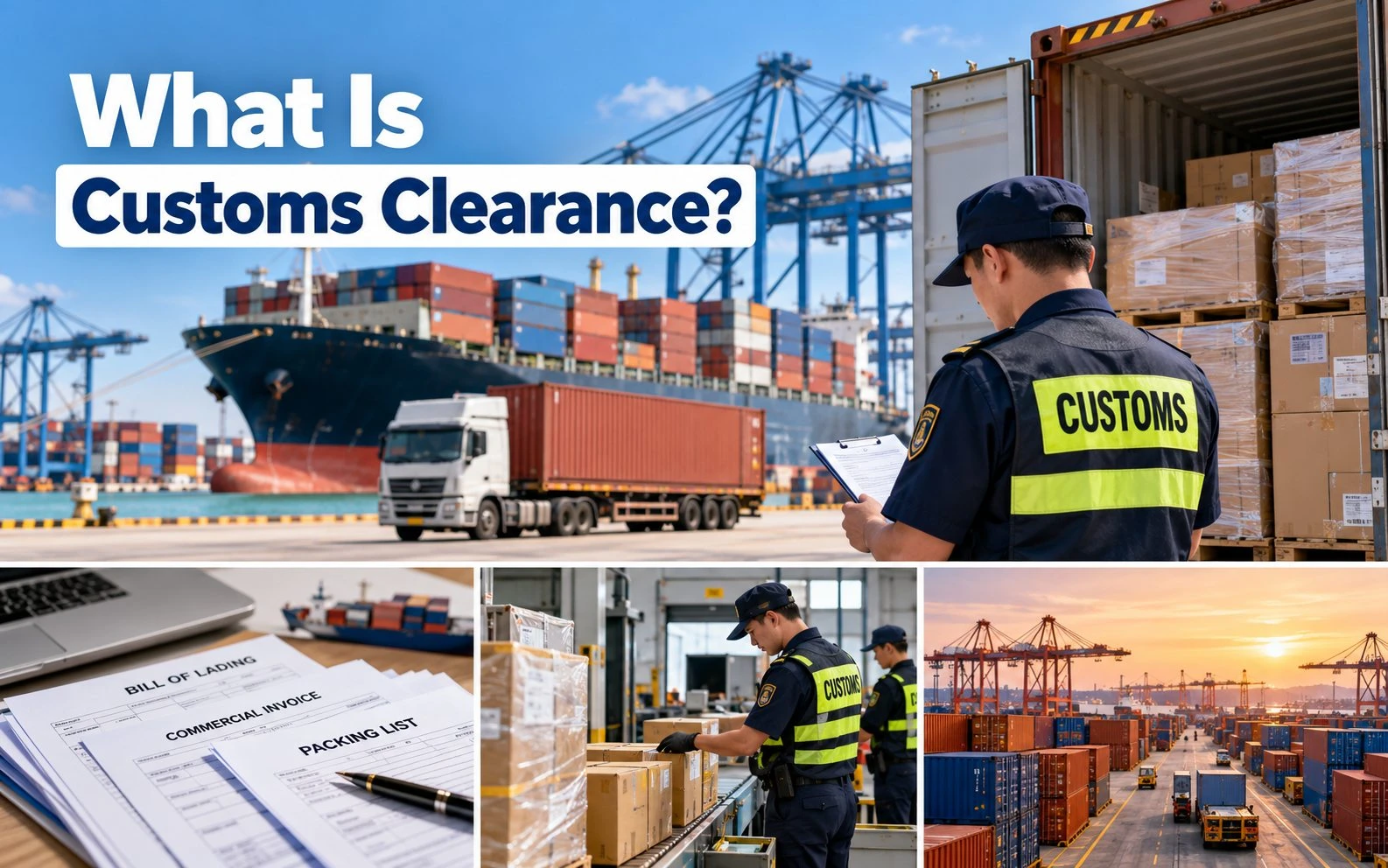
What Is Customs Clearance?
Customs clearance - sometimes called customs release or customs formalities - is the full sequence of steps through which a national customs authority verifies, taxes, and authorizes the entry or exit of goods across its borders. It is not a single event at the port gate. It is a regulated process that begins before cargo ships out and ends only when the consignee takes physical delivery.
Every shipment crossing an international border must clear customs. There are no exceptions for commercial cargo. Whether you are importing a single pallet of electronic components or forty containers of construction machinery, the same legal framework applies - what changes is the depth of documentation, the duty calculation, and the inspection probability.
For companies arranging sea freight from China, customs clearance is one of the most important stages between cargo departure and final delivery.
The process exists for a straightforward reason: governments need to control what enters their territory, collect revenue, and protect public safety. From the importer's perspective, import customs clearance is the gate between "goods shipped" and "goods available." That gate can open in hours or stall for weeks, depending entirely on how well the paperwork is prepared.
Who Handles Customs Clearance?
Customs clearance is not a solo operation. Multiple parties touch each shipment, and understanding who does what prevents the most common source of delays - assuming someone else handled a step that nobody actually did.
1. Importer / Consignee
The party named on the bill of lading who receives the goods. Legally responsible for accurate declaration and duty payment.
2. Customs Broker
A licensed professional who prepares and submits customs declarations on the importer's behalf. Knows tariff classifications, duty rates, and local regulations.
3. Freight Forwarder
Manages the physical transport chain - booking, documentation routing, and coordination between origin and destination agents. Depending on the service scope and destination, a freight forwarder may also coordinate customs clearance services with local customs brokers and other service providers.
If you are unfamiliar with the division of responsibilities, this guide explains in more detail what a freight forwarder does throughout an international shipment.
4. Customs Authority
The government agency that reviews declarations, inspects cargo, assesses duties, and grants or denies release. Examples include CBP in the United States and HMRC in the UK.
The importer is ultimately accountable. Brokers and forwarders execute, but errors in classification, valuation, or documentation trace back to the consignee - and so do the penalties.
What Documents Are Required for Customs Clearance?
Documentation is the backbone of customs clearance. Customs officers rarely see the actual cargo first - they see the paperwork. If the customs clearance documents are inconsistent, incomplete, or contradictory, the shipment is flagged before anyone opens a container.
For importers using ocean transportation, understanding the documents required for sea freight from China can help prevent documentation gaps before the cargo reaches its destination.
The core documents required for nearly every commercial import are:
- Bill of Lading (B/L) - The transport contract and receipt issued by the carrier. It proves title to the goods and is required to claim cargo at the destination port.
- Commercial Invoice - Shows the transaction value, product description, quantity, and terms of sale. Customs uses this to assess dutiable value.
- Packing List - Details the weight, dimensions, and contents of each package. Essential for physical verification during inspection.
- Certificate of Origin - Confirms where the goods were manufactured. Determines whether preferential tariff rates apply under free trade agreements.
- Customs Declaration Form - The formal submission to customs, typically filed electronically, declaring HS codes, value, origin, and intended use.
Beyond these, specific cargo types trigger additional requirements. Dangerous goods require a Material Safety Data Sheet (MSDS) and dangerous goods declaration. Food, cosmetics, and medical products need health or phytosanitary certificates. Used machinery may require pre-shipment inspection reports.
Wood packaging such as pallets and crates may also need to comply with international ISPM 15 requirements for wood packaging material, including appropriate treatment and marking where applicable.
A single mismatch between the invoice value and the declared customs value can trigger a full audit. Consistency across every document is not a best practice - it is the baseline.
The Customs Clearance Process, Step by Step
The customs clearance process follows a predictable sequence. The exact terminology varies by country, but the underlying logic is the same worldwide.
Step 1: Document Preparation (Pre-Arrival)
Before the vessel reaches the destination port, the importer or broker assembles all required documents and verifies consistency.
Many countries require advance cargo information before arrival or even before loading. For covered U.S. ocean imports, the U.S. Importer Security Filing (ISF) is an important pre-arrival filing requirement.
Late or incorrect pre-filing can result in penalties, additional examination, or cargo delays.
Step 2: Goods Arrival and Manifest Filing
When the vessel docks, the carrier files the cargo manifest with customs, confirming what was actually loaded. The consignee or broker then exchanges the bill of lading for a delivery order (D/O), which authorizes them to proceed with formal clearance.
This stage is particularly relevant for companies arranging import sea freight, because terminal procedures, documentation, carrier release, and customs formalities must be coordinated before cargo can leave the port.
Step 3: Customs Declaration Submission
The customs broker files the formal customs declaration - electronically in most modern systems - including the HS code classification, declared customs value, country of origin, and applicable duty rates.
This is the moment where accuracy matters most. A wrong HS code means the wrong duty rate, and potentially a misclassification penalty.
Step 4: Duty Assessment and Payment
Customs reviews the declaration and issues a duty assessment. The importer or broker pays the assessed customs duties and taxes - typically import duty, value-added tax (VAT), and any excise or anti-dumping duties that apply.
Payment triggers the next stage.
Step 5: Customs Inspection (If Selected)
Not every shipment is physically inspected. Customs uses risk-based targeting - high-value cargo, sensitive product categories, and shipments from flagged suppliers face higher inspection probability.
When selected, officers compare the physical cargo against the declaration. Discrepancies in quantity, product type, or packaging can result in seizure, fines, or forced re-export.
Step 6: Customs Release and Delivery
Once duties are paid and any inspection is cleared, customs issues a release order. The consignee can now collect the container from the terminal and arrange inland transport to the final destination.
Customs clearance is complete only at this point - not when the declaration was filed, not when duties were paid.
For importers that prefer one provider to coordinate customs clearance and inland delivery, import transportation services can reduce the number of separate parties that need to be managed.
Each step has a dependency on the previous one. You cannot pay duties before the declaration is accepted, and you cannot collect cargo before customs release is granted. The most experienced importers focus on compressing the timeline of steps 1 through 3, because that is where preparation - not luck - determines speed.
How HS Codes Affect Customs Clearance
The Harmonized System (HS) code is a six-to-ten-digit international product classification used to identify traded goods for customs purposes.
The international Harmonized System is developed and maintained by the World Customs Organization.
It is one of the most important data points in a customs declaration because it influences the applicable duty rate, whether quotas or restrictions apply, and what additional certifications the product may need.
HS codes are structured hierarchically: the first six digits are internationally standardized, while individual countries extend them with additional digits for national tariff and statistical purposes.
An HS code classification error at any level cascades into wrong duty payments, wrong document requirements, and potential customs compliance violations. Importers handling unfamiliar products should therefore pay particular attention to HS code classification before the customs declaration is submitted.
|
HS Code |
Product Category |
Typical Duty Implication |
|
8471.30 |
Portable computers (laptops) |
Often 0% under ITA |
|
8708.29 |
Vehicle parts and accessories |
5%–10% varies by component |
|
8517.62 |
Communication apparatus |
0%–8% varies by market |
|
8428.90 |
Lifting/handling machinery |
5%–12% general rate |
|
2710.19 |
Petroleum oils (non-kerosene) |
Variable + excise duties |
The rates above are illustrative - actual duties depend on the destination country's tariff schedule and any applicable free trade agreement preferences.
The point is that two products that look similar to a non-specialist can carry vastly different duty rates under different HS codes. This is why classification is not a clerical task but a technical decision that benefits from professional review.
What Duties and Taxes Are Paid During Customs Clearance?
Import costs are not limited to a single tariff line. A typical import customs clearance involves several layers of charges, each calculated on a different base.
Understanding import tariffs, duties, and taxes helps importers forecast landed cost more accurately instead of discovering unexpected charges after the shipment arrives.
|
Charge Type |
Calculation Base |
Who Collects |
|
Import Duty |
Customs value (CIF or FOB + freight + insurance) |
Customs authority |
|
VAT / GST |
Customs value + import duty |
Customs authority |
|
Excise Duty |
Quantity or value (alcohol, fuel, tobacco) |
Customs authority |
|
Anti-Dumping Duty |
Specific goods from specific origins |
Customs authority |
|
Customs Processing Fee |
Flat or ad valorem, varies by country |
Customs authority |
Customs valuation is governed internationally by principles reflected in the WTO Customs Valuation Agreement.
The customs value is typically based on the transaction value - the price actually paid for the goods - subject to the applicable customs valuation rules and required adjustments.
Under-declaring value to reduce customs duty is not a strategy. Customs authorities may compare declarations with supporting documentation and other reference information, and undervaluation can trigger reassessment, penalties, and further investigation.
What Causes Customs Clearance Delays and How Can You Prevent Them?
Most customs clearance delays are caused by documentation, classification, compliance, or inspection issues rather than the physical transportation itself.
The following issues account for many common hold-ups at ports worldwide:
- HS code misclassification - Wrong code triggers duty reassessment and potential penalty review.
- Value inconsistency - Invoice value differs from what was declared or from market reference prices.
- Missing or expired certificates - Origin certificates, inspection reports, or licenses that were never obtained or have lapsed.
- Incomplete packing lists - Weight or count discrepancies between documents and physical cargo.
- Restricted goods without permits - Products requiring import licenses that were not secured before shipment.
- Wood packaging non-compliance - Missing or invalid treatment marks on regulated pallets or crates can result in additional treatment, inspection, or refusal.
The pattern is clear: many delays trace back to a document or classification problem that could have been identified before the cargo left the origin port.
Pre-shipment document review by an experienced broker or freight forwarder costs a fraction of what prolonged port storage, inspection, or demurrage may cost after arrival.
How Long Does Customs Clearance Take?
How long customs clearance takes depends heavily on the destination, the cargo category, and document readiness.
The table below reflects typical ranges for well-prepared shipments - add days for any documentation gap.
|
Route / Cargo Type |
Typical Clearance Time |
Key Variable |
|
China → US (general cargo) |
1–3 business days |
CBP risk targeting |
|
China → EU (general cargo) |
2–5 business days |
ENS pre-filing accuracy |
|
China → Middle East (general cargo) |
3–7 business days |
SASO / CoC certification |
|
Dangerous goods (any route) |
5–10 business days |
MSDS + hazard declaration |
|
Used machinery |
7–15 business days |
Pre-shipment inspection |
|
Food / cosmetics |
5–12 business days |
Health / phytosanitary cert |
These ranges assume documents are correct and complete at arrival. A shipment with a single missing certificate can exceed these timelines by weeks.
The difference between a three-day customs clearance and a three-week ordeal is often preparation rather than the customs authority's workload alone.
Do You Need a Customs Broker for Customs Clearance?
For commercial shipments, particularly higher-value or regulated cargo, using an experienced customs broker can substantially reduce the risk of declaration errors.
Brokers understand local customs procedures, tariff classifications, duty payments, bonds, and regulatory requirements. Their local knowledge is particularly valuable because customs procedures and licensing rules differ between countries.
The cost of a customs broker is usually small compared with the potential cost of errors. A misclassified shipment can result in duty underpayment assessments, penalties, cargo holds, or other compliance consequences.
For complex cargo - vehicles, industrial equipment, dangerous goods, oversized loads - the broker's value increases sharply. These categories involve specialized documentation, specific port handling procedures, and potentially higher inspection rates.
The margin for error is smaller, and the cost of getting it wrong is larger.
Conclusion
Customs clearance is the regulated process through which goods legally cross international borders - requiring accurate customs documentation, correct HS classification, duty and tax payment, and possible inspection before customs release.
It works best when treated as a planned sequence rather than a port-side scramble. Careful preparation before shipment can reduce avoidable delays, unexpected customs charges, and compliance risks.
Importers that prefer the seller or logistics provider to manage more of the destination-side process may also want to understand how DDP shipping changes responsibility for freight, customs clearance, duties, and final delivery.
If you are importing from China, Zhejiang Wilson Supply Chain Management Co., Ltd. can coordinate document review, HS code support, customs clearance, DDP, warehousing, international freight, and final delivery as part of an end-to-end supply chain solution.
Contact our team to discuss your shipment and identify the customs clearance requirements before your cargo departs.
FAQ
What documents are required for customs clearance?
For most commercial shipments, the main customs clearance documents include a commercial invoice, packing list, bill of lading or other transport document, customs declaration, and, where applicable, a certificate of origin.
Depending on the product and destination country, import licenses, inspection certificates, dangerous goods documents, or other regulatory certificates may also be required.
How long does customs clearance normally take?
For a well-prepared general cargo shipment, customs clearance may take anywhere from one to several business days.
The actual timeline depends on the destination country, product type, accuracy of the documentation, HS code classification, duty payment, and whether the shipment is selected for customs inspection.
Who pays customs duties and import taxes?
The party responsible depends on the agreed Incoterms and the import arrangement.
In many standard import transactions, the importer or consignee is responsible for customs duties and import taxes. Under a DDP arrangement, the seller is generally responsible for arranging and paying the applicable import charges as defined by the agreed terms.
Can a freight forwarder handle customs clearance?
A freight forwarder can often coordinate customs clearance as part of an international freight or door-to-door logistics service.
Depending on local regulations, the formal customs declaration may be submitted by a licensed customs broker or authorized customs representative working with the freight forwarder.
What does "customs cleared" mean?
"Customs cleared" generally means that customs has reviewed the required declaration and documents, applicable duties and taxes have been addressed, and any required inspection has been completed.
Once customs release is granted, the shipment can normally proceed to port pickup, inland transportation, or final delivery.