Import duties are taxes levied by a country's customs authority on goods entering its territory. For any importer, understanding how import duties are calculated is not optional - it directly determines landed cost, pricing strategy, and profit margin. The import duty calculation rests on three pillars: the customs value (the taxable base), the tariff rate (the percentage or unit amount applied), and the specific formula that ties them together. Get any one wrong, and you either overpay or face penalties.
What Is Customs Value?
Customs value - also called dutiable value - is the monetary figure that a customs authority uses as the tax base for calculating import duty. It is not simply the price on the commercial invoice. Under the WTO Valuation Agreement (formally the Agreement on Implementation of Article VII of GATT 1994), over 160 member economies follow a shared framework for determining this value.
The primary method is the transaction value method: the price actually paid or payable for the goods when sold for export to the importing country, adjusted by adding or deducting certain statutory items.
What Gets Added to the Transaction Value
The transaction value starts with the invoice price, but customs law requires specific additions before it becomes the customs value. The key add-ons include:
|
Add-on Item |
Description |
Typical Impact |
|
Freight (international transport) |
Cost of transporting goods to the port or place of importation |
Varies by route, mode, and cargo type |
|
Insurance |
Marine or transport insurance covering the journey |
Usually 0.1%–0.5% of cargo value |
|
Packing costs |
Cost of packing and labor for export packing |
Often bundled into invoice price |
|
Selling commissions |
Commissions paid by the buyer to an agent |
Added if not already in the price |
|
Assists |
Tools, dies, molds, or engineering supplied free or at reduced cost |
Must be apportioned and added |
|
Royalties and license fees |
Fees the buyer must pay as a condition of sale |
Added if not included in invoice |
What Gets Deducted
Certain charges can be excluded from the customs value if they are separately identified on the invoice or in the contract:
- Charges for construction, erection, assembly, or technical assistance undertaken after importation
- The cost of transport after importation (inland freight within the importing country)
- Customs duties and taxes of the importing country
- Buying commissions (commissions paid by the buyer to an agent representing the buyer, as opposed to selling commissions)
The distinction between what goes in and what stays out matters because every dollar added to the customs value increases the duty payable. Importers who fail to properly separate deductible charges end up paying duty on amounts that should have been excluded.
FOB vs. CIF: Two Valuation Bases
One of the most consequential differences across customs regimes is whether the dutiable value is built on FOB (Free On Board) or CIF (Cost, Insurance, and Freight) terms.
FOB value is the price of the goods at the point of export - essentially the invoice price plus export-side costs up to the moment the goods are loaded onto the vessel or aircraft at the origin port. It excludes international freight and insurance.
CIF value adds international freight and insurance to the FOB price. The formula is straightforward:
CIF = FOB + Freight + Insurance
For a practical breakdown of international transportation expenses, see our guide on how to calculate sea freight costs.
The practical difference is significant. Most major economies - including the EU, Canada, China, and Japan - use CIF as the customs valuation base. The United States, by contrast, uses a system closer to FOB: U.S. Customs and Border Protection (CBP) calculates duty on the transaction value of the goods, and freight and insurance to the U.S. port are generally not included in the dutiable value for most ad valorem duties.
|
Valuation Base |
Used By |
What It Includes |
What It Excludes |
|
CIF |
EU, Canada, China, Japan, most WTO members |
Invoice price + international freight + insurance |
Domestic inland transport after import |
|
FOB-based |
United States (for duty calculation) |
Invoice price + export-side costs to loading |
International freight and insurance (for duty) |
This means the same shipment can produce different duty amounts depending on the destination country's valuation method - even when the tariff rate is identical. An importer paying 5% duty on a CIF basis is effectively paying duty on the freight and insurance as well, while a U.S. importer at the same 5% rate pays duty only on the goods' value.
How Are Import Tariff Rates Determined?
A tariff rate is the percentage or specific amount that a customs authority applies to the customs value to determine the duty owed. The rate is not arbitrary - it is determined by two factors working in combination: the product's classification code and its country of origin.
HS Codes: The Universal Product Identifier
The Harmonized System (HS) is an international product classification system maintained by the World Customs Organization (WCO). It assigns a six-digit code to virtually every tradable product, and over 200 economies use it as the foundation of their tariff schedules. The first six digits are globally standardized; individual countries extend them to 8, 10, or more digits for national tariff and statistical purposes.
The HS code determines which tariff line a product falls under, and therefore which rate applies. Misclassify a product - say, declaring an industrial machine under a consumer-electronics code - and you may face a completely different rate, along with potential penalties for incorrect declaration.
For a more detailed explanation of product classification, learn how to find the correct HS code before preparing your import declaration.
Types of Tariff Rates
Tariff rates come in several forms, and a single product may be subject to more than one type:
|
Tariff Type |
How It Is Calculated |
Example |
|
Ad valorem duty |
Percentage of customs value |
5% of CIF value |
|
Specific duty |
Fixed amount per unit (weight, volume, count) |
USD 0.15 per kilogram |
|
Compound duty |
Ad valorem + specific combined |
3% of value + USD 0.10/kg |
|
Alternative duty |
Higher of ad valorem or specific |
Whichever yields more revenue |
Ad valorem duties are by far the most common globally. Specific duties appear frequently on agricultural products, alcoholic beverages, and certain raw materials. Compound and alternative duties are rarer but apply to selected product categories in some national schedules.
Rate Tiers by Origin and Agreement
The same HS code can carry multiple tariff rates depending on where the goods originated and what trade agreements apply:
|
Rate Category |
Applies When |
Typical Level |
|
Most-Favored-Nation (MFN) rate |
Goods from WTO members (default rate) |
Baseline |
|
Preferential / agreement rate |
Goods qualifying under an FTA or preference scheme |
Lower than MFN, sometimes zero |
|
Generalized System of Preferences (GSP) rate |
Goods from designated developing countries under GSP |
Reduced or zero |
|
Statutory / ordinary rate |
Goods from non-WTO members without agreements |
Highest tier |
The MFN rate is the default - it applies to goods from all WTO members unless a preferential agreement offers something lower. Preferential rates under free trade agreements (FTAs) like RCEP, USMCA, or bilateral deals can reduce duties significantly, but only if the goods meet the agreement's rules of origin and the importer provides valid proof of origin (typically a certificate of origin).
Anti-dumping duties (ADD) and countervailing duties (CVD) are a separate category. These are additional duties imposed when customs authorities determine that imported goods are being sold below fair market value (dumping) or are benefiting from foreign subsidies. ADD and CVD rates can be substantial - sometimes exceeding 100% - and are applied on top of the normal tariff rate.

How to Calculate Import Duties: Formula and Examples
The core formula for ad valorem duty - the most common type - is simple:
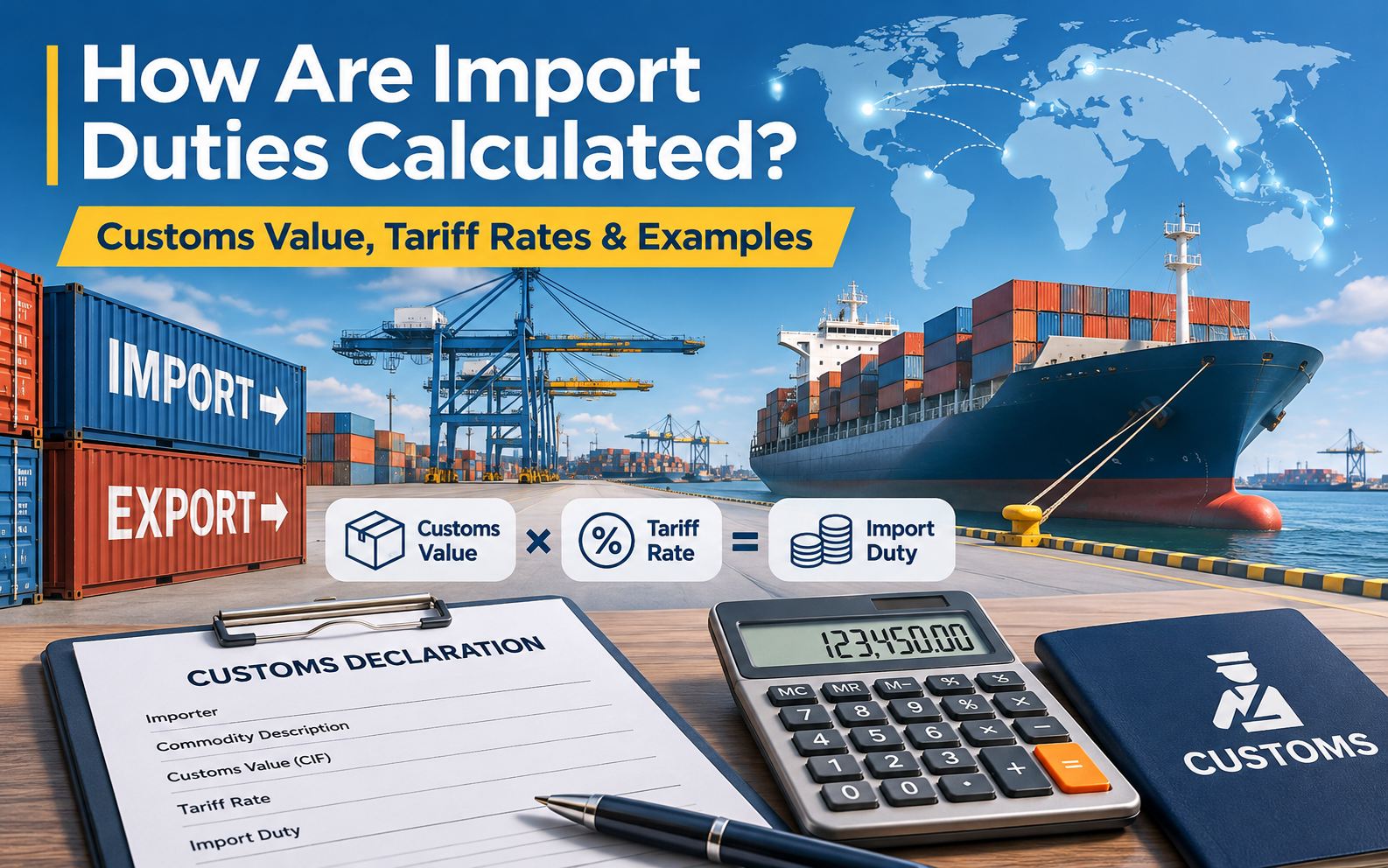
Import Duty = Customs Value × Tariff Rate
But the full landed-cost picture includes additional taxes and fees that vary by country. Below is how the calculation works in practice across major importing jurisdictions.
Step-by-Step Calculation Process
- Classify the product: Identify the correct HS code for the goods.
- Determine the customs value: Start with the transaction value, add required items (freight, insurance, assists, royalties), and deduct allowable charges.
- Identify the applicable rate: Check the tariff schedule for the HS code and the goods' country of origin; apply the lowest eligible rate if preferential treatment applies.
- Calculate the base duty: Multiply customs value by the tariff rate.
- Add additional duties if applicable: Anti-dumping, countervailing, or Section 301-type additional tariffs.
- Calculate import VAT/GST and other taxes: Many countries levy value-added tax or goods and services tax on the sum of customs value + duty.
- Add port and processing fees: Country-specific charges like the U.S. MPF and HMF.
Worked Example 1: EU Import (CIF-Based Valuation)
An EU importer purchases industrial valves from a Chinese supplier. The commercial terms are CIF Rotterdam.
|
Component |
Amount (EUR) |
|
Goods value (FOB) |
20,000 |
|
International freight |
1,200 |
|
Insurance |
100 |
|
CIF customs value |
21,300 |
|
Tariff rate (MFN, ad valorem) |
4% |
|
Import duty |
852 |
|
Import VAT base (CIF + duty) |
22,152 |
|
Import VAT rate (standard EU) |
~20% (varies by member state) |
|
Import VAT |
~4,430 |
|
Total duties and taxes |
~5,282 |
In this scenario, the importer pays EUR 852 in customs duty and approximately EUR 4,430 in import VAT. The VAT is recoverable as input tax in most EU member states if the importer is VAT-registered, but the customs duty is a sunk cost.
For importers planning door-to-door shipping from China to Europe, destination handling, customs clearance, and inland delivery expenses should also be considered when estimating the total landed cost.
Worked Example 2: U.S. Import (FOB-Based Duty + MPF + HMF)
A U.S. importer buys consumer electronics from China. The goods arrive by sea.
|
Component |
Amount (USD) |
|
Goods value (entered value for duty) |
15,000 |
|
International freight |
1,000 |
|
Insurance |
50 |
|
Tariff rate (MFN, ad valorem) |
0% (many electronics enter duty-free under MFN) |
|
Base duty |
0 |
|
MPF rate (ad valorem) |
0.3464% of entered value |
|
MPF |
~55 (subject to min/max thresholds) |
|
HMF rate (ad valorem, sea freight only) |
0.125% of entered value |
|
HMF |
~19 |
|
Total customs charges |
~74 |
If the same product were subject to an additional 25% Section 301 tariff - as many Chinese-origin goods have been under U.S. trade policy measures in recent years - the calculation changes dramatically: 25% of USD 15,000 = USD 3,750 in additional duty, bringing total customs charges to roughly USD 3,824 including the estimated MPF and HMF.
The MPF and HMF are U.S.-specific fees that do not exist in most other customs regimes. The MPF (Merchandise Processing Fee) is assessed on most formal entries at approximately 0.3464% of the entered value, with minimum and maximum caps that are periodically adjusted by CBP. The HMF (Harbor Maintenance Fee) generally applies to commercial cargo imported through U.S. ports by vessel at 0.125% of value. Air freight imports are not subject to HMF.
For businesses arranging sea freight from China to the USA, these customs charges should be included alongside ocean freight, destination handling, and inland transportation expenses when preparing an import budget.
Worked Example 3: China Import (CIF + VAT + Consumption Tax)
China's import tax structure adds layers beyond duty alone. The formula chain is:
Customs Duty = CIF × Tariff Rate
Import VAT = (CIF + Duty + Consumption Tax) × VAT Rate
Consumption Tax = [(CIF + Duty) ÷ (1 − CT Rate)] × CT Rate
The consumption tax formula above applies to goods subject to ad valorem consumption tax.
Consumption tax applies only to specific categories - tobacco, alcohol, fuel, luxury goods, and certain vehicles. For most general cargo, consumption tax is zero and the VAT rate is typically 13%.
For more information about applicable duties and product-specific tax categories, see our guide to China import tariffs and tax rates.
|
Component |
Amount (CNY) |
|
CIF value (converted from USD at customs rate) |
100,000 |
|
Tariff rate |
8% |
|
Customs duty |
8,000 |
|
VAT base (CIF + duty) |
108,000 |
|
VAT rate |
13% |
|
Import VAT |
14,040 |
|
Total duties and taxes |
22,040 |
China's customs authorities use a monthly reference exchange rate to convert foreign-currency invoices into CNY for duty assessment. The applicable customs conversion rate can therefore differ from the exchange rate quoted by a commercial bank on the declaration date.
What Factors Affect the Amount of Import Duty You Pay?
Beyond the mechanical import duty calculation formula, several variables can shift the final amount an importer pays - sometimes by a wide margin.
Country of Origin and Rules of Origin
The country of origin is not always where the goods were shipped from. It is determined under rules of origin that vary by product and by agreement. A product assembled in Vietnam from Chinese components may or may not qualify as Vietnamese origin, depending on whether the assembly meets the "substantial transformation" or tariff-shift criteria of the applicable rules.
Getting origin wrong is costly. If an importer claims a preferential rate and customs later determines the goods did not meet the rules of origin, the importer owes the difference between the preferential and MFN rate - plus potential penalties.
Customs Valuation Challenges
Related-party transactions - where the buyer and seller are affiliated companies - attract extra scrutiny. Customs authorities may question whether the transaction value reflects a genuine arm's-length price. If the relationship influenced the price, customs can reject the transaction value and fall back on alternative methods: comparable goods prices, deductive value, computed value, or a reasonable-means fallback.
The WTO Valuation Agreement establishes six customs valuation methods:
|
Method |
Basis |
|
1. Transaction value |
Actual price paid, with adjustments |
|
2. Transaction value of identical goods |
Price of same goods from same country |
|
3. Transaction value of similar goods |
Price of closely related goods |
|
4. Deductive value |
Resale price in importing country, minus costs |
|
5. Computed value |
Cost of production + profit |
|
6. Fall-back method |
Reasonable means consistent with principles |
Only when a higher-ranked method cannot be applied does customs move to the next, subject to the permitted reversal of the deductive and computed value methods. Importers should be prepared to justify their transaction value with documentation - especially in related-party trade.
Currency Conversion
When the invoice is in a foreign currency, customs converts it to the local currency using a prescribed exchange rate. The timing and source of this rate vary by jurisdiction. China applies customs-prescribed exchange rates; the EU applies customs exchange-rate rules; and the U.S. uses applicable customs exchange rates according to its entry and valuation requirements. For shipments invoiced in volatile currencies, the conversion timing can materially affect the customs value.
Free Trade Agreements and Preferential Treatment
FTAs can reduce or eliminate duties, but they are not automatic. The importer must:
- Confirm the product is covered by the agreement.
- Verify the goods meet the rules of origin.
- Obtain and present a valid certificate of origin (or make a self-certification declaration where the agreement allows).
- Claim the preference at the time of entry filing or through an applicable subsequent claim procedure.
Failure to claim at entry typically means the MFN rate applies, and post-entry claims for refunds are subject to time limits and documentation requirements.
Common Import Duty Calculation Mistakes
Several errors recur in practice, and each carries a cost - either in overpaid duty or in compliance risk.
Underdeclaring the customs value. Omitting freight, insurance, or assists when their inclusion is required by the destination country's customs valuation rules is a violation of customs law. Modern customs systems cross-reference shipping documents, and discrepancies between declared values and supporting documentation can trigger audits.
Misclassifying the product. Choosing an HS code with a lower rate than the correct one is not a strategy - it is misdeclaration. Customs post-entry audits compare declared classifications against product specifications, and reclassification can result in retroactive duty assessments plus penalties.
Ignoring additional tariffs. Importers focused on the base MFN rate sometimes overlook additional duties - anti-dumping measures, Section 301 tariffs in the U.S., or safeguard duties. These can dwarf the base rate and must be checked before shipment, not at the customs counter.
Failing to claim FTA preferences. Many importers leave money on the table by not obtaining certificates of origin or not filing preference claims. For high-volume shipments, even a few percentage points of duty reduction compounds into significant savings over a year.
Not accounting for import VAT/GST in landed cost. Duty is only part of the tax burden. In the EU, import VAT at ~20% often exceeds the customs duty itself. While recoverable for registered businesses, it still affects cash flow and must be factored into pricing and working-capital planning.

How to Estimate Import Duties Before Shipping
The practical workflow for estimating duties before a shipment departs:
- Confirm the HS code with the supplier or a customs broker in the destination country; use the national tariff schedule (not just the international 6-digit HS) to verify the exact rate.
- Obtain a pro forma invoice with a clear breakdown of goods value, freight, and insurance.
- Determine the customs valuation base for the destination country (CIF or FOB-based).
- Check the applicable rate for the HS code and origin country, including any preferential rates and additional tariffs.
- Calculate base duty, then add applicable ADD/CVD and other surcharges.
- Calculate import VAT/GST on the applicable taxable base if the destination country levies it.
- Add processing fees specific to the destination (e.g., MPF/HMF for U.S. imports).
Most national customs authorities provide online tariff lookup tools: the EU's TARIC database, the USITC's HTS search system, and China's customs tariff query portal are the primary resources for their respective jurisdictions.
For businesses managing international shipments, professional import transportation and customs clearance services can help coordinate shipping documents, customs procedures, and destination delivery arrangements.
Understanding how a freight forwarder helps importers can also make it easier to coordinate international transportation and customs clearance while improving visibility over the total landed cost.
FAQs
How Do You Calculate Import Duties on Goods Shipped from China?
To calculate import duties on goods shipped from China, first determine the product's correct HS code and customs value. Next, identify the applicable tariff rate in the destination country based on the product classification and country of origin.
For ad valorem duties, multiply the customs value by the applicable tariff rate. Additional tariffs, import VAT/GST, and customs processing fees may also apply. The final amount depends on the destination country's customs regulations and the specific imported goods.
Are Import Duties Calculated on FOB or CIF Value?
It depends on the destination country's customs valuation rules. Many countries, including China and EU member states, generally use a CIF-based customs value that includes the cost of goods, international freight, and insurance.
The United States generally uses a transaction-value system that excludes separately identified international freight and insurance from the dutiable value. Importers should confirm the valuation rules applicable to their destination country before calculating customs duty.
What Is the Difference Between Import Duty and Import VAT?
Import duty is a customs tax imposed on imported goods based on their classification, customs value, and applicable tariff rate.
Import VAT is a separate tax collected on imported goods in countries that operate a value-added tax system. Its taxable base commonly includes the customs value and applicable import duties, although additional charges may also be included depending on local regulations.
Importers should calculate both taxes when estimating the total landed cost of international shipments.
Can the HS Code Affect How Much Import Duty You Pay?
Yes. The HS code determines the tariff classification of imported goods and is one of the main factors used to identify the applicable customs duty rate.
Different HS codes can carry different tariff rates, even for products with similar functions or characteristics. Incorrect classification may result in overpaid duties, additional assessments, customs delays, or penalties.
Importers should verify the full national tariff classification rather than relying solely on the international six-digit HS code.
Are Import Duties Included in DDP Shipping?
Under Delivered Duty Paid (DDP) terms, the seller is generally responsible for arranging transportation to the named destination, completing the required import customs formalities, and paying applicable import duties and taxes.
However, import procedures, tax registration requirements, and the practical availability of DDP arrangements vary by country. Buyers should confirm the exact responsibilities and charges included in a DDP shipping quotation before placing an order.
For a more detailed explanation, see our guide to DDP shipping and import duty responsibilities.
For businesses importing goods from China, understanding these costs can help compare DDP shipping with other Incoterms and develop a more accurate landed-cost budget.
Conclusion
Import duty calculation comes down to three main variables: the customs value, the applicable tariff rate, and the calculation formula. For most ad valorem duties, import duty equals customs value multiplied by the tariff rate. However, customs valuation methods, HS code classification, country of origin, preferential trade agreements, and additional import taxes all influence the final amount payable. The EU, U.S., and China examples demonstrate why importers must consider destination-specific customs requirements rather than relying on a single universal calculation.
At Zhejiang Wilson Supply Chain Management Co., Ltd., we provide international freight forwarding and supply chain solutions from China, including sea freight, air freight, customs documentation support, customs clearance coordination, and DDP shipping arrangements. If you are planning to import goods, vehicles, industrial equipment, or other cargo from China, contact our team to discuss your shipment requirements and receive assistance with logistics planning and landed-cost estimation.