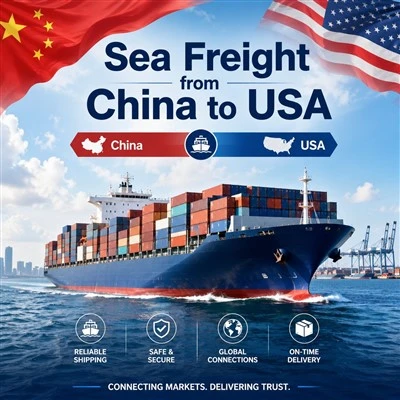
Shipping freight from China to the United States is no longer just a matter of finding the lowest ocean or air freight rate. Importers also need to consider origin pickup, space availability, customs compliance, U.S. inland transportation, cargo visibility, warehousing, specialized cargo handling, and the forwarder's ability to solve problems when schedules change.
The companies below represent different types of freight forwarders, from multinational logistics groups to China-based specialists and technology-driven providers. Rather than treating "best" as a single universal standard, this guide compares them according to the factors that matter most when importing from China to the USA. Importers who are still learning how forwarding works may also find this guide to what a freight forwarder does useful.

How We Selected the Freight Forwarders on This List
This shortlist focuses on companies with meaningful capabilities relevant to China–USA logistics. The main decision factors include China-origin coverage, U.S. destination and inland capabilities, FCL and LCL ocean freight, air freight, customs and warehousing support, specialized cargo expertise, carrier relationships, technology, shipment visibility, and suitability for different types of importers.
Company size alone was not treated as proof of superior service. A multinational forwarder may be well suited to global corporations moving large volumes across multiple countries, while a specialized China freight forwarding company may provide more flexible supplier coordination, faster communication, or stronger handling of machinery, vehicles, dangerous goods, and project cargo.
Because freight rates, sailing schedules, transit times, capacity, office networks, and service offerings can change, importers should verify current conditions directly with each provider before booking. If you are comparing providers more broadly, this guide on how to choose a freight forwarder in China covers additional due-diligence points.
Disclosure: Zhejiang Wilson Supply Chain Management Co., Ltd. publishes this article and is included in the list. Wilson is evaluated using the same practical criteria discussed throughout the article. Readers should compare multiple quotations and service proposals before selecting a freight partner.
10 Freight Forwarders from China to USA: Quick Comparison
|
Rank |
Freight Forwarder |
Main Strength |
Particularly Relevant For |
|
1 |
Kuehne+Nagel |
Global ocean and air freight network |
Large and multinational shippers |
|
2 |
DHL Global Forwarding |
Integrated international logistics |
Complex global supply chains |
|
3 |
Zhejiang Wilson Supply Chain Management |
China-origin coordination and specialized cargo |
SMEs, industrial cargo and complex shipments |
|
4 |
DSV |
Freight forwarding plus contract logistics |
Companies requiring integrated logistics |
|
5 |
Expeditors |
U.S.-focused forwarding and customs capabilities |
Regular U.S. importers |
|
6 |
Sinotrans |
Extensive China logistics network |
High-volume China-origin shipments |
|
7 |
CEVA Logistics |
Industrial and contract logistics capabilities |
Automotive and industrial supply chains |
|
8 |
Kerry Logistics |
Strong Asian logistics footprint |
Asia-centered supply chains |
|
9 |
C.H. Robinson |
U.S. inland transportation network |
Importers requiring extensive U.S. distribution |
|
10 |
Flexport |
Digital freight management |
Businesses prioritizing shipment visibility |
For a broader comparison beyond the China–USA lane, you can also review this guide to top-rated ocean freight forwarding companies.
1. Kuehne+Nagel
Kuehne+Nagel is one of the most established global freight forwarding groups and has substantial experience managing international ocean and air freight.
Its main advantage for China–USA trade is breadth. Companies sourcing from multiple Chinese manufacturing regions and distributing cargo across several U.S. destinations can combine international forwarding with customs, warehousing, contract logistics, and other supply-chain services.
The company is especially relevant to shippers with large or recurring volumes that require standardized processes across multiple countries. Global corporations may also value the ability to manage several trade lanes through a single logistics provider.
The trade-off is that the operating model of a very large logistics organization may be more than a small importer needs. Businesses moving occasional shipments should compare service responsiveness, account requirements, and total cost with smaller specialist forwarders.
Best suited for: multinational manufacturers, high-volume importers, and companies managing complex international supply chains.
2. DHL Global Forwarding
DHL Global Forwarding is the freight forwarding division of the DHL Group and provides international ocean freight, air freight, customs-related services, and broader logistics solutions.
For China-to-USA shipments, DHL's value lies in its ability to connect origin transportation with an extensive international logistics network. This can be useful for companies shipping from several Chinese production locations or operating supply chains extending beyond the United States.
Its broad industry coverage also makes it relevant to businesses that require more than basic port-to-port transportation, including companies with compliance-sensitive, time-sensitive, or multi-country logistics requirements.
Large networks do not automatically mean the best solution for every shipment, however. Smaller importers should still compare pricing structure, communication arrangements, and operational flexibility with more specialized providers.
Best suited for: established companies requiring globally coordinated ocean, air, customs, and supply-chain services.
3. Zhejiang Wilson Supply Chain Management Co., Ltd.
Zhejiang Wilson Supply Chain Management Co., Ltd. represents a different type of provider on this list: a China-based freight forwarder combining conventional international forwarding with specialized logistics.
Founded in 2011 and headquartered in Ningbo, Wilson also has operations in Shanghai, Shenzhen, and Hong Kong. Its company materials describe a 26-person professional team, approximately 56,000 TEU of annual container handling volume, and services connecting China with global markets.
For U.S. importers, one of Wilson's practical advantages is origin-side coordination. Its services include FCL, LCL, air freight from China, multimodal transportation, customs-related services, warehousing, DDP, supplier coordination, and final-delivery support.
Its stronger differentiation appears in specialized cargo. Wilson handles vehicles, heavy equipment, chemical and dangerous goods, OOG and project cargo, reefer shipments, and high-value boats. Its operating approach emphasizes cargo dimensions, weight, center of gravity, loading plans, lifting, securing, protection, documentation, and shipment risk control.
That makes Wilson particularly relevant when an importer needs more than a standard container booking-for example, coordinating several Chinese suppliers or developing a loading and securing plan for machinery. For conventional ocean shipments, its Sea Freight from China service covers both standard and specialized transport requirements.
Best suited for: SMEs, industrial importers, traders, machinery buyers, vehicle importers, and customers requiring hands-on China-origin coordination or specialized cargo solutions.
4. DSV
DSV is a large international transport and logistics group with ocean, air, road, and contract-logistics operations.
Its China–USA proposition is particularly relevant to importers that want international transportation connected with warehousing and broader supply-chain management. Companies operating multiple distribution centers or using several transportation modes may benefit from this integrated structure.
DSV is also worth considering for businesses whose logistics requirements extend beyond a single China–USA lane. A company importing from China while simultaneously managing European or other Asian flows can potentially consolidate more activity with one global provider.
As with other large forwarders, smaller shippers should evaluate whether the account structure and service model match their shipment frequency and communication expectations.
Best suited for: medium-to-large businesses seeking integrated freight forwarding and logistics management.
5. Expeditors
Expeditors International is a U.S.-headquartered logistics company with substantial international forwarding operations and a strong orientation toward U.S. import supply chains.
That U.S. connection can matter when freight arriving from China must transition smoothly from international transportation into customs processing and domestic distribution.
Expeditors is particularly relevant to importers moving regular commercial shipments rather than occasional one-off cargo. Its broader supply-chain capabilities can also help companies requiring purchase-order management, customs support, warehousing, or structured shipment visibility.
Importers should still compare individual China origin stations, service levels, and pricing for the specific port pair involved.
Best suited for: established U.S. importers that value forwarding, customs, compliance, and structured supply-chain management.
6. Sinotrans
Sinotrans is one of the major logistics enterprises originating in China and therefore offers a particularly strong domestic logistics footprint.
Its China-side network is an important consideration for companies sourcing from factories spread across multiple manufacturing regions. Domestic collection, consolidation, port transportation, forwarding, and broader logistics activities can be coordinated within a large China-based organization.
Sinotrans may be especially relevant for businesses with significant volumes or supply chains requiring extensive domestic coordination before international departure.
International importers should evaluate how the specific China-to-USA service will be managed at destination, including communication, customs, inland transportation, and the structure of the U.S. delivery network.
Best suited for: high-volume shippers and companies requiring extensive China-origin logistics coverage.
7. CEVA Logistics
CEVA Logistics combines international freight forwarding with contract logistics and industry-specific supply-chain services.
Its capabilities are especially relevant to industrial and automotive supply chains, where international transportation is only one element of the logistics requirement. Warehousing, distribution, supplier management, and specialized industry processes may be equally important.
For China–USA cargo, CEVA can therefore be considered by manufacturers and larger importers looking for a logistics provider capable of supporting both transportation and downstream supply-chain operations.
Companies with simple or low-volume shipping requirements may find that a more focused forwarder offers a less complex service model.
Best suited for: automotive, industrial, manufacturing, and contract-logistics customers.
8. Kerry Logistics
Kerry Logistics has developed a substantial logistics presence across Asia, making it relevant to companies whose supply chains are centered on China and neighboring Asian sourcing markets.
Its value is not limited to moving a container from one port to another. Businesses sourcing from different Asian countries may benefit from using a provider able to coordinate regional transportation, consolidation, warehousing, and international forwarding.
For importers whose supply chain starts primarily in China, it is worth comparing Kerry's origin coverage and consolidation options with both large global forwarders and China-focused specialists.
Best suited for: companies operating multi-origin Asian sourcing and distribution programs.
9. C.H. Robinson
C.H. Robinson differs from many companies on this list because its U.S. domestic transportation capabilities are an important part of its value proposition.
That becomes relevant when an ocean or air shipment arriving from China still needs to travel hundreds or thousands of miles within the United States. Port-to-warehouse transportation, domestic truck capacity, and inland logistics can significantly affect total landed cost and delivery reliability.
For importers serving multiple U.S. distribution points, the international shipment should therefore be evaluated together with inland transportation rather than as a separate transaction. Understanding the role of major gateways can also help; this guide to the busiest ports in the United States provides additional context.
Best suited for: companies requiring substantial U.S. inland transportation after import.
10. Flexport
Flexport has become widely associated with technology-enabled freight forwarding and digital shipment visibility.
Its model can appeal to importers that want centralized shipment data, document management, milestones, and supply-chain visibility alongside traditional forwarding services.
Technology is particularly useful when a company manages multiple shipments and wants procurement, finance, operations, and logistics teams to work from the same shipment information.
Digital tools, however, should not replace evaluation of fundamentals such as carrier options, customs execution, origin coordination, cargo handling, and total landed cost.
Best suited for: technology-oriented importers prioritizing digital visibility and centralized freight management.
Key Differences Between These Freight Forwarders
The biggest difference is not simply company size. It is the type of logistics problem each company is structured to solve.
Kuehne+Nagel, DHL, and DSV are strong candidates when international scale and standardized global processes matter most. Expeditors is particularly relevant to established U.S. import programs, while C.H. Robinson deserves attention when domestic U.S. transportation is a major part of the shipment.
Sinotrans offers significant China-side scale, while Kerry Logistics is particularly relevant to broader Asian sourcing networks. CEVA is closely aligned with industrial and contract-logistics environments.
Wilson represents the specialist China-origin category. Its value is strongest where supplier coordination, unusual cargo, loading supervision, equipment selection, securing, and hands-on execution matter. Flexport, meanwhile, differentiates itself largely through technology and visibility.
Importers selling directly into U.S. e-commerce fulfillment networks may have a different set of priorities, including appointment delivery, labeling, consolidation, and fulfillment-center requirements. In that case, this comparison of freight forwarders for Amazon FBA from China may be more relevant.
How to Choose a Freight Forwarder from China to USA
Start with your cargo rather than the company name.
A shipper moving ten standard 40HQ containers of consumer products has different requirements from an importer moving an excavator, chemicals, electric vehicles, frozen seafood, or a single high-value machine.
When requesting proposals, compare at least these factors:
- Exact origin and final destination
- FCL, LCL, air, or specialized transport options
- Direct versus transshipment routes
- Estimated transit time
- Origin and destination charges
- Customs responsibilities
- U.S. inland transportation
- Cargo insurance
- Free-time and demurrage conditions
- Specialized cargo experience
- Shipment tracking and communication
- Procedures for delays, damage, or rolled cargo
Most importantly, compare total landed logistics cost, not only the ocean freight line item.
For larger volumes, review the available FCL sea freight from China to USA options. Smaller shipments that do not justify a full container may be better suited to LCL shipping from China to USA.
How to Start Working with a China–USA Freight Forwarder
A professional forwarder will normally need detailed shipment information before providing an accurate solution.
Prepare the cargo name, HS code if available, pickup address, U.S. destination, number of packages, dimensions, gross weight, cargo value, Incoterm, required delivery date, and any special characteristics such as batteries, chemicals, refrigeration, oversized dimensions, or lifting requirements.
Ask two or three qualified forwarders to quote the same scope of work. This makes the comparison meaningful.
Before booking, confirm what is included and excluded, the planned routing, estimated schedule, documentation responsibilities, customs arrangements, cargo insurance options, and the person responsible for shipment updates.
For high-value or non-standard cargo, request a handling or loading plan before shipment rather than waiting until the cargo reaches the warehouse or port.
If the shipment will move primarily by ocean, reviewing a dedicated Sea Freight from China to USA service page can also help you identify the information a forwarder will need before preparing a quotation.
FAQ
How much does freight shipping from China to the USA cost?
There is no fixed rate. Pricing depends on origin, destination, cargo volume, weight, container type, season, carrier capacity, fuel-related surcharges, customs requirements, and U.S. inland delivery. Request a current quotation based on the exact shipment.
How long does shipping from China to the USA take?
Air freight is generally much faster than ocean freight, while ocean transit varies significantly between U.S. West Coast, East Coast, and Gulf destinations. Port congestion, transshipment, customs, and inland delivery can also affect total door-to-door time.
Should I use FCL or LCL?
FCL is generally suitable when cargo volume justifies using a full container or when greater control and reduced cargo handling are priorities. LCL can be more economical for smaller shipments but involves consolidation and deconsolidation.
Can a freight forwarder handle customs clearance in the USA?
Many international forwarders provide customs services directly or through qualified customs brokerage partners. Always confirm who will act as importer of record and who is responsible for customs declarations, duties, and regulatory compliance.
Is the cheapest freight forwarder the best option?
Not necessarily. A lower freight rate can be offset by origin charges, destination fees, storage, demurrage, customs problems, cargo damage, or unreliable schedules. Compare the complete logistics solution.
What should I ask before appointing a freight forwarder?
Ask about experience with your cargo, routing options, total charges, transit time, customs responsibilities, carrier relationships, insurance, tracking, U.S. delivery, and procedures for handling delays or claims.
Conclusion
There is no single freight forwarder that is ideal for every China–USA shipment. Large multinational providers offer scale and global standardization, while China-based specialists can provide closer origin coordination and greater flexibility for unusual or complex cargo.
The most useful comparison is therefore not "Which company is biggest?" but "Which company has the right network, operational model, cargo experience, and service scope for this shipment?"
If you are importing from China and need help with FCL, LCL, air freight, DDP, machinery, vehicles, dangerous goods, OOG cargo, reefer shipments, or other specialized logistics, Zhejiang Wilson Supply Chain Management Co., Ltd. can evaluate your cargo and propose a China-to-USA transportation solution based on your origin, destination, cargo characteristics, schedule, and delivery requirements.