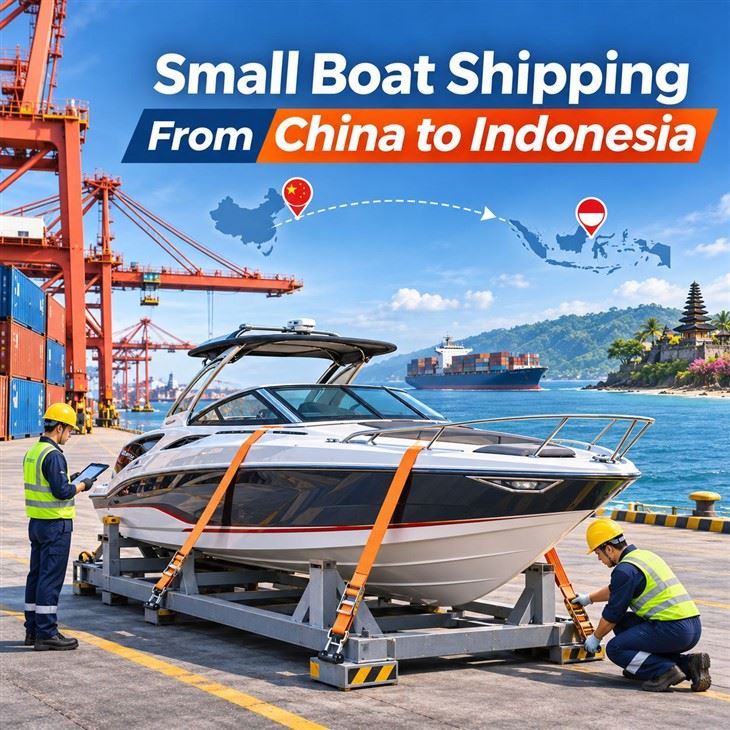
China and Indonesia share one of the most active maritime trade corridors in Southeast Asia. As Indonesia's middle class expands and its tourism sector invests heavily in marine leisure infrastructure-from Bali marinas to Riaot Islands resorts-demand for yachts, speedboats, patrol boats, and other small vessels has grown steadily. Chinese boat builders, known for competitive pricing and improving build quality, have become a key supply source for Indonesian buyers, while Indonesian boat owners and dealers also ship vessels back to China for refit, resale, or seasonal use.
Zhejiang Wilson Supply Chain Management Co., Ltd. provides specialized small boat shipping from China to Indonesia and from Indonesia back to China. We handle the full scope of vessel logistics through sea freight from China-Flat Rack, Open Top, Breakbulk, and container shipping where dimensions allow-covering domestic pickup, professional crating and hull protection, lifting and lashing, export customs clearance, ocean transport tracking, and destination port coordination. Our service range covers Yachts, Speedboats, Small Boats, Patrol Boats, and other high-value vessels of varying sizes and structures.
Estimated shipping cost from China to Indonesia for a typical small boat starts from approximately USD 2,800 for a compact speedboat on a 40' Flat Rack and can exceed USD 12,000 for a mid-size yacht shipped via Breakbulk. Transit time generally ranges from 10 to 25 days depending on routing, port pair, and whether transshipment is required. All rates and transit times quoted in this page are for reference only and subject to confirmation based on your vessel's actual specifications.

Whether you are an Indonesian dealer importing boats from a Chinese shipyard or a Chinese buyer bringing an Indonesian vessel home, we design a tailored transport plan around your boat's exact dimensions, weight, and hull structure.Contact us today with your vessel details for a real-time shipping quote.
Get Latest Ocean Freight Rates Now
Cost of Shipping a Boat From China to Indonesia
Boat shipping cost is driven by the vessel's physical dimensions, the transport method selected, and the complexity of loading and securing the cargo. Unlike standard containerized freight, boats are out-of-gauge (OOG) cargo in most cases, meaning the rate reflects not just weight and volume but also the space the vessel occupies on deck or in a hold.
The table below provides estimated shipping costs for common transport methods from major Chinese ports (Shanghai, Ningbo, Shenzhen) to Jakarta (Tanjung Priok) and Surabaya (Tanjung Perak):
Table 1. Estimated Shipping Cost by Transport Method (China to Indonesia)
| Transport Method | Suitable Vessel Size | Estimated Cost (USD) | Key Cost Factors |
|---|---|---|---|
| 40' Flat Rack (FR) | Up to approx. 12m L × 3.5m W × 3.5m H | 2,800–5,500 | OOG surcharge, lashing, hull cradle |
| 40' Open Top (OT) | Up to approx. 10m L × 2.9m W × 4.0m H | 2,500–4,800 | Overheight surcharge, tarpaulin cover |
| Breakbulk (RoRo / LoLo) | 12m–30m+ length, oversized beam | 6,000–12,000+ | Freight ton (RT) basis, deck space, stevedore |
| 40' Standard Container (GP) | Small boats ≤ 7m, disassembled or trailerable | 1,200–2,500 | Standard FCL rate, minimal OOG fees |
Factors That Influence the Final Cost
- Vessel dimensions (Length, Width, Height): The single most important variable. A boat that fits within a 40' Flat Rack footprint (roughly 12m × 2.4m × 2.6m internal, with overhang tolerance) costs significantly less than one requiring Breakbulk deck space. Every meter of overhang or excess beam triggers additional OOG surcharges from the carrier.
- Weight and hull structure: Heavy displacement hulls or boats with deep keels may require reinforced cradles, specialized lifting equipment, and heavier lashing materials-all adding to cost. Lightweight fiberglass speedboats are simpler and cheaper to secure.
- Lifting and loading requirements: Cranes, spreader bars, and custom lifting frames may be needed for yachts with awkward center of gravity or fragile hull sections. Port crane availability and stevedore rates at both origin and destination affect the total.
- Cradle, support, and lashing: Every boat needs a purpose-built support structure-typically a steel or hardwood cradle engineered to distribute weight along the hull's strong points. Lashing chains, turnbuckles, and shock-absorbing padding are mandatory for ocean transport.
- Origin and destination ports: Shanghai, Ningbo, and Shenzhen offer the most frequent sailings and competitive rates to Jakarta and Surabaya. Smaller ports or secondary Indonesian destinations may require feeder connections, adding cost and transit time.
- Seasonality and carrier space: Peak season (typically September to January before Chinese New Year) sees higher rates and tighter OOG slot availability. Booking early secures better pricing and deck space.
How freight is calculated: For Flat Rack and Open Top, carriers charge a base FCL rate plus OOG surcharges calculated from the vessel's overhang dimensions. For Breakbulk, freight is charged on a "freight ton" basis-the greater of actual weight (MT) or volume (CBM), with oversized vessels often subject to a minimum chargeable tonnage.
The basic formula is:
Total Cost = Base Freight + OOG/Heavy Lift Surcharge + Lashing & Cradle + Origin/Destination THC + Documentation + Customs Clearance.
All costs above are estimated references. Actual quotes depend on your vessel's specifications, prevailing carrier rates, and port conditions at the time of booking.For a precise quote tailored to your specific cargo, origin, and delivery terms, reach out to our team for a detailed breakdown.
Get Latest Ocean Freight Rates Now
Shipping Time From China to Indonesia
Transit time for boat shipping from China to Indonesia depends on the origin port, destination port, direct versus transshipment routing, and the transport method chosen. The table below shows estimated door-to-port transit times for common port pairs:
Table 2. Estimated Transit Time by Port Pair
| Origin Port (China) | Destination Port (Indonesia) | Direct/Transshipment | Estimated Transit Time |
|---|---|---|---|
| Shanghai | Jakarta (Tanjung Priok) | Transshipment via Singapore | 14–20 days |
| Ningbo | Jakarta (Tanjung Priok) | Transshipment via Singapore | 12–18 days |
| Shenzhen (Yantian/Shekou) | Jakarta (Tanjung Priok) | Direct or via Singapore | 10–16 days |
| Shanghai | Surabaya (Tanjung Perak) | Transshipment | 16–22 days |
| Shenzhen | Surabaya (Tanjung Perak) | Transshipment via Singapore | 14–20 days |
| Guangzhou | Jakarta (Tanjung Priok) | Direct available | 10–15 days |
Factors Affecting Transit Time
- Sailing schedule: Vessels depart on fixed weekly or biweekly rotations. Missing a cutoff means waiting for the next sailing, which can add 7 to 14 days. OOG cargo like boats often requires advance carrier approval, so booking early is essential.
- Direct versus transshipment routing: Direct services from South China ports to Jakarta are faster but not always available for OOG cargo. Most boat shipments route through Singapore, where the vessel is transshipped to a feeder service calling at Indonesian ports-adding 3 to 7 days.
- Port operations: Loading and discharging OOG cargo requires crane time and stevedore coordination. Congested ports may delay handling by several days, especially during peak periods.
- Lifting and securing time: Boats require careful crane lifting, cradle positioning, and lashing verification before the carrier issues a loading confirmation. This process can take a full day or more at the origin port.
- Customs clearance at destination: Indonesian customs processing for vessel imports involves HS code verification, duty assessment, and document review. Well-prepared documentation speeds clearance; incomplete files can cause delays of a week or more.
- Port congestion and holidays: Indonesian public holidays, Chinese port closures during Golden Week and Spring Festival, and monsoon-season disruptions can all extend transit time.
The freight rates and transit times above are for reference only. Contact us with your shipping timeline for a real-time transport plan and confirmed schedule.
Boat Shipping Services From China to Indonesia
We provide comprehensive vessel logistics services covering every stage from factory or marina pickup to destination port delivery. Our capabilities are built around the understanding that no two boats are the same-each vessel's length, beam, draft, weight, hull material, and structural weak points dictate a unique handling plan.
Vessel Types We Transport
| Category | Typical Examples | Common Transport Method |
|---|---|---|
| Yachts | Leisure yachts, motor yachts, sailing yachts | Flat Rack, Open Top, or Breakbulk |
| Speedboats | High-speed motorboats, rigid inflatable boats (RIB) | Flat Rack or 40' Container |
| Small Boats | Fishing boats, dinghies, rowboats, small craft | 40' Container or Flat Rack |
| Patrol Boats | Government and security patrol vessels | Breakbulk or Flat Rack |
| Other High-Value Vessels | Custom builds, research boats, work boats | Method determined per vessel |
Transport Methods and When Each Applies
- Flat Rack (FR): The most common method for boats up to approximately 12 meters. The open-frame platform allows overhang on length and height, with the vessel secured to a custom cradle welded or bolted to the rack base. Suitable for most yachts and speedboats with beam under 3.5 meters.
- Open Top (OT): Used when the vessel's height exceeds standard container limits but length and beam are within range. The open-top frame allows top-loading by crane, with tarpaulin coverage for weather protection during transit.
- Breakbulk: For vessels exceeding 12 meters in length or with wide beam, deep keel, or flybridge structures that cannot fit on a Flat Rack. The boat is loaded directly onto the vessel's deck or into the hold using heavy-lift cranes or Roll-on/Roll-off (RoRo) ramps. This is the preferred method for large yachts and patrol boats.
- Container Shipping (40' GP/HQ): Only for small boats (typically under 7 meters) that can be trailer-loaded or partially disassembled to fit within standard container dimensions. This is the most economical option but applies to a narrow range of vessels-we never force a boat into a container if its dimensions or structural integrity require open-frame transport.
Full-Service Scope
- Domestic pickup and inland transport: We arrange trucking from the shipyard, factory, or marina to the departure port using lowboy trailers, extendable flatbeds, or specialized boat transport vehicles equipped with hydraulic tilt beds for keel clearance.
- Warehousing and staging: Short-term storage at port-side facilities for cradle fabrication, pre-loading inspection, and documentation preparation.
- Lifting and loading: Professional crane operations using spreader bars, lifting slings, and custom frames engineered to the vessel's lifting points. Our team calculates center of gravity and load distribution before any lift.
- Hull protection: Full-body shrink wrap, marine-grade padding at all contact points, protective film on gelcoat surfaces, and custom-fabricated foam cradles for hull sections vulnerable to pressure marks or scratching.
- Professional support and cradle engineering: Steel or hardwood cradles designed to match the hull's structural strong points-engine stringers, keel line, and chine reinforcement. Each cradle is load-tested and secured to the transport platform with welding or heavy-duty bolting.
- Lashing and securing: Multi-point lashing using certified chains, turnbuckles, and synthetic webbing. We follow the Code of Safe Practice for Cargo Stowage and Securing, applying diagonal and cross-lashing patterns to prevent longitudinal, lateral, and vertical movement.
- Anti-scratch, anti-collision, and anti-shift measures: Rubber fenders at rack contact points, air cushions between overhangs and platform edges, and secondary restraint lines as backup to primary lashing.
- Export customs clearance: Complete export declaration including HS code classification (Chapter 89, heading 8903 for pleasure boats and yachts), commercial invoice, packing list, and any required certificates of origin (Form E for China-ASEAN FTA preference).
- International transport tracking: Real-time vessel tracking with milestone updates-loading confirmation, ETD, transshipment status, ETA, and discharge notification-so you always know where your boat is.
- Destination port coordination: Pre-arrival notification to your Indonesian consignee or agent, arrangement of discharge crane and stevedore, and handoff to local customs broker for import clearance.
Every vessel receives a personalized logistics plan. We assess your boat's exact dimensions, weight distribution, hull material, and structural vulnerabilities, then select the transport method, cradle design, lashing configuration, and port routing that best protect your asset and optimize cost. Send us your vessel specifications for a customized shipping proposal.
Boat Shipping Process From China to Indonesia
Our shipping process is designed to give you full visibility and control from initial inquiry to destination delivery. Each step is documented and communicated so you can track progress and prepare for the next stage.
Step-by-Step Process
- Inquiry and requirement submission: You provide your vessel details and shipping requirements. The more complete the information, the faster and more accurate our response.
- Vessel information confirmation: We review your boat's specifications-dimensions, weight, hull type, engine configuration, and any special handling needs-to determine transport feasibility and method.
- Transport feasibility assessment: Our team evaluates whether the vessel can be shipped on Flat Rack, Open Top, Breakbulk, or in a container, considering carrier OOG acceptance limits, port crane capacity, and route constraints.
- Transport plan design: We develop a detailed plan covering cradle design, lifting method, lashing scheme, port pair selection, carrier choice, and timeline. For oversized or unusual vessels, we may propose multiple options with cost and risk comparisons.
- Quotation and booking: Once you approve the plan, we issue a formal quote and proceed to book space with the carrier. OOG bookings require carrier approval, which typically takes 2 to 5 working days.
- Domestic pickup: We dispatch the appropriate transport vehicle to your shipyard, factory, or marina for pickup. The vessel is loaded, secured for road transport, and moved to the departure port.
- Loading preparation: At the port, the vessel is staged for cradle finalization, pre-lift inspection, and documentation verification. Hull protection materials are applied and checked.
- Lifting and securing: The crane operator, rigger, and lashing team work together to lift the vessel onto the Flat Rack, Open Top, or vessel deck. The cradle is positioned, welded or bolted, and the boat is lashed to specification. A final securing inspection is conducted and documented with photos.
- Export customs clearance: We file the export declaration with China Customs, submit all required documents, and obtain release. For boats under HS 8903, no export license is typically required, but classification must be accurate.
- Ocean transport: The vessel sails to Indonesia. We provide tracking updates at key milestones: loaded on board, vessel departure, transshipment (if applicable), and arrival notification.
- Destination port coordination: Before arrival, we notify your consignee or Indonesian agent, confirm discharge arrangements, and coordinate with the local customs broker for import filing.
Information You Need to Provide
To prepare an accurate quote and transport plan, please share the following details about your vessel:
| Information Required | Why It Matters |
|---|---|
| Boat brand and model | Identifies known hull characteristics and factory specs |
| Dimensions (Length × Width × Height) | Determines transport method and OOG calculations |
| Weight (empty and with fuel/equipment) | Affects crane selection, cradle design, and carrier limits |
| Hull photos (all sides, top, bottom) | Reveals structural details, lifting points, and vulnerabilities |
| Hull material (fiberglass, aluminum, steel, wood) | Dictates padding, cradle contact design, and protection level |
| Engine information (brand, model, power, fuel type) | Relevant for customs declaration and hazardous material handling |
| Declared cargo value | Used for insurance and customs valuation |
| Pickup address | Determines inland transport route and cost |
| Ownership and import/export documents | Required for customs filing and vessel registration at destination |
| Intended use (private, commercial, charter) | Affects import duty category and permit requirements |
Ready to start? Send us your vessel details and we will respond with a tailored shipping plan within 24 hours.
Why Choose Us
Choosing the right freight forwarder for boat shipping is not just about price-it is about protecting a high-value asset through every stage of a complex logistics chain. Here is what sets us apart:
- International freight forwarding experience: As a China freight forwarding company, Zhejiang Wilson Supply Chain Management Co., Ltd. has years of experience in global freight forwarding, with a proven track record across Southeast Asia, Europe, the Americas, and beyond. We understand the regulatory, operational, and commercial realities of cross-border vessel transport.
- Specialized yacht and high-value vessel transport capability: Boats are not general cargo. We have dedicated experience handling yachts, speedboats, patrol boats, and other high-value vessels-each requiring cradle engineering, hull protection, and lashing protocols that standard freight forwarders do not possess.
- Complex cargo transport plan design: When a vessel does not fit standard parameters-an oversized flybridge, an unusually wide beam, a deep keel-we design a custom solution. We evaluate multiple transport methods, carrier options, and port routings to find the approach that balances cost, safety, and timeline.
- Professional lifting and loading planning: Every lift is engineered. We calculate center of gravity, identify structural lifting points, select appropriate spreader bars and slings, and coordinate with port crane operators before the vessel ever leaves the ground.
- Hull protection and lashing expertise: Our team uses marine-grade materials-shrink wrap, closed-cell foam padding, rubber fenders, and certified lashing chains-to protect gelcoat, paint, and structural components from salt spray, vibration, impact, and shifting during ocean transit.
- Global carrier partnerships: We maintain working relationships with major shipping lines including MSC, Maersk, CMA CGM, Hapag-Lloyd, and specialized Breakbulk and RoRo operators. This gives us access to OOG slot availability and competitive rates that smaller forwarders cannot match.
- Professional logistics team: Our staff includes specialists in OOG cargo handling, customs classification, marine insurance, and project logistics. You work with people who understand boats-not just containers.
- Digital transport tracking: You receive milestone-based updates throughout the shipping process, from pickup confirmation to discharge at the destination port. No guessing where your vessel is or when it will arrive.
- One-stop supply chain service: Beyond ocean transport, we offer domestic trucking, warehousing, export packing, customs brokerage, marine cargo insurance, and destination coordination-a single point of contact for your entire vessel shipping need.
Partner with a team that treats your boat like our own. Contact us for a consultation and customized quote.
Get Latest Ocean Freight Rates Now
China-Indonesia Boat Trade Overview
The maritime trade relationship between China and Indonesia extends well beyond bulk commodities. In recent years, small vessels-yachts, speedboats, patrol boats, and recreational craft-have become a growing segment of bilateral trade, driven by Indonesia's expanding marine tourism sector, government maritime security programs, and Chinese boat builders' increasing competitiveness in the mid-range vessel market.
China's Exports to Indonesia
China has emerged as a significant source of pleasure boats and small craft for the Indonesian market. Chinese shipyards produce a wide range of vessels-from affordable fiberglass speedboats and rigid inflatable boats (RIBs) to mid-size motor yachts and commercial patrol craft-at price points that are highly competitive compared to European or American brands. Under HS heading 8903 (yachts and other vessels for pleasure or sports), Chinese exports to Indonesia have grown as Indonesian dealers and marine tourism operators seek cost-effective fleet expansion.
Key export categories include:
| Product Category | HS Heading | Typical Use in Indonesia |
|---|---|---|
| Motorboats and speedboats | 8903.31–8903.39 | Leisure, water sports, resort operations |
| Sailboats and motor yachts | 8903.21–8903.22 | Private leisure, charter |
| Inflatable boats | 8903.10 | Water sports, rescue, tender boats |
| Patrol and work boats | 8901 / 8906 | Government, security, commercial |
| Boat parts and engines | 8405 / 8903 parts | Aftermarket, refit, maintenance |
Indonesia's archipelagic geography-over 17,000 islands-creates inherent demand for small watercraft across tourism, inter-island transport, fisheries, and maritime security. Chinese-built speedboats and small motorboats are particularly popular in Bali, Lombok, the Riaot Islands, and Papua, where marine tourism and resort development are concentrated.
Indonesia's Exports to China
The reverse trade flow, while smaller in volume, includes Indonesian-built traditional and semi-traditional vessels, wooden phinisi schooners (popular as charter and liveaboard dive boats), and specialized craft. Indonesia also exports marine engines, boat components, and related equipment to China. Additionally, some Indonesian boat owners ship vessels to China for refit, maintenance, or resale-creating a two-way logistics demand that we serve in both directions.
Trade Policy Context
Under the China-ASEAN Free Trade Area (CAFTA) framework, goods meeting origin rules can qualify for preferential tariff rates when accompanied by a Form E certificate of origin. For vessels under HS 8903, the MFN (Most Favored Nation) import duty rate in Indonesia is generally 5% to 10%, with the CAFTA preferential rate potentially lower or zero depending on the specific subheading and origin qualification. Indonesia also applies an 11% Value Added Tax (PPN) on imports, calculated on the CIF value plus import duty, and a PPh (income tax) of 2.5% or 7.5% depending on whether the importer holds an API (importer identification) license.
The growing bilateral vessel trade underscores the need for specialized logistics partners who understand both Chinese export procedures and Indonesian import requirements. Our dual-direction capability-shipping boats from China to Indonesia and from Indonesia to China-makes us a single logistics partner for the full trade cycle.
Latest Regulations and Policies for Boat Import/Export Between China and Indonesia
Boat and yacht imports and exports between China and Indonesia are subject to customs regulations, maritime authority requirements, and trade policy provisions in both countries. The following summarizes the key regulatory framework based on publicly available official sources. Always verify current requirements with the relevant customs authority before shipping, as policies may change.
Customs Classification
Both China and Indonesia use the Harmonized System (HS) for customs classification. Pleasure boats, yachts, and recreational vessels fall under HS Chapter 89, heading 8903:
| HS Code | Description |
|---|---|
| 8903.10 | Inflatable boats for pleasure or sports |
| 8903.21 | Sailboats, length ≤ 7.5m |
| 8903.22 | Sailboats, length > 7.5m but ≤ 24m |
| 8903.31 | Motorboats (outboard), length ≤ 4m |
| 8903.32 | Motorboats (outboard), length > 4m but ≤ 7.5m |
| 8903.39 | Other motorboats, length > 7.5m (including motor yachts) |
| 8903.91 | Sailboats > 24m and other sailboats |
| 8903.92 | Motorboats > 7.5m (motor yachts, excluding outboard) |
| 8903.99 | Other vessels for pleasure or sports |
Accurate classification is critical-it determines the duty rate, VAT treatment, and whether any import permits or restrictions apply. Misclassification can result in duty reassessment, penalties, and clearance delays.
China Export Procedures
- Export declaration: Boats under HS 8903 are generally not subject to export license requirements in China. However, the exporter must file an accurate customs declaration with the correct 10-digit HS code, commercial invoice, packing list, and transport documents.
- Export control check: Certain vessel types-particularly patrol boats, military-use craft, or vessels with specialized equipment-may fall under China's export control regulations under the Export Control Law and related catalogues. Exporters should verify whether their vessel requires an export license from the Ministry of Commerce.
- Certificate of origin (Form E): For shipments to Indonesia, a Form E certificate under the China-ASEAN Free Trade Area can be obtained from China Customs or an authorized issuing body. This enables the Indonesian importer to claim preferential tariff rates, provided the vessel meets the origin rules (typically wholly obtained or meeting regional value content thresholds).
Indonesia Import Procedures
- Import duty and taxes: Indonesia applies import duty based on the HS code and origin country. For HS 8903 vessels, the MFN duty rate is generally in the range of 5% to 10%. With a valid Form E under CAFTA, the preferential rate may be reduced. In addition to import duty, Indonesia applies:
- PPN (VAT): 11% on (CIF value + import duty)
- PPh (Income Tax): 2.5% for importers with API license; 7.5% for those without
- Luxury goods tax (PPnBM): May apply to certain high-value recreational vessels
- Importer requirements: The Indonesian importer must hold a valid NIB (Business Identification Number) and API (Importer Identification) license. Import declarations are filed through the Indonesia National Single Window (INSW) system using a PIB (Import Declaration) form.
- Vessel registration: Imported vessels intended for use in Indonesian waters must be registered with the Directorate General of Sea Transportation under the Ministry of Transportation. Registration requires proof of ownership, builder's certificate, tonnage measurement, and compliance with Indonesian maritime safety standards.
- Technical and safety standards: Imported vessels may need to comply with Indonesian Bureau of Standards (BSN) requirements and maritime safety regulations. Certain vessel types may require SNI (Indonesian National Standard) certification or inspection by the Indonesian Classification Bureau (BKI).
- Engine and environmental requirements: Boat engines must meet emission and environmental standards. Outboard and inboard engines may be subject to separate inspection for compliance with Indonesian environmental regulations.
- Temporary import versus permanent import:
- Temporary import: Vessels brought into Indonesia for exhibitions, races, or short-term use (e.g., a yacht visiting for a regatta) may qualify for temporary admission under customs provisions, typically with a time limit (e.g., 6 months, extendable) and a guarantee deposit refundable upon re-export.
- Permanent import: Vessels imported for permanent use or sale in Indonesia are subject to full duty and tax assessment, registration, and compliance with all domestic requirements.
- Customs clearance at destination port: Import clearance is handled at the port of entry (typically Tanjung Priok for Jakarta or Tanjung Perak for Surabaya). The customs broker submits the PIB with all supporting documents, pays assessed duties and taxes, and obtains release. Physical inspection may be conducted to verify the vessel against declared specifications.
Direction-Specific Considerations
| Direction | Key Regulatory Focus |
|---|---|
| China to Indonesia (export) | Export declaration, Form E issuance, export control verification for patrol/military vessels |
| Indonesia to China (import) | China import duty (MFN 8–10% for HS 8903 motorboats), 13% VAT, vessel registration with MSA, second-hand vessel import restrictions |
For imports into China, pleasure boats under HS 8903 are subject to MFN import duty (generally 8% to 10% depending on subheading) and 13% VAT. Second-hand or used vessels face additional scrutiny-China has specific requirements for used vessel imports including pre-shipment inspection, and certain used vessels may face import restrictions. The vessel must also be registered with the China Maritime Safety Administration (MSA) for domestic operation.
Regulatory information is summarized from publicly available customs and maritime authority sources and is for reference only. Specific requirements vary by vessel type, intended use, and trade direction. We recommend confirming current policies with Indonesian Directorate General of Customs and Excise (DGCE) and China Customs before shipping.
FAQ
Q: 1. How much does it cost to ship a boat from China to Indonesia?
A: Cost depends on the vessel's dimensions, weight, and the transport method. A compact speedboat (under 7m) shipped in a 40' container starts from approximately USD 1,200. A mid-size motorboat on a 40' Flat Rack typically ranges from USD 2,800 to USD 5,500. Larger yachts requiring Breakbulk transport can cost USD 6,000 to USD 12,000 or more. The final quote includes base freight, OOG surcharges, cradle and lashing, origin and destination port charges, and documentation fees. All figures are estimates-contact us with your vessel specs for an exact quote.
Q: 2. How long does boat shipping from China to Indonesia take?
A: Transit time ranges from 10 to 25 days depending on the port pair and whether transshipment is required. Direct services from South China ports (Shenzhen, Guangzhou) to Jakarta are the fastest at approximately 10 to 15 days. Shipments from Shanghai or Ningbo typically route through Singapore, adding 3 to 7 days. Total door-to-door time including pickup, loading, customs, and discharge can be 3 to 5 weeks. Transit times are for reference only-confirmed schedules are provided at booking.
Q: 3. What is the difference between Flat Rack and Breakbulk shipping for boats?
A: Flat Rack uses a 40' open-frame container platform that can be loaded on standard container vessels-suitable for boats up to approximately 12 meters with manageable beam and height. Breakbulk loads the vessel directly onto the ship's deck or hold using heavy-lift cranes or RoRo ramps-necessary for boats exceeding Flat Rack dimensions or with structures (flybridge, deep keel) that cannot be accommodated on a frame. Flat Rack is generally more economical and has more frequent sailings; Breakbulk offers greater size flexibility but at higher cost and less frequent schedules.
Q: 4. How do you transport an oversized yacht that exceeds container dimensions?
A: Oversized yachts are shipped via Breakbulk or RoRo. We assess the vessel's length, beam, height, and weight to determine whether it can be loaded on deck (exposed to weather, requiring full shrink wrap and protective covering) or in the hold (protected but limited by hatch dimensions). For vessels with removable flybridges, radar arches, or outriggers, we may recommend partial disassembly to reduce the shipping envelope-always with a plan for reassembly at the destination. Each oversized yacht receives a custom-engineered transport plan.
Q: 5. How is the boat protected during lifting and ocean transport?
A: Protection begins with a purpose-built cradle that distributes weight along the hull's structural strong points. All contact surfaces are padded with closed-cell foam and rubber fenders to prevent gelcoat damage. The vessel is wrapped in marine shrink wrap for weather protection during ocean transit. Lifting uses spreader bars and soft slings at certified lifting points to avoid hull stress. Lashing chains and turnbuckles secure the cradle to the transport platform with diagonal and cross-pattern restraint to prevent any movement.
Q: 6. What documents do I need to provide for boat shipping?
A: You will need: commercial invoice, packing list, bill of lading, certificate of origin (Form E for CAFTA preference), boat builder's certificate or proof of ownership, vessel registration documents (if previously registered), hull photos and dimension drawings, engine specifications, and any applicable import permits or licenses for the destination country. For Indonesia-bound shipments, the importer's NIB and API are also required. We provide a complete document checklist tailored to your shipment.
Q: 7. Can I insure my boat during shipping?
A: Yes, and we strongly recommend it. Marine cargo insurance (All Risks) for vessel transport typically covers physical loss or damage from loading through discharge. Premium rates depend on the vessel's declared value, transport method, and route. We can arrange insurance through our partnered marine insurance providers or work with your existing policy. Ensure the coverage includes the full transit period from origin pickup to destination discharge.
Q: 8. What are the import duties and taxes for bringing a boat into Indonesia?
A: Indonesia applies import duty on HS 8903 vessels at MFN rates generally ranging from 5% to 10%, potentially reduced under CAFTA with a valid Form E. In addition, 11% PPN (VAT) is applied on (CIF + duty), and PPh (income tax) of 2.5% (with API) or 7.5% (without API). Certain high-value recreational vessels may also attract luxury goods tax (PPnBM). The exact rate depends on the vessel's HS subheading, origin, declared value, and intended use. Confirm current rates with Indonesian DGCE before import.
Q: 9. Do you offer door-to-door boat shipping service?
A: Yes. Our door-to-door service covers domestic pickup at the origin shipyard or marina, port handling and loading, ocean transport, destination port discharge, customs clearance, and inland delivery to your final location in Indonesia (or China for reverse shipments). We coordinate every leg so you have a single point of contact and full visibility throughout. Door-to-door pricing is provided as an all-in quote based on your vessel specifications and delivery address.
Q: 10. Can you ship a used or second-hand boat?
A: Yes, we handle both new and used vessel shipments. For used boats, additional documentation is typically required: proof of previous registration, deregistration or flag cancellation certificate from the country of origin, condition survey or inspection report, and in some cases pre-shipment inspection certification. Indonesia and China each have specific requirements for used vessel imports-some categories may face restrictions or additional scrutiny. We assess your vessel's status and advise on all requirements before shipping.
Have more questions? Contact us directly-we respond to every inquiry within 24 hours.
Get a Customized Boat Shipping Quote
Hot Tags: Small Boat Shipping From China To Indonesia [Updated November 2026]