

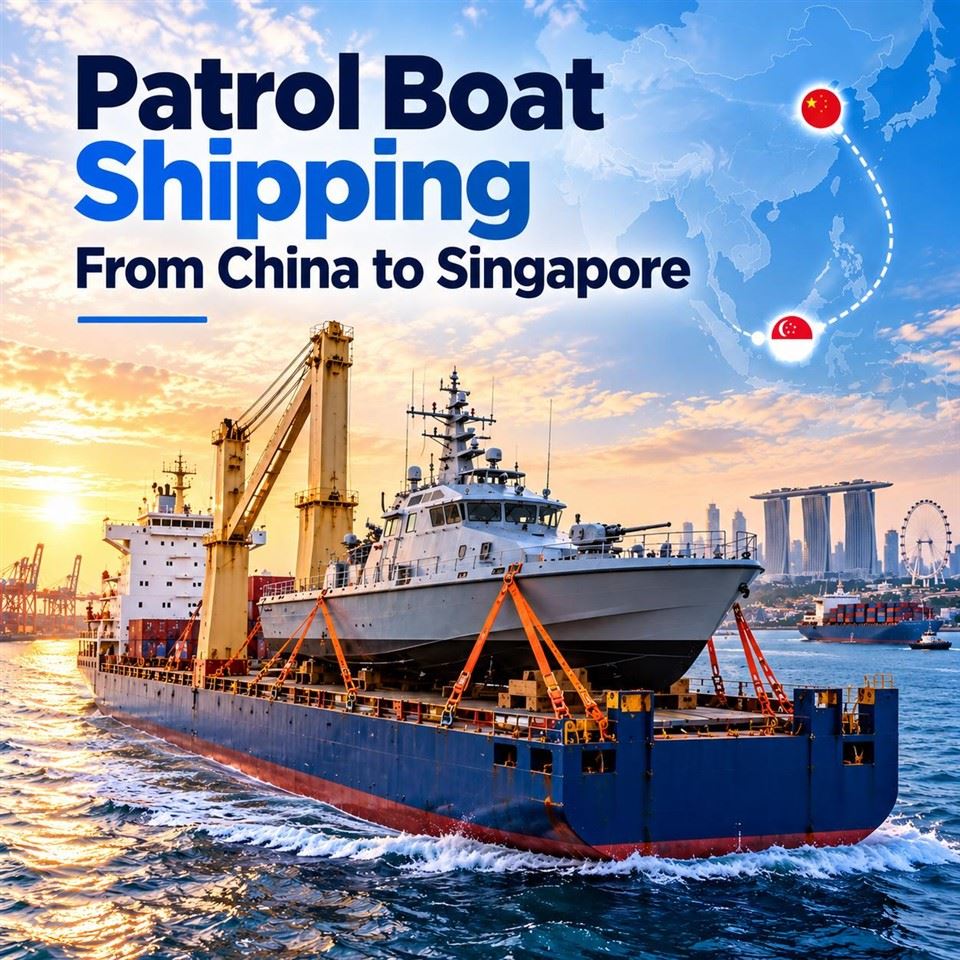
China and Singapore share one of the most active maritime trade corridors in Southeast Asia. As a global freight forwarder headquartered in Zhejiang, Wilson Supply Chain Management Co., Ltd. provides professional yacht and boat shipping services from China to Singapore and from Singapore back to China, covering yachts, speedboats, small boats, patrol boats, and other high-value vessels.
Whether you are a yacht dealer importing pleasure craft into Singapore, a government agency procuring patrol boats from Chinese shipyards, or a vessel owner relocating a boat between the two countries, we design tailored shipping solutions around the exact dimensions, weight, and structural characteristics of your vessel.
Our core shipping methods for yacht and boat transport include Flat Rack container shipping, Open Top container shipping, Breakbulk (RoRo or lift-on/lift-off) shipping, and standard Container Shipping for smaller, dismantlable boats.
Estimated ocean freight from major Chinese ports to the Port of Singapore starts from approximately USD 2,800 for a Flat Rack shipment of a mid-size vessel, with direct sailing transit times of roughly 5 to 10 days. All rates and transit times quoted on this page are for reference only; actual costs depend on vessel specifications, port conditions, and market schedules at the time of booking.
Contact Wilson today for a free, vessel-specific shipping quote. Send us your boat's dimensions, photos, and pickup location, and our team will respond with a detailed transport plan within 24 hours.

Cost of Shipping a Yacht or Boat From China to Singapore
The cost of shipping a yacht, speedboat, or patrol boat from China to Singapore depends primarily on the vessel's overall dimensions (length, width, and height), displacement weight, the chosen shipping method, lifting and cradling requirements, the departure port in China, and the destination port in Singapore.
Because yachts and patrol boats are oversized, high-value goods, they cannot simply be loaded into a standard container like ordinary cargo. Each vessel requires a dedicated transport method selected based on its size profile and structural constraints.
The table below provides estimated shipping costs for different transport methods from major Chinese ports, including Shanghai, Ningbo, Shenzhen, and Guangzhou, to the Port of Singapore. These figures are indicative reference ranges only and do not constitute a firm quotation.
Estimated Shipping Cost by Transport Method – China to Singapore
| Transport Method | Suitable Vessel Size | Estimated Cost Range (USD) | Key Characteristics |
|---|---|---|---|
| Flat Rack (40FR) | Length up to ~12 m, width up to ~2.4 m, height up to ~2.6 m | 2,800–5,500 | Most common for mid-size yachts and patrol boats; vessel secured on a flat rack with custom cradle and lashing |
| Open Top (40OT) | Length up to ~12 m, width up to ~2.3 m, height up to ~2.7 m | 3,000–5,800 | Suitable for vessels with tall superstructures; top-open loading via crane or gantry |
| Breakbulk (LoLo / RoRo) | Length over 12 m, oversized or heavyweight vessels | 5,500–12,000+ | For large yachts, patrol boats, and commercial vessels that exceed container dimensions; loaded by heavy-lift crane or rolled on/off |
| Standard Container (40HQ) | Small boats up to ~6 m, dismantlable or inflatable | 1,200–2,500 | Only for small boats that fit within container internal dimensions or can be partially disassembled |
Key Factors That Influence the Final Shipping Cost
Vessel dimensions – length, width, and height. The overall length (LOA), beam (width), and height of the vessel determine which transport method is feasible. A vessel exceeding approximately 12 meters in length or 2.4 meters in width typically cannot fit on a standard 40-foot Flat Rack and must be shipped via Breakbulk.
Height is equally critical. A flybridge yacht or a patrol boat with a tall radar mast may require an Open Top container or Breakbulk even if the length and width are within Flat Rack limits.
Weight and displacement. Heavy displacement vessels require reinforced cradles, heavier-duty flat racks, and cranes with sufficient lifting capacity. Overweight cargo may incur surcharges from the carrier and require special heavy-lift equipment at both the origin and destination ports.
Shipping method. Flat Rack and Open Top are generally the most cost-effective options for mid-size vessels. Breakbulk is more expensive but necessary for oversized vessels. Standard container shipping is the cheapest option but only applies to small boats that fit within the container's internal dimensions, approximately 12.03 m in length, 2.35 m in width, and 2.39 m in height for a 40HQ.
Lifting and cradling requirements. Every yacht and boat shipment requires a custom-built support cradle or steel frame that distributes the vessel's weight evenly and protects the hull. Cradle fabrication, crane hire at the origin port, and lifting at the destination port are all cost components that vary with vessel size and port infrastructure.
Departure port and destination port. Shanghai, Ningbo, Shenzhen, and Guangzhou are the most common departure ports for Singapore-bound shipments, each with different port handling fees and carrier availability.
The Port of Singapore is one of the world's busiest transshipment hubs with excellent facilities for handling oversized and project cargo, but port-side lifting and stevedoring charges still apply.
Basic Cost Calculation Method
Yacht and boat shipping costs are typically calculated as:
Total cost = Base ocean freight + Equipment surcharge (Flat Rack / Open Top / Breakbulk) + Origin port charges (THC, lifting, cradle fabrication, lashing) + Destination port charges (THC, lifting, stevedoring) + Customs clearance and documentation fees + Marine insurance
For Breakbulk shipments, freight may be calculated on a per-freight-ton basis, using the greater of actual weight or volumetric measurement, or as a lump-sum slot rate negotiated with the carrier.
All prices listed above are for reference only. Contact Wilson with your vessel's specifications for an accurate, obligation-free quotation.
Get Latest Ocean Freight Rates Now
Transit Time for Shipping a Yacht or Boat From China to Singapore
Transit time from China to Singapore is relatively short compared with long-haul routes, thanks to the proximity of the two markets and the frequency of direct sailings.
The table below provides estimated transit times from major Chinese departure ports to the Port of Singapore.
Estimated Transit Time by Departure Port – China to Singapore
| Departure Port | Destination Port | Direct Sailing | With Transshipment |
|---|---|---|---|
| Shanghai | Port of Singapore | 7–10 days | 12–18 days |
| Ningbo | Port of Singapore | 7–10 days | 12–18 days |
| Shenzhen (Yantian / Shekou) | Port of Singapore | 5–8 days | 10–15 days |
| Guangzhou (Nansha) | Port of Singapore | 5–8 days | 10–15 days |
| Tianjin (Xingang) | Port of Singapore | 10–14 days | 15–22 days |
| Qingdao | Port of Singapore | 9–13 days | 14–20 days |
Factors That Affect Transit Time
Sailing schedule and carrier routing. Major carriers including COSCO, Maersk, MSC, Hapag-Lloyd, and Evergreen operate regular services between China and Singapore.
Direct sailings from South China ports such as Shenzhen and Guangzhou are the fastest, typically taking 5 to 8 days. East China ports such as Shanghai and Ningbo generally offer 7 to 10 days on direct services. North China ports such as Tianjin and Qingdao require longer transit due to the greater distance.
Transshipment. If no direct sailing is available on the desired date, the shipment may be routed through a transshipment hub such as Hong Kong, Kaohsiung, or Port Klang, adding approximately 3 to 7 days to the total transit time.
Port operations and lifting. Yacht and boat shipments require specialized handling, including crane lifting, cradle positioning, and lashing, at both the origin and destination ports. This handling is typically scheduled outside standard container loading windows and may add 1 to 3 days at each port.
Customs clearance. Export customs declaration in China and import clearance at Singapore Customs are required for all vessel shipments. With complete and accurate documentation, clearance typically takes 1 to 2 business days at each end. Missing or incorrect documents can cause significant delays.
Seasonal congestion. During peak shipping seasons, typically September through January and around Chinese New Year, port congestion and carrier space shortages may extend transit times. Booking early and maintaining schedule flexibility helps mitigate these delays.
All transit times listed above are for reference only. For real-time sailing schedules and a vessel-specific transport plan, contact Wilson today.
Yacht and Boat Shipping Services From China to Singapore
Wilson provides end-to-end yacht and boat logistics services covering every stage from domestic pickup in China to destination port handover in Singapore. Our service scope is built around the specific requirements of high-value, oversized vessel transport.
Vessel Types We Handle
We transport yachts, speedboats, small boats, patrol boats, rigid inflatable boats (RIBs), and other high-value vessels.
Whether the vessel is a fiberglass pleasure yacht, an aluminum-hulled patrol boat, or a commercial workboat, we assess the hull material, structural weak points, and transport risks before recommending a shipping method.
Shipping Methods
We offer Flat Rack container shipping for mid-size vessels, Open Top container shipping for vessels with tall superstructures, Breakbulk shipping through lift-on/lift-off or roll-on/roll-off methods for oversized and heavyweight vessels, and standard Container Shipping for small boats that fit within container dimensions or can be partially disassembled.
Each method is selected based on a feasibility assessment of the vessel's dimensions, weight, and structural integrity.
Domestic Pickup and Warehousing
We arrange inland transport from the shipyard, marina, or dealer's facility to the departure port using lowboy trailers, flatbed trucks, or specialized boat transporters equipped with hull support frames.
Temporary warehousing and open-yard storage are available at major ports if the vessel needs to wait for a sailing window.
Loading, Lifting, and Hull Protection
Every shipment includes professional crane lifting at the origin port, custom cradle or steel frame fabrication tailored to the vessel's hull shape, and comprehensive hull protection measures.
We use padded cradle supports, foam padding at all contact points, and protective wrapping to prevent gelcoat scratches, hull deformation, and impact damage during loading and transport.
Professional Support, Lashing, and Securing
Vessels are secured to the Flat Rack, Open Top, or Breakbulk stowage position using heavy-duty chains, wire ropes, tension belts, and welded steel braces.
Our lashing plans are designed to prevent longitudinal and lateral movement, resist wave-induced forces during ocean transit, and accommodate the vessel's center of gravity.
Anti-Scratch, Anti-Collision, and Anti-Shifting Measures
In addition to cradle padding, we install fendering between the vessel and adjacent cargo or container walls, secure loose components such as radars, antennas, canvas tops, and outboard motors separately, and use anti-vibration padding under the hull to absorb transit shocks.
Export Customs Declaration and Documentation
We handle the full export customs declaration process in China, including HS code classification under heading 8903 for yachts and other vessels for pleasure or sports.
Documentation may include commercial invoices, packing lists, bills of lading, certificates of origin, and vessel-specific certificates such as builder's certificates, hull identification numbers, and ownership documents.
International Transport Tracking
We provide real-time tracking of vessel shipments from port departure to arrival, including sailing status updates, transshipment notifications, and estimated time of arrival at the Port of Singapore.
Destination Port Coordination
Upon arrival in Singapore, we coordinate with local agents to arrange import clearance, crane lifting off the Flat Rack or Breakbulk stowage, and delivery to the client's designated marina, shipyard, or storage facility.
Customized Logistics Solutions
No two vessels are identical. We design a personalized transport plan for each shipment based on the vessel's brand, model, exact dimensions, weight, hull material, engine configuration, and the client's timeline and budget.
Our project managers oversee the entire process from initial inquiry to final delivery, ensuring that every detail is handled with the same level of care and professionalism.
Yacht and Boat Shipping Process From China to Singapore
Our shipping process is designed to be transparent, structured, and responsive at every stage. Below is the complete workflow from initial inquiry to destination delivery.
Step 1: Inquiry and Requirement Submission
The client submits a transport request with basic vessel information, including brand, model, intended shipping direction, preferred timeline, and pickup and delivery locations.
Step 2: Vessel Information Confirmation
We confirm the vessel's detailed specifications with the client, including exact dimensions, length overall, beam, height from keel to highest point, displacement weight, hull material such as fiberglass, aluminum, steel, or wood, engine type and configuration, and current location.
Photographs of the vessel from multiple angles are requested to assess transport feasibility.
Step 3: Transport Feasibility Assessment
Our logistics engineers evaluate the vessel's dimensions against available shipping methods, port infrastructure constraints, crane capacity at the origin and destination ports, and any route-specific limitations, including bridge clearances and road transport permits for oversized loads.
A feasibility report is prepared identifying the recommended shipping method and any special requirements.
Step 4: Transport Plan Design
Based on the feasibility assessment, we design a detailed transport plan including the shipping method, departure port, carrier selection, cradle or frame specification, lashing plan, lifting arrangement, and timeline.
The plan is shared with the client for review and approval.
Step 5: Quotation and Booking
We provide a detailed quotation covering all cost components. Upon the client's confirmation, we book the vessel space with the carrier, reserve the Flat Rack or Open Top equipment, and schedule the sailing.
Step 6: Domestic Pickup
We arrange inland transport from the vessel's current location to the departure port, using appropriate trailers and escort vehicles if required for oversized loads.
Step 7: Loading Preparation
At the port, the custom cradle or steel frame is positioned, hull protection materials are installed, and the vessel is prepared for lifting. All loose components are removed or secured.
Step 8: Lifting and Securing
The vessel is lifted by crane onto the Flat Rack, Open Top, or Breakbulk stowage position.
The cradle is welded or bolted to the rack, and the vessel is lashed with chains, wire ropes, and tension belts according to the approved lashing plan.
Step 9: Export Customs Declaration
We submit the export customs declaration through China's International Trade Single Window system, including HS code classification, commercial documents, and vessel certificates.
Customs review and release typically takes 1 to 2 business days.
Step 10: International Ocean Transport
The vessel sails from the Chinese departure port to the Port of Singapore. We provide tracking updates throughout the voyage.
Step 11: Destination Port Handover
Upon arrival in Singapore, we coordinate import clearance with local agents, arrange crane lifting off the transport equipment, and deliver the vessel to the client's designated location.
Documents and Information the Client Needs to Provide
| Category | Required Information |
|---|---|
| Vessel identification | Brand, model, hull identification number (HIN) or IMO number, year of build |
| Dimensions and weight | Length overall (LOA), beam, height from keel to highest point, displacement weight, draft |
| Vessel specifications | Hull material (fiberglass / aluminum / steel / wood), engine brand and model, fuel type, number of engines |
| Visual documentation | Photographs from bow, stern, port, starboard, and overhead; photos of the hull bottom and superstructure |
| Commercial information | Declared cargo value, purchase price or invoice, intended use (pleasure / commercial / patrol) |
| Location and logistics | Pickup address or port, delivery address or marina in Singapore, preferred shipping date |
| Ownership and trade documents | Vessel ownership certificate, builder's certificate, bill of sale, original registration or deregistration certificate for used vessels, export/import license if applicable |
Why Choose Wilson for Your Yacht and Boat Shipping
Choosing the right freight forwarder for yacht and boat transport is critical. These are high-value, irreplaceable assets that require specialized handling at every stage.
Wilson brings the following core advantages to every vessel shipment.
International Freight Forwarding Experience
Wilson is an established international freight forwarder with a comprehensive global transportation network covering sea freight, air freight, rail, road, and multimodal transport.
Our core business spans FCL, LCL, special containers, reefer cargo, Breakbulk, and project cargo, giving us the operational depth to handle complex vessel shipments alongside mainstream logistics services.
Specialized Yacht and High-Value Vessel Transport Capability
Yacht, speedboat, small boat, and patrol boat transport is a dedicated service line within our specialized logistics division.
We have hands-on experience with vessel shipments to Southeast Asian destinations, including actual project operations transporting boats to neighboring markets such as Malaysia. This regional experience translates directly into smoother execution for Singapore-bound shipments.
Complex Cargo Transport Plan Design
Our project managers are experienced in designing transport solutions for oversized, overweight, and irregularly shaped cargo, from 53-ton heavy equipment to crawler-mounted geological drilling rigs.
The same engineering approach applies to vessel transport. We assess dimensions, center of gravity, structural weak points, and port constraints before recommending a shipping method, rather than defaulting to a one-size-fits-all container solution.
Professional Lifting and Loading Planning
We produce detailed loading and lashing plans for every vessel shipment, specifying crane capacity requirements, cradle dimensions, lashing points, and weight distribution.
For complex projects, we create loading diagrams and stowage drawings to maximize loading efficiency and transport safety, a capability developed through years of handling heavy equipment and special container projects.
Hull Protection and Securing Expertise
Vessel transport risks include gelcoat scratching, hull deformation, superstructure damage, and shifting during transit.
We address each risk with specific measures: padded cradle supports, foam padding at contact points, protective wrapping, fendering between the vessel and adjacent structures, separate securing of loose components, and anti-vibration padding under the hull.
Every lashing plan is designed to resist longitudinal, lateral, and vertical forces encountered during ocean transport.
Global Carrier Partnerships
We maintain working relationships with major shipping lines including COSCO, Maersk, MSC, Hapag-Lloyd, and Evergreen, giving us access to regular sailing schedules, competitive rates, and reliable vessel space between China and Singapore.
Our carrier partnerships also extend to special equipment availability, including Flat Racks, Open Tops, and Breakbulk slots, which can be scarce during peak seasons.
Professional Logistics Team
Our team includes dedicated project managers who focus on large equipment, vehicles, and vessel shipments, monitoring loading plans, delivery milestones, and on-site risks throughout each project.
Clients work with a single point of contact from inquiry through delivery, ensuring continuity and accountability.
Digital Transport Tracking
We provide real-time shipment tracking from port departure to arrival, including sailing status, transshipment notifications, and ETA updates.
Clients are kept informed at every stage without needing to chase multiple parties.
One-Stop Supply Chain Service
Beyond port-to-port ocean freight, we offer a full suite of supply chain services including domestic pickup, warehousing, export customs declaration, marine insurance, destination port clearance, and last-mile delivery to marinas or shipyards.
This end-to-end capability means clients do not need to coordinate multiple vendors. Wilson manages the entire chain.
For a precise quote tailored to your specific cargo, origin, and delivery terms, reach out to our team for a detailed breakdown.
Get Latest Ocean Freight Rates Now
China–Singapore Yacht and Boat Trade Overview
China and Singapore have developed an increasingly active trade relationship in yachts, pleasure craft, speedboats, and commercial vessels in recent years.
Singapore, as one of the world's leading maritime hubs, ranked first globally in the Xinhua-Baltic International Shipping Centre Development Index for 13 consecutive years, serves as both a destination market for Chinese-built vessels and a regional transshipment point for yacht and boat trade across Southeast Asia.
China's Exports to Singapore
China is a significant exporter of pleasure craft, speedboats, and small vessels under HS heading 8903, which covers yachts and other vessels for pleasure or sports.
Chinese shipyards, particularly in Guangdong, Fujian, Shandong, and Hainan, produce a wide range of vessels from small rigid inflatable boats and personal watercraft to mid-size motor yachts and patrol boats.
According to China Customs trade data, China's total exports of motor boats and yachts under HS 89033200, covering motor boats with a length exceeding 7.5 m but not exceeding 24 m, reached approximately USD 101.3 million in 2024, with exports under HS 89033300, covering motor boats exceeding 24 m in length, growing approximately 83% year-on-year to about USD 3.9 million in 2025.
While Singapore is not the single largest destination for Chinese pleasure craft exports, with Australia, the United States, and European markets leading in volume, Singapore serves as a key gateway for Chinese vessels entering the Southeast Asian market, both for direct domestic use and for re-export to neighboring countries such as Malaysia, Indonesia, and Thailand.
Chinese vessel types commonly exported to Singapore and the broader Southeast Asian region include fiberglass motor yachts, aluminum patrol boats and workboats, rigid inflatable boats (RIBs), personal watercraft, fishing boats, and commercial passenger vessels.
Patrol boats and government-use vessels represent a specialized segment, often built to specific operational requirements including aluminum hulls, reinforced structures, and customized engine and navigation configurations.
Singapore's Exports to China
Singapore's domestic yacht and boat manufacturing sector is relatively small compared with China's, but Singapore serves as an important trading and transshipment hub for European and American-built yachts entering Asian markets, including China.
High-end European yacht brands, particularly from Italy, France, and the Netherlands, frequently transit through Singapore on their way to Chinese buyers.
Singapore's maritime services ecosystem, including yacht brokerage, marine financing, vessel registration through the Singapore Registry of Ships (SRS), and maritime legal services, supports a robust trade flow of both new and pre-owned vessels.
For imports from Singapore into China, the primary vessel categories include pre-owned luxury yachts from European brands brokered through Singapore dealers, commercial vessels and workboats, and marine equipment and components.
China's growing high-net-worth population and expanding marina infrastructure in cities such as Sanya, Shenzhen, Xiamen, and Qingdao continue to drive demand for imported yachts, while government and commercial procurement of patrol boats and specialized vessels supports outbound trade in the opposite direction.
Trade Policy Context
The China–Singapore Free Trade Agreement (CSFTA) and the Regional Comprehensive Economic Partnership (RCEP) provide preferential tariff treatment for goods traded between the two countries.
Under these agreements, vessels classified under HS 8903 may qualify for reduced or zero import duties when accompanied by a valid certificate of origin.
China Customs and Singapore Customs have implemented an electronic certificate of origin data exchange system, streamlining the preferential tariff claim process.
Importers should confirm the applicable tariff rate and origin documentation requirements with their customs broker or freight forwarder before shipment.
Regulations and Policies for Yacht and Boat Import and Export Between China and Singapore
Yacht and boat shipments between China and Singapore involve customs procedures, maritime registration, and regulatory compliance in both countries.
The requirements differ depending on the direction of trade, whether exporting from China or importing into Singapore, the vessel's intended use, whether pleasure, commercial, or patrol, and the vessel type.
The following summary is based on publicly available information from Singapore Customs, the Maritime and Port Authority of Singapore (MPA), China Customs, and relevant Chinese maritime authorities.
Clients should always verify current requirements with the relevant authorities or a licensed customs broker before shipping.
Singapore Import Requirements
Customs classification and import declaration. Yachts and pleasure craft imported into Singapore are classified under HS heading 8903.
Importers must obtain a Unique Entity Number (UEN) by registering with the Accounting and Corporate Regulatory Authority (ACRA) or the relevant UEN issuance agency, activate a Customs Account, and submit import declarations through Singapore's TradeNet electronic system.
An import permit is required for all vessel imports.
Import duty and GST. Singapore imposes import duties on only four categories of dutiable goods: intoxicating liquors, tobacco products, motor vehicles, and petroleum products.
Yachts and pleasure craft are not classified as dutiable goods under Singapore's customs tariff schedule, meaning import customs duty on yachts and boats is generally zero percent.
However, all imported goods are subject to Goods and Services Tax (GST). Singapore's GST rate was raised from 8% to 9% effective January 1, 2024, and remains at 9%.
GST is calculated on the CIF value, including cost, insurance, and freight, of the imported vessel plus any customs duty payable.
Low-value imports below SGD 400 may qualify for GST relief, but this threshold is negligible for yacht and boat shipments.
Vessel registration with MPA. Vessels intended for use in Singapore waters must be registered or licensed with the Maritime and Port Authority of Singapore.
The Singapore Registry of Ships handles registration of commercial vessels, while pleasure craft used exclusively for sport or pleasure purposes by the owner or the owner's guests may be registered as pleasure craft with MPA.
Registration requirements include proof of ownership, such as a builder's certificate, bill of sale, or hull receipt/invoice; proof of GST payment, such as a cargo clearance permit or import permit; proof of vessel origin; and a valid insurance policy for all mechanically propelled pleasure craft equipped with outboard or auxiliary engines.
SRS-registered vessels must meet international convention requirements including SOLAS, MARPOL, Load Line, and Tonnage Measurement conventions.
Pleasure Craft Licence. In addition to vessel registration, mechanically propelled pleasure craft operating in Singapore port waters require a Pleasure Craft Licence issued by MPA.
The licence application requires submission of ownership documents, proof of GST payment, insurance policy, and vessel specifications. A Powered Pleasure Craft Driving Licence (PPCDL) is required for the operator of the vessel.
Technical and safety standards. Vessels registered in Singapore must comply with MPA's safety and construction standards, which align with international maritime conventions.
Patrol boats and commercial vessels may be subject to additional survey and certification requirements depending on their intended operational profile.
Engine and environmental requirements. Singapore actively promotes green shipping through the Maritime Singapore Green Initiative.
Vessels with engines that meet lower emission standards may qualify for incentives under the Green Ship Programme.
Singapore has also set a target of full decarbonization for port craft, yachts, and tugs by 2050, with all new harbour craft required to be fully electric or use 100% biofuel (B100) and other green fuels from 2030 onward.
Importers of vessels with conventional diesel engines should be aware of the long-term regulatory trajectory toward electrification and alternative fuels.
Temporary import vs. permanent import. Vessels brought into Singapore temporarily, for example for a regatta, exhibition, or short-term private use, may qualify for temporary import relief from GST, subject to MPA and Singapore Customs procedures.
A customs bond or guarantee may be required.
Permanent imports are subject to full GST payment and registration requirements as described above.
China Export Requirements
Customs classification and export declaration. Yachts and boats exported from China are classified under HS heading 8903, with subheadings determined by vessel type, hull material, and length.
Common subheadings include:
- HS 89033100: Motor boats not exceeding 7.5 m in length
- HS 89033200: Motor boats exceeding 7.5 m but not exceeding 24 m
- HS 89033300: Motor boats exceeding 24 m
- HS 89039900: Other pleasure or sports vessels
Export declarations are submitted through China's International Trade Single Window system.
Export license requirements. Most pleasure craft and commercial yachts do not require a specific export license and follow general trade export procedures.
However, patrol boats, military-use vessels, and vessels with specialized technical capabilities may be subject to export control regulations under China's Export Control Law and the Dual-Use Items and Technologies Import and Export License Management Catalogue.
Exporters of such vessels must verify whether an export license from the Ministry of Commerce is required before shipment.
Vessels with advanced navigation, communication, or propulsion technologies may trigger dual-use export control review.
Vessel ownership and registration documents. Exporting a vessel from China requires proof of ownership, including the vessel's ownership certificate, builder's certificate or factory certificate of origin, and bill of sale.
For used vessels being exported, a deregistration certificate from the original registration authority, the China Maritime Safety Administration, may be required to confirm that the vessel has been properly removed from the Chinese domestic registry.
Maritime safety administration procedures. Vessels being exported as cargo on a Flat Rack, Open Top, or Breakbulk shipment are treated as goods for customs purposes and follow standard cargo export procedures.
Vessels being sailed or delivered under their own power to the destination country must comply with international voyage departure procedures, including obtaining port departure clearance from the local Maritime Safety Administration.
China Import Requirements for Singapore-to-China Shipments
Import duty and VAT. For yachts and pleasure craft imported into China from Singapore, import customs duties and import-stage value-added tax (VAT) apply.
The applicable tariff rate depends on the HS subheading and the vessel's country of origin.
Under the China–Singapore Free Trade Agreement and RCEP, vessels originating in Singapore or other RCEP member states may qualify for preferential tariff rates when accompanied by a valid certificate of origin.
Import VAT is generally levied at the standard rate. Consumption tax may also apply to certain luxury vessel categories.
Importers should confirm the current applicable rates with China Customs or a licensed customs broker.
Import license. Used yachts and certain vessel categories imported into China may require an import license for mechanical and electronic products, issued through the Single Window system by the Ministry of Commerce.
The specific license requirement depends on the vessel type, age, and intended use.
New yachts imported for personal or commercial use may follow general trade import procedures without a separate import license, subject to customs classification.
Vessel age and survey requirements. China imposes vessel age restrictions on certain categories of imported used vessels.
Used yachts imported into China generally require a survey and inspection by a recognized classification society, such as the China Classification Society (CCS), to verify the vessel's condition and compliance with Chinese maritime safety standards.
The survey report is submitted as part of the import customs declaration.
Vessel registration in China. After customs clearance, vessels imported into China must be registered with the China Maritime Safety Administration to obtain Chinese nationality and be eligible to fly the Chinese flag.
Registration requires the vessel's ownership certificate, customs release documents, survey certificate, and other supporting documents.
Under China's Yacht Safety Management Regulations, yachts navigating in Chinese waters must hold a valid nationality certificate.
FAQ
Q: 1. How Much Does It Cost to Ship a Yacht From China to Singapore?
A: The cost depends on the vessel's dimensions, weight, and chosen shipping method. For a mid-size yacht, approximately 8 to 12 meters in length, shipped on a 40-foot Flat Rack, the estimated cost ranges from USD 2,800 to USD 5,500, including ocean freight, port charges, cradle fabrication, and lashing. Larger vessels exceeding 12 meters typically require Breakbulk shipping, with costs starting from approximately USD 5,500. Small boats that fit inside a standard 40HQ container can be shipped from approximately USD 1,200. All prices are for reference only. Contact Wilson with your vessel's specifications for an accurate quotation.
Q: 2. How Long Does It Take to Ship a Boat From China to Singapore?
A: Direct sailings from South China ports such as Shenzhen and Guangzhou to Singapore typically take 5 to 8 days. From East China ports such as Shanghai and Ningbo, direct transit is approximately 7 to 10 days. North China ports such as Tianjin and Qingdao require approximately 9 to 14 days on direct services. Including port handling, lifting, customs clearance, and delivery, the total door-to-door timeline is typically 12 to 20 days. Transshipment routes add approximately 3 to 7 days. All transit times are for reference only.
Q: 3. What Is the Difference Between Flat Rack and Breakbulk Shipping for Yachts?
A: Flat Rack shipping uses a 40-foot flatbed container frame (40FR) on which the vessel is secured with a custom cradle. It is suitable for vessels up to approximately 12 meters in length and 2.4 meters in width that fit within the Flat Rack's dimensions. Breakbulk shipping involves loading the vessel directly onto the cargo hold or deck of a multipurpose or heavy-lift vessel, either by crane through lift-on/lift-off operations or by rolling through roll-on/roll-off operations. Breakbulk is used for vessels that exceed Flat Rack dimensions, typically over 12 meters in length, over 2.4 meters in width, or with heights that exceed container limits. Breakbulk is more expensive but offers greater flexibility for oversized vessels.
Q: 4. How Are Oversized Yachts That Exceed Container Dimensions Transported?
A: Oversized yachts that cannot fit on a Flat Rack or in an Open Top container are shipped via Breakbulk. The vessel is lifted by a heavy-lift crane at the origin port and secured directly on the deck or in the hold of a multipurpose cargo vessel. For extremely large yachts over 20 meters, a dedicated slot may be booked on a heavy-lift or semi-submersible vessel. The lashing and securing plan for Breakbulk shipments is more complex than for containerized transport and requires specialized engineering to ensure the vessel remains stable throughout the voyage.
Q: 5. How Is the Yacht Protected During Lifting and Transport?
A: Every vessel shipment includes a custom-built cradle or steel frame shaped to match the hull's contours, with padded contact points to distribute weight and prevent localized stress. The hull is wrapped in protective material to prevent gelcoat scratches and surface damage. Loose components, including radars, antennas, canvas tops, and outboard motors, are removed and shipped separately or securely fastened. Fendering is installed between the vessel and adjacent cargo or structures. Anti-vibration padding is placed under the hull to absorb transit shocks. The vessel is lashed with heavy-duty chains, wire ropes, and tension belts designed to prevent movement in all directions.
Q: 6. What Documents Do I Need to Provide for Yacht Shipping?
A: You will need to provide:
- Vessel brand, model, and hull identification number (HIN) or IMO number
- Exact dimensions, including length, beam, and height
- Vessel weight
- Hull material and engine specifications
- Photographs from multiple angles
- Declared cargo value and purchase invoice
- Pickup address and delivery location
- Ownership documents, including builder's certificate, bill of sale, and original registration or deregistration certificate for used vessels
- Any applicable export or import licenses
For Singapore imports, proof of GST payment and an insurance policy are required for MPA pleasure craft registration.
Q: 7. Is Marine Insurance Available for Yacht Shipping?
A: Yes. We strongly recommend marine cargo insurance, often referred to as hull and machinery or all-risk cargo insurance, for all yacht and boat shipments. Insurance coverage typically protects against physical loss or damage during loading, ocean transit, unloading, and inland transport. The premium is usually calculated as a percentage of the declared vessel value. Wilson can arrange marine insurance through our partner underwriters or work with the client's designated insurer. For high-value yachts and patrol boats, all-risk coverage is strongly advised.
Q: 8. What Are the Import Duty and GST Rates for Yachts Imported Into Singapore?
A: Singapore does not impose import customs duty on yachts and pleasure craft. They are not among the four categories of dutiable goods: intoxicating liquors, tobacco products, motor vehicles, and petroleum products. However, all imported goods are subject to Goods and Services Tax at the current rate of 9%, effective from January 1, 2024. GST is calculated on the CIF value of the vessel plus any applicable customs duty. Importers should confirm current rates with Singapore Customs or a licensed customs broker before shipment.
Q: 9. Do You Offer Door-to-Door Yacht Shipping Service?
A: Yes. Wilson provides full door-to-door service including domestic pickup from the shipyard or marina in China, inland transport to the departure port, Flat Rack, Open Top, or Breakbulk loading, export customs declaration, ocean freight to Singapore, import customs clearance, crane lifting at the Port of Singapore, and delivery to the client's designated marina, shipyard, or storage facility. A single project manager oversees the entire chain, providing tracking updates and coordinating all parties involved.
Q: 10. Can Patrol Boats and Government-Use Vessels Be Shipped?
A: Yes. We handle patrol boats, government-use vessels, and specialized workboats alongside pleasure craft. Patrol boats, typically aluminum-hulled with reinforced structures and customized engine and navigation configurations, are shipped via Flat Rack or Breakbulk depending on size. Export of patrol boats from China may be subject to export control regulations under China's Export Control Law and the Dual-Use Items catalogue. We advise clients to confirm export license requirements with the relevant authorities before shipment and ensure that all technical specifications are accurately declared on the export customs filing.
All rates, transit times, and policy information on this page are for reference only and are subject to change based on market conditions, carrier schedules, and regulatory updates.
For a vessel-specific quotation and the most current information, contact Wilson Supply Chain Management Co., Ltd. today.
Hot Tags: Patrol Boat Shipping From China To Singapore


