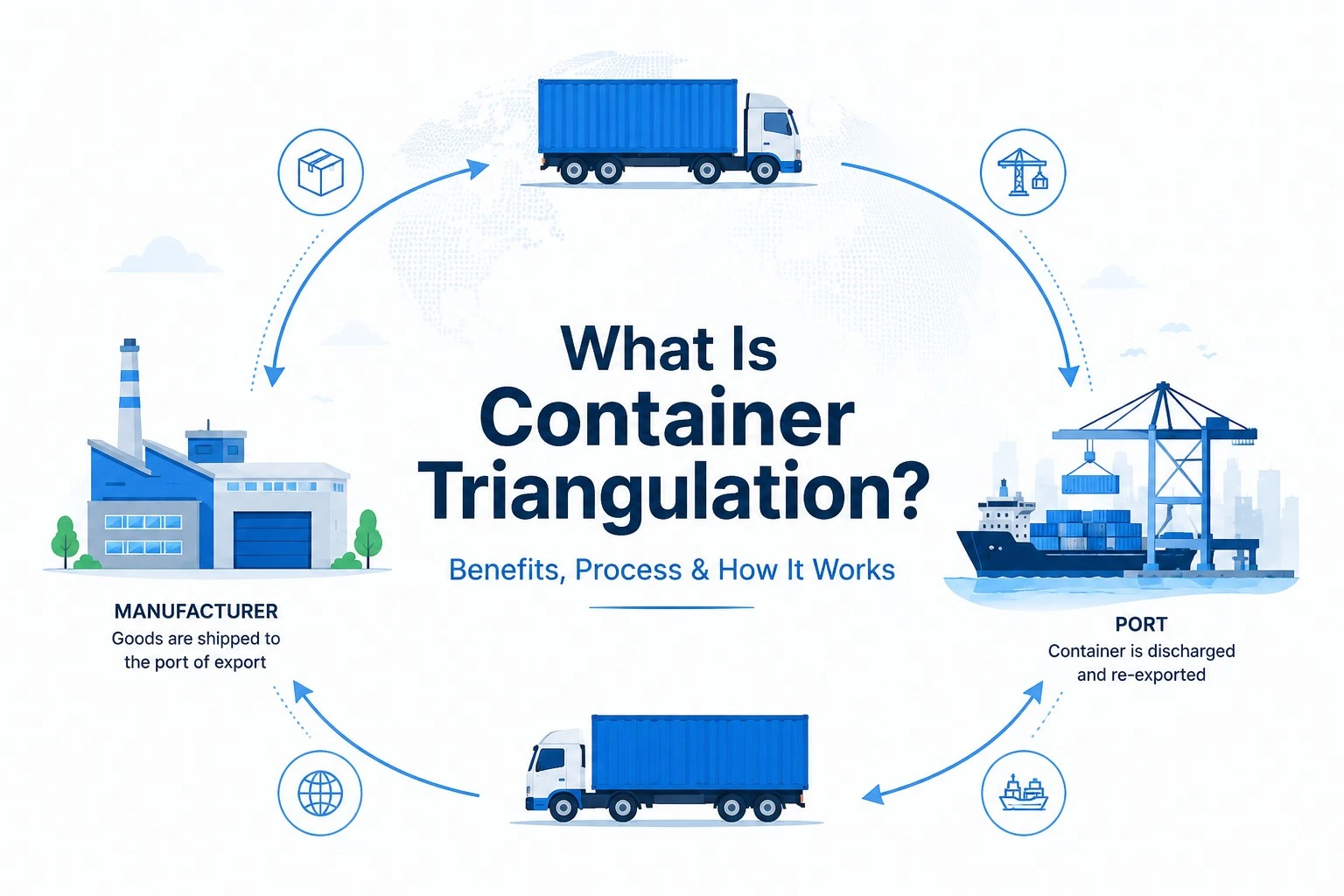
Container triangulation is a logistics strategy where an empty import container is reused for an export shipment after delivery, instead of being returned empty to a port, depot, or container yard.
The basic idea is simple: a container arrives with import cargo, is delivered to the importer, unloaded, then moved directly to a nearby exporter for reloading. After that, it returns to the port as a loaded export container.
The value is not just "one less empty trip." Done correctly, container triangulation can reduce inland transport costs, improve container availability, shorten turnaround time, and support a more sustainable logistics network.
But it is not a casual arrangement between two warehouses.
A triangulation move only works when the container type, cargo requirement, trucking route, carrier approval, time window, documents, and responsibility transfer all line up. That is where many companies underestimate the operation.
What Is Container Triangulation in Shipping?
In shipping, container triangulation means redirecting an empty import container to an exporter for reuse, rather than sending it back empty to the original depot or port.
A standard container movement may look like this:
Port → Importer's warehouse → Empty return to depot → Exporter picks up another empty container → Port
A container triangulation movement removes the unnecessary depot leg:
Port → Importer's warehouse → Exporter's facility → Port
This makes the container act less like a one-way carrier and more like a movable logistics asset. The goal is to reduce the time a container spends empty, idle, or moving without cargo.
For example, a 40HQ container arrives at a European inland warehouse with consumer goods from China. After unloading, the traditional process would send the empty box back to a container yard. If a nearby factory needs a 40HQ for an export shipment, the same box can be moved directly there, loaded, and sent back to the port.
That is container triangulation.
The concept is closely related to container reuse, street turn, empty container repositioning, and drayage optimization. The terms are not always used consistently in the market, but the operating logic is the same: avoid empty movement where a loaded or useful move can be arranged instead.
Why Container Triangulation Matters in Global Logistics
Container shipping has a persistent imbalance problem.
Some regions receive more import cargo than they export. Other regions need empty containers for exports but do not have enough available boxes nearby. This creates two opposite problems at the same time: empty containers sitting in one location and exporters waiting for equipment in another.
That imbalance leads to extra costs.
A container may need to be trucked empty back to a depot. Another truck may then pick up a different empty container for an export shipment. The shipper pays more, the trucker runs more empty miles, the port or depot handles more moves, and the container spends more time out of productive use.
Container triangulation turns that mismatch into an opportunity.
Instead of treating the import leg and export leg as two separate operations, the freight forwarder or logistics team connects them into one planned flow. The import container becomes the exporter's available equipment.
This matters most in regions with active two-way cargo movement: industrial zones near ports, inland distribution hubs, manufacturing clusters, cross-border trade corridors, and areas where import warehouses and export factories sit within a practical trucking distance.
A triangulation move does not reduce the ocean freight rate itself. The savings usually come from inland logistics: fewer empty truck trips, fewer depot visits, less waiting time, and better use of containers and vehicles.
That distinction matters. If a freight quote claims "lower sea freight" from triangulation, ask where the savings really come from.
How Container Triangulation Works: The Basic Route
Container triangulation is easy to understand when the route is compared with the traditional container flow.
| Item | Traditional Container Movement | Container Triangulation Movement |
|---|---|---|
| Route | Port → Importer → Depot → Exporter → Port | Port → Importer → Exporter → Port |
| Empty movement | More empty truck mileage | Less empty truck mileage |
| Depot handling | Usually required | Often reduced or avoided |
| Exporter's container access | Depends on depot availability | Can be faster if the import box is approved |
| Main cost impact | Higher inland handling and trucking cost | Lower inland movement cost when well matched |
| Key requirement | Standard return and pickup process | Carrier approval, timing match, box condition, document control |
Traditional Container Movement
In a traditional import-export cycle, the import container is delivered to the consignee, unloaded, then returned empty to the carrier's nominated depot or container yard.
Later, an exporter books a shipment and requests an empty container. A truck picks up an empty box from a depot, moves it to the exporter's facility, waits for loading, and then returns the loaded container to the port.
This process is simple from a control point of view, but it often creates duplicate movements. The same region may have an empty import box and an exporter waiting for the same box type, yet the box still goes back to the depot first.
That is wasted motion.
Container Triangulation Movement
In a triangulation setup, the empty import container is moved directly from the importer's site to the exporter's facility after unloading.
The container still needs approval from the carrier or equipment owner. The new booking must match the container type. The box must be suitable for the next cargo. The exporter must be ready to load within the allowed time.
When these conditions match, the route becomes much cleaner.
A 40HQ does not go back to the yard just to be picked up again. A truck does not run extra empty miles. The exporter does not wait for a different box if a suitable one is already available nearby.
The physical move is simple. The coordination behind it is not.
Container Triangulation vs. Street Turn
A street turn is a common form of container reuse where an import container, after being unloaded, is assigned directly to an export shipment without returning to the depot.
Container triangulation is a broader logistics concept. It may include street turns, but it can also involve wider planning across several warehouses, different customers, inland trucking routes, multiple bookings, and regional equipment balance.
In practical terms:
| Term | Meaning |
|---|---|
| Street turn | Direct reuse of an import container for export after unloading |
| Container triangulation | A planned container flow that connects import delivery, export loading, and port return to reduce empty movement |
| Empty repositioning | Moving an empty container to another location where it is needed |
| Drayage optimization | Improving short-distance container trucking between port, depot, warehouse, and factory |
If the move is only a one-off box reuse, people may call it a street turn. If it is part of a planned network to match import and export flows, container triangulation is the better term.
Key Principles Behind Container Triangulation
Container triangulation works only when several practical conditions align. The following principles are more useful than a generic "save cost" explanation.
Reuse Over Idle Return
The first principle is simple: do not let a usable container sit idle or travel empty if it can carry another shipment.
A container is an asset. It has a box number, owner, condition, free time, return rule, and location. If the container is clean, approved, and near an exporter that needs the same equipment, sending it back to the depot may be unnecessary.
This is especially relevant for common equipment such as 20GP, 40GP, and 40HQ containers. It can also work for reefers, open tops, and flat racks, but the matching requirements become stricter.
Route Optimization
The exporter must be close enough to make the move worthwhile.
If the importer's warehouse is 20 km from the exporter's factory, the case may be strong. If the exporter is 180 km away in the wrong direction, the triangulation move may cost more than the standard depot return.
A good forwarder does not only ask, "Can we reuse the box?"
The better question is: "Does this route still save money after trucking cost, waiting time, carrier rules, free time, loading schedule, and risk are counted?"
Supply and Demand Matching
The core of container triangulation is matching empty container supply with export container demand.
A successful match usually needs the following:
- The same container type is required.
- The exporter is within a practical trucking radius.
- The loading time fits the import unloading time.
- The carrier allows the reuse.
- The container condition fits the next cargo.
- The export booking and port cut-off can still be met.
Miss one condition, and the whole plan may fail.
For example, a food exporter cannot simply accept a container that previously carried chemical cargo if odor, residue, or contamination risk exists. A machinery exporter using a flat rack cannot use a standard 40GP. A reefer exporter needs temperature-controlled equipment and power checks, not just an empty box.
Process Compliance and Standardization
Container triangulation must follow carrier, depot, customs, and documentation rules.
The carrier or equipment owner needs to approve the reuse. The system must show the container is released for the export booking. The responsibility for damage, cleaning, detention, and late return must be clear. The container number must match the booking, customs declaration, VGM, EIR, and terminal entry information.
This is where informal arrangements become risky.
If the paperwork does not match the physical movement, the box may be rejected at the terminal, delayed at customs, or charged extra fees.
Step-by-Step Container Triangulation Process
The process varies by country, carrier, and depot rule, but most container triangulation operations follow the same practical sequence.
Step 1: Identify the Import Container and Delivery Details
The logistics team first needs the basic container data:
- Container number
- Container type, such as 20GP, 40GP, 40HQ, reefer, open top, or flat rack
- Carrier or equipment owner
- Import delivery address
- Estimated unloading time
- Free time and detention terms
- Original empty return depot
- Cargo history, if relevant
- Current seal and EIR status
This information tells the forwarder whether the box is even a candidate for reuse.
A 40HQ carrying furniture may be easy to reuse for general cargo if the box is clean. A container used for liquid chemicals may need closer inspection before it is assigned to sensitive goods.
Step 2: Match a Suitable Export Shipment
Next, the forwarder checks nearby export demand.
The export shipment must fit the container physically and operationally. Cargo weight, volume, packaging, loading method, and destination schedule all matter.
For example:
| Export Cargo | Typical Container Need | Triangulation Concern |
|---|---|---|
| Textiles and garments | 40HQ | Clean, dry, odor-free container |
| Machinery | 20GP / 40GP / flat rack | Floor strength, lashing points, loading equipment |
| Chemicals | 20GP / ISO tank / special container | Residue, compatibility, DG rules |
| Food products | 40GP / reefer | Hygiene, odor, temperature control |
| E-commerce goods | 40HQ | Fast loading window, carton condition, moisture control |
| Oversized cargo | open top / flat rack | Carrier approval, route permits, special handling |
A match on location alone is not enough. The cargo must fit the box and the schedule.
Step 3: Submit the Reuse or Triangulation Request
In most real operations, the importer or forwarder cannot freely hand the empty container to another shipper.
The carrier, shipping line, equipment owner, or platform must approve the reuse. Some carriers support this through online systems. Others require email approval, equipment release confirmation, or local depot coordination.
The request may include:
- Container number
- Import booking or B/L reference
- Export booking reference
- Current location
- Proposed exporter loading point
- Planned loading date
- Final port return location
- Party responsible for charges
- Confirmation of container condition
Without approval, the move can create trouble even if the truck route makes sense.
Step 4: Confirm Carrier Approval and Responsibility Transfer
Once the carrier approves the move, the responsibility chain needs to be clear.
This is a point many shippers overlook.
Who is responsible if the container is damaged between the importer and exporter? Who pays if the box is dirty? Who pays detention if the exporter misses the loading window? What happens if the terminal rejects the container due to wrong booking data?
These questions should be settled before the truck moves.
In many triangulation moves, responsibility shifts from the consignee or importer to the exporter or shipper after approval and handover. The exact point depends on carrier rules, local practice, and the contract between parties.
A clean handover record matters. Photos, EIR, digital interchange records, and written approval can prevent disputes later.
Step 5: Inspect Container Condition
Container condition is not a formality. It decides whether the box can safely carry the next shipment.
The inspection should check:
- Interior cleanliness
- Odor
- Moisture
- Holes or water leakage
- Floor condition
- Door gasket and locking condition
- Visible contamination
- Structural damage
- Suitability for the next cargo
For general cargo, this may be a quick check. For food, pharma, chemicals, electronics, or high-value goods, it needs more care.
A dirty container may save one truck move but damage a shipment worth hundreds of thousands of dollars. That is not optimization; that is bad risk control.
Step 6: Arrange Inland Transportation and Export Loading
After approval and inspection, the empty container is moved from the importer's site to the exporter's loading point.
This is the visible part of container triangulation, but it is only one piece of the operation.
The trucking plan should control:
- Pickup time after import unloading
- Truck appointment
- Driver waiting time
- Distance between importer and exporter
- Loading equipment at exporter's site
- Local road restrictions
- Port return time
- Terminal cut-off
For heavy cargo, the forwarder also needs to check legal weight limits. A 20GP can carry dense cargo, but road weight rules may limit what can actually be moved. For flat racks or open tops, route clearance, lashing, and special permits may enter the plan.
Step 7: Complete Export Customs, VGM, and Port Return
After export loading, the container returns to the port or terminal.
At this stage, the documentation must match the real container movement. The container number, booking, VGM, customs declaration, terminal appointment, and export cut-off must be aligned.
If the system still expects the box to return empty to a depot, the terminal may not accept it as an export-loaded container. If the export booking shows a different equipment type, the cargo may be delayed. If the VGM is missing, the box may miss the vessel.
The cost saving from triangulation can disappear quickly when documentation is handled carelessly.
Who Benefits from Container Triangulation?
Container triangulation creates value for several parties, but the value is different for each one.
Importers
Importers can benefit from a more controlled empty container release process. If the triangulation plan is well managed, the importer may reduce pressure around empty return timing and avoid some detention risks.
The importer's role is still active. They must unload on time, release the container in acceptable condition, and provide correct handover information.
Exporters
Exporters often gain the most visible benefit: faster access to an empty container.
This is valuable during peak season, regional container shortages, or when specific equipment is hard to secure. An exporter that needs a 40HQ for cartons, furniture, garments, or e-commerce goods may avoid waiting for depot allocation if a suitable import box is available nearby.
They may also reduce inland trucking cost because the container comes from a nearby consignee instead of a distant depot.
Freight Forwarders
Freight forwarders create the operating plan.
They match import and export flows, coordinate with carriers, check depot rules, confirm the truck route, monitor documents, and control responsibility transfer. A forwarder that handles container triangulation well can offer customers more than a freight rate. They can offer a better logistics design.
This is where the role of a freight forwarder becomes practical, not decorative.
Transporters and Drayage Providers
Transporters can reduce empty miles and improve vehicle productivity.
Instead of driving from importer to depot empty, then from depot to exporter empty again, the truck can move the same box into the next useful leg. That can reduce fuel use, driver time, and unproductive distance.
For trucking companies working around ports and inland hubs, fewer empty moves can also improve daily dispatch planning.
Shipping Lines and Equipment Owners
Shipping lines and container owners may also benefit when triangulation improves equipment flow.
If a carrier has empty boxes accumulating in an import-heavy region and exporters need equipment nearby, approved reuse can reduce repositioning pressure. The carrier still needs control over its assets, which is why approval and system updates are necessary.
The Environment
The environmental benefit is direct: fewer empty truck miles mean less fuel use and lower emissions.
Container triangulation does not change the physics of shipping. It reduces waste inside the transport chain. That makes it useful for companies working toward greener supply chains without waiting for a full change in transport mode or fuel technology.
Main Benefits of Container Triangulation
Container triangulation should be judged by real operating value, not by theory. The main benefits are clear when the route and timing are well matched.
Lower Inland Transportation Costs
The cost saving usually comes from the inland section.
A normal cycle may include one truck move to return the empty import box and another move to pick up an empty export box. Triangulation can replace those with a direct move between the importer and exporter.
Potential savings may come from:
- Fewer empty return trips
- Fewer depot visits
- Less driver waiting time
- Lower fuel use
- Fewer handling steps
- Reduced empty pickup cost for exporter
Some pilot operations in the market have reported per-container operating savings after adopting triangulation-type models. Actual savings vary widely. A short, well-matched 40HQ move near a port may work well. A long detour with tight cut-off time may not save anything.
The only honest answer is route-by-route calculation.
Reduced Empty Container Repositioning
Empty container repositioning is one of the least productive costs in container logistics. It moves equipment, not cargo.
Container triangulation reduces the need to reposition empty boxes by matching them with export demand in the same area. This helps carriers, forwarders, truckers, and shippers all at once.
The best case is simple: one empty box becomes available exactly where another shipper needs it.
Faster Container Turnaround
A container that returns empty to a depot may wait before being assigned again. A triangulated container can move into the next export task faster.
This improves container turnaround time. It can also help exporters during periods when box supply is tight or depot pickup appointments are difficult to secure.
Speed is useful only when controlled. If the schedule is too tight, the same speed can become risk.
Better Export Container Availability
Exporters often feel container shortages before importers do.
When the market is tight, the problem is not always a global lack of containers. Sometimes the right container is simply in the wrong place. Container triangulation helps solve that local mismatch.
For industries with regular export volume, such as garments, consumer goods, furniture, machinery parts, and packaged chemicals, a predictable container reuse plan can reduce last-minute equipment stress.
Stronger Supply Chain Resilience
A supply chain is more resilient when it has more routing and equipment options.
Container triangulation gives logistics teams another tool. It reduces dependence on depot allocation alone and creates more flexibility around inland container supply.
This is especially useful for companies with both inbound procurement and outbound distribution networks. When import and export flows are visible under one logistics plan, the company has more room to reduce waste.
Lower Carbon Emissions
The environmental logic is straightforward:
Fewer empty miles → less fuel consumption → lower emissions → less pressure on ports and depots
This is not marketing language. It is an operational result.
A single avoided empty truck leg may not change a company's carbon profile. But repeated across hundreds or thousands of containers, the effect becomes part of a serious sustainable logistics program.
When Is Container Triangulation Most Suitable?
Container triangulation is not suitable for every shipment. It works best under specific operating conditions.
Import and Export Cargo Flows Exist in the Same Region
The strongest cases appear where importers and exporters operate within the same logistics area.
Examples include:
- Port-adjacent manufacturing zones
- Inland warehouse clusters
- Bonded logistics parks
- Cross-border trade corridors
- Industrial zones with both imported materials and export finished goods
If the importer and exporter are far apart, the cost advantage weakens quickly.
Container Type and Cargo Requirements Match
The container type must match the export cargo.
A 40HQ is often suitable for light, bulky goods such as furniture, textiles, and e-commerce cartons. A 20GP is often used for dense cargo such as metal parts, chemicals in drums, or machinery components. A reefer must meet temperature and inspection requirements. Flat racks and open tops require special cargo handling.
The box must fit both the cargo and the compliance rules.
The Time Window Is Practical
Timing is one of the biggest limits.
The importer must unload on time. The exporter must be ready to load. The truck must be available. The port cut-off must still be reachable. Customs and VGM must be completed before terminal deadlines.
If these steps do not line up, triangulation becomes a source of delay rather than savings.
The Distance Between Importer and Exporter Is Reasonable
A short detour can be smart. A long detour can be expensive.
The distance must be calculated against the standard empty return and empty pickup route. The forwarder should compare the total cost of both options, not just look at the map.
Carrier Rules Allow Container Reuse
The carrier or equipment owner has the final say over whether the container can be reused.
Some carriers support street turns and triangulation moves. Some allow them only under certain conditions. Some may require formal application, system approval, or a specific return location.
No approval, no move.
When Container Triangulation May Not Be a Good Option
Container triangulation becomes risky when companies chase savings without checking the operation.
Carrier or Equipment Owner Does Not Approve
If the container owner does not approve reuse, the move should not proceed. Using a box outside the approved process can create charges, rejection, or disputes.
The container is not just an empty steel box. It is controlled equipment.
The Container Condition Is Not Suitable
A box with odor, wet flooring, cargo residue, holes, door damage, or contamination may not be suitable for the next shipment.
This matters more for sensitive cargo. Food, medicine, electronics, chemicals, and high-value goods need careful condition review. A poor match can create cargo claims far larger than any trucking saving.
The Schedule Is Too Tight
If the shipment depends on perfect timing, the risk may be too high.
Import unloading can be delayed. A truck can miss its slot. The exporter may need longer loading time. Customs may require inspection. The terminal cut-off may be earlier than expected.
A triangulation plan needs buffer. Without it, the exporter may miss the vessel.
The Cost Saving Is Not Enough
Some moves look efficient on paper but fail in the cost calculation.
Extra coordination, waiting time, inspection, carrier fees, longer trucking distance, or risk of detention may erase the benefit. The correct question is not whether triangulation is possible. The correct question is whether it improves the total landed logistics cost.
Responsibility Is Not Clearly Defined
Responsibility needs to be assigned before the move.
The parties should know who pays for:
- Container damage
- Cleaning
- Detention
- Truck waiting time
- Failed loading
- Missed cut-off
- Late return
- Documentation correction
If responsibility is vague, a small operating issue can become a commercial dispute.
Documentation Does Not Match the Actual Movement
Container triangulation depends on accurate data.
The container number, export booking, VGM, customs declaration, EIR, B/L information, terminal appointment, and carrier system record must match. If the documents still reflect the old return route or wrong equipment status, the shipment can be delayed.
Documentation errors are one of the fastest ways to lose the benefit of a good logistics plan.
Container Triangulation Example in Real Shipping Operations
Consider a 40HQ container shipped from Ningbo to an inland warehouse in Germany.
The container carries household goods. After customs clearance and delivery, the importer unloads the cargo at a warehouse near an industrial area. Under the normal process, the truck would take the empty 40HQ back to the carrier's nominated depot.
At the same time, a machinery parts exporter 35 km away needs a 40HQ for an export shipment back to Asia. The goods are ready in cartons and wooden crates. The cargo is dry, non-dangerous, and suitable for a standard dry container.
A forwarder checks the case:
- The container is a 40HQ, matching the exporter's booking.
- The importer can unload by Tuesday afternoon.
- The exporter can load Wednesday morning.
- The carrier allows reuse after approval.
- The box is clean, dry, and has no visible damage.
- The port cut-off is Friday.
- The direct truck move is shorter than depot return plus new empty pickup.
In this case, container triangulation makes sense.
The truck moves the empty box from the importer to the exporter. The exporter loads it, submits VGM, completes export customs, and sends the loaded container back to port.
The operation may save one empty depot return, one empty pickup, depot waiting time, and unnecessary truck mileage. It also gives the exporter quicker access to a suitable 40HQ.
Now change one condition. If the exporter is 180 km away, the loading date is uncertain, or the carrier does not approve reuse, the same plan may no longer work.
That is the real nature of container triangulation: it is valuable when the match is real, not when it only looks tidy on a diagram.
How Freight Forwarders Make Container Triangulation Work
A freight forwarder's role is to turn a possible match into a controlled operation.
Cargo Flow Matching
The forwarder needs visibility over both import and export flows. Without that view, triangulation opportunities are easy to miss.
For companies with regular shipments, this can be planned across suppliers, warehouses, factories, and ports. A forwarder can identify repeat lanes where import containers regularly become available near export demand.
Carrier and Depot Coordination
Carrier approval is one of the first checkpoints.
The forwarder confirms whether the shipping line allows reuse, where the container may be returned after export loading, what system updates are required, and whether any fees apply.
Depot rules also matter. In some regions, the carrier may still require an inspection or digital release before the box can be assigned to the export booking.
Container Inspection and Cargo Suitability Review
A good forwarder does not send a box to the next shipper blindly.
The container condition must match the cargo. For chemicals, oversized cargo, high-value goods, food products, or special equipment shipments, this review needs more care.
This is especially relevant for companies using special containers such as open tops, flat racks, reefers, or tank-related equipment. The wrong box choice can create loading failure, cargo damage, or terminal rejection.
Route and Cost Optimization
The forwarder should calculate the full cost, not just the shorter route.
That includes:
- Trucking cost
- Driver waiting time
- Depot fees
- Carrier reuse charges
- Detention risk
- Demurrage risk
- Customs timing
- Cut-off risk
- Documentation cost
A triangulation plan should make the total operation better. If it only shifts cost from one party to another, it is not a good solution.
Documentation and Compliance Control
Documentation control is where many triangulation moves succeed or fail.
The forwarder must align the container number, booking, customs declaration, VGM, EIR, B/L details, carrier approval, and terminal entry data.
If any document adjustment is required, it must follow legal and carrier rules. Container triangulation should never be treated as a shortcut around compliance.
SOP and Digital Coordination
Standard operating procedures make triangulation repeatable.
Digital tools can help with container tracking, online approval, photo-based box condition records, electronic interchange records, and supply-demand matching. The technology is useful because it reduces guesswork.
But the tool does not replace logistics judgment. Someone still has to decide whether the move is commercially and operationally sound.
Container Triangulation and Sustainable Logistics
Container triangulation supports sustainable logistics because it reduces unnecessary movement.
The benefit does not come from a new fuel, a new vessel, or a new container design. It comes from using the existing logistics network with less waste.
A company that reduces empty truck mileage also reduces fuel use. Lower fuel use means lower emissions. Fewer depot moves also reduce yard congestion and handling pressure around ports.
For large shippers, the effect becomes more meaningful when triangulation is part of a wider supply chain design. Import flows, export flows, supplier locations, warehouse networks, and carrier contracts should be reviewed together.
Sustainability in freight is often discussed at a high level. Container triangulation is more practical. It is one of the places where cost reduction and emissions reduction can move in the same direction.
Is Container Triangulation Right for Your Business?
Container triangulation may be worth reviewing if your business has regular container movements and some control over import or export schedules.
It is especially relevant if several of the following conditions apply:
- You have both import and export cargo flows.
- Your warehouses or factories are located near other exporters or importers.
- You often use standard containers such as 20GP, 40GP, or 40HQ.
- You face high empty return or empty pickup costs.
- Exporters in your area sometimes wait for available containers.
- You want to reduce inland trucking cost.
- You need better visibility over container movement.
- You have sustainability targets linked to transport emissions.
- You work with a forwarder that can coordinate carriers, truckers, depots, and documents.
If your shipments are rare, your routes are scattered, or your cargo requires strict container conditions, triangulation may still be possible, but it needs closer review.
The best approach is not to force the model. The best approach is to test lanes where the operational match is already strong.
FAQ About Container Triangulation
What is container triangulation in simple terms?
Container triangulation means using an empty import container for an export shipment after unloading, instead of sending it back empty to a depot or port.
Is container triangulation the same as street turn?
Not exactly. A street turn is a common form of container reuse where an import box is directly assigned to an export shipment. Container triangulation is a broader logistics strategy that can include street turns, route planning, cargo flow matching, and equipment optimization.
Does container triangulation require carrier approval?
Usually, yes. The container belongs to a shipping line, leasing company, or equipment owner. Before the box can be reused, the carrier or equipment owner usually needs to approve the move and update the system record.
Who benefits from container triangulation?
Importers, exporters, freight forwarders, truckers, carriers, and the environment can all benefit. Exporters may get faster access to containers, truckers may reduce empty miles, and carriers may improve equipment flow.
Does container triangulation always reduce shipping costs?
No. It only saves cost when the route, timing, container type, carrier approval, and cargo requirement match. If the exporter is too far away or the schedule is too tight, the move may cost more than a standard depot return.
What are the main risks of container triangulation?
The main risks are carrier rejection, poor container condition, unclear responsibility, documentation mismatch, missed vessel cut-off, detention charges, and cargo suitability issues.
Can container triangulation reduce carbon emissions?
Yes. It can reduce carbon emissions by cutting unnecessary empty truck mileage. The environmental benefit depends on the number of avoided empty moves and the distance saved.
Conclusion
Container triangulation is a practical way to reduce empty container movement by connecting import delivery with export loading. When the box type, route, timing, carrier approval, cargo condition, and documents are properly managed, it can lower inland logistics costs and improve supply chain efficiency.
It is not a universal solution, but it is a valuable tool for companies with regular import and export flows.
Zhejiang Wilson Supply Chain Management Co., Ltd. helps businesses design more efficient international freight and supply chain solutions, including container routing, inland transportation planning, special cargo handling, and global freight forwarding. If you want to know whether container triangulation can work for your shipments, our team can review your cargo flow and help build a practical plan. You can contact us for a route and container flow review.