Buying a car from China and shipping it to the USA is possible.
But it is not a simple "buy online, load on a vessel, clear at the port" process. The hard part is not always the shipping. The hard part is whether the vehicle can legally enter the United States, pass customs, meet federal requirements, and later be registered for road use in your state.
A car can be physically shipped from China to the U.S. and still fail at the import or registration stage.
That is the first thing a buyer should understand.
Shipping a car is a logistics process. Importing and registering it in the USA is a compliance process.
This guide explains how to buy a car from China, what to check before payment, which shipping method to choose, what documents are usually involved, how much the total cost may include, and where a freight forwarder can help.
Can You Buy a Car from China and Ship It to the USA?
Yes, you can buy a car from China and ship it to the USA. The shipment can be arranged by RoRo vessel, container shipping, or in rare cases, air freight.
The real question is different:
Can that specific vehicle be legally imported into the United States?
For many modern China-market vehicles, especially new passenger cars and electric vehicles, the answer is not always simple. U.S. vehicle import rules involve several agencies and standards, including CBP, EPA, DOT, and NHTSA. After customs clearance, state-level DMV registration may still bring another layer of requirements.
For a private buyer, importing a modern Chinese vehicle into the U.S. can become expensive and slow. For commercial buyers, dealers, test programs, classic vehicles, display units, or special-use vehicles, the project may make more sense, but only if the compliance path is checked before shipment.
The worst order is this:
Buy the car first. Ask about U.S. import rules later.
The safer order is:
Check import eligibility first. Then verify the seller, confirm documents, arrange payment, book shipping, and prepare customs clearance.
Check U.S. Import Eligibility Before You Buy
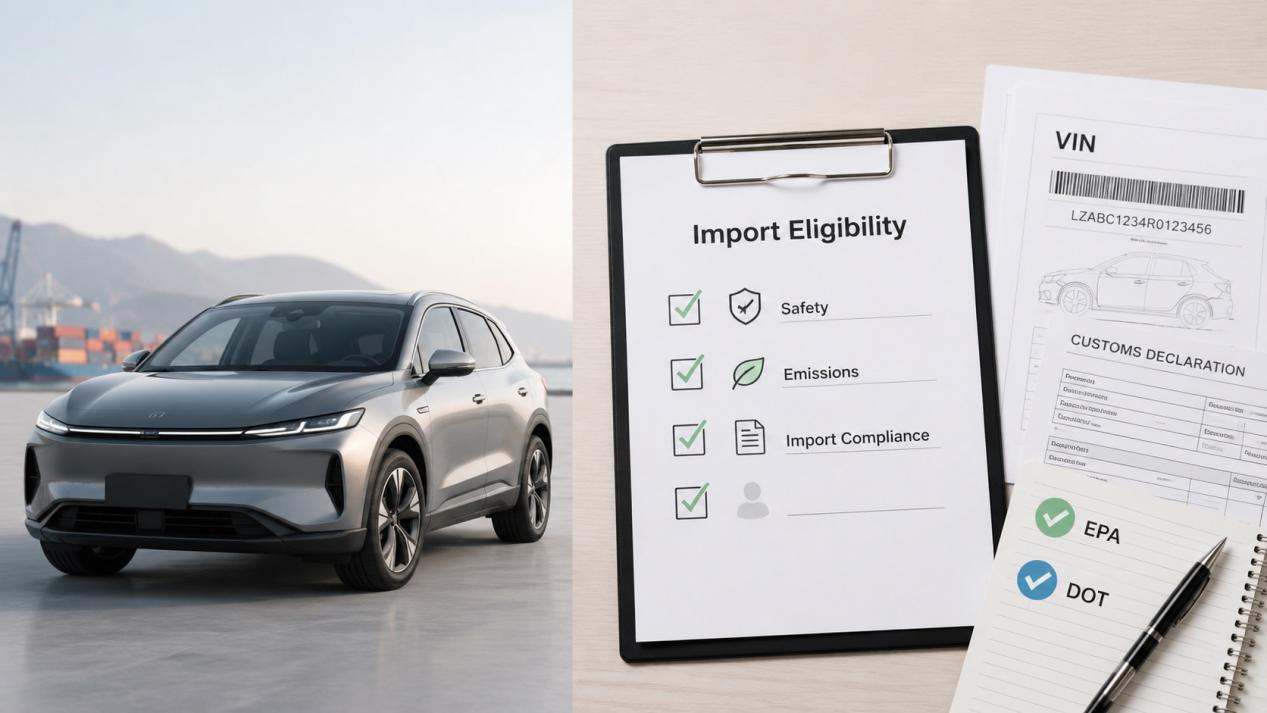
U.S. vehicle import eligibility means whether a vehicle can legally enter the United States under federal import, safety, emissions, and customs rules. This is separate from whether the car can be loaded onto a ship.
A freight forwarder can help with the logistics chain, but the importer must still confirm whether the vehicle meets U.S. import requirements.
DOT, NHTSA, EPA and CBP Requirements
For most vehicle imports into the United States, four areas need attention.
| Agency / Area | What It Covers | Why It Matters |
| CBP | Customs entry, duty, import declaration | The vehicle cannot be released without proper customs clearance |
| DOT / NHTSA | Federal Motor Vehicle Safety Standards, often called FMVSS | Many non-U.S.-market cars do not meet U.S. safety standards |
| EPA | Emissions and environmental requirements | Gasoline and diesel vehicles may need emissions compliance proof |
| State DMV | Title, registration, inspection, road use | Customs clearance does not guarantee state registration |
FMVSS refers to U.S. Federal Motor Vehicle Safety Standards. These standards cover areas such as crash protection, lighting, airbags, seat belts, mirrors, labels, and other road safety requirements.
EPA requirements focus on emissions. For gasoline or diesel vehicles, the EPA may require specific compliance documents. For electric vehicles, emissions may not be the same issue, but battery safety, carrier acceptance, tariffs, and policy restrictions still need to be reviewed.
For U.S. import paperwork, two common forms are often discussed:
● DOT HS-7, used for declaring whether a vehicle conforms to U.S. safety standards or qualifies under an exemption.
● EPA Form 3520-1, used for declaring the emissions status of imported vehicles and engines.
These forms are not just routine paperwork. If the vehicle does not qualify under the correct declaration category, the shipment may face detention, export, modification, or refusal.
Modern Cars, EVs, Classic Cars and Special-Use Vehicles
Not all vehicles should be treated the same.
A new China-market passenger car is usually the most difficult case. Many are not manufactured for U.S. certification. Even if the vehicle is legal and popular in China, that does not mean it meets U.S. FMVSS or EPA requirements.
Chinese electric vehicles bring another layer of review. Buyers often focus on price and technology, but the U.S. side may involve additional tariffs, safety requirements, data or connected vehicle concerns, battery handling rules, and carrier acceptance conditions. From a logistics angle, EVs may also require battery state checks, secure loading, and approval from the ocean carrier before booking.
Classic vehicles are different. The U.S. 25-year rule may allow some older vehicles to be imported with fewer DOT restrictions. This is why classic cars often have a clearer import path than modern non-U.S.-market vehicles. The exact treatment still depends on manufacturing date, documentation, vehicle type, and EPA status.
Special-use vehicles also need separate judgment. A display car, racing car, non-road vehicle, prototype, or commercial fleet project may fall under different import purposes. These are not the same as importing a car for daily road use.
The buyer should decide the import purpose before negotiating price. A vehicle for display at a trade show and a vehicle for public road registration are two very different projects.
When RI or ICI Support May Be Needed
If a vehicle does not conform to U.S. safety or emissions standards, a Registered Importer, known as an RI, or an Independent Commercial Importer, known as an ICI, may be needed.
An RI deals with nonconforming vehicles under NHTSA-related rules. An ICI deals with certain EPA-related compliance issues.
This path can be expensive. Modification can cost thousands or even tens of thousands of dollars, and not every model can be made compliant. A low vehicle price in China can quickly lose its advantage once compliance work, tariffs, port charges, customs broker fees, storage, and inland delivery are added.
For individual buyers, this is where many projects stop.
How to Buy a Car from China Safely
Buying a car from China is not only about finding the lowest listed price. The buyer needs to verify the seller, the vehicle, the documents, and the export arrangement.
China has many vehicle sellers, but not every seller understands export procedures. Some can sell domestically but cannot support overseas documentation. Others may offer attractive prices but provide weak vehicle history, incomplete ownership documents, or unclear delivery terms.
Common Buying Channels
Typical buying channels include:
● Authorized car dealers
● Used car exporters
● Vehicle trading companies
● Export platforms
● Factory or brand-connected sales channels
● Wholesale vehicle suppliers for fleet projects
For a U.S.-bound shipment, the seller should have export experience. They should understand VIN matching, invoice preparation, export declaration support, vehicle handover, and cooperation with a freight forwarder.
A vehicle exporter that can provide FOB China port terms is often easier to manage from a logistics perspective. FOB means the seller is responsible for delivering the vehicle to the agreed Chinese port and completing export-side responsibilities under the contract. After that, the buyer or buyer's forwarder controls the international freight.
EXW may look cheaper, but it pushes more local pickup, documentation, and export responsibility onto the buyer. CIF includes ocean freight arranged by the seller, but the buyer has less control over carrier choice, insurance quality, and destination charges.
What to Check Before Payment
Before paying the seller, ask for more than a few product photos.
At minimum, check:
● VIN and vehicle identification details
● Brand, model, year, trim, and configuration
● Exterior and interior photos
● Mileage and vehicle condition
● Battery condition for EVs, if available
● Sales contract and commercial invoice draft
● Export capability of the seller
● Ownership or vehicle source documents
● Whether the vehicle can be legally exported from China
● Incoterms and delivery point
● Whether third-party inspection is needed
For used vehicles, a third-party inspection is often worth the cost. The inspection should record exterior condition, interior condition, odometer reading, tires, glass, visible damage, and whether the vehicle can start and move under its own power.
For high-value vehicles, ask for a short video showing the VIN plate, dashboard, odometer, startup, lights, and vehicle walkaround. These records help reduce disputes during pickup, loading, and insurance claims.
The vehicle should not move to the port until the buyer, seller, and forwarder agree on the document set.
Documents Needed to Import and Ship a Car from China to the USA
Vehicle shipping is document-heavy because the same car is checked at several points: seller handover, China export customs, ocean carrier booking, U.S. customs entry, port release, and possibly state registration.
Document consistency matters. The VIN on the invoice, Bill of Lading, export declaration, photos, and import paperwork should match.
China-Side Purchase and Export Documents
China-side documents vary by vehicle type, seller, and export method, but the common set may include:
● Sales Contract
● Commercial Invoice
● Vehicle information sheet
● VIN record and vehicle photos
● Certificate of Origin, when applicable
● Vehicle certificate or conformity-related documents, when applicable
● Export declaration documents
● Packing or loading details, if shipped in a container
During export customs declaration in China, the vehicle's brand, model, VIN, declared value, and other details must be accurate. If the declared model does not match the physical vehicle or the VIN appears inconsistent, customs inspection and delay are possible.
For used cars or quasi-new vehicles, extra rules may apply depending on China export policy and the seller's export qualification. This should be checked with the exporter before booking freight.
Shipping and U.S. Import Documents
On the shipping and U.S. import side, the common documents may include:
● Bill of Lading
● Bill of Sale
● Commercial Invoice
● Marine insurance policy
● Arrival notice
● DOT HS-7
● EPA Form 3520-1
● Customs entry documents
● ISF information, when required for ocean shipments
● Any compliance documents requested by the customs broker
The Bill of Lading is the main transport document issued by the carrier or freight forwarder. It shows shipper, consignee, vessel, port of loading, port of discharge, cargo description, and shipment reference details.
For ocean cargo entering the U.S., Importer Security Filing, often called ISF, may be required before arrival. This is usually coordinated by the U.S. customs broker or importer using shipment data from the seller and forwarder.
A missing document is not always the biggest problem. A wrong document can be worse. Incorrect VIN, wrong consignee name, unclear vehicle value, or inconsistent model description can trigger customs questions and storage costs at the port.
Choose the Right Shipping Method: RoRo, Container or Air Freight
The best way to ship a car from China to the USA depends on the vehicle type, value, running condition, departure port, destination port, and protection needs.
RoRo and container shipping are the two main options. Air freight exists, but it is rarely practical for ordinary cars.
RoRo Shipping
RoRo means "Roll-on/Roll-off." The vehicle is driven onto the vessel at the origin port and driven off at the destination port.
RoRo is usually suitable for standard vehicles that can start, steer, brake, and move safely. It is often more cost-effective than container shipping, especially for regular passenger vehicles.
But RoRo has limits. Not every port offers suitable RoRo service. The vehicle normally cannot carry personal items. Protection is also lower than container shipping because the vehicle is handled in an open port and loaded into a vessel garage.
RoRo is a good fit when the car is standard, running, not extremely high-value, and the route has reliable vessel service.
Container Shipping
Container shipping means the vehicle is loaded and secured inside a 20ft or 40ft container.
A 20ft container is usually used for one vehicle. A 40ft container may fit two or more vehicles depending on size and loading method. For high-value cars, EVs, prototypes, non-running vehicles, or vehicles needing better protection, container shipping is often the safer choice.
The vehicle must be secured with wheel chocks, straps, and proper lashing points. For EVs, the carrier may request battery-related information or handling confirmation. For luxury vehicles, enclosed transport and marine insurance should not be skipped.
Container shipping costs more, but it gives better control over loading, protection, and documentation.
Air Freight for Urgent or High-Value Projects
Air freight is the fastest option, but it is extremely expensive. It is usually only used for urgent exhibitions, motorsport events, prototypes, or very high-value vehicles.
For a normal buyer, air freight rarely makes financial sense. The shipping cost alone can exceed the value advantage of buying from China.
| Shipping Method | Best For | Main Advantage | Main Limitation |
| RoRo | Running standard vehicles | Lower cost and efficient loading | Port and route limitations, less protection |
| Container | High-value cars, EVs, non-running cars | Better protection and control | Higher cost, more loading work |
| Air Freight | Urgent or special projects | Fastest transit | Very high cost |
Choose the shipping method after the vehicle is checked, not before. A non-running car quoted as RoRo may later need container shipping, and that changes the cost.
Step-by-Step Process from China Pickup to U.S. Delivery
Once the vehicle is purchased and import eligibility has been checked, the logistics process can begin.
China Pickup, Inspection and Export Customs
The China-side process usually starts with pickup coordination. The forwarder confirms the seller's location, vehicle status, pickup date, delivery port, and required handover documents.
At pickup, the vehicle condition should be recorded. This includes:
● Exterior photos
● Interior photos
● VIN photo
● Odometer reading
● Fuel level
● Tire and glass condition
● Battery status for EVs
● Running or non-running condition
This record protects the buyer, seller, forwarder, and insurer. If damage is found later, the pre-loading record helps determine where the issue occurred.
After pickup, the vehicle may go to a warehouse, inspection point, container yard, or RoRo terminal. The export documents are then prepared and submitted for China customs declaration.
For container shipping, the car is loaded, secured, photographed, and sealed in the container. For RoRo, the car is delivered to the terminal based on the vessel cutoff schedule.
Ocean Shipping, U.S. Customs and Final Delivery
After loading, the carrier or forwarder issues the Bill of Lading. The buyer and customs broker use this document for U.S. import preparation.
During ocean transit, the shipment can be tracked by vessel schedule, booking number, container number, or Bill of Lading number. Transit time varies by route, port pair, vessel schedule, and congestion. China to U.S. West Coast routes are generally faster than East Coast routes, but final timing also depends on booking availability and port operations.
When the vehicle arrives in the U.S., the customs broker handles customs entry with the importer. Duties, port charges, broker fees, and any other applicable charges must be paid before release.
After release, the vehicle can be picked up from the port or delivered inland by truck.
Do not confuse port release with legal road registration. The vehicle may still need state DMV review, title processing, inspection, emissions checks, insurance, and registration before it can be driven on public roads.

How Much Does It Cost to Ship and Import a Car from China to the USA?
The common mistake is asking only for the ocean freight.
A better question is: what is the estimated landed cost?
Landed cost means the total cost of getting the vehicle from the seller in China to the buyer's final point in the USA, including purchase, export, freight, insurance, import charges, destination fees, and inland delivery.
Main Cost Items
A full cost estimate may include:
| Cost Item | What It Covers |
| Vehicle purchase price | Price paid to the seller in China |
| China inland pickup | Transport from seller to warehouse or port |
| Export customs and port charges | China-side declaration, handling, terminal costs |
| Ocean freight | RoRo or container shipping from China to the U.S. |
| Marine insurance | Coverage for damage or loss during transport |
| Import duty and possible tariffs | U.S. customs duty and other applicable tariff treatment |
| Customs broker fee | U.S. import filing and customs coordination |
| Destination port charges | Terminal, handling, documentation, storage if delayed |
| U.S. inland delivery | Trucking from port to final address |
| Compliance, inspection, registration | Possible modification, testing, DMV-related costs |
Chinese-origin vehicles may face base import duty plus additional tariff treatment depending on vehicle type, origin, policy status, and current U.S. rules. EVs can be more sensitive to tariff and policy changes.
Because of this, no serious forwarder should quote a final landed cost from only the vehicle price. The shipment route, vehicle type, and import status must be checked.
What Affects the Final Quote
Shipping cost changes based on practical details:
● Vehicle dimensions and weight
● Running or non-running condition
● Pickup city in China
● Departure port
● Destination port
● RoRo or container service
● Vessel schedule
● Season and carrier space
● Insurance value
● U.S. destination ZIP code
● Port congestion
● Special handling for EVs or non-standard vehicles
For example, a running compact sedan near Shanghai going to Los Angeles by RoRo is a very different project from a non-running EV in inland China going to Texas by container with inland delivery.
That is why a freight quote should always start with the actual vehicle and route.
Common Mistakes to Avoid Before Shipping a Car from China
Most costly problems happen before the car leaves China.
Buying Before Checking U.S. Compliance
A car can be legal to buy in China and still not qualify for U.S. road use. This is the most common misunderstanding.
Before signing the purchase contract, the buyer should check the vehicle's import category, EPA/DOT status, tariff exposure, and state registration path.
If there is no clear import path, the cheapest decision may be not buying the vehicle.
Comparing Only the Lowest Shipping Rate
The lowest ocean freight rate is not always the lowest total cost.
A cheap quote may exclude China pickup, export handling, insurance, destination charges, customs broker fees, storage, port pickup, and inland trucking. For vehicle imports, a missing cost line can become a large surprise after arrival.
Compare the full service scope, not only the freight number.
Missing or Inconsistent Documents
Vehicle imports depend heavily on document accuracy. The VIN, invoice, Bill of Lading, export declaration, and customs documents must tell the same story.
Small mistakes can create delays. Large inconsistencies can lead to inspection, detention, extra storage, or refusal.
For vehicle shipping, document review is not paperwork. It is risk control.
How Wilson Can Help with Car Shipping from China to the USA
Zhejiang Wilson Supply Chain Management Co., Ltd. can coordinate the logistics side of shipping vehicles from China to the USA, including China pickup, basic vehicle handover records, export document coordination, RoRo or container shipping, booking, loading support, China export customs coordination, marine insurance, Bill of Lading handling, destination port communication, and inland delivery arrangements.
We can help you compare route options and shipping methods based on the vehicle type, pickup city, destination port, and delivery requirements.
At the same time, U.S. import eligibility, EPA/DOT compliance, customs classification, tariff treatment, and state registration should be confirmed with the importer, U.S. customs broker, CBP, EPA, NHTSA, DMV, or a qualified compliance specialist before shipment.
To prepare a shipping plan, send us the vehicle brand and model, VIN if available, dimensions and weight, pickup city in China, running condition, destination port or ZIP code in the USA, preferred shipping method, and import purpose. Wilson can help review the logistics route, required shipping documents, and estimated transport cost before the car leaves China.