

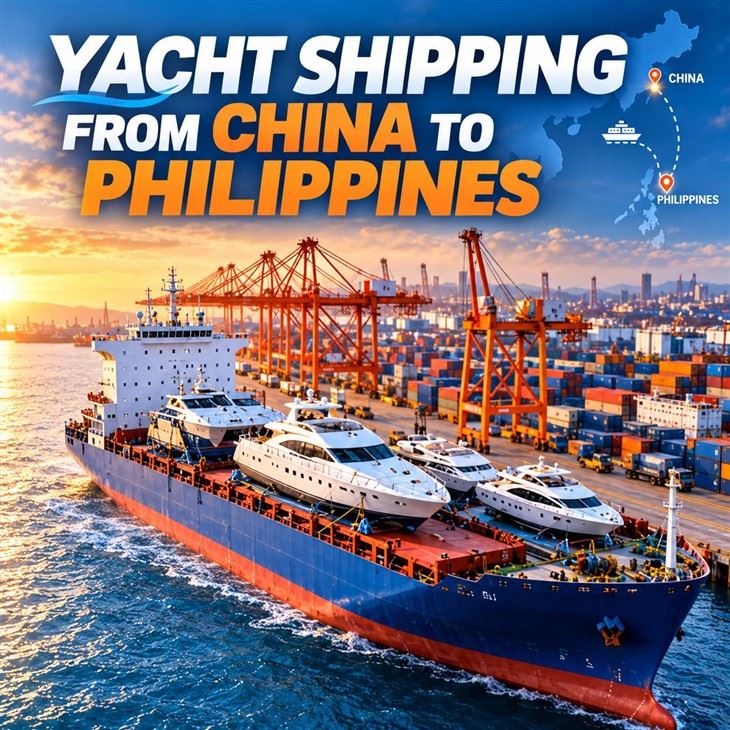
The maritime trade between China and the Philippines has grown steadily over the past decade, driven by the Philippines' expanding leisure-boating market, commercial vessel demand, and government investment in maritime infrastructure. As an archipelago of over 7,600 islands, the Philippines relies heavily on watercraft for transportation, tourism, fisheries, and maritime security, creating sustained demand for imported yachts, speedboats, patrol boats, and other vessels. China, as one of the world's largest boat and yacht manufacturing hubs, supplies a significant share of these vessels to the Philippine market, while Philippine-built and international-brand vessels also move in the reverse direction through China's major ports.
Wilson offers comprehensive yacht and boat shipping services from China to the Philippines, covering both export and import directions. Our service portfolio includes Flat Rack container shipping, Open Top container shipping, Breakbulk (Lo-Lo) shipping, and standard container shipping where vessel dimensions permit. Depending on the vessel's size, weight, and destination port, estimated shipping costs typically range from USD 2,800 to USD 18,000, with transit times of approximately 7 to 18 days from major Chinese ports such as Shanghai, Ningbo, Shenzhen, and Guangzhou to Philippine ports including Manila, Cebu, and Davao. All rates and transit times are for reference only and are subject to confirmation based on actual shipment details.
Our yacht and boat shipping service covers yachts, speedboats, small boats, patrol boats, and other high-value vessels, with the shipping method selected according to each vessel's dimensions, weight, and transport requirements.

Overview of China–Philippines Yacht and Boat Shipping
| Vessel Category | Typical Length Range | Common Shipping Method |
|---|---|---|
| Yachts | 8 m – 30 m+ | Flat Rack / Open Top / Breakbulk |
| Speedboats | 4 m – 12 m | Flat Rack / Container |
| Small Boats | 2 m – 8 m | Container / Flat Rack |
| Patrol Boats | 10 m – 25 m | Flat Rack / Breakbulk |
| Other High-Value Vessels | Varies | Custom Solution |
As Zhejiang Wilson Supply Chain Management Co., Ltd., we are a China-based international freight forwarder specializing in global transportation, with strong capabilities in sea freight, customs clearance, warehousing, and specialized logistics for high-value cargo including yachts and boats. Our partnerships with major carriers such as COSCO, Hapag-Lloyd, Maersk, MSC, and Evergreen ensure reliable vessel space and competitive rates on the China–Philippines route.
Ready to ship your yacht or boat to the Philippines?
Contact Us Today for a Tailored Shipping Quote
Cost of Shipping a Yacht from China to the Philippines
Shipping cost is one of the first questions every yacht owner, dealer, and maritime project manager asks. Because yachts and high-value boats are oversized, irregularly shaped, and often delicate cargo, there is no single flat rate that applies to all shipments. The final cost depends on the interaction of multiple factors, and understanding these variables helps you budget accurately and avoid surprises.
Estimated Shipping Rates by Method
The table below provides estimated shipping costs for different methods commonly used on the China–Philippines route. These figures are for reference only; actual quotes depend on vessel specifications, port conditions, and market rates at the time of booking.
Estimated Yacht Shipping Costs from China to the Philippines
| Shipping Method | Suitable Vessel Size | Estimated Cost Range (USD) | Key Characteristics |
|---|---|---|---|
| Flat Rack (40FR) | Up to ~12 m LOA, within 2.4 m width | 2,800 – 6,500 | Open sides and top; ideal for beam-restricted vessels; weather protection required |
| Open Top (40OT) | Up to ~10 m LOA, height-sensitive | 3,200 – 7,000 | Removable top for top-loading; suitable for tall-profile vessels |
| Breakbulk (Lo-Lo) | 12 m – 30 m+ LOA, oversize/overweight | 6,000 – 18,000 | Lift-on/lift-off via ship's crane; most flexible for large yachts |
| Container (40HQ/40GP) | Small boats ≤ ~6 m, disassembled or compact | 1,500 – 4,000 | Most economical; only for vessels fitting within container internal dimensions |
| RoRo (when available) | Trailerable boats on cradle | 2,500 – 5,500 | Roll-on/roll-off via trailer; limited service on this route |
Factors That Influence Yacht Shipping Cost
Vessel dimensions (Length, Width, Height). The single most important cost driver. A yacht's length overall (LOA), beam (width), and air draft (height) determine which shipping method is viable. Vessels exceeding 12 m in length or 2.4 m in beam typically cannot fit inside a standard container and require Flat Rack, Open Top, or Breakbulk shipping. Each step up in transport method increases the base cost.
Weight and displacement. Heavier vessels require stronger cradles, heavier-duty lashing materials, and sometimes specialized lifting equipment at both origin and destination ports. Overweight surcharges may apply if the vessel and cradle combined exceed the carrier's payload limits for a given equipment type.
Shipping method selection. Flat Rack and Open Top containers are the most common choices for mid-sized yachts because they balance cost and protection. Breakbulk shipping is reserved for large or unusually shaped vessels that cannot be accommodated by any container-based method. Container shipping is only viable for small boats, inflatable craft, or vessels that can be partially disassembled.
Lifting and loading requirements. Yachts shipped by Flat Rack, Open Top, or Breakbulk require crane lifting at both the origin yard and the destination port. Port crane fees, stevedore charges, and specialized lifting sling arrangements all contribute to the total cost. Some Philippine ports have limited crane capacity, which may necessitate routing through Manila as the primary port of discharge.
Support, bracing, and securing. Every yacht requires a custom-built steel or wooden cradle (stand) to support the hull during transit. Additional lashing chains, turnbuckles, shock-absorbing padding, and anti-movement strapping are mandatory. The cost of cradle fabrication, lashing materials, and on-site securing labor is built into the overall shipping expense.
Port of origin and destination. Shipping from Shanghai or Ningbo to Manila is generally the most cost-effective combination on this route. Routing to secondary ports such as Cebu or Davao may add USD 500 – 1,500 in transshipment and feeder charges. The choice of origin port also affects cost: southern Chinese ports (Shenzhen, Guangzhou) are geographically closer to the Philippines and may offer shorter transit times, while eastern ports (Shanghai, Ningbo) may have more frequent sailings and competitive carrier rates.
How Yacht Shipping Cost Is Calculated
The basic calculation method for yacht shipping combines several components:
Freight charge (based on shipping method and equipment type) + Origin charges (cradle fabrication, lifting, lashing, port THC, customs declaration, documentation) + Destination charges (port THC, lifting, devanning, customs clearance, delivery) + Insurance (optional but strongly recommended for high-value vessels) + Surcharges (bunker adjustment factor, currency adjustment factor, oversize surcharge if applicable).
For Breakbulk shipments, freight is often calculated on a per-revenue-ton basis (the greater of actual weight in metric tons or volume in cubic meters), with a minimum charge that typically applies. For Flat Rack and Open Top shipments, the carrier charges a flat equipment rate plus origin and destination handling fees.
All shipping costs listed above are for reference only. Contact Wilson for a precise quote based on your vessel's actual specifications.
Get Latest Ocean Freight Rates Now
Transit Time for Yacht Shipping from China to the Philippines
Transit time is a critical planning factor, especially for yacht dealers managing inventory timelines, maritime project coordinators working against delivery deadlines, and private owners coordinating arrival with marina berthing arrangements. The China–Philippines route is relatively short compared to intercontinental yacht shipments, but transit time still varies based on the specific port pair, shipping method, and operational factors.
Estimated Transit Times by Port Pair
Estimated Transit Times from Major Chinese Ports to Philippine Ports
| Origin Port (China) | Destination Port (Philippines) | Estimated Transit Time | Typical Service Frequency |
|---|---|---|---|
| Shanghai | Manila (North/South Harbor) | 7 – 12 days | Weekly |
| Ningbo | Manila | 7 – 12 days | Weekly |
| Shenzhen (Yantian/Shekou) | Manila | 5 – 10 days | Twice weekly |
| Guangzhou (Nansha) | Manila | 5 – 10 days | Weekly |
| Shanghai | Cebu | 12 – 18 days | Bi-weekly (often via Manila transshipment) |
| Shenzhen | Cebu | 10 – 15 days | Weekly (via Manila transshipment) |
| Shanghai | Davao | 14 – 20 days | Bi-weekly (via Manila transshipment) |
| Shenzhen | Davao | 12 – 18 days | Weekly (via Manila transshipment) |
Factors Affecting Transit Time
Vessel schedule and sailing frequency. The frequency of direct sailings between China and the Philippines varies by port pair. The Shanghai/Ningbo–Manila and Shenzhen/Guangzhou–Manila corridors have the most frequent direct services. Secondary Philippine destinations such as Cebu and Davao typically require transshipment through Manila, adding 3 to 7 days.
Routing and transshipment. Direct sailings are faster but may not be available for every port pair or every shipping method. Breakbulk and Flat Rack shipments sometimes require specific vessels with crane or open-deck capability, which may mean waiting for the next suitable sailing rather than the next available container vessel.
Port operations. Port congestion, berth availability, and customs processing efficiency at both origin and destination affect total door-to-door time. Manila's ports are the busiest in the Philippines and occasionally experience congestion during peak seasons.
Lifting and loading operations. Yacht loading and unloading require crane availability and favorable weather conditions. Heavy-lift operations may be scheduled on specific days, and wind or sea state restrictions can delay lifting by a day or more.
Customs clearance. Philippine customs clearance for vessels requires proper documentation, HS code classification, and potentially import permits. Well-prepared documentation can reduce clearance time to 1–3 days; incomplete or incorrect paperwork can cause delays of a week or more.
All transit times and shipping rates listed above are for reference only. Contact Wilson for a real-time shipping plan based on current vessel schedules and your specific requirements.
Yacht and Boat Shipping Services from China to the Philippines
Wilson provides end-to-end professional yacht and boat logistics services tailored to the unique requirements of each vessel. Our service capability spans the full spectrum of vessel types and shipping methods, with specialized attention to the protection, securing, and handling that high-value watercraft demand.
Vessel Types We Ship
| Vessel Type | Shipping Expertise | Typical Clients |
|---|---|---|
| Yachts (luxury motor yachts, sailing yachts) | Flat Rack, Open Top, Breakbulk with full hull protection | Yacht dealers, private owners, charter operators |
| Speedboats and motorboats | Flat Rack or container, cradle-secured | Marine dealers, water sports operators |
| Small boats (dinghies, inflatables, RIBs) | Container shipping, bulk-loaded | Retail distributors, resort operators |
| Patrol boats and government vessels | Breakbulk or Flat Rack with security protocols | Government agencies, maritime security firms |
| Commercial and fishing vessels | Breakbulk, custom stowage plan | Fishery companies, commercial operators |
Shipping Methods We Offer
Flat Rack (40FR) shipping. The most widely used method for yachts up to approximately 12 m LOA. The open-top, open-sided flat rack allows side-loading of the vessel on its cradle, with the hull protected by custom padding and the entire assembly secured with heavy-duty lashing chains and turnbuckles. Tarpaulin or shrink-wrap weather protection is applied for ocean transit.
Open Top (40OT) shipping. Used when the vessel's height profile makes top-loading more practical than side-loading. The removable top allows crane placement of the yacht directly into the container footprint, after which the top is replaced or the vessel is secured with an open-top configuration.
Breakbulk (Lo-Lo) shipping. The preferred method for yachts exceeding 12 m LOA or with beams too wide for Flat Rack accommodation. The vessel is lifted on and off the vessel by ship-mounted or shore-based cranes, stowed on deck or in a designated cargo hold, and secured with professional lashing. Breakbulk offers the greatest dimensional flexibility and is the standard choice for large luxury yachts and patrol vessels.
Container shipping. Applied only when the vessel fits within standard container internal dimensions (approximately 12.05 m length × 2.35 m width × 2.39 m height for a 40HQ). Suitable for small boats, inflatable craft, and vessels that can be shipped disassembled or on a custom low-profile trailer.
Full-Service Logistics Capabilities
Our yacht shipping service is not limited to ocean freight. We provide a complete logistics chain:
Domestic pickup and inland transport. We arrange trucking from the manufacturer, marina, or seller's location to the departure port, using lowboy trailers, flatbed trucks, or specialized boat transport vehicles with escort vehicles for oversize loads.
Warehousing and staging. Short-term storage at port-side warehouses or open yards, with cradle staging areas for pre-loading preparation.
Loading, lifting, and crane operations. Coordinated crane lifting at origin and destination ports, with certified rigging teams experienced in yacht handling. Lifting plans are prepared in advance, accounting for the vessel's center of gravity, lifting point locations, and sling angles.
Hull protection. Comprehensive protection measures including custom-fitted padding at all contact points, shrink-wrap or tarpaulin weather covering, keel protection, and anti-chafe materials at lashing contact areas.
Professional cradle fabrication and support. Steel or heavy timber cradles engineered to match the vessel's hull shape, distributing weight evenly and preventing hull deformation during transit. Cradles are inspected and certified before loading.
Lashing, bracing, and securing. Multi-point lashing using marine-grade chains, wire rope, and turnbuckles, with shock-absorbing components to absorb vessel movement during ocean transit. All securing arrangements comply with IMO/CTU Code guidelines.
Anti-scratch, anti-collision, and anti-movement measures. Foam padding, rubber fenders, and protective films at all potential contact points. Additional bracing prevents longitudinal and lateral movement within the shipping unit.
Export customs declaration. Complete China export customs clearance, including HS code classification under heading 8903, export license verification where applicable, and preparation of all required shipping documents (commercial invoice, packing list, bill of lading, certificate of origin).
International shipment tracking. Real-time vessel tracking and status updates from departure to arrival, with proactive communication at each milestone (vessel sailing, transshipment, arrival, discharge).
Destination port coordination. Pre-arrival coordination with Philippine customs brokers, port operators, and delivery teams to ensure smooth handoff and timely pickup after discharge.
Every yacht is unique. We design a personalized logistics plan based on your vessel's specific dimensions, weight, structural characteristics, and shipping requirements – never a one-size-fits-all approach.
Yacht Shipping Process from China to the Philippines
A well-structured shipping process is essential for high-value, oversized cargo like yachts. Wilson follows a proven step-by-step workflow that ensures every shipment is planned, executed, and delivered with precision.
Step-by-Step Shipping Workflow
| Step | Stage | Key Activities |
|---|---|---|
| 1 | Inquiry and requirement submission | Client provides vessel details and shipping requirements |
| 2 | Vessel information confirmation | Wilson reviews specs, photos, and documentation |
| 3 | Feasibility assessment | Evaluate shipping method, port compatibility, and lifting requirements |
| 4 | Shipping plan design | Develop cradle, lashing, loading, and routing plan |
| 5 | Quotation and booking | Provide cost estimate, confirm booking with carrier |
| 6 | Domestic pickup | Arrange inland transport from origin to departure port |
| 7 | Loading preparation | Cradle fabrication, hull protection, pre-loading inspection |
| 8 | Lifting and securing | Crane loading onto Flat Rack/Open Top/vessel deck, lashing and bracing |
| 9 | Export customs declaration | China customs clearance, document preparation |
| 10 | Ocean transport | Vessel sails to Philippine destination port |
| 11 | Destination port coordination | Discharge, Philippine customs clearance, delivery arrangement |
Information Clients Need to Provide
To design an accurate and cost-effective shipping plan, we ask clients to provide the following basic information at the inquiry stage:
Vessel Specifications
| Information Category | Details Required |
|---|---|
| Brand and model | Manufacturer name, model designation |
| Dimensions | Length overall (LOA), beam (width), height (air draft) |
| Weight | Displacement or shipping weight including engine and equipment |
| Hull material | Fiberglass (FRP), aluminum, steel, wood, or composite |
| Engine information | Engine brand, model, power output, fuel type |
| Hull photos | Clear photos showing side profile, deck, keel, and lifting points |
| Vessel value | Declared cargo value for insurance and customs purposes |
Logistics and Documentation
| Information Category | Details Required |
|---|---|
| Pickup address | Full address of manufacturer, marina, or seller's location |
| Destination port | Manila, Cebu, Davao, or other Philippine port |
| Ownership documents | Bill of sale, builder's certificate, or registration documents |
| Import/export documents | Import permit (if required), certificate of origin, commercial invoice |
| Special requirements | Time constraints, insurance needs, marina delivery arrangement |
The more complete and accurate the information provided at the outset, the more precise our feasibility assessment, cost estimate, and shipping plan will be. Incomplete specifications are the most common cause of cost overruns and timeline delays in yacht shipping.
Why Choose Wilson for Your Yacht Shipping
Selecting the right freight forwarder for yacht and high-value vessel shipping is a decision that directly impacts the safety of your asset, the predictability of your delivery timeline, and the total cost of your shipment. Wilson brings a combination of experience, technical capability, and global resources that makes us a trusted partner for yacht shipping from China to the Philippines.
Core Competitive Advantages
| Advantage | Description |
|---|---|
| International freight forwarding experience | Years of operation in global sea freight, air freight, and multimodal transport, with established China–Philippines route expertise |
| Professional yacht and high-value vessel shipping capability | Dedicated specialization in oversized, high-value watercraft logistics – not general cargo repackaged as "yacht shipping" |
| Complex cargo transport plan design | Engineering-grade approach to cradle design, weight distribution, lifting plans, and stowage arrangements for non-standard vessels |
| Professional lifting and loading planning | Certified rigging teams, pre-planned lift configurations, and coordination with port crane operators at both origin and destination |
| Hull protection and lashing expertise | Multi-layer protection systems and IMO/CTU Code-compliant securing methods that prevent hull damage during ocean transit |
| Global carrier partnership network | Direct working relationships with COSCO, Hapag-Lloyd, Maersk, MSC, and Evergreen for reliable space allocation and competitive rates |
| Professional logistics team | Experienced project managers who understand vessel handling, port operations, and customs requirements specific to the China–Philippines corridor |
| Digital shipment tracking | Real-time visibility from departure to arrival, with milestone notifications at each transit stage |
| One-stop supply chain service | Door-to-door capability covering inland transport, warehousing, port operations, customs clearance, and final delivery – a single point of accountability |
Our approach is built on a simple principle: every yacht deserves the same level of care and planning regardless of its size or value. Whether you are shipping a 6-meter speedboat or a 25-meter luxury yacht, the same professional standards apply to cradle design, hull protection, lashing, and documentation.
For a precise quote tailored to your specific cargo, origin, and delivery terms, reach out to our team for a detailed breakdown.
Get Latest Ocean Freight Rates Now
China–Philippines Yacht and Boat Trade in Recent Years
The trade relationship between China and the Philippines has grown significantly, with China maintaining its position as the Philippines' largest trading partner and largest import source for over a decade. According to China Customs statistics, bilateral goods trade between China and the Philippines reached approximately USD 72.29 billion in 2025, with China's exports to the Philippines totaling USD 55.58 billion and imports from the Philippines at USD 16.71 billion. This robust trade foundation supports a steady flow of vessel and marine equipment shipments between the two countries.
China's Yacht and Boat Exports to the Philippines
China is a major global exporter of pleasure boats, yachts, and marine vessels, classified under HS heading 8903 (yachts and other vessels for pleasure or sports; rowing boats and canoes). Key HS subheadings include:
| HS Code | Product Description | China Export Tax Rate | Export VAT Refund Rate |
|---|---|---|---|
| 8903.10 | Inflatable yachts and pleasure boats | 0% | 13% |
| 8903.21/8903.22 | Sailboats (by length) | 0% | 13% |
| 8903.31/8903.32/8903.33 | Motorboats (by length) | 0% | 13% |
| 8903.91/8903.92/8903.99 | Other pleasure/sports vessels (by length) | 0% | 13% |
China's pleasure boat and yacht exports have grown as domestic manufacturers have improved in quality and competitiveness, with the Philippines serving as a growing Southeast Asian destination for Chinese-built speedboats, small motorboats, and marine equipment. The Philippines' expanding tourism sector, resort development, and maritime security modernization programs drive demand for imported vessels ranging from recreational speedboats to commercial patrol craft.
Philippine Vessel Exports and Reverse Trade to China
While the yacht and boat trade flow is predominantly from China to the Philippines, there is also a reverse trade of vessels and marine equipment from the Philippines to China. This includes Philippine-built fishing vessels, small commercial craft, and used or pre-owned yachts that owners relocate between the two countries. Additionally, international-brand yachts purchased in the Philippines by Chinese buyers or maritime companies are shipped back to China, requiring the same level of professional logistics planning as export shipments.
For import shipments into China, vessels are classified under the same HS 8903 heading, with China's most-favored-nation (MFN) import tariff rate of 10% applicable to most pleasure boat subheadings, and a value-added tax (VAT) rate of 13%. Certain motorboats with lengths between 8 m and 90 m are also subject to a 10% consumption tax at the import stage. Importers should verify the exact HS subheading and applicable rates based on the vessel's specifications.
Bilateral Trade Development and Shipping Demand
The Philippines' participation in the Regional Comprehensive Economic Partnership (RCEP), which entered into force for the Philippines on June 2, 2023, has created additional tariff preferential conditions for trade between China and the Philippines. Under RCEP, certain goods benefit from reduced tariff rates, which can influence the cost structure for vessel and marine equipment imports. The continued growth of bilateral trade, combined with the Philippines' geographic proximity to China's southern ports, sustains strong demand for professional yacht and boat shipping services on this route.
Regulations and Policies for Yacht Import and Export Between China and the Philippines
Shipping a yacht or boat between China and the Philippines involves compliance with customs regulations, maritime authority requirements, and tax obligations in both countries. The following overview covers the key regulatory considerations based on publicly available official information. Specific requirements may vary depending on the direction of trade (export from China or import into the Philippines), the vessel's intended use (private, commercial, or government), and the vessel type. Clients are advised to confirm current requirements with the relevant authorities before shipment.
China Export Customs Requirements
HS code classification. Yachts and pleasure boats exported from China are classified under HS heading 8903, with the specific 10-digit subheading determined by the vessel's type (inflatable, sailboat, motorboat, or other), length, and propulsion method. Accurate classification is essential for correct customs declaration, export tax refund processing, and compliance with any export control requirements. China's export tax rate for vessels under HS 8903 is generally 0%, with an export VAT refund rate of 13%.
Export customs declaration. Exporters must file a customs declaration through China's electronic customs system (China International Trade Single Window), submitting the commercial invoice, packing list, bill of lading, and any required certificates. Declaration elements for HS 8903 typically include brand type, export benefit status, intended use, vessel type, hull length, fixed installation configuration, brand name, model, engine brand and model, and engine power.
Export documentation. Standard export documents include the commercial invoice, packing list, bill of lading (or sea waybill), and certificate of origin (if the importer requests preferential tariff treatment under RCEP or other agreements). For used or second-hand vessels, additional documentation such as the original builder's certificate, bill of sale, and previous registration deletion certificate may be required.
Philippine Import Regulations
Philippine tariff system. The Philippines imposes import duties based on the ASEAN Harmonized Tariff Nomenclature (AHTN), which aligns with the international HS system. Import tariff rates generally range from 0% to 30%, with the specific rate depending on the product classification. For pleasure boats and yachts classified under AHTN/HS 8903, the applicable most-favored-nation (MFN) tariff rate should be confirmed through the Philippine Tariff Commission's online tariff finder (tariffcommission.gov.ph/tariff_finder) prior to importation.
RCEP preferential rates. Following the Philippines' accession to RCEP in June 2023, goods originating from RCEP member states (including China) may qualify for preferential tariff rates. Importers claiming RCEP preference must provide a valid certificate of origin (Form R or self-certification of origin) demonstrating that the goods meet the agreement's rules of origin requirements.
Value-added tax (VAT). The Philippines imposes a 12% VAT on imported goods, calculated on the CIF value plus applicable customs duty. This VAT applies to most imported vessels and must be factored into the total landed cost calculation.
Import permit and licensing. Depending on the vessel type and intended use, certain imports may require permits or clearances from Philippine government agencies. Commercial vessels, patrol boats, and vessels intended for charter operations may require additional approvals from the Maritime Industry Authority (MARINA) or other relevant agencies. Importers should verify permit requirements based on their specific circumstances.
Vessel registration with MARINA. The Maritime Industry Authority (MARINA) is the Philippine government agency responsible for the registration and regulation of domestic vessels, including yachts and pleasure craft intended for use in Philippine waters. Vessels imported for permanent use in the Philippines must be registered with MARINA, which involves submitting ownership documents, technical specifications, and compliance with applicable safety and construction standards. MARINA's regulations cover vessel acquisition, registration, and operational requirements for different vessel categories.
Ownership documentation. Importers must provide proof of ownership, typically including the bill of sale, builder's certificate (for new vessels), or previous registration documents (for used vessels). These documents may need to be notarized and consularized (authenticated) for acceptance by Philippine customs and MARINA.
Technical and safety standards. Vessels imported into the Philippines must comply with applicable Philippine maritime safety standards, which may include hull integrity requirements, safety equipment specifications, and engine emission standards. MARINA and the Philippine Coast Guard enforce these standards through inspection and certification processes.
Engine and environmental requirements. Vessel engines must comply with Philippine environmental regulations, including emission standards and fuel quality requirements. Engines imported as part of a vessel or separately may be subject to additional environmental compliance certifications.
Temporary importation vs. permanent importation. The Philippines, as a party to international customs conventions, may allow temporary importation of vessels for specific purposes such as yacht rallies, maritime exhibitions, or short-term charter operations, under customs bond or ATA Carnet arrangements. Temporary importation typically defers the payment of duties and taxes for the duration of the authorized stay, after which the vessel must be re-exported. Permanent importation requires full payment of applicable duties, VAT, and any other taxes, followed by MARINA registration for domestic use. The specific conditions and duration for temporary importation should be confirmed with the Bureau of Customs of the Philippines.
Destination port customs clearance. Philippine customs clearance is processed through the electronic customs system (e-Customs/e2m), with the importer or their licensed customs broker submitting the import entry, commercial invoice, packing list, bill of lading, certificate of origin (if claiming preferential rates), and any required permits. Customs may route shipments through green (automatic release), yellow (document review), or red (physical inspection) channels based on risk assessment. Proper HS code classification and complete documentation are critical to avoiding delays and additional costs.
All regulatory information above is based on publicly available official sources as of the time of writing. Policies and requirements may change. Clients should verify current requirements with the Philippine Bureau of Customs, MARINA, and other relevant authorities before finalizing any shipment.
Frequently Asked Questions
Q: 1. How much does it cost to ship a yacht from China to the Philippines?
A: Shipping cost depends primarily on the vessel's dimensions (length, beam, height), weight, and the selected shipping method. For a typical 8–12 m yacht shipped on a Flat Rack from Shanghai or Shenzhen to Manila, the estimated cost ranges from USD 2,800 to USD 6,500, including origin handling, ocean freight, and basic destination charges. Larger yachts (12 m+) requiring Breakbulk shipping typically cost USD 6,000 to USD 18,000 or more. All figures are for reference only – contact us with your vessel's specifications for a precise quote.
Q: 2. How long does yacht shipping take from China to the Philippines?
A: Transit time from major Chinese ports (Shanghai, Ningbo, Shenzhen, Guangzhou) to Manila is approximately 5 to 12 days for direct sailings. Shipments to Cebu or Davao typically require transshipment through Manila, adding 3 to 7 days. Total door-to-door time, including domestic pickup, loading, customs clearance, and destination delivery, is generally 15 to 25 days. All transit times are for reference only and depend on vessel schedules and operational conditions.
Q: 3. What is the difference between Flat Rack and Breakbulk shipping for yachts?
A: Flat Rack (40FR) shipping uses a standard-sized open platform container (approximately 12.19 m × 2.44 m) that can be handled by standard container terminal equipment. It is suitable for yachts up to approximately 12 m LOA with beams within 2.4 m. Breakbulk (Lo-Lo) shipping involves lifting the vessel directly onto the ship's deck or into a cargo hold using ship-mounted or shore-based cranes, with no container constraint. Breakbulk is used for yachts exceeding Flat Rack dimensional limits or with unusual shapes. Flat Rack is generally more cost-effective for mid-sized yachts; Breakbulk offers greater flexibility for large or oversized vessels.
Q: 4. How are oversized yachts transported if they exceed container dimensions?
A: Yachts that exceed standard Flat Rack or container dimensions are shipped via Breakbulk (Lo-Lo) or, in some cases, on specialized heavy-lift vessels or semi-submersible carriers for very large yachts. The vessel is lifted by crane onto the ship's deck, secured on a custom-built cradle, and lashed with heavy-duty chains and wire rope. For exceptionally large yachts (30 m+), a detailed stowage plan, lifting engineering study, and port capability assessment at both origin and destination are required. Wilson coordinates all aspects of oversized yacht transport, including crane availability, port restrictions, and route planning.
Q: 5. How is the yacht protected during shipping?
A: Hull protection is a critical part of our service. Every yacht is placed on a custom-fabricated steel or timber cradle engineered to match the hull shape and distribute weight evenly. Contact points are padded with high-density foam, rubber fenders, and anti-chafe materials. The vessel is wrapped in shrink-wrap or covered with marine tarpaulin for weather protection. All lashing contact points use shock-absorbing components to prevent chafing and stress concentration. Additional bracing prevents longitudinal and lateral movement during ocean transit.
Q: 6. What documents do I need to provide for yacht shipping?
A: For export from China, you need to provide: vessel brand and model, dimensions (LOA, beam, height), weight, hull material, engine information (brand, model, power), hull photos, declared cargo value, pickup address, and ownership documents (bill of sale, builder's certificate, or registration documents). For import into the Philippines, additional documents may include the certificate of origin (for RCEP tariff preference), import permit (if required for the vessel type), and any MARINA registration documents. We will provide a complete document checklist after reviewing your specific shipment.
Q: 7. Do I need yacht transport insurance?
A: While insurance is not legally mandatory, it is strongly recommended for all yacht shipments. Yachts are high-value assets exposed to risks during lifting, ocean transit, and port handling. Marine cargo insurance (All Risks coverage) typically costs 0.3% to 0.8% of the declared vessel value, depending on the vessel type, shipping method, and route. Wilson can arrange insurance coverage through our partner providers or work with your designated insurer.
Q: 8. What are the import duties and taxes for bringing a yacht into the Philippines?
A: The Philippines imposes import duties based on the AHTN/HS classification of the vessel. For pleasure boats and yachts under HS 8903, the applicable tariff rate should be confirmed through the Philippine Tariff Commission's tariff finder. In addition to customs duty, a 12% VAT is applied to the CIF value plus duty. Under RCEP, vessels originating from China may qualify for preferential tariff rates if a valid certificate of origin is provided. The exact duty and tax amounts depend on the vessel's HS subheading, value, and origin. We recommend confirming current rates with the Philippine Bureau of Customs or a licensed customs broker before shipment.
Q: 9. Do you offer door-to-door yacht shipping service?
A: Yes. Wilson provides full door-to-door service, including domestic pickup from the origin location in China, inland transport to the departure port, loading and securing, ocean freight, Philippine customs clearance, and final delivery to the destination marina or address in the Philippines. Our single-point-of-contact project management ensures seamless coordination across all stages, with real-time tracking and proactive communication throughout the shipment.
Q: 10. Can you ship a used or second-hand yacht?
A: Yes. Used and pre-owned yachts can be shipped in both directions (China to Philippines and Philippines to China). For used vessels, additional documentation is typically required, including the original bill of sale, previous registration deletion certificate, and builder's certificate where available. Importing used vessels into China involves specific regulatory requirements including customs inspection and potential maritime authority registration procedures. We will assess the feasibility and documentation requirements for your specific vessel during the inquiry stage.
About Wilson
Zhejiang Wilson Supply Chain Management Co., Ltd. is a China-based international freight forwarder and supply chain company specializing in global transportation from China. Our core capabilities span sea freight, air freight, customs clearance, warehousing, and specialized logistics for vehicles, heavy equipment, chemical cargo, oversized and project cargo, special containers, reefer cargo, and high-value yacht and boat logistics.
With a network covering Europe, the Americas, Asia, the Middle East, Africa, and Oceania, and partnerships with major carriers including COSCO, Hapag-Lloyd, Maersk, MSC, and Evergreen, we serve clients across major Chinese logistics nodes including Ningbo, Shanghai, Shenzhen, Guangzhou, Tianjin, Qingdao, Hangzhou, and Beijing.
Contact us today to discuss your yacht shipping needs from China to the Philippines.
Email: lucy@ylls.net | gm@wilson-cargo.com | jy@wilson-cargo.com
Phone: +86 195 5809 8285
Wilson – International Freight Forwarding · Supply Chain · Specialized Logistics. Your trusted partner for yacht and boat shipping from China to the Philippines.
Hot Tags: Yacht Shipping From China To Philippines


