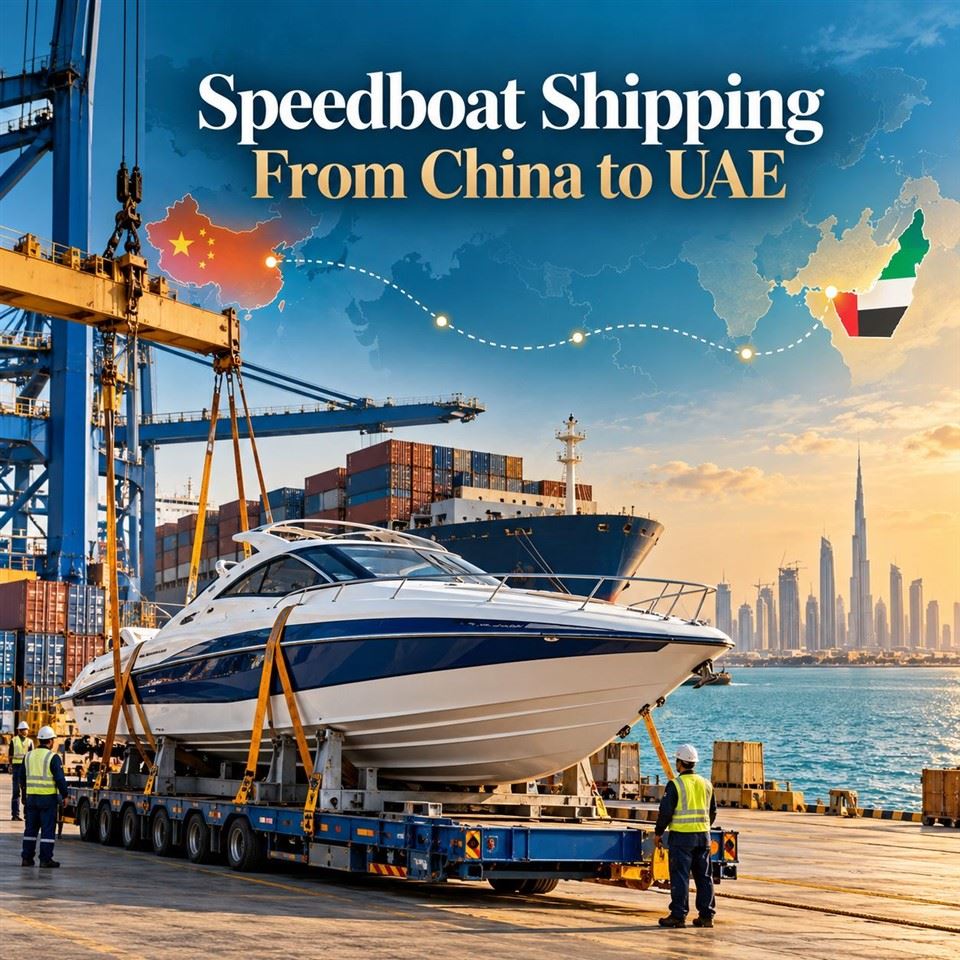
China and the United Arab Emirates have built one of the most dynamic bilateral trade corridors in the Middle East. In 2024, China–UAE bilateral goods trade reached approximately USD 101.8 billion, up 7.2 percent year on year, and China has remained the UAE's largest trading partner for consecutive years. Within this fast-growing trade relationship, yacht, speedboat, and small craft logistics occupies a specialised but increasingly important niche - driven by the UAE's booming marine leisure market, expanding commercial fleet requirements, and China's growing boat manufacturing capacity.
Whether you are exporting a newly built speedboat from a Chinese shipyard to Dubai, importing a European-brand yacht from the UAE back to China, or moving patrol boats and commercial vessels between the two countries, the logistics requirements are fundamentally different from standard container freight. Yachts and high-value boats are oversized, fragile, and dimensionally complex cargo that demand professional loading, crating, lifting, hull protection, and securing at every stage of transit.
At Wilson, we provide end-to-end yacht and boat shipping services from China to the UAE - and in the reverse direction - covering yachts, speedboats, small boats, patrol boats, and other high-value vessels. Our transport methods include Flat Rack container shipping, Open Top container shipping, Breakbulk (Ro-Ro and lift-on/lift-off), and standard Container Shipping where vessel dimensions permit. Estimated shipping costs from major Chinese ports to Jebel Ali, Abu Dhabi, and other UAE ports typically range from USD 3,500 to USD 18,000 depending on vessel size, weight, transport method, and route, with transit times of approximately 18 to 35 days for direct and transhipment sailings.
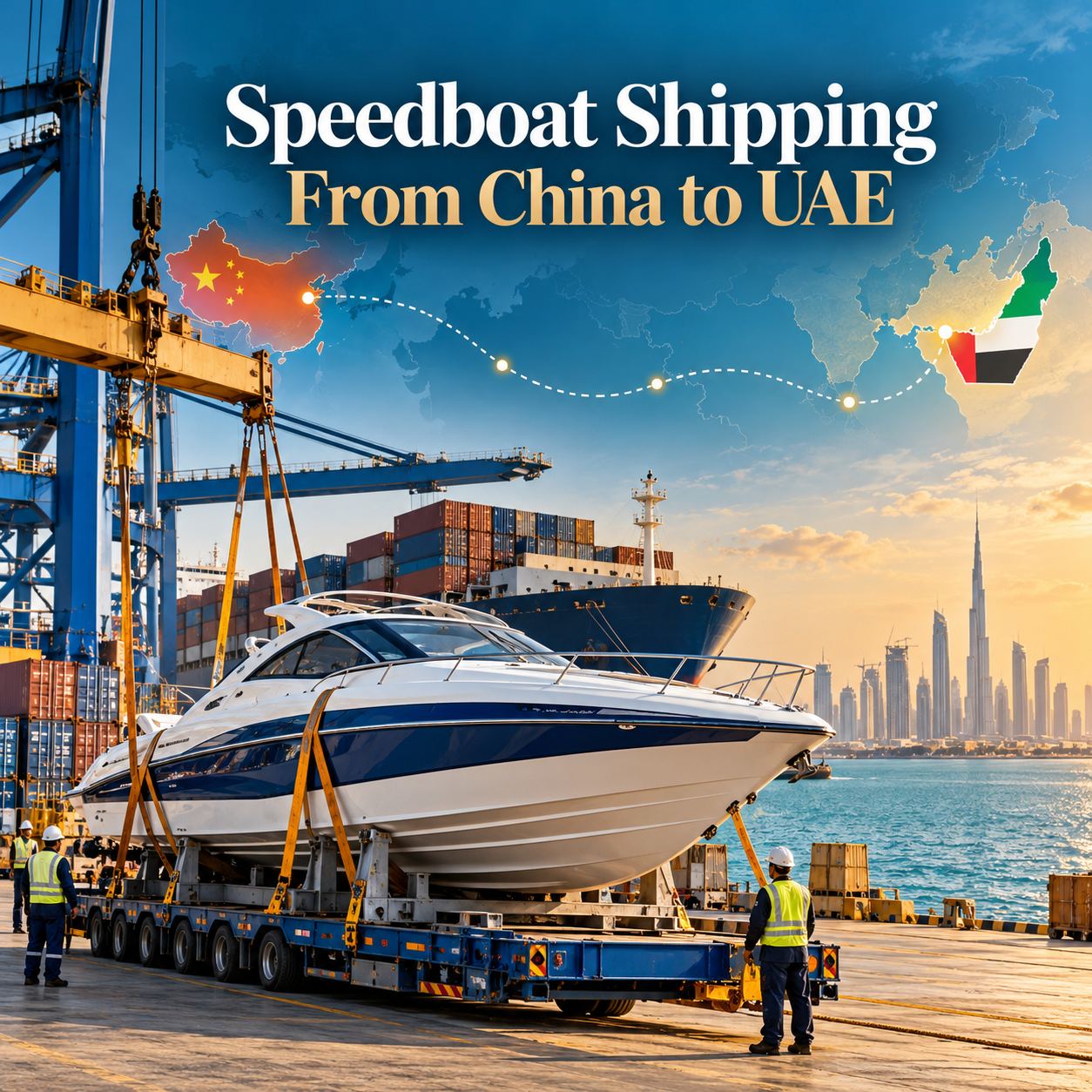
Overview of China–UAE Yacht and Boat Shipping
All rates and transit times quoted in this page are for reference only. Actual costs and schedules depend on vessel specifications, port conditions, season, and market rates at the time of booking. Contact our team today for a tailored shipping quotation and a real-time transport plan.
Wilson - Zhejiang Wilson Supply Chain Management Co., Ltd. - is a China-based international freight forwarder and supply chain company specialising in global transportation from China. With strong capabilities in sea freight, customs clearance, warehousing, and specialised logistics, we have accumulated hands-on experience in yacht, speedboat, and small boat cross-border transport projects. Our long-standing partnerships with major carriers including COSCO, Hapag-Lloyd, Maersk, MSC, and Evergreen enable us to secure stable vessel space and competitive rates for your high-value cargo.
Contact Wilson for a Free Consultation and Quotation
Cost of Shipping a Yacht from China to the UAE
Shipping cost is determined by a combination of vessel dimensions, transport method, handling requirements, and route specifics. Unlike standard containerised goods, yachts and boats cannot be quoted by a simple per-CBM or per-kilogram rate - each vessel requires an individualised cost assessment based on its actual measurements and handling complexity.
The table below provides estimated cost ranges for the principal transport methods used for yacht and boat shipping from China to the UAE. These figures are indicative only and should not be treated as a firm quotation.
Table 1: Estimated Shipping Costs by Transport Method (China to UAE)
| Transport Method | Typical Vessel Size | Estimated Cost Range (USD) | Key Cost Drivers |
|---|---|---|---|
| Flat Rack Container | Up to approx. 12 m LOA, fits 20' or 40' flat rack | 3,500–8,500 | Hull length and width, overhang surcharges, lashing and bracing |
| Open Top Container | Up to approx. 11 m LOA, height within container limits | 4,000–9,000 | Loading crane access, tarpaulin coverage, height clearance |
| Breakbulk (Lo-Lo) | 10 m and above, oversized or non-containerisable | 7,000–18,000 | Vessel slot, stevedore lifting, cradle fabrication, port handling |
| Breakbulk (Ro-Ro) | Trailerable vessels, self-propelled or on trailer | 6,000–15,000 | Trailer or MAFI availability, ramp access, deck space |
| Standard Container (40' HQ) | Small boats, disassembled, or under approx. 6 m | 2,800–6,000 | Container availability, stuffing and securing, disassembly if required |
Key Factors Affecting Yacht Transport Cost
Vessel dimensions (Length, Width, Height). The single most important cost factor. A vessel that fits within a 40' flat rack footprint (approximately 12.19 m × 2.44 m) will cost significantly less than one requiring Breakbulk deck space. Every centimetre of overhang beyond standard equipment dimensions triggers additional surcharges from the carrier and may require special permits.
Weight and displacement. Heavy displacement hulls require heavier-duty cradles, stronger lashing materials, and cranes with higher lifting capacity at both origin and destination ports. Vessels exceeding approximately 25–30 tonnes typically cannot use Flat Rack or Open Top methods and must move via Breakbulk.
Transport method selection. Flat Rack and Open Top are the most economical options for vessels within dimensional limits. Breakbulk becomes necessary for oversized yachts, catamarans with wide beams, or vessels with tall superstructures. Standard container shipping applies only to small boats that can be stuffed into a 40' container, either fully assembled within the dimensions or partially disassembled.
Lifting and loading requirements. Yachts require specialised lifting slings, spreader bars, and sometimes custom-built steel cradles. Port crane availability and stevedore experience with high-value vessels directly affect handling costs. Some Chinese origin ports and UAE destination ports have more developed heavy-lift infrastructure than others.
Support, bracing, and securing. Professional hull cradles, timber bracing, steel frames, anti-abrasion padding, and certified lashing chains/straps are mandatory. The cost of materials and labour for proper securing typically ranges from USD 500 to USD 3,000 depending on vessel size and complexity.
Origin and destination ports. Major Chinese departure ports include Shanghai, Ningbo, Shenzhen, Guangzhou, Qingdao, and Tianjin. Primary UAE arrival ports are Jebel Ali (Dubai), Abu Dhabi (Zayed Port and Khalifa Port), and Sharjah (Khorfakkan). Port selection affects base ocean freight, terminal handling charges (THC), and local delivery costs.
Season and market conditions. Peak shipping seasons (typically before major holidays and year-end) see higher rates and tighter space. Carrier rate fluctuations, fuel surcharges (BAF), and currency adjustments also impact final cost.
How Yacht Shipping Cost Is Calculated
The basic calculation method combines several components:
- Base ocean freight - determined by transport method (Flat Rack / Open Top / Breakbulk / Container) and carrier tariff for the China–UAE lane.
- Origin charges - terminal handling, documentation, customs declaration, lifting and loading, cradle fabrication, lashing and bracing.
- Destination charges - terminal handling, discharging/lifting, port dues, customs clearance, local delivery.
- Surcharges - oversize surcharge, overhang surcharge, BAF (fuel), currency adjustment factor (CAF), and any special permit fees.
- Insurance - marine cargo insurance for high-value vessels, typically 0.3 to 0.5 percent of declared cargo value.
The total cost is the sum of these components, with the base ocean freight and handling charges being the largest variable items.
For a precise quotation, our team will need your vessel's exact specifications and intended shipping schedule.
Get Latest Ocean Freight Rates Now
Transit Time for Yacht Shipping from China to the UAE
Transit time depends on the shipping route, vessel schedule, number of transhipments, and port handling efficiency. The table below provides estimated transit times from major Chinese origin ports to principal UAE destination ports.
Table 2: Estimated Transit Times from Major Chinese Ports to UAE Ports
| Origin Port (China) | Destination Port (UAE) | Direct / Transhipment | Estimated Transit Time (Days) |
|---|---|---|---|
| Shanghai | Jebel Ali (Dubai) | Direct | 20–25 |
| Shanghai | Jebel Ali (Dubai) | Transhipment (Singapore / Colombo) | 28–35 |
| Ningbo | Jebel Ali (Dubai) | Direct | 18–24 |
| Ningbo | Abu Dhabi (Khalifa Port) | Transhipment | 25–32 |
| Shenzhen (Yantian / Shekou) | Jebel Ali (Dubai) | Direct | 15–22 |
| Shenzhen (Yantian / Shekou) | Sharjah (Khorfakkan) | Direct | 14–20 |
| Guangzhou (Nansha) | Jebel Ali (Dubai) | Direct | 16–23 |
| Qingdao | Jebel Ali (Dubai) | Transhipment | 26–33 |
| Tianjin | Jebel Ali (Dubai) | Transhipment | 28–35 |
Factors Affecting Transit Time
Vessel schedule and frequency. Direct sailings from southern Chinese ports (Shenzhen, Guangzhou) to the UAE are generally more frequent and faster than those from northern ports (Qingdao, Tianjin), which typically require transhipment at Singapore, Colombo, or other intermediate hubs. Carrier schedules vary weekly, and space availability for oversized cargo (Flat Rack, Open Top, Breakbulk) is more limited than for standard containers.
Routing and transhipment. Direct routes reduce transit time but may have less frequent departures. Transhipment routes offer more scheduling flexibility but add 5 to 10 days depending on the connection. For Breakbulk cargo, direct conventional vessel sailings may be less frequent than container ship services, requiring more advance planning.
Port operations. Loading and discharging of yachts and oversized vessels require specialised crane slots, stevedore teams, and sometimes tidal window coordination. Port congestion during peak periods can add several days to both origin and destination handling.
Lifting and securing time. Pre-loading preparation - including cradle positioning, sling rigging, hull protection installation, and lashing - typically requires one to two days at the origin port. Discharging and de-rigging at the destination port requires a similar timeframe.
Customs clearance. UAE import customs clearance for yachts and boats typically takes 2 to 5 working days after vessel arrival, depending on documentation completeness, inspection requirements, and whether the vessel is entering under temporary importation or permanent import. Chinese export customs declaration is generally completed within 1 to 2 working days when documentation is in order.
The rates and transit times shown above are for reference only. Actual schedules and costs vary based on carrier availability, season, port conditions, and your vessel's specific requirements.
Contact Wilson for a Real-Time Shipping Plan
Yacht and Boat Shipping Services from China to the UAE
Wilson provides comprehensive, specialised marine logistics services for yacht and boat transport between China and the UAE. Our service portfolio covers the full spectrum of vessel types, transport methods, and value-added handling:
Vessel Types We Transport
| Vessel Category | Typical Examples | Transport Considerations |
|---|---|---|
| Yachts | Luxury motor yachts, sailing yachts, superyachts | High hull value, delicate finishes, custom cradle and sling requirements |
| Speedboats | Sport boats, rigid inflatable boats (RIB), performance craft | Lightweight but sensitive to hull stress, may fit Flat Rack or container |
| Small Boats | Fishing boats, dinghies, tenders, leisure craft | Often transportable in standard containers if dimensions permit |
| Patrol Boats | Government and security patrol vessels, coast guard craft | Requires robust securing, possible confidentiality and export licence requirements |
| Other High-Value Vessels | Catamarans, trimarans, research vessels, commercial boats | Wide beam or tall superstructure may require Breakbulk transport |
Transport Methods We Offer
- Flat Rack shipping - the most common method for vessels up to approximately 12 metres that fit within flat rack dimensions. The vessel is secured to a custom cradle on a 20' or 40' flat rack, lashed with chains and straps, and protected with tarpaulin or shrink wrap.
- Open Top shipping - suitable for vessels that fit within container length and width but exceed standard container height. Loading is performed by crane from above, and the top is covered with a tarpaulin.
- Breakbulk shipping - for oversized yachts, wide-beam catamarans, and vessels exceeding container dimensions. The vessel is loaded directly onto the vessel deck or into a conventional cargo hold using shipboard cranes or floating cranes, secured on a purpose-built cradle.
- Container shipping - for small boats under approximately 6 metres, or vessels that can be partially disassembled (mast, windshield, or outboard motor removed) to fit within a 40' HQ container. The most economical option when applicable.
Full-Service Logistics Capabilities
| Service Area | What We Provide |
|---|---|
| Domestic pickup | Inland transport from shipyard, factory, or marina to departure port using lowboy trailer, flatbed, or specialised boat transport vehicle |
| Warehousing and storage | Short-term secure storage at port-side facilities before loading, with CCTV monitoring and weather protection |
| Loading and lifting | Professional crane operations with certified riggers, spreader bars, and custom lifting slings designed for hull shape and weight distribution |
| Hull protection | Anti-abrasion padding, foam cradle liners, shrink wrap, tarpaulin coverage, and fendering to prevent gelcoat and paint damage |
| Professional support and bracing | Custom-built steel or timber cradles engineered to the vessel's hull shape, keel support, and chine configuration |
| Lashing and securing | Certified lashing chains, webbing straps, and tensioning systems to prevent longitudinal and lateral movement during ocean transit |
| Anti-scratch, anti-collision, anti-shift measures | Multi-layer protection including bubble wrap on fittings, foam padding at contact points, and redundant securing points |
| Export customs declaration | Complete Chinese export customs filing, including HS code classification, vessel value declaration, and any required export licences |
| International transport tracking | Real-time shipment status updates from origin port through ocean transit to destination port arrival |
| Destination port coordination | Pre-arrival liaison with UAE receiving agents, arrangement of discharging crane slots, and coordination of local delivery |
Every yacht and boat is unique. We do not apply a one-size-fits-all approach. Our team evaluates each vessel's length, width, height, weight, hull material, superstructure configuration, and destination port infrastructure to design a personalised logistics plan. A 9-metre speedboat shipping from Shenzhen to Jebel Ali will have a fundamentally different transport solution than a 18-metre motor yacht moving from Ningbo to Abu Dhabi - and our quotations reflect that difference.
Yacht Shipping Process from China to the UAE
Our structured shipping process ensures that every vessel moves safely, efficiently, and in full compliance with both Chinese and UAE regulations. The workflow below applies to both export (China to UAE) and import (UAE to China) directions, with adjustments based on the specific trade lane.
Step-by-Step Shipping Workflow
- Inquiry and requirement submission. The client provides initial shipping requirements, including vessel type, intended origin and destination, and desired timeline.
- Vessel information confirmation. We collect detailed vessel specifications - brand, model, length overall (LOA), beam (width), height, draft, displacement weight, hull material, engine type, and current location. Photographs of the vessel from multiple angles are requested to assess hull condition and handling requirements.
- Transport feasibility assessment. Our technical team evaluates whether the vessel can be transported by Flat Rack, Open Top, Breakbulk, or standard container, based on dimensional analysis against equipment specifications. Port infrastructure at both origin and destination is assessed for crane capacity, tidal conditions, and handling capability.
- Transport solution design. A personalised logistics plan is developed, including transport method, cradle design, lifting plan, lashing scheme, route selection, and port pair. For oversized or complex vessels, we may produce loading drawings and securing diagrams.
- Quotation and booking. A detailed quotation covering all cost components is provided. Upon client confirmation, we book vessel space with the selected carrier, securing the earliest available sailing that accommodates the cargo type.
- Domestic pickup. Our inland transport team arranges pickup from the shipyard, factory, marina, or storage location using appropriate trailer or lowboy transport. Over-dimensional permits are arranged for road transport where required.
- Loading preparation. At the departure port, the vessel is positioned for lifting. The custom cradle is placed on the flat rack, open top container, or Breakbulk deck position. Hull protection materials are installed.
- Lifting and securing. Certified riggers perform the lift using spreader bars and lifting slings. The vessel is lowered onto the cradle, aligned, and secured with lashing chains and straps. Anti-abrasion padding is applied at all contact points. The entire securing process is supervised and documented with photographs.
- Export customs declaration. We file the Chinese export customs declaration, including HS code classification (typically under Chapter 8903 for yachts and pleasure boats), commercial invoice, packing list, and any required export licences or certificates. For import direction (UAE to China), we handle the UAE export documentation and Chinese import filing.
- International ocean transport. The vessel departs on the booked sailing. We provide tracking updates at key milestones: vessel departure, transhipment (if applicable), and estimated time of arrival at the destination port.
- Destination port coordination. Before vessel arrival, we liaise with the UAE receiving agent (or Chinese agent for import direction) to arrange discharging crane slots, customs broker, and local delivery transport. All destination documentation is prepared in advance to minimise port storage time.
- Discharging and delivery. The vessel is lifted off the vessel or container, de-rigged from its cradle, and transferred to local transport for final delivery to the client's marina, warehouse, or designated location.
Information and Documents Required from the Client
To prepare an accurate quotation and execute the shipping smoothly, we request the following information and documents:
| Category | Required Information |
|---|---|
| Vessel identification | Brand, model, year of manufacture, hull identification number (HIN) or IMO number |
| Dimensions | Length overall (LOA), beam (maximum width), height (from keel to highest point), draft |
| Weight | Displacement weight, dry weight, and any trailer weight if applicable |
| Photographs | Clear photos from bow, stern, port side, starboard side, and overhead if possible |
| Hull and construction | Hull material (fibreglass, aluminium, steel, wood), superstructure details, keel type |
| Engine information | Engine brand, model, fuel type, and whether engines remain installed or are shipped separately |
| Cargo value | Declared value for customs and insurance purposes |
| Pickup address | Full address of shipyard, factory, marina, or current storage location |
| Ownership and trade documents | Bill of sale, commercial invoice, packing list, certificate of origin, builder's certificate, previous registration or deletion certificate |
| Import/export documents | Import licence (if required by destination country), export licence (if required), and any relevant vessel registration or ownership transfer documents |
Providing complete and accurate information at the outset enables us to design the optimal transport solution, avoid costly delays at customs, and ensure your vessel arrives safely and on schedule.
Why Choose Wilson for Your Yacht Shipping
Choosing the right freight forwarding partner for high-value yacht and boat transport is a decision that directly impacts the safety of your asset and the efficiency of your supply chain. Wilson brings the following core competitive advantages to every yacht shipping project:
International freight forwarding experience. As a China-based international freight forwarder with a global transportation network, we have built our reputation on reliable, compliant, and cost-effective logistics services. Our annual trade volume and established carrier relationships give us priority access to vessel space and competitive rate structures that smaller operators cannot match.
Specialised yacht and high-value vessel transport capability. We have accumulated direct project experience in yacht, speedboat, and small boat cross-border transport. We understand that a yacht is not just another piece of freight - it is a high-value asset with a fragile hull, sensitive electronics, and finishes that require expert handling at every stage.
Complex cargo transport solution design. Yacht shipping often involves dimensional challenges that standard freight forwarders cannot solve. Our team has designed loading and securing solutions for heavy equipment, oversized project cargo, drilling rigs, and specialised vessels - the same engineering approach is applied to your yacht transport plan.
Professional lifting and loading planning. Every lift is planned in advance: crane capacity verification, sling configuration, spreader bar selection, centre of gravity calculation, and tidal window coordination. We do not leave lifting to chance or to port stevedores without supervision.
Hull protection and securing expertise. Our cradle designs, anti-abrasion padding systems, and multi-layer lashing schemes are engineered to prevent gelcoat scratching, hull deformation, superstructure damage, and cargo shift during ocean transit. We treat your vessel as if it were our own.
Global carrier partnership network. Long-standing working relationships with COSCO, Hapag-Lloyd, Maersk, MSC, and Evergreen mean we can secure stable space allocations, flexible sailing options, and competitive rates - even during peak season when general cargo space is tight.
Professional logistics team. Our team includes specialists in oversized cargo, customs compliance, and marine insurance. We assign a dedicated project coordinator to each yacht shipment, ensuring single-point accountability and clear communication from inquiry to delivery.
Digital shipment tracking. We provide real-time status updates at every milestone - pickup, port arrival, loading, vessel departure, transhipment, arrival, discharging, and delivery. You always know where your vessel is and what happens next.
One-stop supply chain service. Beyond ocean transport, we offer domestic pickup, warehousing, customs brokerage, marine insurance arrangement, and destination delivery - a single partner managing your entire yacht logistics chain from origin to final destination.
Get a Tailored Logistics Proposal
China–UAE Yacht and Boat Trade Overview
The yacht and boat trade between China and the UAE has grown steadily alongside the broader bilateral trade relationship. The UAE is the Middle East's leading marine leisure market, with Dubai positioned as the region's premier yachting destination. China, meanwhile, has been developing its domestic boat manufacturing industry, producing an increasing range of yachts, speedboats, and small craft for both domestic use and export.
China's Yacht and Boat Exports to the UAE
Chinese yacht and boat exports to the UAE span several categories:
| Export Category | Typical Products | Market Context |
|---|---|---|
| Speedboats and motor boats | Sport boats, fishing boats, RIBs, small cabin cruisers | Chinese manufacturers offer competitive pricing; UAE demand from leisure and commercial sectors |
| Small pleasure boats | Dinghies, tenders, kayaks, small sailing craft | Volume exports, often containerised; supplied to UAE retailers and marinas |
| Patrol and commercial vessels | Patrol boats, work boats, passenger ferries | Government and commercial procurement; requires export licences and technical compliance |
| Yacht components and equipment | Marine engines, trailers, navigation equipment, deck fittings | Supports UAE boat assembly and after-sales market |
In November 2025, a Chinese-built yacht manufactured by Hunan Haiquan Yacht - measuring 18.9 metres with a displacement of 32 tonnes - was loaded at Yuanjiang and shipped to the UAE, marking the first processing-trade mode yacht export from Hunan Province. This case illustrates the growing capability of Chinese shipyards to produce yachts that meet UAE market requirements in terms of size and quality.
Chinese yacht manufacturing output reached approximately USD 1.28 billion in 2024, with exports of about USD 600 million, though the global market share remains under 5 percent. The UAE represents a significant and growing destination within the Middle East for Chinese-built vessels, particularly in the speedboat and small-to-mid-size motor boat segments where Chinese manufacturers are price-competitive.
UAE Yacht and Boat Exports to China
The reverse trade lane - from the UAE to China - is smaller in volume but includes distinct product categories:
| Import Category | Typical Products | Market Context |
|---|---|---|
| European-brand yachts transhipped via UAE | Luxury motor yachts and sailing yachts from European brands distributed through UAE dealers | UAE serves as a regional distribution hub; final destination is China |
| Used and pre-owned vessels | Second-hand yachts and boats sold to Chinese buyers | UAE's active used boat market, including the Dubai Used Boat Show, supplies Chinese buyers |
| Marine equipment and components | Marine engines, parts, and accessories | Supports Chinese boat manufacturing and after-sales service |
China's yacht market has been expanding, with the domestic fleet estimated at approximately 45,000 vessels (including unregistered fishing boats and sailboats) as of 2024. The demand for imported yachts - particularly European brands - remains strong among Chinese high-net-worth individuals and marine tourism operators. The UAE, with its extensive dealer network and active yacht brokerage market, serves as an important sourcing and transhipment point for yachts ultimately destined for China.
Bilateral Trade Development and Transport Demand
The broader China–UAE trade relationship provides a strong foundation for growth in yacht and boat logistics. In 2025, China–UAE non-oil trade reached approximately USD 111.5 billion, up 24.5 percent year on year, surpassing the USD 100 billion mark for the first time. China has consistently been the UAE's largest trading partner, and the UAE is one of China's most important trade partners in the Middle East and Africa region.
Over 6,000 Chinese companies have established offices or subsidiaries in the UAE, creating a natural business network that supports bilateral trade in specialised goods including yachts and marine equipment. The UAE's continued investment in marina infrastructure, waterfront development, and marine tourism - particularly in Dubai and Abu Dhabi - drives sustained demand for both new and used vessels.
For the yacht transport sector specifically, this means growing two-way cargo flows: Chinese-built speedboats and small craft moving to the UAE for leisure and commercial use, and European-brand yachts and used vessels moving through the UAE to Chinese buyers. Both directions require the same level of professional logistics handling, and Wilson is positioned to serve both trade flows with equal expertise.
Regulations and Policies for Yacht Import and Export Between China and the UAE
Yacht and boat import and export involves a complex regulatory framework in both China and the UAE. The requirements differ depending on the direction of trade (export from China or import to China), the vessel's intended use (private, commercial, or temporary), and the vessel type. The following information is based on publicly available official sources from Chinese and UAE government authorities and is provided for general guidance. Specific regulatory requirements should be confirmed with the relevant authorities or a licensed customs broker before shipping.
UAE Import Regulations
Customs classification and duties. Under the GCC Common Customs Law, which the UAE applies as a member of the Gulf Cooperation Council, most imported goods are subject to a standard customs duty of 5 percent ad valorem, calculated on the CIF value (cost, insurance, and freight). Yachts and pleasure boats are classified under HS Chapter 8903 in the GCC Common Customs Tariff. Specific duty rates may vary depending on the exact vessel type and classification, and certain categories may be eligible for exemptions or reduced rates under specific conditions.
Value Added Tax (VAT). The UAE imposes a standard VAT rate of 5 percent under Federal Decree-Law No. 8 of 2017 (the UAE VAT Law), in effect since 1 January 2018. Imported yachts are generally subject to 5 percent VAT on the customs value plus duties. The Federal Tax Authority (FTA) administers VAT registration and compliance. Businesses with taxable supplies and imports exceeding AED 375,000 in the preceding 12 months are required to register for VAT. Under amendments introduced by Federal Decree-Law No. 16 of 2025, effective from 1 January 2026, certain VAT procedural rules have been updated, including modifications to the reverse charge mechanism.
Temporary importation. The UAE customs system permits temporary importation of goods - including yachts - for purposes such as exhibitions, racing events, or temporary use, with a security deposit or guarantee equivalent to the applicable duties and taxes. Temporary importation typically allows the vessel to remain in the UAE for up to six months, with possible extensions. If the vessel is not re-exported within the permitted period, it must be converted to permanent import with full duty and tax payment. This is particularly relevant for yacht owners participating in UAE boat shows or racing events.
Permanent importation. For yachts imported for permanent use in the UAE, full customs duties and VAT apply. The importer must provide a complete documentation package, including commercial invoice, bill of lading, certificate of origin, and vessel ownership documents. The vessel must also comply with UAE maritime safety and registration requirements.
Vessel registration and maritime authority requirements. Yachts operating in UAE waters must be registered with the relevant maritime authority. In Dubai, the Dubai Maritime City Authority (DMCA) handles yacht registration; in Abu Dhabi, the Department of Transport - Maritime Sector oversees registration. Registration requirements typically include proof of ownership, builder's certificate, tonnage certificate, safety equipment compliance, and insurance. Foreign-flagged yachts may operate in UAE waters under certain conditions but are subject to specific regulations regarding duration of stay and permitted activities.
Technical and safety standards. Imported yachts must comply with UAE maritime safety standards, including equipment requirements for life-saving appliances, fire protection, navigation lights, and communication equipment. Vessels may be subject to inspection by the relevant maritime authority before registration is granted.
Engine and environmental requirements. Yacht engines must meet applicable emission standards. The UAE has been progressively aligning its environmental regulations with international maritime conventions. Engine specifications, fuel type, and emissions documentation may be required during the import process.
Free zone considerations. Yachts imported into UAE free zones (such as Jebel Ali Free Zone) may benefit from customs duty suspension while the goods remain within the free zone. However, movement of the vessel from a free zone to the UAE mainland triggers the standard import duty and VAT obligations.
Chinese Export and Import Regulations
Export customs declaration. Yachts and boats exported from China are declared under HS Chapter 8903 (yachts and other pleasure or sports boats). The exporter must provide a commercial invoice, packing list, customs declaration form, and any required export licences. For certain vessel types - particularly patrol boats, military-related vessels, or dual-use watercraft - an export licence from the relevant Chinese authority may be required.
Import regulations for yachts entering China. Yachts imported into China are subject to customs duties, VAT, and consumption tax. Under the Chinese Customs Tariff, yachts classified under HS 8903 may be subject to a customs duty rate of approximately 30 percent, a VAT rate of 13 percent, and a consumption tax of 10 percent, depending on the vessel type and value. These rates are indicative and should be confirmed with Chinese customs authorities based on the specific vessel classification.
Temporary importation into China. China permits temporary importation of yachts for purposes such as exhibitions, races, or tourism events, with a security deposit equivalent to the applicable taxes and duties. The ATA Carnet system - an international customs document for temporary admission of goods - is available in China and can be used for yachts entering temporarily for events or exhibitions. In 2025, Chinese customs handled 28,457 ATA Carnet entries with a total goods value of approximately USD 3.72 billion.
Vessel registration in China. Yachts imported into China for permanent use must be registered with the Chinese maritime administration. Registration requirements include proof of ownership, customs clearance documents, vessel survey reports, and compliance with Chinese maritime safety standards. The China Classification Society (CCS) or other recognised survey organisations may need to survey the vessel before registration.
Hainan Free Trade Port zero-tariff policy. Under the Hainan Free Trade Port policy, enterprises registered in Hainan engaged in transportation or tourism may import vessels and yachts with exemption from customs duties, import VAT, and consumption tax, subject to specific eligibility conditions. As of early 2025, the cumulative value of zero-tariff imported vehicles and yachts under this policy exceeded RMB 5 billion. This policy is specific to Hainan-registered enterprises and does not apply to imports into other Chinese ports.
Documentation Requirements Summary
| Document | Export from China | Import to UAE | Import to China |
|---|---|---|---|
| Commercial invoice | Required | Required | Required |
| Packing list / loading plan | Required | Required | Required |
| Bill of lading | Required | Required | Required |
| Certificate of origin | Recommended | May be required | May be required |
| Builder's certificate | Recommended | Required for registration | Required for registration |
| Vessel ownership / bill of sale | Required | Required | Required |
| Previous registration / deletion certificate | If applicable | Required | Required |
| Export licence (China) | Required for certain vessel types | N/A | N/A |
| Import licence | N/A | May be required for certain types | May be required |
| Insurance certificate | Recommended | Recommended | Recommended |
| Technical / survey reports | If applicable | Required for registration | Required for registration |
The regulatory information above is based on publicly available official sources as of the date of preparation and is provided for general reference only. Customs duties, tax rates, import licence requirements, and maritime regulations are subject to change. Wilson recommends confirming all regulatory requirements with the relevant Chinese and UAE authorities or a licensed customs broker before finalising any shipment. We work closely with customs brokers in both countries to ensure full compliance.
FAQ
Q: 1. How much does it cost to ship a yacht from China to the UAE?
A: Shipping cost depends primarily on the vessel's dimensions, weight, and the selected transport method. For a speedboat or small boat under 6 metres that fits in a 40' container, estimated cost starts from approximately USD 2,800. For a mid-size yacht of 9 to 12 metres shipped on a Flat Rack, the range is typically USD 3,500 to USD 8,500. Larger yachts requiring Breakbulk transport can range from USD 7,000 to USD 18,000 or more. These figures are for reference only - contact us with your vessel specifications for an accurate quotation.
Q: 2. How long does yacht shipping from China to the UAE take?
A: Transit time ranges from approximately 14 days (direct sailing from Shenzhen to Khorfakkan) to 35 days (transhipment route from northern Chinese ports to UAE). Direct sailings from southern Chinese ports are generally the fastest. Add 3 to 5 working days for origin loading and securing, and 3 to 5 working days for destination discharging and customs clearance. Total door-to-door time is typically 25 to 40 days.
Q: 3. What is the difference between Flat Rack and Breakbulk shipping for yachts?
A: Flat Rack shipping places the vessel on a 20' or 40' flat rack platform container, which is handled alongside standard containerised cargo. It is suitable for vessels up to approximately 12 metres that fit within flat rack dimensions. Breakbulk shipping loads the vessel directly onto the ship's deck or into a conventional cargo hold, and is used for oversized yachts, wide-beam catamarans, or vessels exceeding container dimensions. Flat Rack is generally more economical; Breakbulk is necessary for larger or non-standard vessels.
Q: 4. How are oversized yachts transported if they exceed container dimensions?
A: Oversized yachts that exceed Flat Rack or Open Top dimensions are transported via Breakbulk - loaded directly onto the vessel deck using shipboard cranes or floating cranes. The vessel is secured to a purpose-built steel cradle welded or bolted to the deck. For extremely large superyachts, dedicated semi-submersible heavy-lift vessels may be used, where the yacht floats into the vessel's flooded dock and is then secured for transit. Wilson assesses each oversized vessel individually to determine the safest and most cost-effective transport method.
Q: 5. How is the yacht protected during lifting and transport?
A: Hull protection is a critical part of our service. We use custom-built cradles engineered to the vessel's hull shape, with foam or timber lining at all contact points to prevent gelcoat abrasion. Lifting is performed with spreader bars and soft slings designed to distribute weight evenly without point-loading the hull. During ocean transit, the vessel is wrapped in shrink wrap or tarpaulin to protect against salt spray, and all protruding fittings (radar arches, windshields, outdrives) are padded or removed if necessary. Lashing chains and straps are positioned to prevent both longitudinal and lateral movement.
Q: 6. What documents do I need to provide for yacht shipping?
A: The essential documents include: commercial invoice, packing list, bill of lading, vessel ownership documents (bill of sale or builder's certificate), previous registration or deletion certificate (if the vessel was previously registered), and photographs of the vessel. For UAE import, certificate of origin may be required. For Chinese import, technical survey reports may be needed for registration. For certain vessel types (patrol boats, commercial vessels), export or import licences may be required. Our team provides a complete document checklist tailored to your specific shipment.
Q: 7. Is marine cargo insurance necessary for yacht shipping?
A: We strongly recommend marine cargo insurance for all yacht and high-value boat shipments. Insurance typically costs 0.3 to 0.5 percent of the declared cargo value and covers loss or damage during ocean transit, loading, and discharging. Given the high value of yachts and the specialised handling involved, insurance is a prudent investment. Wilson can arrange marine cargo insurance through our partner insurers, or you may use your own broker - we will provide the necessary shipment documentation for your policy.
Q: 8. What are the import duties and taxes for bringing a yacht into the UAE?
A: Under the GCC Common Customs Law, the UAE generally applies a 5 percent customs duty on the CIF value of imported goods. Yachts and pleasure boats classified under HS Chapter 8903 are subject to this general framework, though specific rates may vary by vessel classification. A 5 percent VAT is also applied under the UAE VAT law. Temporary importation for events or exhibitions may be permitted with a security deposit. Exact duty and tax liabilities should be confirmed with UAE customs or a licensed customs broker based on the specific vessel and import circumstances.
Q: 9. Do you provide door-to-door yacht shipping service?
A: Yes. Wilson offers full door-to-door service, including domestic pickup from the shipyard or marina in China, port handling and loading, ocean transport, UAE customs clearance, discharging, and local delivery to your marina or designated location in the UAE. The same door-to-door service is available for the reverse direction (UAE to China). We manage every link in the logistics chain, so you deal with a single coordinator throughout the entire shipment.
Q: 10. Can all yachts be shipped in standard containers?
A: No. Standard container shipping is only suitable for small boats under approximately 6 metres, or vessels that can be partially disassembled to fit within a 40' HQ container's internal dimensions (approximately 12.03 m × 2.35 m × 2.69 m). The majority of yachts and speedboats exceed these dimensions and require Flat Rack, Open Top, or Breakbulk transport. We assess each vessel's dimensions against equipment specifications and recommend the appropriate method - we never force a vessel into an unsuitable transport mode to cut costs.
Contact Wilson Yacht Shipping Specialists
Hot Tags: Speedboat Shipping From China To UAE