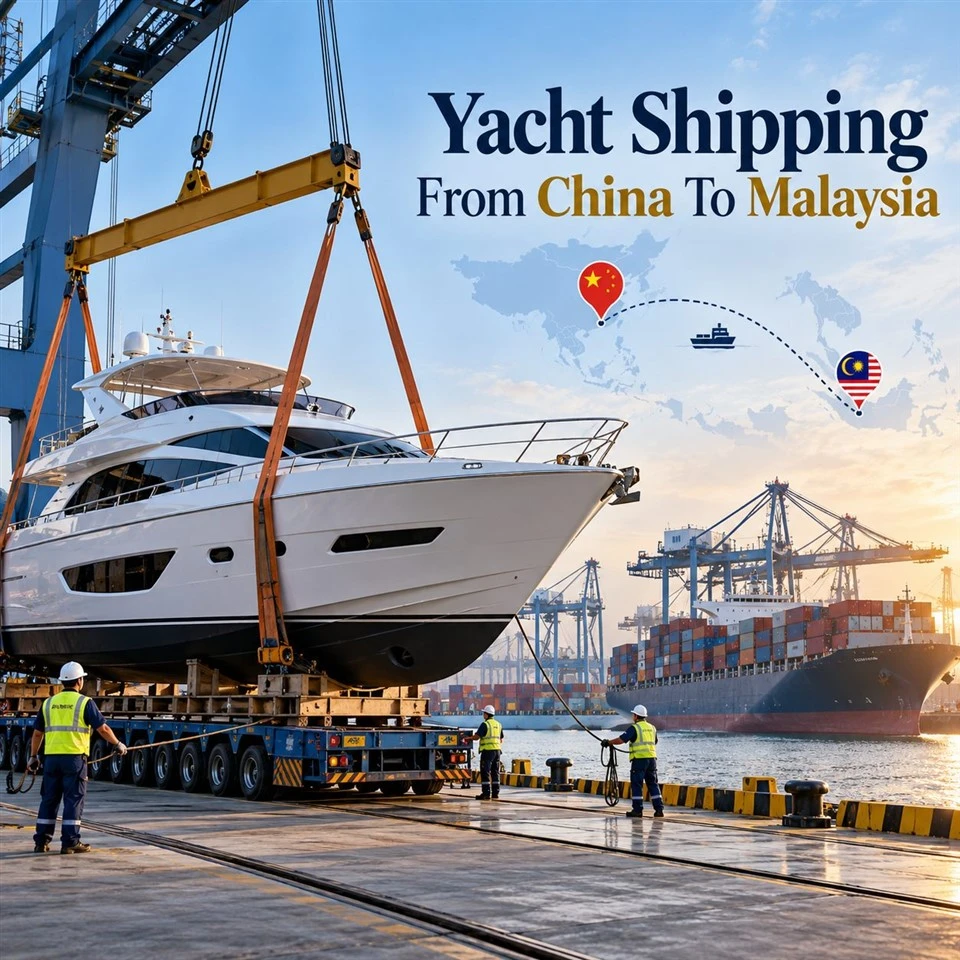
As maritime trade between China and Malaysia continues to expand, the demand for professional yacht and boat shipping services along this route has grown steadily. Whether you are a yacht dealer importing vessels from Chinese shipyards, a private owner relocating a pleasure craft, or a commercial operator moving patrol boats and workboats between the two countries, the logistics involved are far more complex than ordinary container freight. Yachts and high-value watercraft require specialised handling at every stage - from precise measurement and crane lifting to hull protection, custom cradle support, and heavy-duty lashing.
At Zhejiang Wilson Supply Chain Management Co., Ltd., we provide end-to-end yacht and boat logistics from China to Malaysia and from Malaysia back to China. Our service covers the full spectrum of watercraft, including yachts, speedboats, small boats, patrol boats, and other high-value vessels. Depending on the size, weight, and structure of each craft, we design a tailored shipping plan using Flat Rack containers, Open Top containers, Breakbulk (RoRo or lift-on/lift-off), or standard container shipping where the vessel's dimensions permit.
Estimated sea freight from major Chinese ports such as Shenzhen, Guangzhou, or Shanghai to Port Klang typically ranges from 7 to 15 sailing days, with overall door-to-door transit times of roughly 15 to 25 days depending on port operations, customs clearance, and inland delivery. Shipping costs vary widely based on vessel dimensions and the chosen transport method - a precise quotation can only be provided after we review your craft's specifications.
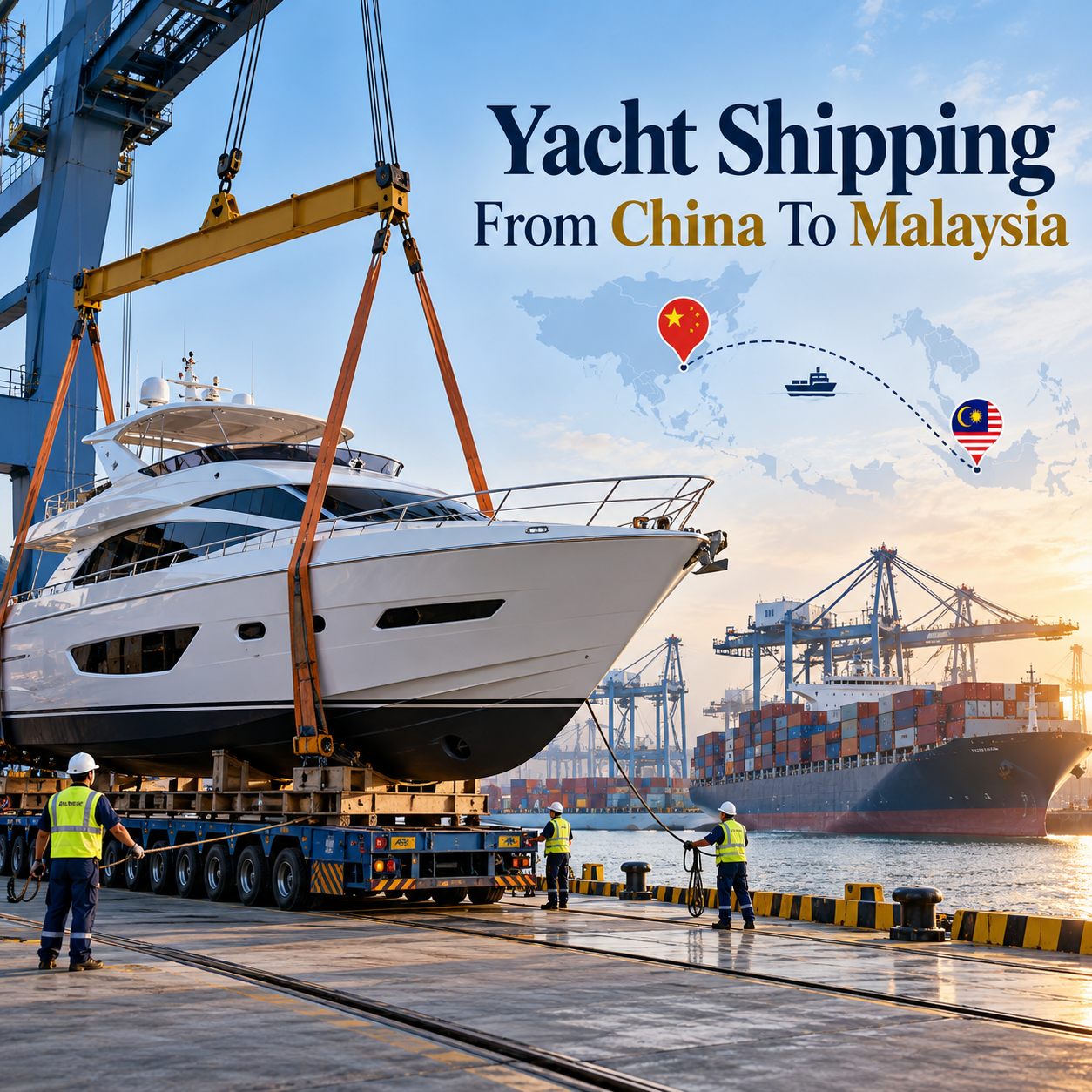
Cost of Shipping a Yacht From China to Malaysia
Because yachts and boats are oversized, high-value goods, there is no single flat rate that applies to every shipment. The final cost depends on the interaction of multiple factors - vessel dimensions, transport method, lifting requirements, and port conditions - all of which we evaluate before issuing a quotation.
The table below provides estimated cost ranges for the principal shipping methods used on the China-to-Malaysia route. These figures are indicative only; actual pricing will be confirmed after we assess your specific vessel and route requirements.
Table 1 Estimated Shipping Costs by Method (China to Malaysia)
| Shipping Method | Suitable Vessel Size | Estimated Cost Range (USD) | Key Cost Drivers |
|---|---|---|---|
| 20' Flat Rack | Up to approx. 6 m LOA | 1,800 – 3,500 | Base ocean freight + lifting + lashing |
| 40' Flat Rack | Approx. 6–12 m LOA | 3,200 – 6,500 | Larger cradle, heavier lift, more lashing material |
| 20' Open Top | Up to approx. 5.5 m LOA, low profile | 1,600 – 3,000 | Suitable for low-height vessels loaded from the top |
| 40' Open Top | Approx. 6–11 m LOA, low profile | 2,800 – 5,500 | Tarpaulin cover, top-loading crane operation |
| Breakbulk (Lo-Lo / RoRo) | Over 12 m LOA or oversized beam/height | 5,000 – 15,000+ | Vessel charter space, port heavy-lift equipment, stevedoring |
| Standard Container (40' HQ) | Small boats, dismantled, or inflatable RIBs under 12 m | 1,200 – 2,800 | Only when vessel fits within container internal dimensions |
All prices are for reference only. Actual costs depend on vessel specifications, season, carrier availability, and port conditions.
Factors That Influence Yacht Shipping Cost
Vessel dimensions (Length, Width, Height). The single most important cost driver. A vessel's overall length (LOA), beam (width), and height determine whether it can fit inside a standard container or must travel on a Flat Rack, Open Top, or Breakbulk. Even a few centimetres of excess height can force a shift from container to Flat Rack, substantially increasing cost.
Weight and displacement. Heavier vessels require stronger cradles, heavier-duty lifting gear, and more robust lashing chains. Weight also affects port handling fees, which are often calculated per ton for heavy-lift operations.
Transport method. Flat Rack and Open Top containers are generally more economical than Breakbulk for mid-sized vessels, but once a yacht exceeds container dimensions, Breakbulk becomes the only viable option. Container shipping is the most cost-effective method but is limited to small boats that fit within the container's internal dimensions (approximately 5.69 m × 2.13 m × 2.18 m for a 20' GP, or 11.8 m × 2.13 m × 2.72 m for a 40' HQ).
Lifting and crane requirements. Most yachts cannot be driven onto a container or vessel and must be lifted by crane. Port crane availability, crane capacity, and the need for spreader bars or lifting slings all add cost. Some smaller Malaysian ports have limited heavy-lift capability, which may require routing through Port Klang or Penang.
Cradle, support, and lashing. Every vessel requires a custom-built support cradle - typically steel or timber - engineered to distribute weight evenly and prevent hull stress. Lashing chains, tensioners, shock absorbers, and anti-friction pads are mandatory. These materials and their installation are a significant line item in the total cost.
Origin and destination ports. Shipping from Shenzhen or Guangzhou to Port Klang is generally less expensive than from Shanghai or Tianjin due to shorter sailing distances and more frequent direct sailings. Destination port selection also matters: Port Klang (West Port and North Port) is Malaysia's primary container terminal with the best heavy-lift infrastructure, while ports such as Penang, Pasir Gudang, or Kota Kinabalu may involve additional feeder or coastal transport costs.
How Yacht Shipping Cost Is Calculated
The basic calculation method combines several components:
- Base ocean freight - determined by the shipping method (Flat Rack, Open Top, Breakbulk, or container) and the carrier's tariff for the specific route.
- Lifting and stevedoring charges - crane hire at both origin and destination ports, including heavy-lift surcharges where applicable.
- Cradle and lashing material costs - custom-built support structures, chains, tensioners, padding, and protective wrapping.
- Port charges (THC, documentation, handling) - Terminal Handling Charges at both ends, document fees, customs broker fees.
- Origin inland transport - trucking the vessel from the shipyard or marina to the departure port, including any special permits for oversized road transport.
- Destination inland transport - trucking from Port Klang or other arrival port to the final marina or delivery address in Malaysia.
- Insurance - marine cargo insurance for high-value vessels, typically calculated as a percentage of the declared cargo value.
For Breakbulk shipments, cost is often quoted per cubic metre (CBM) or per freight ton (revenue ton, the greater of weight in tonnes or volume in CBM), with additional heavy-lift and stevedoring surcharges applied separately.
For a precise quote tailored to your specific cargo, origin, and delivery terms, reach out to our team for a detailed breakdown.
Get Latest Ocean Freight Rates Now
Transit Time for Yacht Shipping From China to Malaysia
Transit time for yacht shipping depends on the departure port, arrival port, shipping method, and the operational steps required at each end. The table below provides estimated transit times for the most common port pairs on the China-to-Malaysia route.
Table 2 Estimated Transit Times by Port Pair (China to Malaysia)
| Departure Port (China) | Arrival Port (Malaysia) | Port-to-Port Sailing | Door-to-Door (Estimated) |
|---|---|---|---|
| Shenzhen (Shekou / Yantian) | Port Klang | 5 – 7 days | 15 – 20 days |
| Guangzhou (Nansha) | Port Klang | 5 – 8 days | 15 – 20 days |
| Shanghai | Port Klang | 7 – 10 days | 18 – 25 days |
| Ningbo | Port Klang | 7 – 10 days | 18 – 25 days |
| Qingdao | Port Klang | 9 – 12 days | 20 – 28 days |
| Tianjin (Xingang) | Port Klang | 10 – 14 days | 22 – 30 days |
| Shenzhen / Guangzhou | Penang (Butterworth) | 7 – 10 days | 18 – 25 days |
| Shenzhen / Guangzhou | Pasir Gudang (Johor) | 6 – 9 days | 16 – 22 days |
All transit times are for reference only. Actual schedules depend on carrier, season, and port conditions.
Factors Affecting Transit Time
Vessel schedule and frequency. Direct sailings from South China to Port Klang are frequent - often several departures per week - which keeps waiting time short. Ports further north (Shanghai, Qingdao, Tianjin) have fewer direct services and may require transhipment via Singapore or Kaohsiung, adding several days.
Routing and transhipment. Some services route through Singapore, the region's major transhipment hub, before feeder vessels carry cargo to Port Klang or other Malaysian ports. Each transhipment adds 2 to 5 days.
Port operations. Heavy-lift operations for yachts require special scheduling - cranes must be available, and the vessel must be loaded or discharged outside peak container-handling windows. This can add 1 to 3 days at each port.
Lifting and securing. The physical process of lifting a yacht onto a Flat Rack or Breakbulk vessel, building the cradle, and completing lashing typically takes 1 to 2 days at the origin port. Discharge at the destination requires similar time.
Customs clearance. Export customs declaration in China and import customs clearance in Malaysia each take 1 to 3 days under normal conditions. Yachts may attract additional scrutiny due to their high value and specific HS code classification, which can extend clearance time if documentation is incomplete.
Inland transport at destination. Moving a yacht by road from Port Klang to a marina in Kuala Lumpur, Putrajaya, or Johor Bahru requires special permits for oversized loads and may be restricted to night-time or specific routes, adding 1 to 3 days.
All freight rates and transit times quoted on this page are for reference only. For a real-time shipping plan tailored to your vessel and schedule, please contact us with your craft details.
Yacht and Boat Shipping Services From China to Malaysia
We provide a comprehensive range of specialised logistics services for yachts, boats, and high-value watercraft moving between China and Malaysia. Our capabilities cover every vessel type and every transport method required by the diversity of craft in this trade.
Vessel Types We Handle
| Category | Typical Examples | Common Transport Method |
|---|---|---|
| Yachts | Motor yachts, sailing yachts, luxury cruisers | Flat Rack, Open Top, or Breakbulk depending on size |
| Speedboats | High-speed motorboats, racing boats, RIBs | Flat Rack or 40' container (if trailer-mounted) |
| Small Boats | Dinghies, inflatables, kayaks, small fishing boats | Standard container or LCL |
| Patrol Boats | Police patrol boats, coast guard vessels, harbour patrol craft | Flat Rack or Breakbulk (often government/ institutional shipments) |
| Other High-Value Craft | Survey vessels, workboats, commercial boats, ferry components | Breakbulk or Flat Rack with custom engineering |
Transport Methods
Flat Rack shipping. The most common method for mid-sized yachts and boats. A Flat Rack is a container platform with no walls or roof, allowing the vessel to sit on a custom cradle and be lashed directly to the platform. 20' Flat Racks suit vessels up to approximately 6 m, while 40' Flat Racks accommodate craft up to about 12 m. The open structure permits crane loading from above or the side.
Open Top shipping. Similar to a standard container but with a removable tarpaulin top, allowing top-loading by crane. Open Top containers suit vessels with low profiles that fit within the container's length and width but are too tall for a standard closed container. A 40' Open Top can carry vessels up to approximately 11 m if height permits.
Breakbulk shipping. For vessels that exceed container dimensions - typically over 12 m LOA, or with excessive beam or height - the craft is loaded directly onto the deck or in the hold of a multipurpose or Breakbulk vessel, either by crane (lift-on/lift-off) or by sailing or driving the vessel on (Roll-on/Roll-off, where a ramp is available). Breakbulk is the most flexible method for large or unusual craft but is also the most expensive.
Container shipping. Standard 20' GP, 40' GP, or 40' HQ containers can be used for small boats, inflatable craft, or vessels that can be partially dismantled (mast removed, console detached, etc.) and packed within the container's internal dimensions. This is the most economical option but is viable only for a limited range of craft.
Full-Service Logistics Coverage
Our yacht and boat shipping service is not limited to ocean transport. We manage the entire logistics chain on both the China-to-Malaysia and Malaysia-to-China directions:
Domestic pickup. We arrange specialised low-bed trailers and oversized-load transport permits to collect vessels from shipyards, marinas, factories, or private addresses anywhere in China - from Guangdong and Fujian shipbuilding clusters to Shandong and Zhejiang yards.
Warehousing and staging. Short-term storage at port-side warehouses, with secure compounds for high-value vessels awaiting vessel loading windows.
Loading, lifting, and crane operations. We coordinate port crane operations, select appropriate lifting slings and spreader bars, and supervise every lift to ensure the hull is not stressed or damaged.
Hull protection. Every vessel is wrapped in protective materials - bubble wrap, corrugated board, shrink wrap, or custom timber crating for vulnerable areas such as windshields, railings, and gelcoat surfaces.
Custom cradle and support. We engineer and fabricate vessel-specific cradles - steel or timber - designed to match the hull shape, distribute weight evenly, and prevent any point loading that could deform the hull during transport.
Lashing and securing. Heavy-duty chains, turnbuckles, tensioners, and shock-absorbing lashing systems secure the vessel to the Flat Rack, container floor, or Breakbulk deck. Anti-friction pads prevent chafing, and additional bracing prevents fore-and-aft or lateral movement.
Anti-scratch, anti-collision, and anti-shift measures. All contact points between the vessel and its cradle, supports, or lashing are padded. We use fendering and buffer materials to prevent collision damage during loading, transport, and discharge.
Export customs declaration. We handle the full export clearance process in China, including HS code classification (typically under HS 8903 for pleasure boats and yachts), preparation of commercial invoices, packing lists, and coordination with China Customs for inspection and release.
International transport tracking. Throughout the ocean voyage, we provide shipment status updates - from vessel departure and mid-voyage position to arrival and discharge - so you always know where your vessel is.
Destination port coordination. At Port Klang, Penang, Pasir Gudang, or other Malaysian ports, we arrange discharge, customs clearance assistance, and onward inland transport to the final marina or delivery address.
Tailored Solutions for Every Vessel
No two yachts are identical, and we never apply a one-size-fits-all approach. For each shipment, our team conducts a detailed assessment of the vessel's dimensions, weight, hull material, engine configuration, centre of gravity, and any protruding features (flybridge, radar arch, outriggers). Based on this assessment, we design a shipping plan that selects the optimal transport method, cradle design, lifting plan, and lashing configuration - ensuring the vessel arrives in the same condition it left.
Yacht Shipping Process From China to Malaysia
A well-structured process is essential for shipping high-value, oversized vessels safely and on time. Below is the complete workflow we follow for every yacht and boat shipment between China and Malaysia, applicable to both export (China to Malaysia) and import (Malaysia to China) directions.
Step-by-Step Shipping Workflow
| Step | Activity | Description |
|---|---|---|
| 1 | Enquiry and requirement submission | Client provides vessel details and shipping requirements |
| 2 | Vessel information confirmation | We verify dimensions, weight, photos, and technical specs |
| 3 | Transport feasibility assessment | We evaluate whether the vessel fits Flat Rack, Open Top, Breakbulk, or container |
| 4 | Shipping plan design | We engineer the cradle, lifting plan, lashing configuration, and route |
| 5 | Quotation and booking | We issue a detailed quote and, upon confirmation, book vessel space |
| 6 | Domestic pickup | Specialised trailer collects the vessel from shipyard, marina, or factory |
| 7 | Loading preparation | Cradle fabrication, hull wrapping, protective measures applied at port |
| 8 | Lifting and securing | Crane lift onto Flat Rack or Breakbulk deck; cradle positioned; lashing completed |
| 9 | Export customs declaration | China Customs export clearance, HS code filing, inspection, and release |
| 10 | International ocean transport | Vessel sails from Chinese port to Port Klang or other Malaysian port |
| 11 | Destination port coordination | Discharge, Malaysian import customs assistance, and inland delivery to final address |
Information You Need to Provide
To design an accurate shipping plan and quotation, we need the following details about your vessel. The more complete this information, the more precise our proposal will be:
| Information Category | Specific Details Required |
|---|---|
| Vessel brand and model | Manufacturer name, model name/number, year of build |
| Dimensions | Overall length (LOA), beam (width), height (from keel to highest point - flybridge, radar arch, or windscreen) |
| Weight | Dry weight, displacement, or shipping weight including any trailer |
| Hull photos | Clear photos showing side profile, top view, stern, bow, and any protruding features |
| Hull material | Fibreglass (GRP), aluminium, steel, carbon fibre, wood, or inflatable (Hypalon/PVC) |
| Engine information | Engine brand, model, number of engines, fuel type, and whether engines are installed or shipped separately |
| Cargo value | Declared value for insurance and customs purposes |
| Pickup address | Full address of shipyard, marina, factory, or current location |
| Ownership and trade documents | Bill of sale, builder's certificate, previous registration/deletion certificate, commercial invoice |
| Destination details | Final delivery address in Malaysia (or in China for import direction), marina name, or port of discharge |
For import shipments from Malaysia to China, additional documents may include the Malaysian vessel registration deletion certificate, proof of ownership transfer, and any applicable import permits depending on the vessel's intended use in China.
Why Choose Wilson for Your Yacht Shipping
Choosing the right freight forwarder for yacht and high-value vessel transport is a decision that directly affects the safety of your asset and the reliability of your delivery timeline. Below are the core advantages that distinguish our service.
| Advantage | What It Means for You |
|---|---|
| International freight forwarding experience | Founded in 2011, with over a decade of cross-border logistics operations and a team of 26 professionals handling complex shipments |
| Specialised yacht and high-value vessel capability | Proven experience shipping yachts, speedboats, patrol boats, and other high-value watercraft - including actual boat shipping projects to Malaysia |
| Complex cargo solution design | We engineer transport plans for oversized, overweight, and irregular cargo - not just standard container freight |
| Professional lifting and loading planning | Every lift is pre-planned with crane capacity checks, sling configurations, and spreader bar selection tailored to the vessel's weight and centre of gravity |
| Hull protection and lashing expertise | Custom cradles, anti-scratch padding, heavy-duty chain lashing, and anti-shift bracing designed for each vessel's hull shape and structure |
| Global carrier partnerships | Working relationships with major shipping lines including COSCO, Hapag-Lloyd, Maersk, MSC, and Evergreen - ensuring reliable space allocation and competitive rates |
| Professional logistics team | A dedicated team experienced in Southeast Asian routes, with deep knowledge of port conditions, customs procedures, and local regulations on both sides |
| Digital shipment tracking | Real-time status updates from pickup through ocean transport to destination discharge |
| One-stop supply chain service | From domestic pickup and export clearance to ocean freight, destination customs assistance, and inland delivery - a single point of contact for the entire journey |
Our approach is built on a simple principle: every vessel is unique, and every shipping plan must be engineered to match. We do not treat yachts as ordinary freight. From the first measurement to the final delivery, our team applies the same level of care and technical precision regardless of vessel size or value.
China–Malaysia Yacht and Boat Trade Overview
China and Malaysia share one of the most active bilateral trade relationships in Southeast Asia. China has been Malaysia's largest trading partner for over a decade, and Malaysia is China's largest trading partner among ASEAN countries. Within this broad trade relationship, the movement of yachts, pleasure boats, speedboats, and related marine equipment represents a growing niche driven by rising maritime leisure activity, coastal tourism development, and commercial vessel procurement on both sides.
China's Exports to Malaysia
China is a significant exporter of pleasure and sports boats, classified under HS code 8903, which covers yachts, motorboats, sailboats, inflatable craft, and other recreational vessels. Chinese shipyards - concentrated in Guangdong (Zhuhai, Zhongshan), Shandong, and Zhejiang - produce a wide range of watercraft from small inflatable RIBs and speedboats to mid-sized motor yachts and commercial patrol craft.
Key export categories from China to Malaysia include:
| Product Category | HS Code | Typical Examples |
|---|---|---|
| Motorboats (outboard) | 8903.92 | Speedboats, RIBs, small fishing boats |
| Motorboats (inboard) | 8903.32 / 8903.99 | Motor yachts, cabin cruisers, patrol boats |
| Sailboats | 8903.91 | Sailing yachts, dinghies |
| Inflatable craft | 8903.10 | Inflatable boats, rescue boats, kayaks |
| Other pleasure/sports vessels | 8903.99 | Wakeboard boats, jet ski components, specialty craft |
Malaysia's growing marine tourism sector - particularly around Langkawi, Penang, Tioman, and the East Coast - drives demand for imported pleasure craft. Additionally, Malaysian government agencies and port operators source patrol boats and workboats from Chinese manufacturers, supported by competitive pricing and established production capacity.
Malaysia's Exports to China
Malaysia also exports marine vessels and related equipment to China, though the volume is smaller than the reverse flow. Malaysian-built craft, re-exported used yachts, and marine components find buyers in China's expanding leisure boating markets - particularly in Hainan, which has developed into China's premier yachting hub with marina infrastructure at Sanya and Haikou.
Malaysian exports to China in this category include:
| Product Category | Direction | Typical Examples |
|---|---|---|
| Used and re-exported yachts | Malaysia to China | Pre-owned motor yachts and sailboats sourced from Southeast Asian or European origins |
| Marine engines and components | Malaysia to China | Outboard motors, marine parts, and accessories (often re-exported through Malaysian trade hubs) |
| Small commercial vessels | Malaysia to China | Workboats, ferries, and specialised craft from Malaysian boatyards |
Bilateral Trade Context
Under the ASEAN–China Free Trade Area (ACFTA) framework and the Regional Comprehensive Economic Partnership (RCEP) agreement - which entered into force for Malaysia in March 2022 - many goods traded between China and Malaysia benefit from preferential tariff rates. For vessels classified under HS 8903, the applicable tariff treatment depends on the specific sub-heading, the vessel's origin, and whether a valid preferential certificate of origin (Form E under ACFTA) is presented at customs.
The growth in bilateral vessel trade reflects broader trends: China's shipbuilding industry has expanded its recreational and commercial boat production capacity, while Malaysia's maritime leisure and commercial sectors continue to develop. This two-way trade creates consistent demand for professional yacht and boat shipping services in both directions - a demand we are equipped to meet with specialised logistics capabilities on both the export and import legs.
Regulations and Policies for Yacht Import and Export Between China and Malaysia
Shipping a yacht or boat between China and Malaysia involves compliance with customs regulations, maritime registration requirements, and tax obligations in both countries. The specific requirements differ depending on whether the vessel is being exported from China, imported into Malaysia, or moved in the reverse direction. Below is a summary of the key regulatory considerations based on publicly available information from the relevant authorities.
Customs Classification
Yachts, pleasure boats, and recreational vessels are classified under HS Chapter 89, heading 8903, which covers "yachts and other vessels for pleasure or sports; rowing boats and canoes." The sub-headings under HS 8903 distinguish between inflatable craft (8903.10), sailboats (8903.91), motorboats with outboard motors (8903.92), and other motorboats by length (8903.31, 8903.32, 8903.39, 8903.99). The correct sub-heading must be identified at the time of customs declaration, as it determines the applicable tariff rate and any regulatory requirements.
Export From China
When exporting a yacht from China, the following applies:
| Requirement | Details |
|---|---|
| Exporter qualification | The exporter must hold import/export registration with China Customs and a valid customs registration code |
| Customs declaration | A formal export declaration is filed via China's electronic customs system (China E-Port), including commercial invoice, packing list, and contract |
| HS code declaration | The vessel is declared under the appropriate HS 8903 sub-heading, with declaration elements including brand, model, length, engine type, and engine power |
| Export licence | Standard pleasure yachts generally do not require a special export licence; however, vessels with military, police, or dual-use characteristics may be subject to export control review under China's Export Control Law |
| Inspection and quarantine | China Customs may conduct inspection of the exported vessel; inspection certificates may be required depending on the vessel type and destination |
Import Into Malaysia
When importing a yacht into Malaysia, the following regulatory framework applies, administered primarily by Royal Malaysian Customs (KDRM) and the Marine Department of Malaysia (Jabatan Laut Malaysia) under the Ministry of Transport:
| Requirement | Authority / Details |
|---|---|
| Import declaration | A Customs Form No. 1 is filed with Royal Malaysian Customs, accompanied by commercial invoice, packing list, bill of lading, and any required permits |
| Import duty | Import duty rates vary by HS code classification; under ACFTA/RCEP, goods with Malaysian-origin certification may benefit from preferential rates. Duty is generally assessed on the CIF value (cost + insurance + freight) |
| Sales Tax (SST) | Malaysia applies a Sales and Service Tax (SST) system. The standard sales tax rate is 10%, applied to imported goods. The sales tax is calculated on the CIF value plus any applicable import duty. Specific rates should be confirmed with Royal Malaysian Customs via the MySST system, as certain categories may be subject to different treatment |
| Import permit | Depending on the vessel type and intended use, an import permit (AP - Approved Permit) may be required from the Ministry of Investment, Trade and Industry (MITI). Applications are submitted through the DagangNet system. Permit requirements and approval timelines vary by category |
| Vessel registration | Vessels intended for use in Malaysian waters must be registered with the Marine Department of Malaysia. Registration requirements include proof of ownership, builder's certificate, tonnage measurement, and compliance with the Merchant Shipping Ordinance 1952 |
| Safety and technical standards | Vessels must comply with Malaysian maritime safety standards. The Marine Department may require survey certificates, safety equipment certification, and compliance with environmental regulations including engine emission standards |
| Temporary import vs. permanent import | Temporary import (for repair, exhibition, or short-term use) may be permitted under customs bond or ATA Carnet arrangements, deferring duty and tax payment. Permanent import requires full payment of applicable duties and taxes and completion of the registration process |
| Engine and environmental requirements | Marine engines must comply with applicable emission and environmental standards. Certain engine types may require separate declaration and certification |
Import Into China (Reverse Direction)
For vessels imported from Malaysia into China, the following applies:
| Requirement | Details |
|---|---|
| Import declaration | Filed with China Customs under the appropriate HS 8903 sub-heading, with commercial invoice, packing list, bill of lading, and certificate of origin |
| Import duty and VAT | Import duty and import-stage VAT apply; rates depend on the specific HS sub-heading and the applicable tariff treatment (MFN rate or preferential rate under ACFTA/RCEP if a valid Form E is presented). VAT on imported goods is generally 13% |
| Consumption tax | Certain luxury or large-displacement vessels may be subject to consumption tax; applicability depends on the vessel classification and specifications |
| Vessel registration | Vessels intended for use in Chinese waters must be registered with the China Maritime Safety Administration (MSA) under the Vessel Registration Regulations. Requirements include ownership certificate, vessel survey certificate, nationality certificate, and compliance with the Yacht Safety Management Provisions |
| Ownership documentation | Bill of sale, builder's certificate, and deletion certificate from the previous registration jurisdiction must be provided |
| Hainan Free Trade Port policy | Under the Hainan FTP "zero-tariff" policy for transport vehicles and yachts, eligible enterprises registered in Hainan and engaged in transport or tourism may import yachts with exemption from import duty, import-stage VAT, and consumption tax, subject to specific qualification criteria and customs supervision |
Important Notes on Policy Compliance
The regulatory information above is summarised from publicly available sources including Royal Malaysian Customs, the Marine Department of Malaysia, the Ministry of Transport Malaysia, China Customs, and the China Maritime Safety Administration. Regulations and tariff rates are subject to change. We strongly recommend confirming the current requirements with the relevant authorities or a licensed customs broker before finalising any shipment. Our team can assist in coordinating with customs brokers and regulatory consultants on both sides to ensure your shipment complies with all applicable rules.
FAQ
Q: 1. How much does it cost to ship a yacht from China to Malaysia?
A: The cost depends primarily on the vessel's dimensions, weight, and the chosen transport method. For a mid-sized motorboat (approximately 8–10 m) shipped on a 40' Flat Rack from Shenzhen to Port Klang, estimated costs typically range from USD 3,200 to USD 6,500, including ocean freight, lifting, cradle, and lashing. Larger yachts requiring Breakbulk shipping can cost significantly more. We provide a precise quotation after reviewing your vessel's specifications. All prices are for reference only.
Q: 2. How long does yacht shipping take from China to Malaysia?
A: Port-to-port sailing time from South China (Shenzhen, Guangzhou) to Port Klang is approximately 5 to 7 days; from Shanghai or Ningbo, 7 to 10 days; from Qingdao or Tianjin, 9 to 14 days. Including domestic pickup, loading, export clearance, ocean transport, destination discharge, import clearance, and inland delivery, the total door-to-door time is typically 15 to 25 days from South China and 18 to 30 days from North China. All transit times are for reference only.
Q: 3. What is the difference between Flat Rack and Breakbulk shipping for yachts?
A: Flat Rack shipping places the vessel on a container-sized platform (20' or 40') that is loaded onto a container vessel. It is suitable for yachts up to approximately 12 m that fit within the platform's dimensions. Breakbulk shipping loads the vessel directly onto the deck or hold of a multipurpose vessel, either by crane or via a ramp. Breakbulk is used for yachts exceeding container dimensions - typically over 12 m LOA or with excessive beam or height. Flat Rack is generally more economical; Breakbulk offers greater size flexibility but at higher cost.
Q: 4. How are oversized yachts transported if they exceed container dimensions?
A: Yachts that exceed the maximum dimensions of a 40' Flat Rack (approximately 12 m length, 2.35 m width on platform) are shipped via Breakbulk. The vessel is lifted by port crane directly onto the deck of a multipurpose or project cargo vessel, secured on a custom-built cradle, and lashed with heavy-duty chains. For exceptionally large yachts, we may arrange a dedicated vessel charter or deck-space booking on a Breakbulk service. Each case requires a custom engineering assessment.
Q: 5. How is the yacht protected during lifting and transport?
A: Every vessel receives comprehensive protection: the hull is wrapped in protective materials (bubble wrap, corrugated board, or shrink wrap), vulnerable areas such as windshields and railings are individually crated or padded, and all contact points between the vessel and its cradle are lined with anti-friction pads. During lifting, we use soft slings or spreader bars configured to distribute load evenly across the hull, preventing point stress. Lashing chains are padded where they contact the hull, and additional bracing prevents any movement during the voyage.
Q: 6. What documents do I need to provide for yacht shipping?
A: You will need to provide: vessel brand, model, and year of build; overall dimensions (length, beam, height); weight; hull photos; hull material; engine details (brand, model, power); declared cargo value; pickup address; and ownership/trade documents (bill of sale, builder's certificate, previous registration or deletion certificate, commercial invoice). For import into Malaysia, an import permit (AP) may be required from MITI. For import into China, a certificate of origin (Form E) may be needed for preferential tariff treatment. Our team will provide a complete document checklist tailored to your shipment direction.
Q: 7. Do I need marine cargo insurance for my yacht shipment?
A: We strongly recommend marine cargo insurance for all yacht and high-value vessel shipments. Insurance is typically calculated as a percentage of the declared cargo value and covers risks during loading, ocean transport, and discharge. While our handling procedures are designed to minimise risk, insurance provides financial protection against events beyond our control. We can assist in arranging insurance coverage through our partner providers, or you may use your own insurer.
Q: 8. What import duties and taxes apply when importing a yacht into Malaysia?
A: Import duty rates vary by HS code classification under heading 8903. In addition, Malaysia applies a Sales Tax (SST) at the standard rate of 10% on imported goods, calculated on the CIF value plus any applicable import duty. Under ACFTA/RCEP, vessels with Chinese origin and a valid Form E certificate of origin may benefit from preferential tariff treatment. An import permit (AP) may also be required from MITI depending on the vessel category. Specific rates and permit requirements should be confirmed with Royal Malaysian Customs and MITI before shipment, as they are subject to change.
Q: 9. Do you provide door-to-door yacht shipping service?
A: Yes. Our service covers the full chain from domestic pickup at the origin address in China (or Malaysia for reverse shipments) through ocean transport, customs clearance assistance, and inland delivery to the final marina or destination address. Door-to-door service includes specialised road transport with oversized-load permits, port-side handling, and coordination with destination marinas for crane discharge and launching.
Q: 10. Can you ship a used or second-hand yacht?
A: Yes, we handle both new and used vessels. For used yachts, additional documentation is typically required, including the deletion certificate from the previous registration jurisdiction, proof of ownership transfer, and in some cases a pre-shipment survey report. Import regulations for used vessels may differ from those for new craft - particularly in China, where used yacht imports are subject to specific customs and maritime requirements. We will advise on the exact requirements based on your vessel and import direction.
Email: lucy@ylls.net | gm@wilson-cargo.com | jy@wilson-cargo.com
Phone: +86 195 5809 8285
Hot Tags: Yacht Shipping From China To Malaysia