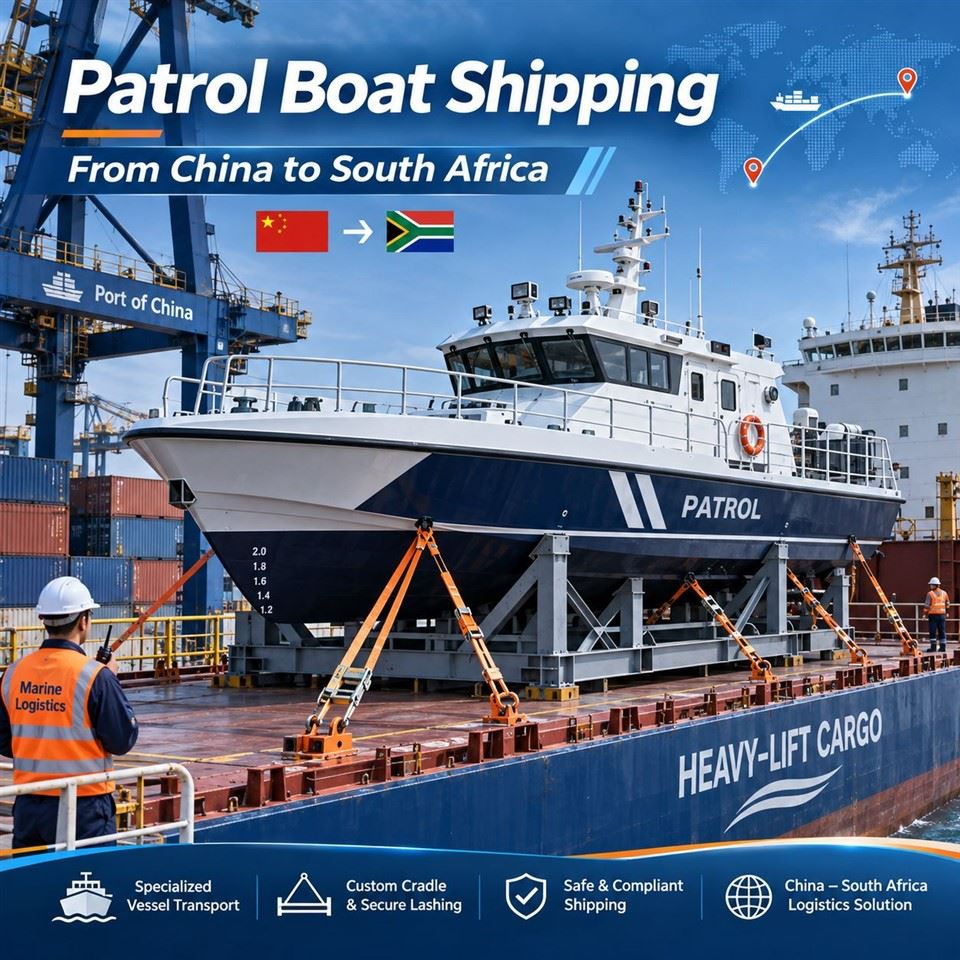
Maritime trade between China and South Africa has grown steadily over the past decade, with China remaining South Africa's largest trading partner and South Africa serving as China's biggest trade partner in Africa. While bulk commodities and manufactured goods dominate the headline figures, a growing segment of this trade involves high-value vessels - yachts, speedboats, small boats, patrol boats, and other specialised marine craft - moving in both directions between Chinese ports and South African harbours such as Durban, Cape Town, and Port Elizabeth (Ngqura).
Whether you are a Chinese boat manufacturer exporting vessels to South African buyers, a South African yacht dealer sourcing vessels from Chinese shipyards, or a government agency importing patrol boats for maritime security operations, the shipping requirements for these cargo types are fundamentally different from standard containerised freight. Boats and yachts are oversized, high-value, and structurally delicate goods that demand specialised transport methods, professional lifting and cradling, and meticulous securing to prevent damage during ocean transit.
At Zhejiang Wilson Supply Chain Management Co., Ltd., we provide end-to-end vessel shipping services from China to South Africa and from South Africa to China, covering the full range of transport methods - Flat Rack, Open Top, Breakbulk, and, where dimensions permit, standard Container Shipping. Our service scope encompasses Yachts, Speedboats, Small Boats, Patrol Boats, and other high-value marine vessels of varying sizes and configurations. Estimated shipping costs from China to South Africa typically range from USD 3,500 to USD 18,000 per vessel depending on size, transport method, and route, with ocean transit times of approximately 25 to 40 days for direct services. All rates and transit times quoted in this page are for reference only; actual pricing and schedules are confirmed based on your specific vessel and shipping requirements.
If you have a boat, yacht, or patrol vessel to ship between China and South Africa, contact us today for a tailored transport solution and a detailed quotation.

Cost of Shipping Boats and Yachts from China to South Africa
Shipping costs for boats and yachts are determined by a combination of vessel dimensions, weight, transport method, lifting requirements, securing and cradling needs, origin port, destination port, and prevailing market conditions. Because no two vessels are identical, each shipment requires a customised cost assessment rather than a one-size-fits-all rate.
The table below provides estimated shipping costs for common transport methods used for boat and yacht shipments from major Chinese ports (such as Shanghai, Ningbo, Shenzhen, and Qingdao) to South African ports (primarily Durban and Cape Town). These figures are indicative ranges only and should not be treated as a formal quotation.
Table 1: Estimated Shipping Costs by Transport Method (China to South Africa)
| Transport Method | Suitable Vessel Types | Estimated Cost Range (USD) | Key Cost Drivers |
|---|---|---|---|
| Flat Rack (20FR / 40FR) | Motorboats, speedboats, small yachts up to approx. 12m LOA | 3,500–7,500 | Vessel length and height, over-dimensional surcharges, lashing and cradle |
| Open Top Container (20OT / 40OT) | Small boats, rigid inflatable boats, vessels with low profile | 3,200–6,500 | Container availability, height clearance, loading method |
| Breakbulk (Ro-Ro or Lift-On/Lift-Off) | Large yachts, patrol boats, multi-vessel consignments | 6,000–18,000+ | Vessel tonnage, deck space, crane lift, stevedoring, port handling |
| Standard Container (20GP / 40GP / 40HQ) | Disassembled boats, inflatable boats, small craft under 6m, parts and components | 2,800–5,500 | Container type, weight, LCL or FCL, origin and destination THC |
Several factors influence the final shipping cost beyond the base freight rate:
Vessel dimensions (Length, Width, Height). The single most important cost driver. A vessel that fits within standard Flat Rack or Open Top dimensions (for example, a 40FR platform measures approximately 12.19m × 2.44m at the base with a maximum payload height of about 2.7m under the rails) will cost significantly less than one that exceeds these limits and requires Breakbulk shipping. Every additional metre of length or height can shift the transport method and increase the rate.
Vessel weight. Heavy vessels require reinforced cradles, higher-capacity lifting equipment, and in some cases specialised deck reinforcement. Weight also affects port handling charges and any road transport costs for inland movement to or from the port.
Transport method selection. Flat Rack and Open Top containers are generally the most cost-effective options for vessels that fit within their dimensional limits. Breakbulk shipping becomes necessary for larger yachts and patrol boats that cannot be accommodated on Flat Racks, and it carries a premium for deck space, crane operations, and stevedoring. Standard container shipping is only viable for small craft, disassembled vessels, or boat parts - it is not appropriate for a complete yacht or patrol boat of any significant size.
Lifting and cradling requirements. Professional cradle fabrication, custom steel supports, and crane lifting services add to the total cost. A well-engineered cradle is essential not only for safe loading but also for protecting the hull throughout the voyage.
Securing and lashing. Marine-grade lashing chains, turnbuckles, tensioners, and shock-absorbing materials are required to immobilise the vessel against the dynamic forces of ocean transit. The complexity of the lashing plan directly affects labour and material costs.
Origin and destination ports. Durban is South Africa's largest and busiest container port, handling approximately 60% of the country's container throughput, and generally offers the most competitive rates and frequent sailings. Cape Town serves as the second major gateway. Port selection affects both the ocean freight rate and the destination port handling charges (THC), documentation fees, and customs clearance costs.
The basic calculation method for boat shipping costs is:
Total Cost = Base Ocean Freight + Origin Charges (inland transport, loading, cradle, lashing, export customs clearance, THC, documentation) + Destination Charges (THC, customs clearance, duties and taxes, inland delivery if required).
Surcharges such as Bunker Adjustment Factor (BAF), Peak Season Surcharge (PSS), and Currency Adjustment Factor (CAF) may apply depending on market conditions and carrier policies.
For shipments from South Africa to China, the same cost structure applies in reverse, with origin charges at the South African port and destination charges at the Chinese port. Import duties and taxes in China for yachts and pleasure boats under HS Chapter 89.03 can be substantial, and this should be factored into the total landed cost.
For a precise quote tailored to your specific cargo, origin, and delivery terms, reach out to our team for a detailed breakdown
Get Latest Ocean Freight Rates Now
Transit Time for Shipping Boats and Yachts from China to South Africa
Transit times for vessel shipments from China to South Africa depend primarily on the shipping route, whether the service is direct or transhipment, the carrier's sailing schedule, and port handling efficiency at both ends. The table below provides estimated transit times from major Chinese origin ports to the principal South African destination ports.
Table 2: Estimated Transit Times by Route (China to South Africa)
| Origin Port (China) | Destination Port (South Africa) | Service Type | Estimated Transit Time (Days) |
|---|---|---|---|
| Shanghai | Durban | Direct | 28–35 |
| Shanghai | Durban | Transhipment (via Singapore) | 35–42 |
| Ningbo | Durban | Direct | 27–34 |
| Shenzhen / Shekou | Durban | Direct | 25–32 |
| Shenzhen / Shekou | Cape Town | Direct | 28–35 |
| Shanghai | Cape Town | Transhipment (via Singapore or Colombo) | 33–42 |
| Qingdao | Durban | Direct | 30–38 |
| Guangzhou | Durban | Direct | 26–33 |
Several factors influence the actual transit time:
Sailing schedules and frequency. Major carriers including Maersk, MSC, CMA CGM, and COSCO operate regular services between Asia and South Africa. Direct sailings from southern Chinese ports such as Shenzhen and Guangzhou to Durban tend to offer the shortest transit times. During peak shipping seasons, vessel space on Flat Rack and Breakbulk services can become tight, potentially delaying the next available sailing.
Route and transhipment. Direct services are faster but may have less frequent departures. Transhipment routes via Singapore, Port Klang, or Colombo offer more sailing options but add 5 to 10 days to the overall transit time. For Breakbulk shipments, the availability of suitable vessels on a particular route may require flexibility in scheduling.
Port operations. Durban, as the busiest container port in Africa, generally offers efficient handling, but periodic congestion, labour disruptions, or weather events can cause delays. Cape Town port operations can be affected by strong winds, particularly during the southern hemisphere spring and summer months.
Lifting and loading. Breakbulk and Flat Rack shipments require crane operations and careful positioning, which take longer than standard container loading. Allow additional time at the origin port for cradle placement, lifting, and lashing - typically 1 to 3 working days depending on vessel size and complexity.
Customs clearance. Export customs clearance in China typically takes 1 to 2 working days with complete documentation. Import customs clearance in South Africa generally takes 3 to 7 working days, provided all documents are in order. Incomplete or incorrect documentation, HS code disputes, or customs inspections can extend this to 7 to 15 days.
All freight rates and transit times quoted in this page are for reference only. Actual schedules, routing, and costs are subject to carrier availability, market conditions, and the specific characteristics of your vessel.
Contact us for a real-time shipping solution tailored to your vessel and timeline.
Get Latest Ocean Freight Rates Now
Boat and Yacht Shipping Services from China to South Africa
We offer a comprehensive suite of specialised vessel logistics services designed to handle the unique requirements of boat and yacht transportation between China and South Africa. Our services cover both export shipments from China to South Africa and import shipments from South Africa to China.
Vessel types handled. We transport a full range of marine vessels, including luxury yachts, motor yachts, sailing yachts, speedboats, rigid inflatable boats (RIBs), small recreational boats, patrol boats, law enforcement vessels, commercial workboats, and other high-value craft. Each vessel type has distinct structural characteristics, weight distribution profiles, and sensitivity points that inform the transport plan.
Transport methods. We arrange Flat Rack shipping (20FR and 40FR) for vessels within dimensional limits, Open Top container shipping for low-profile craft, Breakbulk shipping (both Lift-On/Lift-Off and Roll-On/Roll-Off where available) for larger yachts and patrol boats, and standard container shipping for small disassembled vessels, inflatable boats, and marine parts and components. The transport method is selected based on the vessel's dimensions, weight, structural integrity, and the handling capabilities available at origin and destination ports.
Domestic pickup and warehousing. We coordinate inland transport from the manufacturer's facility, shipyard, or marina to the departure port, using specialised trailers and low-bed vehicles suitable for oversized boat transport. Temporary warehousing and storage are available at major Chinese ports if the vessel needs to be held pending vessel loading.
Loading, lifting, and crane operations. Professional lifting services are arranged using mobile harbour cranes, floating cranes, or shipyard gantry cranes depending on the vessel size and port facilities. Every lift is planned with a detailed rigging plan that accounts for the vessel's centre of gravity, lifting points, and hull strength. Trial lifts are conducted before the final lift to verify balance and stability.
Hull protection. The vessel hull is the most critical and vulnerable component during transport. We apply comprehensive hull protection measures, including padded contact points, custom-fitted cradle supports that distribute weight evenly along the hull, anti-chafe padding at all strap and chain contact points, and protective wrapping for sensitive areas such as the gel coat, windscreen, and deck fittings.
Professional cradling and support. Custom steel or timber cradles are fabricated to match the hull shape and provide uniform support along the keel and chines. The cradle design accounts for the vessel's weight distribution, structural strong points, and the dynamic forces encountered during ocean transit. Improper support can cause hull deformation, gel coat stress cracking, or structural failure - which is why cradle design is engineering work, not carpentry.
Lashing, securing, and anti-movement measures. Vessels are secured using marine-grade lashing chains, wire rope, turnbuckles, and tensioners rated for the vessel's weight and the expected sea conditions. The lashing plan is designed to prevent fore-and-aft, lateral, and vertical movement. Shock-absorbing components are incorporated to absorb dynamic loads from vessel pitching and rolling. All lashings are inspected and tensioned before departure and can be re-checked at transhipment ports.
Anti-scratch, anti-collision, and anti-displacement protection. Beyond the primary cradle and lashing system, we install fendering and padding between the vessel and any adjacent structures, protective covers over exposed surfaces, and secondary restraint systems as a fail-safe against primary lashing failure.
Export customs clearance. We handle the full export customs declaration process in China, including HS code classification under Chapter 89.03, preparation of commercial invoices, packing lists, bills of lading, certificates of origin where applicable, and coordination with China Customs for inspection and release.
International transport tracking. Throughout the ocean voyage, we provide shipment tracking updates so you can monitor your vessel's progress from departure to arrival. Tracking information includes vessel name, current position, estimated arrival time, and any transhipment milestones.
Destination port coordination. Upon arrival at the South African port (or Chinese port for reverse-direction shipments), we coordinate discharge operations, customs clearance, duty payment arrangements, and inland delivery to the final destination. We work with local agents and customs brokers who are familiar with the specific requirements for vessel imports.
Customised logistics solutions. Because every vessel has unique dimensions, weight, structural characteristics, and transport requirements, we do not apply a standardised approach. Each shipment begins with a detailed vessel assessment, followed by a tailored transport plan that specifies the transport method, cradle design, lifting plan, lashing configuration, port selection, and documentation requirements appropriate to that specific vessel.
Boat and Yacht Shipping Process from China to South Africa
Our shipping process is designed to provide clarity and control at every stage, from initial enquiry through to final delivery. The following steps outline the complete service workflow.
- Transport enquiry and vessel information submission. The process begins when you submit your transport requirements. We need detailed information about the vessel to assess feasibility and design an appropriate transport plan.
- Vessel information confirmation. We review and confirm the vessel specifications you provide. Accurate measurements and details at this stage are critical - even small discrepancies in reported dimensions can affect the transport method, cost, and loading plan. The information we require includes the vessel details listed in Table 3 below.
Table 3: Vessel Information Required for Shipping Assessment
| Information Category | Specific Details Needed |
|---|---|
| Vessel brand and model | Manufacturer name, model designation, year of build |
| Dimensions | Length overall (LOA), beam (width), height from keel to highest point (mast, flybridge, or antenna) |
| Weight | Dry weight, fuel and water tank capacities, estimated shipping weight |
| Hull material | Fibreglass (GRP), aluminium, steel, wood, carbon fibre, or composite |
| Engine information | Engine brand, model, number of engines, fuel type, whether engines remain installed or are shipped separately |
| Vessel photos | Clear photos showing side profile, front, rear, deck, hull bottom, and any protruding features |
| Cargo value | Declared value for customs and insurance purposes |
| Pickup address | Full address of the shipyard, manufacturer, marina, or storage facility |
| Ownership and trade documents | Bill of sale, registration certificate, export licence (if required), and any applicable import permits |
- Transport feasibility assessment. We evaluate whether the vessel can be shipped by Flat Rack, Open Top, Breakbulk, or container, based on the confirmed dimensions and weight. This assessment considers not only the vessel's physical parameters but also the lifting capacity and handling facilities available at the origin and destination ports.
- Transport plan design. A detailed transport plan is prepared, specifying the recommended transport method, port of loading, port of discharge, carrier and vessel selection, cradle or support frame design, lifting plan, lashing and securing plan, and the documentation required for both export and import clearance.
- Quotation and booking. We provide a detailed quotation covering all cost components. Upon your confirmation, we proceed with carrier booking, space reservation, and scheduling of the loading window.
- Domestic pickup. We arrange inland transport from the pickup location to the port of loading, using specialised trailers appropriate for the vessel's size and weight. The vessel is transported with protective measures in place to prevent road transport damage.
- Loading preparation. At the port, the cradle or support frame is positioned and secured. The vessel is prepared for lifting - all loose items are removed or secured, fuel tanks are drained to compliant levels, batteries are disconnected, and sensitive equipment is protected.
- Lifting and securing. The vessel is lifted using the planned crane and rigging configuration, carefully positioned on the Flat Rack, Open Top platform, or Breakbulk stowage position, and then secured with the pre-designed lashing system. A trial lift is conducted before the final positioning.
- Export customs clearance. We submit the export customs declaration with all required documents, coordinate any customs inspection, and obtain release for loading onto the ocean vessel.
- International ocean transport. The vessel is loaded aboard the ocean carrier and transported to the destination port. Tracking updates are provided throughout the voyage.
- Destination port coordination. Upon arrival, we coordinate discharge, import customs clearance, duty and tax payment, and inland delivery to the final destination if required. For shipments arriving in South Africa, this includes coordination with SARS customs and any relevant maritime authorities. For shipments arriving in China, this includes coordination with China Customs and the Maritime Safety Administration.
Why Choose Wilson for Your Boat and Yacht Shipping
We bring together the specialised capabilities required to move high-value vessels safely and efficiently between China and South Africa. Our competitive advantages include:
International freight forwarding experience. As a global freight forwarding company, we have extensive experience managing complex international shipments across multiple trade lanes. Our understanding of carrier networks, port operations, and customs procedures in both China and South Africa allows us to design efficient and reliable transport solutions.
Specialised boat and high-value vessel transport capability. Boat and yacht shipping is not a standard freight service - it requires specific expertise in handling oversized, delicate, and high-value cargo. We have the knowledge and operational experience to manage the unique challenges of vessel transport, from dimensional constraints to hull protection.
Complex cargo transport solution design. We excel at designing transport solutions for cargo that does not fit standard parameters. Whether your vessel is slightly over-dimensional for a Flat Rack, requires a custom cradle for an unusual hull shape, or needs a multi-leg transport plan involving road, sea, and port handling, we can engineer a workable solution.
Professional lifting and loading planning. Every vessel lift is planned by experienced personnel who understand load distribution, rigging configurations, and the structural limitations of different hull types. We coordinate with port crane operators and stevedoring teams to ensure safe and precise loading.
Hull protection and lashing expertise. Our cradle designs, padding systems, and lashing plans are built around the principle that the vessel must arrive in the same condition it departed. We use marine-grade securing equipment and follow the principles of the Cargo Securing Manual to ensure the vessel remains immobile throughout the voyage.
Global carrier partnerships. We maintain working relationships with major shipping lines including Maersk, MSC, CMA CGM, and COSCO, giving us access to vessel space, competitive rates, and multiple sailing options on the China–South Africa trade lane.
Professional logistics team. Our team includes specialists in oversized cargo handling, customs clearance, marine insurance, and project logistics. Each shipment is managed by a dedicated coordinator who serves as your single point of contact from enquiry through to delivery.
Digital shipment tracking. We provide real-time tracking information so you can monitor your vessel's location and status throughout the shipping process. Tracking updates include departure confirmation, transhipment milestones, and estimated arrival times.
One-stop supply chain services. Beyond the ocean transport itself, we offer a complete supply chain service - domestic pickup, warehousing, export clearance, marine insurance arrangement, destination customs clearance, duty payment, and inland delivery.
You can engage us for the entire process or for specific components, depending on your needs.
Get Latest Ocean Freight Rates Now
China–South Africa Boat and Vessel Trade in Recent Years
China and South Africa maintain one of the most significant bilateral trade relationships on the Africa continent. According to China Customs statistics, bilateral trade between the two countries reached approximately USD 53.58 billion in 2025, with China's exports to South Africa amounting to about USD 29.85 billion. South Africa has consistently ranked as China's largest trading partner in Africa, and China has been South Africa's largest import source for several consecutive years.
Within this broad trade relationship, the vessel and marine equipment segment - classified under HS Chapter 89.03 covering yachts, pleasure boats, motorboats, sailboats, and other recreational or sporting vessels - represents a niche but growing category. China's boat and yacht manufacturing sector has been expanding, with Chinese shipyards producing an increasing range of vessels from small recreational craft to mid-size motor yachts and commercial patrol boats. According to industry trade data, China's total yacht and pleasure boat exports under HS 8903 reached approximately USD 1.28 billion in 2023, with continued growth reported in subsequent periods.
China's exports to South Africa. Chinese vessel exports to South Africa primarily include small to mid-size motorboats, speedboats, rigid inflatable boats, fishing vessels, patrol boats, and marine components and accessories. South Africa's coastline, spanning both the Atlantic and Indian Oceans, supports active recreational boating, commercial fishing, and maritime security sectors that generate demand for imported vessels. Chinese-manufactured patrol boats and law enforcement vessels have also been exported to South African government agencies and private security firms operating in the maritime domain. Additionally, Chinese marine engines, outboard motors, and vessel components form a significant portion of the bilateral marine trade, supporting both the South African boat-building industry and end-user vessel maintenance.
South Africa's exports to China. South Africa has a well-established boat-building industry, particularly known for its catamaran designs - both power and sail - and luxury sailing yachts. South African boat builders have gained international recognition for innovation in multihull vessel design and construction. While the volume of South African vessel exports to China is smaller than the reverse flow, there is a growing interest in South African-built catamarans and sailing yachts among Chinese buyers, particularly as China's recreational boating market develops. South Africa also exports marine components, boat fittings, and specialised marine equipment to Chinese boatyards and distributors.
Trade development and transport demand. The growth in bilateral vessel trade has been supported by several factors: the expanding middle-class recreational boating market in both countries, government maritime security initiatives requiring patrol vessel procurement, commercial fishing fleet renewal, and the development of marine tourism infrastructure. The Southern African Customs Union (SACU) framework, under which South Africa applies a common external tariff, provides a structured tariff environment for vessel imports. China's zero-tariff treatment for certain products from African countries under the framework of China–Africa cooperation has also contributed to trade facilitation, although its application to vessels specifically requires case-by-case verification.
The international transport demand generated by this bilateral vessel trade requires specialised logistics capabilities that go beyond standard container shipping. As vessel sizes, values, and shipment frequencies increase, the need for professional boat transport services - with expertise in dimensional assessment, cradle engineering, lifting operations, hull protection, and customs compliance - continues to grow.
Latest Regulations and Policies for Boat and Yacht Imports and Exports Between China and South Africa
Boat and yacht imports and exports between China and South Africa are subject to customs regulations, maritime authority requirements, and trade policies administered by multiple government agencies in both countries. The following information is based on publicly available official sources and is provided for general guidance. Specific requirements may vary depending on the vessel type, intended use, trade direction, and applicable regulations at the time of shipment. You should verify all requirements with the relevant authorities or a licensed customs broker before proceeding.
Customs Classification
Boats, yachts, and pleasure craft are classified under HS Chapter 89.03, which covers "yachts and other vessels for pleasure or sports; rowing boats and canoes." The subheadings within 8903 distinguish between inflatable boats, sailboats, motorboats (including outboard motorboats), and other vessels by length and propulsion type. Both China and South Africa, as members of the World Customs Organization, use the Harmonized System for tariff classification. South Africa applies an 8-digit HS code structure as part of SACU's common tariff schedule, administered by the South African Revenue Service (SARS). China uses a 10-digit code with additional CIQ codes for customs declaration purposes.
Correct HS code classification is essential because it determines the applicable duty rate, VAT treatment, and any regulatory requirements. Misclassification can result in duty reassessment, penalties, and shipment delays.
South Africa Import Requirements
Import duties and VAT. South Africa, as a SACU member, applies the common external tariff maintained by the Southern African Customs Union. Import duty rates for vessels under HS 8903 vary by subheading and vessel type. South Africa applies a standard Value Added Tax (VAT) rate of 15% on imported goods, calculated on the customs value (typically the transaction value) plus any applicable duties. The specific duty rate for a given vessel depends on its HS subheading, length, propulsion type, and whether it is classified as new or used. Current tariff rates should be confirmed through the SARS tariff schedule or the SACU common external tariff database.
Import permits. Certain vessel types may require an import permit issued by the Department of Trade, Industry and Competition (DTIC) or other relevant authorities. The need for a permit depends on the vessel classification, intended use, and whether the vessel falls under any restricted or controlled import categories. Importers should verify permit requirements with DTIC before shipment.
Vessel registration and maritime authority requirements. Vessels intended for use in South African waters may need to be registered with the South African Maritime Safety Authority (SAMSA). SAMSA is responsible for the regulation of maritime safety, vessel registration, and compliance with international maritime conventions. Vessels above certain tonnage or length thresholds may require safety certification, survey, and registration before being operated in South African waters. The specific requirements depend on the vessel type, size, and intended use (recreational, commercial, or government).
Technical and safety standards. Imported vessels may need to comply with South African national standards for vessel construction, equipment, and safety. This can include requirements for life-saving equipment, fire protection, navigation lights, and engine emissions compliance. Vessels used for commercial purposes are subject to more stringent survey and certification requirements than those used for private recreational purposes.
Temporary importation versus permanent importation. South Africa, as a member of the World Customs Organization, provides for temporary importation of vessels under the ATA Carnet system or through customs bonding arrangements. Vessels imported temporarily - for example, for a regatta, exhibition, or short-term use - may be admitted without payment of import duties and VAT, subject to a time limit (typically up to 12 months) and a security deposit or bond guaranteeing re-exportation. Permanent importation requires full payment of applicable duties and VAT and compliance with all import regulations. The choice between temporary and permanent importation depends on the vessel's intended use and duration of stay in South Africa.
Customs documentation for South Africa import clearance. The standard document set required by SARS for vessel import clearance includes: commercial invoice, packing list, bill of lading (original or telex release), certificate of origin (where applicable for preferential tariff treatment), import permit (if required), and any vessel-specific documents such as the bill of sale, builder's certificate, or previous registration certificate. SARS may request additional documentation or conduct physical inspection of the vessel.
China Import Requirements (for South Africa to China Shipments)
Import duties and taxes. China's import duty rates for yachts and pleasure boats under HS 8903 can be significant. Motor yachts and pleasure boats are generally subject to a customs duty rate, an import-stage VAT (currently 13% for most goods), and in some cases a consumption tax (luxury tax). The specific rates depend on the vessel's HS subheading, engine displacement, and length. These rates should be confirmed with China Customs at the time of import, as tariff schedules are subject to periodic adjustment.
Import licences and regulatory requirements. The import of vessels into China is subject to regulatory oversight by China Customs and the Maritime Safety Administration (MSA). Used or second-hand vessels face additional regulatory requirements, including potential pre-shipment inspection and restrictions on vessel age. Importers should verify whether their vessel requires an import licence or falls under any restricted import category.
Vessel registration in China. Vessels imported into China for operation in Chinese waters must be registered with the MSA or the relevant local maritime authority. Registration requires proof of ownership, customs clearance documentation, vessel survey, and compliance with Chinese maritime safety standards. The registration process varies depending on the vessel's intended use (private, commercial, or charter) and the port of registration.
Special policy considerations. China has implemented zero-tariff treatment for certain products imported from African countries under the framework of China–Africa cooperation. Whether a specific vessel import from South Africa qualifies for preferential tariff treatment depends on the applicable rules of origin, the specific HS code, and the current policy scope. Importers should consult China Customs or a qualified customs broker to determine eligibility.
Export Requirements
China export procedures. Exporting vessels from China requires a customs export declaration under the appropriate HS code, a commercial invoice, packing list, and supporting documents such as the vessel's builder's certificate or certificate of origin. Certain vessel types may be subject to export licence requirements or export inspection. China Customs reviews export declarations for accuracy of HS classification, declared value, and compliance with any export control regulations.
South Africa export procedures. Exporting vessels from South Africa requires a customs export declaration submitted to SARS, along with supporting commercial and vessel documentation. Export permits may be required for certain vessel types, particularly those with potential military or security applications such as patrol boats. Exporters should verify permit requirements with the relevant South African authorities.
Marine Insurance
Given the high value and specialised nature of boats and yachts, marine cargo insurance (specifically All-Risks or Institute Cargo Clauses A) is strongly recommended for all vessel shipments. Insurance coverage should account for the full declared value of the vessel, including any accessories and equipment shipped with it. We can assist in arranging appropriate marine insurance through our partner insurance providers.
FAQ
Q: 1. How much does it cost to ship a boat from China to South Africa?
A: The cost depends on the vessel's dimensions, weight, transport method, and the specific origin and destination ports. As a general guide, Flat Rack shipping for a motorboat or small yacht up to approximately 12 metres ranges from USD 3,500 to USD 7,500. Breakbulk shipping for larger yachts or patrol boats typically starts from USD 6,000 and can exceed USD 18,000 for large or complex shipments. Standard container shipping for small craft or disassembled vessels ranges from USD 2,800 to USD 5,500. These are reference ranges only - contact us with your vessel specifications for an accurate quotation.
Q: 2. How long does it take to ship a boat from China to South Africa?
A: Ocean transit time from major Chinese ports to Durban typically ranges from 25 to 35 days for direct services and 35 to 42 days for transhipment routes via Singapore or other hubs. Cape Town destinations may take slightly longer. Adding origin port handling (loading, lashing, export clearance) of 3 to 5 days and destination customs clearance of 3 to 7 days, the total door-to-door timeframe is generally 35 to 50 days. Actual times vary with sailing schedules, port conditions, and customs processing.
Q: 3. What is the difference between Flat Rack and Breakbulk shipping for boats?
A: Flat Rack shipping uses a 20-foot or 40-foot platform container with folding end walls, on which the vessel is secured on a cradle and shipped as a containerised unit. It is suitable for vessels that fit within the platform's dimensional limits (approximately 12.19m × 2.44m for a 40FR, with height limited to around 2.7m above the platform under the rails). Breakbulk shipping involves loading the vessel directly onto the deck or into the hold of a multipurpose or heavy-lift vessel, without a container. Breakbulk is used for vessels that exceed Flat Rack dimensions or are too heavy for container-based transport. Breakbulk is more flexible for oversized vessels but generally costs more due to deck space, crane operations, and stevedoring requirements.
Q: 4. How are oversized yachts that exceed container dimensions transported?
A: Oversized yachts that cannot fit on a Flat Rack or Open Top container are shipped by Breakbulk - loaded directly onto the deck of a multipurpose cargo vessel or heavy-lift ship using a floating crane or harbour crane. For very large yachts, specialised semi-submersible heavy-lift vessels can be used, where the vessel floats on and off the ship (Float-On/Float-Off method). The transport method is determined by the yacht's dimensions, weight, and the available equipment at the origin and destination ports.
Q: 5. How is the vessel protected during lifting and transport?
A: Protection begins with a custom-engineered cradle that matches the hull shape and distributes weight evenly along the keel and structural strong points. All contact areas between the cradle, lifting slings, and lashing equipment are padded with anti-chafe material. The hull is wrapped or covered in areas vulnerable to scratching or impact. Sensitive components - windscreens, electronics, canvas tops, and protruding fittings - are removed or protected separately. The lashing system uses marine-grade chains and tensioners designed to prevent any movement in any direction during the voyage.
Q: 6. What documents do I need to provide for boat shipping?
A: You will need to provide: the vessel's brand, model, and year of build; accurate dimensions (length, beam, height); weight (dry weight and estimated shipping weight); hull material; engine details (brand, model, fuel type); clear vessel photographs; declared cargo value; the pickup address; and ownership documents (bill of sale, registration certificate). For customs purposes, a commercial invoice and packing list are required. Additional documents such as certificates of origin, import permits, or export licences may be needed depending on the trade direction and vessel type.
Q: 7. Is marine insurance necessary for boat shipping?
A: Marine insurance is strongly recommended for all boat and yacht shipments. Vessels are high-value goods exposed to risks during lifting, ocean transit, and port handling. We recommend All-Risks coverage (Institute Cargo Clauses A) for the full declared value of the vessel, including accessories and equipment. We can arrange marine insurance through our partner providers as part of the shipping service.
Q: 8. What import duties and taxes apply when importing a boat into South Africa?
A: South Africa applies import duties under the SACU common external tariff, with rates varying by HS subheading under Chapter 89.03. In addition, a standard VAT of 15% is applied to the customs value plus duties. The exact duty rate depends on the vessel's classification, length, propulsion type, and whether it is new or used. Import permits may be required for certain vessel types. We recommend confirming the applicable rates with SARS or a licensed South African customs broker, and we can assist in coordinating with local customs clearance agents.
Q: 9. Do you offer door-to-door shipping service?
A: Yes. We provide door-to-door service that includes domestic pickup from the origin facility, port handling and loading, ocean transport, destination customs clearance, duty and tax payment arrangements, and inland delivery to the final destination. Door-to-door service is available for both China-to-South Africa and South Africa-to-China shipments. The scope can be customised - you can engage us for the full door-to-door service or for specific segments only.
Q: 10. Can patrol boats and government vessels be shipped?
A: Yes. We have experience handling patrol boats, law enforcement vessels, and other government or security-related marine craft. These shipments may involve additional documentation requirements, including end-user certificates, export or import permits, and compliance with relevant security export control regulations. We coordinate closely with the relevant authorities in both countries to ensure that all regulatory requirements are met. Contact us with the vessel details and intended use for a specific assessment.
Ready to ship your boat, yacht, or patrol vessel between China and South Africa? Contact Zhejiang Wilson Supply Chain Management Co., Ltd. today with your vessel specifications and transport requirements. Our team will assess your vessel, design a tailored transport plan, and provide a detailed quotation - typically within one business day. Let us handle the logistics so your vessel arrives safely, on time, and in pristine condition.
Get a Customized Shipping Quote
Hot Tags: Patrol Boat Shipping From China To South Africa [Updated November 2026]